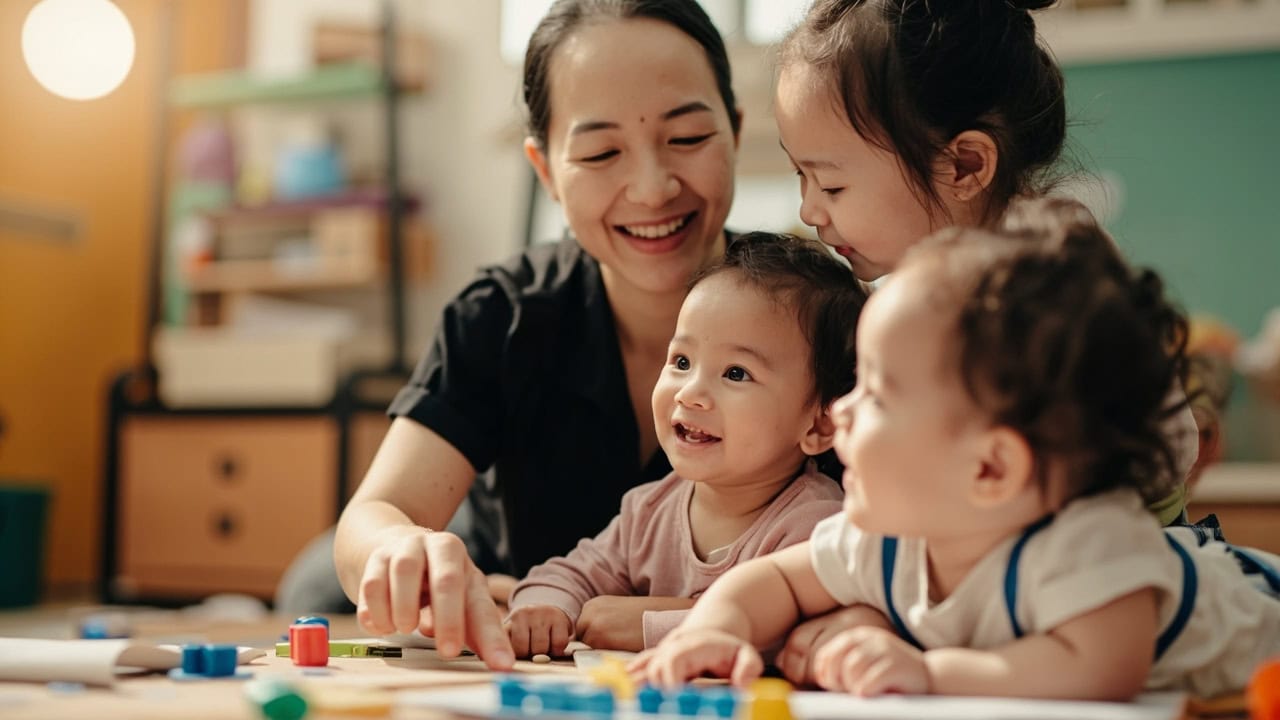
What Your Child’s Evening Homecoming Reveals About Their Day
The Evening Homecoming: What It Reveals About Your Child’s Day
Before we explore this in depth, here is what every parent should know:
- The evening homecoming is not random. Your child’s state when they return to you carries information about their entire day—their emotional experience, the quality of care they received, and whether their needs were met.
- A bright, open child is evidence of a day that worked. When your child returns eager and expansive, it signals an environment where they felt safe enough to explore and grow.
- A quieter, more contained child is also communicating. They may simply need time to transition, or they may be telling you the day was hard in ways they cannot yet name.
- The caregiver handoff matters as much as the morning goodbye. Quality care includes a knowledge transfer—not just facts about meals and naps, but the emotional narrative of your child’s day.
- You can trust what you observe. The evening homecoming is your daily opportunity to understand your child, and you are already noticing more than you realize.
Why That First Moment at the Door Matters More Than You Think
Here is what we have come to understand: that moment at the door is not merely a logistics exchange. It is the most diagnostically valuable moment in your child’s daily cycle of care—and for reasons that deserve careful exploration, it remains almost entirely unnamed in the conversations parents have about childcare.
Think about the morning routine. Parents have read about drop-off strategies. They have heard about separation anxiety and attachment theory. They have prepared rituals and contingency plans. The morning goodbye has become, in parenting culture, a recognized rite of passage.
But the evening homecoming has not received the same attention. And this is a loss for parents everywhere.
When your child comes home, they arrive carrying the full texture of their day. Not just the facts—what they ate, when they napped, whether there was a moment of conflict or a burst of laughter—but the emotional residue of every hour spent in your absence.
A young child does not compartmentalize the way adults have learned to do. They do not set down their feelings at the door of the childcare setting and pick them up again later. Everything stays with them. The excitement stays. The fatigue stays. The small triumphs and the minor disappointments stay. And all of it becomes visible, in some form, in those first minutes of reunion.
Reading Your Child’s State Upon Reunion
Watch your child’s face when you arrive. Not the performance they may give for your benefit, but the unguarded response—the one that happens before they remember to be delighted, or before they register that you have come.
That micro-expression, that split-second of genuine feeling, is one of the most honest communications your child will offer you all day.
Signs of a Day That Met Your Child’s Needs
Some children come home bright and buzzing with energy, eager to show you a toy, eager to tell you about a song, eager simply to have you present in the same room. This is not just happiness to see you—though it is certainly that.
It is also a sign of a day that met their needs. It is evidence that they were engaged, stimulated, emotionally held. A child who returns to you open and expansive has been in an environment where they felt safe enough to explore, where their curiosity was encouraged, where their small social world was responsive to their needs.
When Your Child Returns Quieter
Other children arrive quieter. Not distressed, but contained. They may want to be held, or they may want to sit near you without quite touching. They may be slower to warm, slower to engage.
This, too, is information. Young children carry the accumulated stimulation of a childcare day in their bodies, and some come home needing quiet before they can be social again. This is completely normal and does not signal a problem.
But a child who returns withdrawn—who flinches at small surprises, who cannot be comforted by your presence, who seems genuinely unsettled by the evening—is communicating something different. They are telling you that the day was hard in ways they cannot yet name.
The Uncertainty Parents Often Feel
Here is what many Singapore parents tell us when we speak with them about the evening homecoming: they feel uncertain about what they are supposed to be noticing. They know the morning goodbye matters. They know they should feel confident about their childcare choice.
But when they walk through their own front door at the end of the day, they are often unsure what they are looking at.
Is my child okay? Is this normal? Should I be concerned about this, or is this just how children are at the end of the day?
This uncertainty is real, and it is widespread, and it matters. Because a parent who cannot read the evening homecoming is a parent who cannot fully participate in their child’s daily narrative.
The Evening Caregiver Handoff: What Quality Transfer Looks Like
Which brings me to what may be the most underappreciated element of the evening transition: the caregiver’s handoff.
When a quality caregiver hands your child back to you at the end of the day, they are doing far more than transferring physical custody. They are transferring knowledge. They are offering you an account of your child’s day—not a transactional report, not a checklist of meals and naps, but a narrative.
They are telling you about the moments that mattered:
- The story your child asked to hear three times
- The new friend they sat next to at lunch
- The frustration that led to tears and the way it was gently held until your child was ready to move forward
- The small victory of trying a food they had previously refused
- The way they reached for a caregiver’s hand during the afternoon walk
This is what separates good care from great care. A good caregiver keeps your child safe, fed, and stimulated. A great caregiver also holds the emotional arc of your child’s day and translates it into language you can receive.
What a Quality Evening Handoff Should Include
- Emotional highlights and challenges: Not just what happened, but how your child responded emotionally to events throughout the day.
- Relationship observations: Who your child engaged with, how they played, and any shifts in their social interactions.
- Developmental moments: A new skill attempted, a milestone reached, a moment of breakthrough or connection.
- Practical continuity: What your child ate, how they slept, and any health or comfort notes that help you plan the evening ahead.
- Recommendations for the evening: Gentle insights like “she seemed tired today, so an earlier dinner might help” or “he was asking to show you his drawing.”
Building Confidence in Reading Your Child’s Day
Here is what we want every parent to understand: you are already reading the homecoming. You are already noticing things, even if you do not yet have the framework to name them.
The moment your child arrives and you think, something was hard today, or they seem lighter than yesterday, or this is the most settled I have seen them in weeks—you are doing the work of a parent who pays attention.
The difference is not that you need to learn to see. The difference is that you need permission to trust what you see.
We live in an age of expert anxiety. Singapore parents, in particular, are surrounded by information about what they should be doing, what choices they should be making, what outcomes they should be aiming for. In this environment, it can feel presumptuous to trust your own observations. It can feel safer to defer to the checklist, to the milestone chart, to the comparative metric.
But the evening homecoming is not a data point. It is a relationship moment. And the person who knows your child best, who has the deepest investment in their wellbeing, who will be with them through every evening of their early life, is you.
What You Can Trust
- Trust that the fatigue in your child’s eyes tells you something real about their day
- Trust that the ease in their body tells you something true about their environment
- Trust that if something feels off, you are not imagining it
- Trust that if something feels right—if your child is glowing with the particular happiness of a day well spent—you can believe that too
Questions Parents Often Carry
Every parent who uses childcare—whether through a childminder, infant care centre, or family arrangement—carries legitimate questions about whether their child is truly okay during the hours apart. These concerns deserve honest answers, not deflecting reassurances.
“How do I know my child is safe and well-cared for?”
The evening homecoming is your daily answer to this question. When your child runs to you, when they are genuinely glad to see you, when they are expansive and open rather than withdrawn and fearful, they are telling you something real. Your child’s state upon reunion is one of the most reliable indicators of care quality available to you.
“What if something happened during the day and my child can’t tell me?”
Young children communicate through their behavior and emotional state, not through verbal reports. This is precisely why the evening homecoming matters. A quality caregiver fills the gaps in your child’s narrative by offering their own observation. When the caregiver’s account aligns with what you see in your child’s face and body, you have a complete picture. When it does not align, that discrepancy itself is information worth exploring.
“Is my child’s adjustment to childcare normal?”
Most children go through an adjustment period when beginning with a new caregiver or setting. Some children adjust quickly; others take weeks. What matters is the direction of movement: Is your child becoming more comfortable over time? Are they returning home with greater ease each week?
A Simple Framework for Reading the Evening Homecoming
Here is a simple framework for reading the evening homecoming with greater confidence:
Step 1: Pause Before You Act
When you arrive, take a breath. Let your child have a moment to show you who they are before you scoop them up, before you ask how their day was, before you prompt them to perform. That first unguarded moment is the most informative.
Step 2: Notice Before You Ask
What is your child’s face showing? What is their body language communicating? Are they reaching for you, or hanging back? Are they talkative or quiet? Bright or subdued? Compare this to their baseline—not to some abstract ideal of how children should behave.
Step 3: Receive the Caregiver’s Handoff as Information
The caregiver’s account of the day should complement what you see in your child’s face. Ask open-ended questions: “What was a highlight for her today?” “How did she handle rest time?” “Was there anything that seemed to challenge her?” The answers should create a coherent narrative with what you observe at home.
Step 4: Adjust Your Evening Accordingly
Let what you learn inform your evening:
- A tired child may need a slower dinner and an earlier bedtime
- An overstimulated child may need dim lights and quiet voices before bed
- A child who is still processing a small conflict from the afternoon may need your full presence before they can let go of the day
You are not managing logistics. You are responding to a person.
Step 5: Trust Your Growing Understanding
Over days and weeks, you will develop a richer understanding of your child’s patterns and what different states mean. Trust this accumulation of knowledge. You are becoming the expert on your child.
Your Evening Ritual, Protected
And make no mistake: that reunion matters. It matters for your child, and it matters for you.
When your child runs to you at the end of the day, when they lean their full weight against you, when they are genuinely glad to see you, they are not just expressing a momentary emotion. They are consolidating their sense of the world as a place where people leave and return. They are building the internal architecture of attachment that will serve them for the rest of their lives.
Every reunion teaches your child something about permanence, about reliability, about whether the adults in their life can be trusted to come back. This is not a metaphor. This is developmental understanding, respected and reflected in the design of quality childcare programs.
This is what quality childcare looks like when it is complete. It is not a service you purchase and forget. It is a daily cycle of separation and reunion, of observation and response, of trust extended and trust repaid. It is the work of raising a child in a city that asks so much of its parents, and it is not always easy, and it is always, always worth it.
So the next time you arrive at the end of your workday, pause at the threshold. Take a breath. Look at your child’s face before you speak, before you scoop them up, before you ask how their day was.
Let that first moment be yours. Let it tell you what it has to tell you.
And then step into the evening, carrying with you the knowledge that this moment—this small, ordinary, irreplaceable moment—is one of the most important rituals in your child’s life, and in yours.
The EduNanny Approach to Evening Transitions
At EduNanny Singapore, we understand that the evening homecoming is not an afterthought—it is the natural completion of the daily cycle of care. Not just at the morning goodbye, but at the evening reunion. Not just on the first day, but every day.
EduNanny was founded on the conviction that great childcare extends parental care into the hours when you cannot be there yourself. Our model, developed in partnership with ECDA through the Childminding Pilot, is designed around home-based care that prioritizes continuity, individualized attention, and genuine relationship depth.
We maintain small ratios—up to one caregiver for three infants in our care settings. This is not a marketing decision. It is an operational necessity. Quality observation requires space. It requires a caregiver who is not overwhelmed, who can notice when a child’s energy shifts, who can tell you at the end of the day that your child asked for you by name.
For families in our program, the evening transition includes the communication tools you need to read your child’s day. Our caregivers are trained not just to provide care but to document and share it—building a narrative of your child’s day that complements what you observe at home.
When you walk through your door at the end of the day, you should feel not uncertainty but clarity. You should feel that you have received back not just your child but knowledge about your child—enough to continue the conversation, to carry the day forward, to prepare for tomorrow.
If you are exploring infant care or childminding in Singapore and want to learn more about how EduNanny approaches the full daily cycle of care, we would welcome the conversation.
EduNanny Singapore supports families with thoughtful, development-oriented childcare rooted in trust, quality, and genuine care. Learn more about our approach or explore our services.