What Your Child’s Day Reveals About Their Childcare
The Arrival: Where Trust Begins
The beginning is the hardest moment of the day for every parent and every child, though we rarely talk about it that way. We talk about drop-off as a logistics problem, a necessary inconvenience.
But a child experiences arrival at childcare as a profound transition—a crossing from the known world of home into the social world of peers and caregivers. The way this transition is handled is, in many respects, the single most revealing indicator of whether a childcare setting is truly quality or merely adequate.
The Ritual That Matters
Watch a quality centre in those first morning moments. The caregiver does not simply receive the child at the door. There is a ritual unfolding, deliberate and warm.
The caregiver crouches to the child’s level, makes eye contact, and speaks in a tone that acknowledges both the parent and the child simultaneously. The message is clear: We see you. We are glad you are here. Your parent is leaving you in a place that is safe.
This is not politeness. This is developmental work. A child who transitions well in the morning carries that security through the entire day. A child who is hurried through drop-off, whose caregiver looks distracted or cold, begins the day slightly unmoored—and that small unmooring has a way of compounding.
What Small Ratios Make Possible
At EduNanny, caregivers understand that the arrival transition is not a box to check. It is the emotional foundation upon which the entire day will be built. Our infant ratio of up to one caregiver to three infants means that during drop-off, a caregiver has the space to give each family the attention they deserve.
There is no rushing. There is no standing at the door waving goodbye to twelve children at once. There is one child, one family, and one caregiver who is fully present for that exchange. This is what small ratios enable, and small ratios are not a luxury. They are the condition that makes everything else possible.
Guided Play vs. Supervision: The Difference That Shapes Development
Once the children have settled and the doors close behind the last parent, the day begins to take its shape. But here is where most descriptions of childcare stop—and where we want to go deeper.
The word most centres use to describe what happens next is the same word: play. And play is everywhere in childcare marketing. But not all play is equal, and understanding the difference between guided play and mere supervision is one of the most useful tools a parent can have when evaluating a centre.
Two Classrooms, Two Approaches
Consider two classrooms.
In the first, children are in a room with toys scattered about. Caregivers are present, watching, occasionally intervening when a child cries or a conflict arises. This is supervision. It is not nothing. It is safer than a child being at home alone. But supervision is passive. It responds to what happens. It does not shape what happens.
In the second classroom, the caregiver has arranged the environment with intentionality. There are areas for different kinds of play: a construction corner with blocks and loose parts that invite problem-solving, a quiet reading nook with books at eye level, a sensory table with materials that encourage exploration through touch.
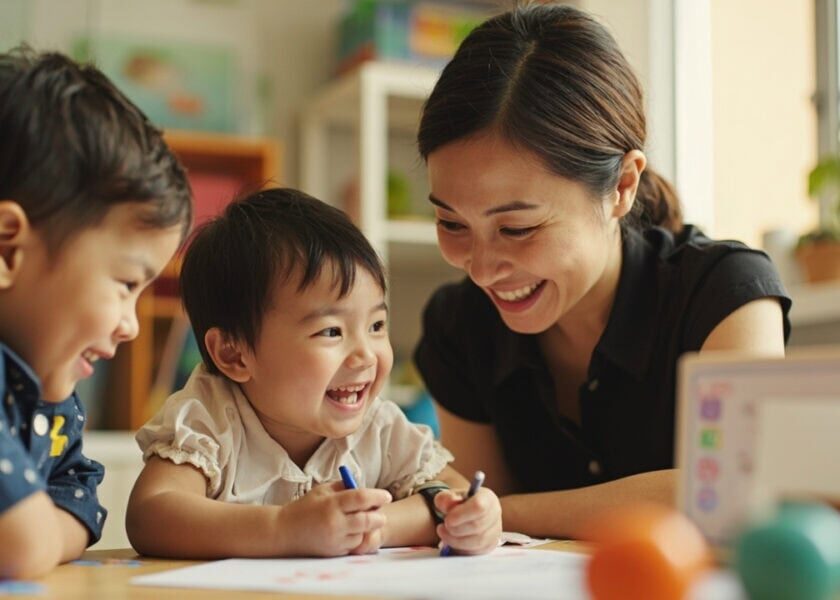
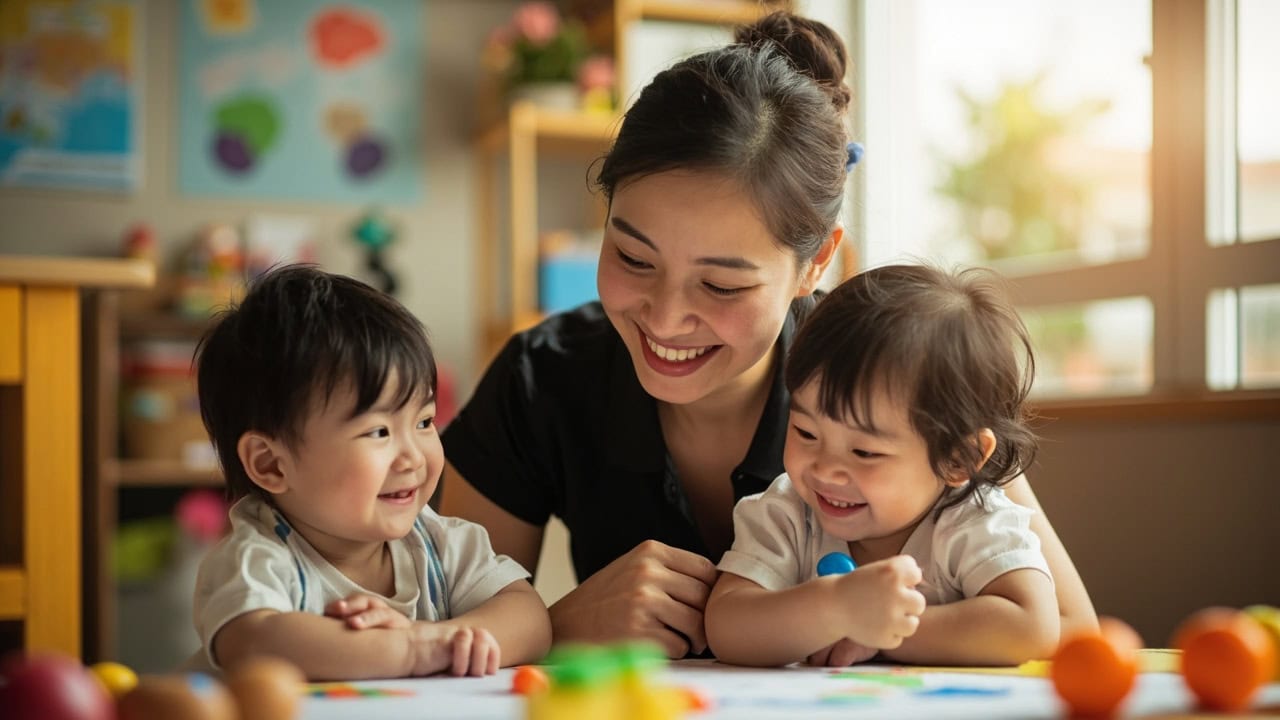
The caregiver moves through the room not just watching but observing. When a child reaches for a toy, the caregiver notices. When a child hovers at the edge of a group, the caregiver quietly joins the group in a way that invites rather than intrudes. When a conflict emerges over a toy, the caregiver stands nearby, ready to support, giving the children the chance to work through their own negotiation.
What Guided Play Actually Does
Guided play means the caregiver understands child development well enough to set up environments and interactions that stretch a child’s capabilities just slightly beyond where they are—in the zone of proximal development that developmental psychologists describe as the sweet spot for learning.
It means a caregiver who can read the difference between a child who is struggling and a child who is reaching. It means that when your child spends an hour with blocks, they are not just stacking objects. They are building spatial reasoning, developing persistence, learning about gravity and balance, and discovering what it feels like to complete something they started.
Mealtimes, Rest, and Social Learning: The Architecture of the Day
But guided play is not the whole story, because children are not only developing minds. They are developing bodies—and bodies need to eat and rest. They are also learning to be human among other humans.
Mealtimes as Learning
Watch a quality mealtime in an infant or toddler classroom. There is a caregiver seated with a small group of children, not feeding them en masse from a central table, but sitting among them, eating alongside them, narrating what is happening. This is bitter gourd today. We wash our hands before we eat.
The caregiver is not just ensuring children consume food. They are teaching the vocabulary of meals, the social ritual of eating together, the motor skills required to hold a spoon, the sensory experience of new textures and flavours. A child who is three years old and still struggling with a spoon is being given patient, repeated opportunities to master this skill—not because the caregiver is rushing them, but because the caregiver understands that motor development happens through exactly this kind of purposeful repetition in a supportive context.
Rest as an Active Process
Sleep is not merely the absence of activity. For infants and young children, sleep is when the brain consolidates learning, when the body grows, when emotions that were stirred during the morning’s play are processed and settled.
A quality childcare setting approaches rest with the same seriousness it approaches learning. There are routines that signal to the child’s body that it is time to slow down. There are caregivers who understand that not every child falls asleep easily, and that for those children, rest might look like quiet play in a dimly lit room rather than forced sleep.
A child who slept well at the centre comes home in a better mood than a child who was rushed through nap time. The afternoon reunion tells this story.
Learning to Be Human
A two-year-old in a quality classroom is learning what it means to want something another child has. They are learning that other people have feelings, that their actions have consequences, that the word “mine” is both powerful and limiting. These are not small lessons. These are the foundations of empathy, of moral reasoning, of the capacity to live successfully in a social world.
The caregiver’s role in this process is critical. A caregiver who intervenes too quickly steals these learning opportunities. A caregiver who never intervenes leaves children without the scaffolding they need to manage overwhelming emotions.
The skilled caregiver walks a careful line. They observe more than they act. They let small conflicts play out to see if children can resolve them themselves. But when a child is about to hit another, or when tears have turned from manageable frustration into genuine distress, they step in with calm authority.
They name what is happening. They offer words to children who do not yet have them. They model the behaviour they want to see: “I can see you are feeling angry because Ken took your truck. You can say, ‘I am not finished with that. Please give it back.'”
This is not micromanagement. This is teaching, and it is happening constantly in quality childcare—often so seamlessly that a parent observing might not even notice it is instruction.
The Quiet Moments: Where Safety Becomes Visible
And then there are the quiet moments, and these are the moments that most parents never think to ask about, because quiet is not dramatic, and drama is what we notice.
But watch a quality classroom during free exploration time, when the structured activity has ended and children are moving at their own pace through the environment. You will see something remarkable.
Children who are comfortable, who feel secure, who have learned that their needs will be met, will sometimes pause. They will stand by a window and look outside. They will sit with a toy for a long time without moving. They will watch another child work on something.
These are not moments of boredom. These are moments of processing, of integration, of the mind and body settling into a state that developmental psychologists call sustained shared thinking.
A child who feels unsafe does not have these moments. A child who is in a chaotic or understaffed environment is always in a state of alert, always scanning for threats, never still enough to simply be.
The ability to be quiet and content in the presence of others is itself a developmental milestone—and it is only possible in an environment where the child has learned that the world is reliable, that their caregiver is nearby, and that they are free to explore at their own pace.
The Afternoon Reunion: When the Day Speaks
The afternoon comes. The children have been in care for several hours. And soon, the parents will arrive.
In Singapore, where most working parents collect their children between five and seven in the evening, the afternoon reunion is the moment of truth. It is the moment when the child’s body tells the story of their day, whether they are ready to share it or not.
What Quality Looks Like at Pickup
A quality reunion looks like this. The caregiver is ready. They have notes, not because they are required to, but because they care. They know that a parent has been working all day, wondering, and they know that a brief conversation at the door can either confirm or destroy the trust that was built in the morning.
The caregiver shares something specific. Not “she had a good day”—which is vague and meaningless. Instead: “She ate really well at lunch and then had a long nap. She seemed particularly interested in the water play this afternoon. She kept trying to pour from one container to another.”
These details are not just pleasantries. They are evidence. They tell the parent that their child was seen, that their individual preferences and experiences were noticed, that the caregiver was paying attention. They transform the invisible into the visible.
Bridging the Gap Between Home and Care
We know that parents cannot be inside the door. They have jobs, responsibilities, obligations. And so we bring the door to them, as much as we can—through consistent updates, through transparent practices, and in homes where CCTV measures are in place, through that additional layer of visibility that helps parents feel anchored to their child’s day.
Our caregivers are trained not just to care for children but to document and share what they observe, because we believe that the more parents can see, the more confident they become—and the more confident parents are, the better the partnership between home and care becomes.
How to Recognise Quality: A Parent’s Observation Guide
Here we arrive at the question every parent in Singapore eventually asks, whether they voice it aloud or not: How do I know? How do I know if this centre is truly quality, or if it just looks quality? How do I make this decision with confidence?
The answer is not complicated, though it requires parents to look past the brochures and the painted walls and the gleaming facilities. Here is what you can observe when you visit a centre—whether it is EduNanny or any other.
Watch the Caregivers
- Do they get down to the children’s level, or do they tower over them, issuing commands from above?
- Do they speak to children with respect, using full sentences and real words, or do they baby-talk in a way that suggests they do not quite see these children as full human beings in the process of becoming?
- Do they seem to enjoy their work, or does their attention seem to be elsewhere?
- Do the children look at the caregivers with recognition, or with wariness?
Watch the Children
- Are they engaged, or are they just occupying space?
- Do they seem curious, or are they subdued in a way that suggests their curiosity has been trained out of them?
- Do you see moments of quiet contentment, or is there constant noise and commotion?
- Are there children at the edges of groups who are being noticed, or are they overlooked?
Watch the Environment
- Is the room organized in a way that suggests intentionality, with materials at child height and clear areas for different kinds of play?
- Is it chaotic, with toys everywhere and no clear sense of how a child is meant to move through the space?
- Are there quiet spaces as well as active ones?
- Do the materials look like they are actually used, or like they are there for show?
Ask the Questions
- Ask about ratios. How many children per caregiver?
- Ask about transitions. What does drop-off look like?
- Ask what a typical day looks like, and listen to whether the answer is specific or vague.
- Ask how caregivers are trained and supported.
- Ask what happens when a child is upset.
The quality of the answers you receive will tell you a great deal. Centres that are genuinely thoughtful about their practice will be able to articulate it. Centres that are merely going through the motions will offer platitudes.
Trust Your Own Reaction
When you walk into a quality centre, there is a feeling. It is difficult to name, but it is unmistakable.
The room feels alive but not chaotic. The caregivers look tired in a good way—the tiredness of people who have been actively engaged with children all morning, not the tiredness of people who have been managing boredom. The children look like children, which is to say, they look like they are in the process of becoming something, not just being kept safe.
What EduNanny Offers
EduNanny Singapore operates as part of the ECDA Childminding Pilot, which means we operate within a framework that values small ratios, trained caregivers, and developmental intentionality.
We offer pathways that serve families across Singapore:
- Home-based care—which brings the caregiver to your child in familiar surroundings
- Community and centre-based options—that give children the rich peer environment where guided play and social learning flourish
Our fee structures are designed to be accessible within the pilot framework, and families can use their Child Development Account and Baby Bonus where applicable, because we believe quality care should not be a privilege reserved for those who can afford premium pricing.
The Thomas AI Chatbot we offer is another expression of our commitment to parent partnership. It is a tool that helps parents navigate the questions and concerns that arise outside of centre hours—from sleep challenges to feeding questions to developmental milestones. Because quality care does not stop at the centre door. It extends into the home, and the more supported parents feel, the more consistent and nurturing the overall environment for the child becomes.
Ready to Look Behind the Door?
We believe that every child in Singapore deserves quality care. Not because their parents are wealthy or well-connected or especially knowledgeable, but because every child is a child—and every child deserves to spend their days in a place where they are seen, where they are safe, where they are given the time and attention they need to grow.
The truth is that childcare, when it is done well, is not a substitute for family. It is an extension of it. It is the village that every child needs, and that modern life in Singapore—with its pressures and demands and long working hours—has made it difficult for many families to assemble on their own.
When a child spends their day in quality care, they are not missing their parents. They are being held by trusted hands while their parents do what they need to do to provide. And that is not a failure. That is modern family life, and it deserves support, not judgment.
EduNanny is that support. We are not here to replace anyone. We are here to stand alongside families—to offer our expertise, our warmth, and our commitment to doing this work with the seriousness it deserves.
We know that choosing childcare is one of the most consequential decisions a parent will make in the early years. We do not take that responsibility lightly.
So when you are ready to look, we invite you to look. Come and see what we do. Ask us the hard questions. Watch our caregivers with your own eyes.
Because we believe that once you see quality, you will know it. And once you know it, you will understand why EduNanny exists—and why we come to this work each day with open hands and a genuine love for the children and families we are honoured to serve.
To learn more about EduNanny Singapore and how we support families, visit our homepage, read about our ECDA Childminding Pilot programme, or get in touch with our team. You can also read more about us and our commitment to quality, development-oriented childcare for families across Singapore.