What Your Child’s Body Language Reveals About Their Care Experience
What Does It Actually Feel Like for Your Child?
There is a moment, every morning, when a parent in Singapore hands their child to someone else and walks away.
You have prepared for this. You have toured the facilities, read the credentials, compared ratios, asked about curriculum, checked the licensing, read reviews, and cross-referenced everything with advice from friends, family, and forums. You have done your research. You have made a considered decision.
And then you hand your child over, and you walk away, and you do not — cannot — know what is happening inside your child’s body and mind in the minutes and hours that follow. That is the part no parent can access. That is the part that keeps you up at night — not because you doubt your choice, but because the most important question has no answer you can verify from the outside.
What does it actually feel like, right now, in this moment, for my child?
This is the question we built EduNanny around. Not just the logistics of childcare — though we care about those with enormous precision. Not just the pedagogy — though our approach is grounded in developmental science. We built EduNanny around the understanding that a parent’s deepest need is not information. It is something simpler and more urgent. They need to know, in their bones, that their child’s inner life — their fear, their wonder, their exhaustion, their curiosity, their small daily triumphs — is being held with the same seriousness and tenderness they would bring to it themselves.
What Quality Childcare Feels Like for Your Child
Before we go deeper, here is what research and observation tell us about how children experience quality care:
- A child’s nervous system reads a room before their conscious mind does — they feel safe or unsafe in their body before they can articulate it
- Safety and curiosity are neurologically linked — a child who feels genuinely held becomes curious; a child who merely feels supervised stays alert and watchful
- The caregiver ratio matters profoundly — not as a compliance metric but as the architecture of a child’s emotional experience
- Children show us how they feel in their bodies — relaxed musculature, direct eye contact, and the ability to move away from caregivers into play are signs of genuine security
- Routine creates psychological safety — when a child knows what comes next, their brain is freed to explore, play, and learn
- The pickup moment tells the truth — a child who runs to their parent in joy, not panic, is giving you the answer no tour or brochure can provide
The First Moments: What Happens Inside Your Child When You Leave
When a child walks into a space they do not yet know — a room with different light than home, different sounds, different smells, different faces — their nervous system does not pause to consult a brochure. It responds immediately and completely.
Their shoulders rise slightly. Their breathing shallows. Their hand, which may have been reaching for yours, draws back and finds their own body. Their eyes scan the room not with curiosity, not yet, but with the urgent, biological question every young human carries in their DNA: Is this place safe? Is anyone here going to respond if I need something?
You have seen this happen. You have watched it at the beginning of a playdate, at a birthday party, in a new classroom. Your child does not need to be told how to feel this. They feel it in their bodies, the way an adult feels the hair rise on the back of their neck when they walk into an environment that is subtly wrong, even if they cannot name why.
How Children Read Rooms
What a child is doing, in those first moments in any new environment, is reading the room with a sophistication that most adults underestimate entirely.
They are watching faces. They are listening to tone. They are tracking whether the adults in the room are rushed or calm, distracted or attentive, performing care or actually inhabiting it. A child knows the difference between an adult who is babysitting and an adult who is genuinely present, because their survival has depended on reading that difference since before they could speak.
This is why the ratio matters. Not as a compliance metric, not as a marketing point, but as the fundamental architecture of a child’s emotional experience.
When one caregiver holds the attention of fifteen infants, the child can feel, in real time, the difference between being seen and being overlooked. When one caregiver holds the attention of one, or two, or three young children, the child feels something else entirely. They feel held — not just physically, though that matters enormously to a toddler with no concept of boundaries who will simply walk into the street if no one is watching. They feel held in the way that allows their nervous system to gradually, over minutes or hours or weeks, to say: oh. This person is here. This person is really here.
That shift — from vigilance to safety — is not small. It is, in many ways, the entire thing.
The Body as Diagnostic Instrument
A child’s body is a diagnostic instrument for the quality of care they have received. This is not metaphor.
When a child has been in an environment where their needs were anticipated and met, their musculature is different. Their posture is more relaxed. Their eye contact is direct and sustained. They are more available — available to learn, available to play, available to connect.
When a child has been in an environment where they were largely unsupervised or reactively managed, you see it in the tension they carry in their shoulders, in the way they startle more easily, in the way they hover near adults instead of moving away from them into play, because their nervous system has learned that distance from a caregiver is not safe.
These are not subtle differences to a trained eye. They are the difference between a child who has been held and a child who has merely been managed.
When Safety Becomes Curiosity: The Neurological Link
A child who feels safe does something remarkable that a child who merely feels supervised does not. They become curious.
Safety and curiosity are neurologically linked in ways that every parent intuitively understands even if they have never read the neuroscience. When the threat-detection systems of a young brain are quiet — when a child has internalized, through hundreds of small moments, that the adults around them respond reliably — the prefrontal cortex is freed to do what it evolved to do in early childhood: explore.
To reach for the thing that makes an interesting sound. To follow the other child who is building something with blocks. To point at a butterfly outside the window and look back at a caregiver’s face to ask, silently, what is that, and why does it matter?
What Developmental Micro-Moments Actually Look Like
These are the moments researchers call developmental micro-moments, and what parents call the things they notice when their child comes home and is somehow more — more talkative, more confident, more interested, more themselves.
These moments do not happen because a child sat through a structured learning activity. They happen because a child felt safe enough to take a risk. To walk two steps away from the caregiver to look at something. To try a new sound. To offer a toy to another child and wait, with their heart in their throat, to see if it will be received.
A child who feels genuinely held does not just tolerate the experience of being in care. They thrive inside it.
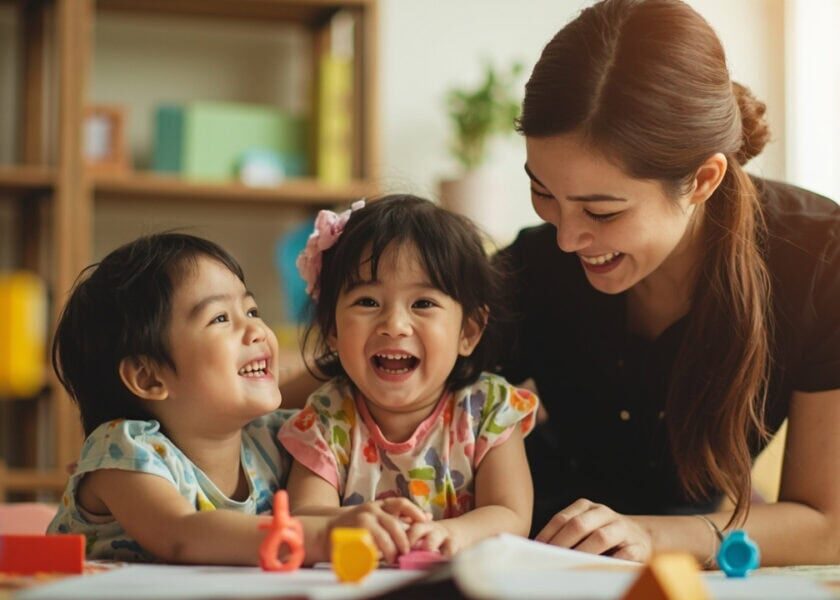
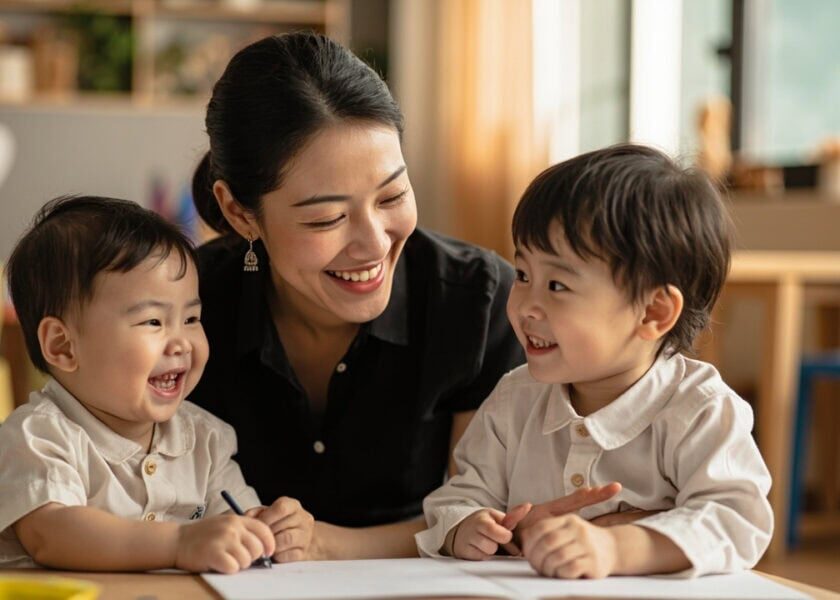
There is a visible difference, and if you have spent any time around children in both kinds of environments, you recognize it immediately. It is the difference between a child who is managing — alert, watchful, performing okay-ness — and a child who is expansive. Who is experimenting with their own voice because no one is judging it. Who is resting their head on a caregiver’s shoulder not because they have been told to calm down, but because they have decided this is a person whose shoulder is a good place to rest. Who looks up when a parent arrives at pickup not with relief or desperation, but with the quiet, settled certainty of someone who has had a good day and is delighted to share it.
That child is not surviving childcare. They are living inside it.
The Conditions That Allow Children to Thrive
The conditions that allow a child to be curious, exploratory, and emotionally regulated are not mysterious. They are not dependent on expensive equipment or elaborate curriculum. They are surprisingly simple, and surprisingly demanding to maintain consistently.
Why Routine Matters More Than You Think
Young children do not experience routine the way adults do — as a minor convenience or a productivity tool. They experience routine the way a sailor experiences the tide. It is the thing that makes the world predictable.
When a child knows that the morning always begins the same way, that snack comes after playing, that the caregiver reads a story before nap time, their brain is freed from the exhausting work of constant prediction. They know what comes next. They can relax into the present.
And when a child can relax into the present, they can play. And when they can play, they learn. And when they learn, they grow in ways that are visible, measurable, and profound.
The Quality of Caregiver Attention
Another condition is the quality of the caregiver’s attention. Not just whether the caregiver is watching the children, but how.
Whether they are genuinely curious about what the child is doing — following the child’s lead, narrating what they observe, responding to the child’s initiations rather than directing them.
A child knows within days, sometimes hours, whether an adult finds them interesting. And a child who feels interesting — who feels that their way of stacking blocks or babbling a new sound or pointing at a cloud is worthy of a real, engaged response — that child begins to believe something enormous about themselves.
They begin to believe they are worth paying attention to. That the world is a place that notices them and responds.
This is not a small thing. For a child in their first thousand days, this is the foundation of everything that comes after — their relationship with learning, with authority, with other people, with themselves.
How EduNanny Singapore Creates These Conditions
Understanding what children need is one thing. Creating the conditions where those needs are met, day after day, requires a different kind of commitment.
EduNanny Singapore is part of the ECDA Childminding Pilot, operating through home-based and community pathways alongside centre-based options. Our structure is designed around a specific belief: that the ratio is not a bureaucratic requirement but a philosophical commitment to being genuinely present inside your child’s experience.
We maintain ratios of up to one to three infants in our infant care settings. This is not a feature we advertise alongside other features. It is the foundation from which everything else follows — the architecture that makes it possible for a caregiver to know your child, not just watch them.
What “Known” Actually Means
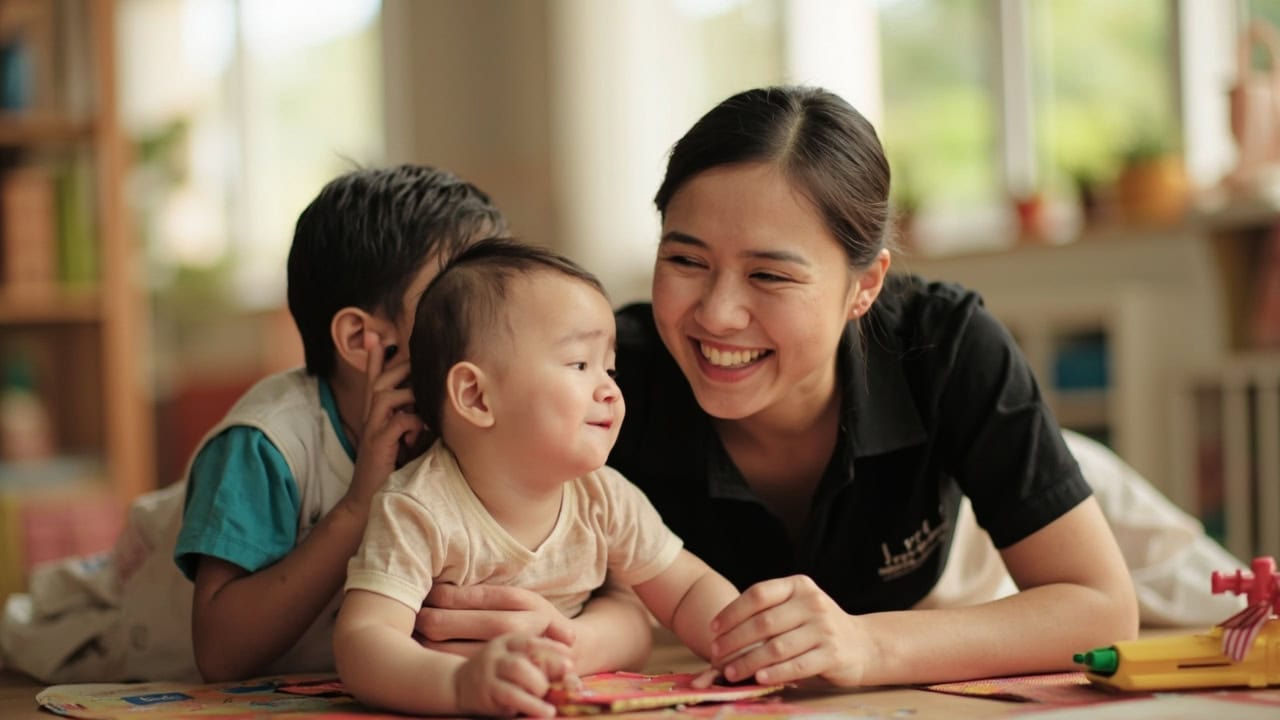
The people who care for your children are not interchangeable service providers. They are the adults who sit on the floor with your child, who learn the sound of their laugh, who notice when they are favouring one hand or developing a new fear or saying their first word with that particular pronunciation that only someone who spends real hours with them would catch.
The caregiver relationship is not incidental to quality care. It is the core of it.
This is why EduNanny is committed to a model that is small enough, and intentional enough, that every child is known. Not processed. Not managed. Known.
We believe this is not a luxury. We believe this is what every child deserves, and we believe Singapore parents know this too — which is why so many of them carry that quiet ache of not quite trusting the options available to them. Not because those options are bad. Because they are not quite this.
What to Look For: A Practical Guide for Singapore Parents
You cannot be inside your child’s experience. But there are things you can look for that give you reliable signals about the quality of care your child will receive.
Questions to Ask During Your Visit
- Observe the caregivers’ tone of voice when they are not aware of being watched. Is it warm? Flat? Stressed?
- Notice the children’s bodies. Are they tense or relaxed? Do they move freely away from caregivers into play?
- Ask about the ratio — and then ask what it looks like in practice, not just on paper
- Ask how new children are integrated. The answer tells you how seriously they take attachment
- Notice whether your questions are welcomed or deflected. Providers who take your concerns seriously are more likely to take your child’s needs seriously
Signs of Quality You Can Observe
- Routine that feels calm, not rigid — children knowing what comes next but not anxious about it
- Caregivers who follow the child’s lead — who narrate what they see rather than directing what the child should do
- Children who can be frustrated — and come back to equilibrium because adults help them through it
- Caregivers who are genuinely curious — who seem interested in the children, not just responsible for them
- Separation that gets easier over time — not harder, not the same, but gradually softening
The Test That Takes No Extra Time
Ask to observe — not participate, just observe — for a short period. Watch how the caregiver responds when a child initiates something. Watch whether the caregiver notices a child who is about to climb something versus one who intervenes after. Watch whether children who are upset are soothed or just quieted.
These moments, in thirty minutes, will tell you more than any tour.
Questions Singapore Parents Actually Ask
How do I know what is happening behind the door?
Where we have deployed CCTV measures, we have done so transparently and with communication to families, because we believe that transparency is not the opposite of trust — it is the foundation of it. Singapore parents are sophisticated. They do not want to be reassured. They want to understand. They want to know what is happening behind the door they walk through every morning, and they want that knowledge to be honest and complete, not curated.
What about the practicalities of payment?
Our fees are designed to be affordable within the pilot framework. Where families use the Child Development Account or Baby Bonus for payments, those options are available, because we know that the logistics of paying for care should not add another layer of stress to parents who are already navigating one of the most consequential decisions of early parenthood.
The Pickup Moment: What Every Parent Should Watch For
There is a moment at the end of every day that we think about a great deal. It is the moment when a parent arrives at pickup.
The room brightens. A small head turns. There is a recognition — first the physical, cellular recognition of a parent, and then, if the day has gone well, something more.
The child looks up, and their face is open, and their body is relaxed, and they do not run to the door in panic. They run to the door in joy. The kind of joy that says: I had a good day. I did interesting things. I felt safe. I want to tell you about it.
And then the child reaches the parent, and there is the brief, perfect exchange of arms — the child lifting, the parent catching — and in that exchange is something that cannot be faked and cannot be manufactured and cannot be delivered by anything other than the real, daily, patient, attentive work of being genuinely present to a child’s inner life.
That moment is the answer to the question every parent carries. Not an answer in words. An answer in a child’s body. In the way they breathe. In the way they settle. In the way they let go of the parent at drop-off, trusting that the parting is temporary and the return is certain and the day between will be good.
You cannot get that answer from a tour. You cannot get it from a brochure. You get it from watching your child over weeks and months, and slowly, gradually, unmistakably, understanding that the child who comes home is not the same child who would come home from any generic arrangement.
They are a child who has been inside a quality experience. They are a child who has been held — in all the ways that matter — and who carries the evidence of that holding in their confidence, their curiosity, their calm, and their capacity to love the people who care for them while also, clearly, belonging to the family that brought them into the world.
What We Believe Children Deserve
That is what we do here at EduNanny Singapore. Not simply childcare. Not merely infant care and childminding in the structural, regulatory sense, though we take that structure with full seriousness.
We do something more intimate and more important than any of those words capture on their own.
We hold the inner world of your child with the same attention, the same care, and the same love that you would bring if you could be there every moment of every day.
You cannot be there. We can. And we do — with precision, with warmth, with the quiet confidence of people who have sat with children all day and know exactly what to look for, and why it matters, and how to make sure your child feels it.
This is EduNanny Singapore. This is what we believe children deserve. And this is why we are here — for every family, in every neighbourhood, across Singapore — ready to welcome your child into a space where they will not just be safe.
They will be known.
If you are researching infant care or childminding options in Singapore and would like to explore how EduNanny Singapore creates the conditions for your child to thrive, we invite you to speak with our team. Every family deserves to know, in their bones, that their child’s inner world is in trusted hands.
Learn more about EduNanny Singapore