What Your Children Really Learn From Each Other in Childcare
The Hidden Classroom: What Siblings Teach Each Other in Childcare
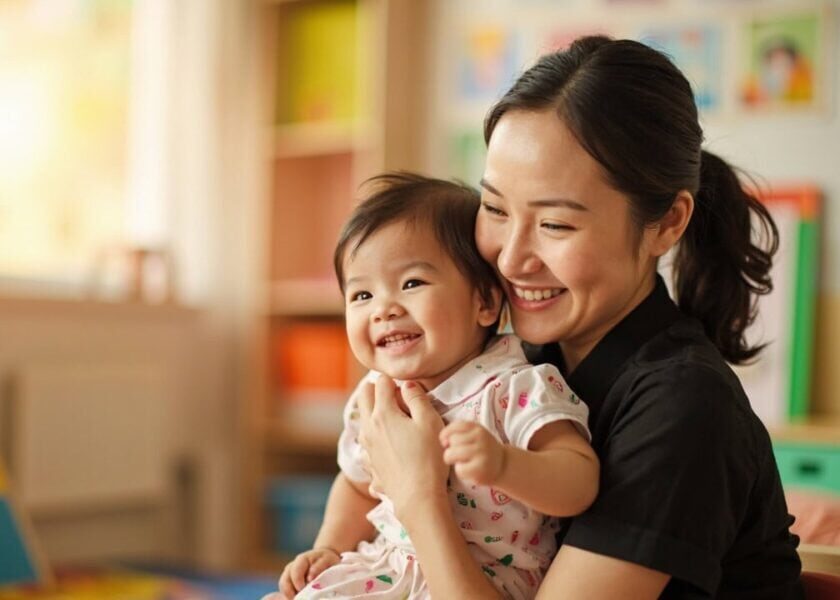
There is a moment every parent of multiple children will recognize. It happens quietly, without announcement. One afternoon, you pick up your children from childcare and you notice something has shifted. Perhaps your older child is speaking differently — with a gentleness you didn’t expect, modeling patience for the younger one in a way that surprises you. Perhaps your younger child has absorbed a skill overnight, something your older child demonstrated weeks ago that you assumed went unnoticed. Perhaps they have negotiated something between themselves — a disagreement resolved, a game built together, a comfort offered — and you realize you were not there for the lesson.
Someone else taught them this. Someone exactly their size, exactly their age, exactly their person.
That someone is their sibling.
And the classroom where this happened? The one that never appears on any brochure, that carries no syllabus and issues no report cards — that classroom is childcare.
We spend a great deal of time thinking about what children learn from caregivers, from structured activities, from the physical environment of childcare settings. We think carefully — as we should — about ratios and qualifications, about the warmth of the person who holds our infant when we cannot, about the communication we receive and the trust we build. These things matter enormously, and they are the foundation of what quality care has always meant.
But there is another curriculum operating in every childcare setting where siblings are present, and it is one we have rarely examined with the attention it deserves. It is the curriculum siblings teach each other. And it may, in ways that no planned activity can replicate, be one of the most important educations your children will receive in these early years.
Quick Summary
- Siblings in childcare teach each other emotional regulation, social skills, and confidence in ways no planned activity can replicate
- Older siblings become reference points; younger siblings absorb borrowed courage from watching them
- Parents can support both individual identity and sibling bonds through thoughtful attention and the right childcare arrangement
- Quality childcare for multiple children means small ratios, clear communication, and caregivers trained to observe sibling dynamics
- The sibling relationship built in early childcare years will outlast almost every other bond your children will form
Understanding the Hidden Curriculum
The research on sibling relationships is clear and growing. Siblings are each other’s first peers, first co-conspirators, first rivals, first teachers. The dynamics established in early childhood — the patterns of give and take, of competition and protection, of identity formation through comparison and contrast — these patterns do not disappear with time. They deepen. They become the architecture of a relationship that will witness every major passage of both lives, long after parents have become elders and friends have come and gone.
In childcare settings, this architecture is being built in real time, under conditions we cannot fully observe. This is why the sibling dynamic in childcare deserves its own careful attention — not as an afterthought to individual care, but as something worthy of understanding in its own right.
Consider what is actually happening when two of your children share a childcare space.
Your older child — whether by months or years — is becoming a reference point. Every skill your younger child observes, experiments with, and eventually masters is filtered through what an older sibling can do. The older child knows this, even if they cannot articulate it. They feel the weight of being watched, being wanted, being needed. And they respond in ways that range from the most generous modeling of patience and instruction to the most frustrating refusal to share that spotlight. Both responses are teaching your younger child something essential about power, about generosity, about the complexities of wanting to help and wanting to be seen.
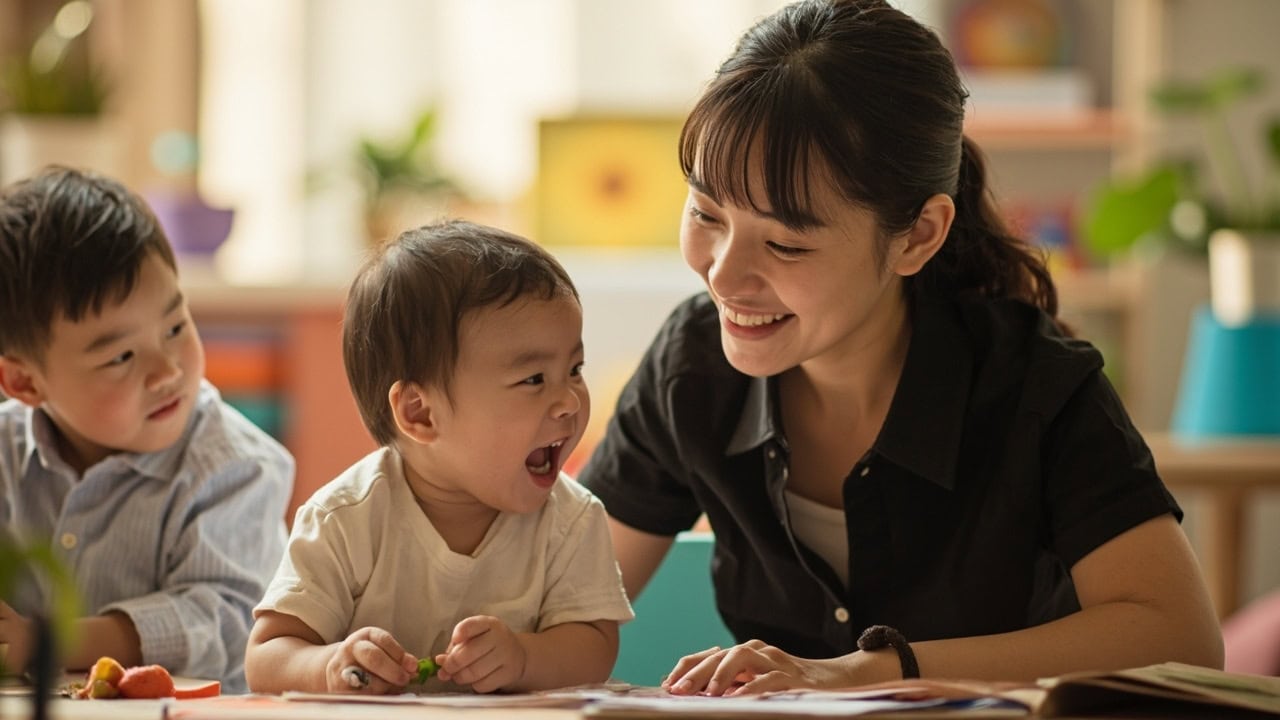
Your younger child, meanwhile, is catching more than you may realize. The confidence to try something new often comes from having watched a sibling try first. The emotional vocabulary that develops earlier in children with older siblings — the words for frustration, for wanting, for “that’s mine” — these words arrive faster because there is someone in the home, or in the childcare setting, who has already mapped that emotional territory. Your younger child is learning from proximity, from observation, from the raw data of watching someone they love navigate a world they will soon enter themselves.
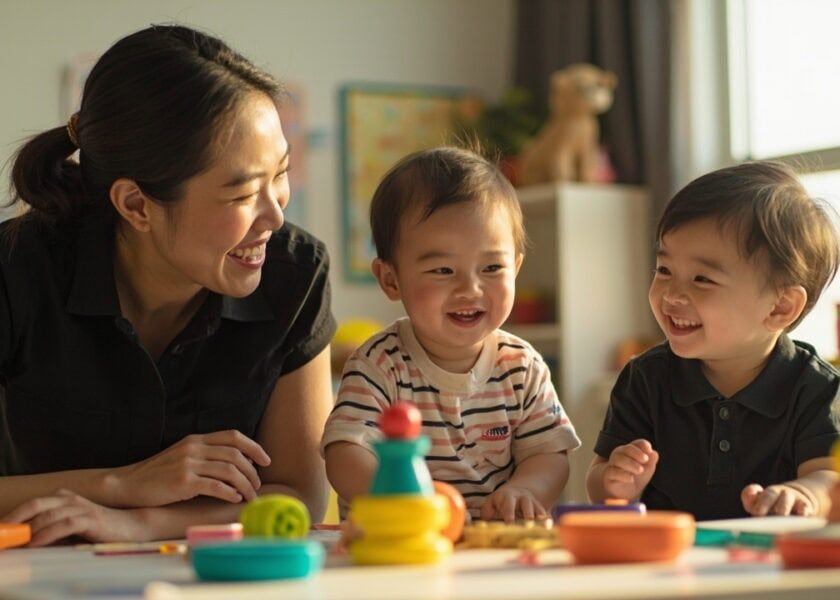
And if your children are closer in age, the dynamic shifts again. They become something more like equals — co-learners, co-discoverers, reluctant cooperators who must negotiate space, attention, and caregiver response with someone whose needs and abilities are remarkably similar to their own.
This is not a comfortable thing to sit with. Because if siblings are genuinely teaching each other — and they are — then we must also sit with the less romantic truth that they are doing so largely without us. In the hours when we are apart, working, managing, holding together the logistics of modern Singapore family life, our children are not simply waiting for us. They are forming each other. Reshaping each other. Learning the shape of a relationship that will outlast every other relationship they will ever have.
The Complex Reality of Sibling Dynamics in Childcare
There is a phenomenon that every parent of siblings eventually observes, and it is one that childcare settings make visible in ways that home cannot: siblings become each other’s emotional regulators.
This is different from what caregivers do. Caregivers provide a secure base, predictable routine, warm responsiveness — the foundations of emotional security. But siblings provide something adjacent and essential: a peer who understands the experience of being a child in a world of adults, who faces the same bewildering rules and unjust bedtimes and inexplicable vegetables. When a child is upset in a childcare setting, the caregiver may offer comfort, but the sibling offers recognition. Someone else was there. Someone else felt that. Someone else knows.
This is why adaptation to childcare — that tricky period when children must separate from parents and find their footing in a new environment — can look so different for siblings. The child who has no sibling may take longer to settle, may cry more consistently, may need more from the caregiver in those early weeks. The child with a sibling in the same setting has something additional: a co-pilot. A witness to their struggle who is struggling too, and who will remember with them the day it got better.
Older siblings, in particular, often take on a protective role in childcare settings that surprises parents. Your four-year-old, who at home may be thoughtless in the way of all four-year-olds, becomes a guardian to your toddler. They watch out for them. They include them in games. They advocate for them with caregivers. This is not learned behavior — it emerges because the sibling relationship has already established a vocabulary of care that simply extends into the new environment.
Younger siblings, meanwhile, absorb confidence they have not yet earned. They attempt tasks they would not attempt alone because they have seen an older sibling attempt them first. They enter social situations with a kind of borrowed courage, as if the older sibling’s social success is a resource they can draw upon. This is one of the most beautiful and underappreciated gifts of siblinghood — the way it allows children to be more than they would be alone.
But the dynamics are complex. Siblings close in age do not always cooperate in childcare settings. They compete. They comparison-shop themselves against each other in ways that can be painful to witness. One child’s natural ease with caregivers becomes the backdrop against which the other child’s shyness is measured. One child’s quick mastery of a skill becomes the standard that the other child feels they must reach.
This is not a reason to separate siblings in childcare. It is a reason to understand sibling dynamics with the same seriousness we bring to any other aspect of child development — and to seek childcare arrangements where caregivers are equipped to see these dynamics clearly, to intervene thoughtfully when comparison becomes destructive, and to nurture each child’s sense of individual worth within the group.
The Weight Parents Carry
Now here is the harder truth, the one that sits beneath the wonder of it all: this is also what keeps parents up at night.
If siblings are shaping each other so powerfully, then every inequality in how they are treated — every moment when one child seems to receive more attention, every decision about who started childcare first and why, every pickup where one child was clearly more ready to leave than the other — becomes freighted with a weight that single-child parents simply do not carry.
You feel it as you make decisions about childcare for multiple children. You feel it when you enroll one child but not the other, when one child’s needs seem to dominate a conversation with the caregiver, when you notice that your quiet child seems to recede in the presence of your more assertive one.
You feel it when you pick them up and one child runs to you with the full force of abandonment recovered, while the other offers a more measured greeting, and you wonder: has the second child always been this way, or has repeated experience taught them to expect your return but not to depend on it quite so desperately?
This is the parent’s guilt that no childcare arrangement fully resolves. The knowledge that you cannot be equally present to each child, that your attention is a finite resource that must be divided, that every choice you make about one child reverberates through the experience of the other. You are not just choosing a childcare setting. You are choosing an environment in which your children will form each other, and that is a responsibility with no clean solution.
Supporting Individual Identity and Sibling Bonds
What does it actually look like to support both individual identity and sibling bonds simultaneously? This is the question that matters most to parents navigating childcare for multiple children, and it deserves a thoughtful answer.
The first thing to understand is that sibling bonds and individual identity are not in competition. This is the conceptual error that leads parents to overcorrect — to seek childcare arrangements that deliberately separate siblings “so each child can have their own experience,” or conversely, to keep siblings together “because they should be with each other,” without examining what that togetherness actually means for each child.
The research is actually reassuring here, if we let it be. Children who grow up with strong sibling bonds alongside clear individual identities do not suffer from comparison — they thrive from it. What matters is not whether siblings are together or apart, but whether each child has sufficient experiences of being seen as themselves, valued for their own qualities, recognized as an individual rather than as someone’s brother or sister.
In practical terms, this means attending to both dynamics deliberately.
- When siblings are in the same childcare setting: ensure each child has moments of individual caregiver attention — time when the spotlight is not complicated by the presence of the other. Notice when your quieter child is always responding to your louder child rather than initiating their own engagement. Ask the caregiver about how each child behaves when the other is not in the room, or when the caregiver is explicitly engaging with just one.
- When siblings are in different childcare arrangements: create space for them to share the experience in conversation — not as competitors comparing who had the better day, but as siblings who both know what it means to be apart from you and to find their way in a world of other children. Validate each child’s experience without ranking it.
- In all cases: talk to your children about each other. Not as an obligation, but as a genuine interest. Ask your older child what they think your younger child is learning. Ask your younger child what they admire about how their older sibling handles certain situations. Name the sibling relationship as something worth attending to, because attention is how any relationship grows.
Addressing Common Parent Concerns
“I’m worried my quieter child will always be in the shadow of my louder one.”
This is a legitimate concern, and the first step is awareness. Ask your caregiver specifically about moments when each child initiates their own engagement, separate from the other. A good caregiver will notice these moments and can tell you about them. If your caregiver cannot distinguish between your children’s individual expressions, that is a signal worth heeding.
“Should I keep them in the same childcare setting or separate them?”
There is no universal answer. What matters is whether each child has sufficient experiences of being seen as themselves. Sometimes the same setting works beautifully; sometimes different arrangements serve each child better. The decision should be based on observation of how each child actually behaves and grows, not on ideology about what siblings “should” do.
“I feel guilty that I can’t give each child individual attention all the time.”
You are right that you cannot. No parent can. What you can do is choose arrangements that make individual attention possible, create space for one-on-one connection at home, and trust that your children are developing resilience, flexibility, and their own identities partly because they must share you. Guilt is information, not a verdict.
“What if my children are competing in childcare?”
Competition between siblings in childcare is normal and not inherently harmful. What matters is whether caregivers notice when comparison becomes destructive and intervene thoughtfully. Ask your caregiver how they handle sibling dynamics when they become sources of distress rather than growth.
What Quality Sibling-Friendly Care Looks Like
Understanding sibling dynamics is one thing. Finding a childcare arrangement that supports healthy sibling development is another. Here is what to look for:
- Small ratios: In home-based childminding, ratios of up to one to three infants allow each child room to breathe, to be noticed, to develop as an individual while existing in relation to others. In larger settings, ask about how caregiver attention is distributed.
- Caregiver awareness: Caregivers who are trained to observe sibling dynamics — who notice when one child is always following another’s lead, who create space for individual engagement, who can tell you about each child as a distinct person — are worth their weight in gold.
- Communication systems: Regular updates that help you understand not just what your child did today, but how they engaged with the other children in care. You cannot support what you cannot see.
- Transparency measures: Where deployed, CCTV measures mean the space where your children are becoming siblings in a deeper sense is also a space you can access with your eyes. Trust is built on visibility.
- Flexibility for family systems: Families are not uniform. The best care arrangements recognize this — offering pathways that can adapt as your family’s needs evolve, whether that means both children in the same setting, different arrangements for different ages, or transitions as children grow.
For families in Singapore navigating these decisions, EduNanny offers home-based and community childminding pathways designed with these principles in mind: ratios that allow each child to be truly seen, communication that keeps parents informed about individual development alongside group dynamics, and structures that can flex as your family’s needs change over time. The use of CDA and Baby Bonus funds where applicable reflects a practical commitment to making quality care accessible for working families.
The Long View: Building a Bond That Lasts
We live in a culture that is, by necessity, focused on the immediate. The next pickup. The next milestone. The next decision about school, about enrichment, about whether to try another arrangement. It is easy to lose sight of the fact that the sibling relationship your children are building today, in these early years, in these childcare settings, will be one of the longest relationships they will ever have.
Brothers and sisters who share a childhood of quality care together — who remember the same caregiver, the same routines, the same small triumphs and frustrations of learning to be away from parents among other children — carry that shared history forward in ways that bind them. Not always smoothly. Sibling relationships are famously complex, full of resentments and rivalries that persist for decades alongside fierce loyalty and love. But the foundation is being laid now, in these hours apart from you, in the small moments that will become shared memory.
You cannot control what your children teach each other. You cannot orchestrate every interaction, cannot ensure that every lesson is one you would have chosen. But you can create the conditions for healthy sibling dynamics to flourish.
You can choose childcare arrangements that allow enough individual attention for each child to develop their own identity. You can maintain communication with caregivers so that you understand what is happening in the space where your children are becoming siblings in a new way. You can talk to your children about each other, about what they notice, about what they appreciate and what they struggle with. You can model for them, in your own relationship with your own siblings if you have them, what it means to carry a lifelong bond with someone who shares your origins.
The sibling curriculum your children are learning in childcare is not a bonus. It is not an incidental byproduct of having multiple children in the same place at the same time. It is one of the most powerful educational forces in your children’s lives, and it is happening largely outside your view, shaped by dynamics you cannot control and informed by needs you cannot fully anticipate.
This should not frighten you. It should inform you.
The parents who navigate sibling dynamics in childcare most successfully are not the ones who have solved every tension or eliminated every rivalry. They are the ones who have developed a thoughtful awareness of what is happening — who ask questions, who stay curious, who resist the temptation to either ignore the sibling relationship entirely or to manage it so closely that it becomes another arena of parental performance.
They are the parents who understand that their children are not just being cared for — they are being shaped by each other, in ways that will define their relationship for decades. And they choose childcare arrangements that take this seriously: arrangements with small enough ratios that each child can be seen, with communication systems that help parents understand the full picture, with caregivers who are trained to observe sibling dynamics with the same attention they bring to individual development.
Your children are becoming siblings in a new way in childcare. They are learning from each other in a classroom that has no walls. They are building something that will last longer than anything else you are giving them right now — longer than any enrichment class, any carefully chosen school, any perfectly timed milestone.
Pay attention to it. Choose partners who pay attention to it too.
Because in the end, the sibling bond your children are building today — in the hours you are apart, in the small negotiations and big feelings of childcare — is not just shaping who they are. It is shaping who they will be together, for the rest of their lives.
If you are exploring childcare arrangements for multiple children in Singapore and would like to understand how EduNanny approaches sibling dynamics within a thoughtful, development-oriented framework, we would be glad to hear from you.