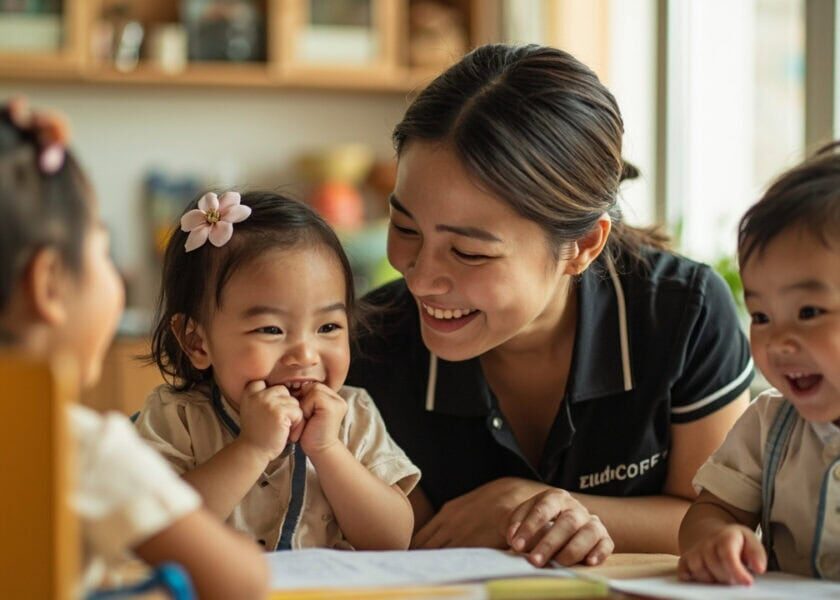
What Your Childcarer Gives Your Child That Report Cards Cannot Measure
The Scene Every Singapore Parent Knows
It happens at the door of a childcare centre, or in the hallway of someone’s home, or in that quiet space between dropping off your infant and the commute to work. Your child is in someone else’s arms, and you are watching.
You are watching your baby reach for a stranger—or worse, not reach for anyone at all—and you are carrying with you a question so heavy it sits somewhere between your ribs and your throat.
You are wondering: what is my child experiencing right now? Will this be okay? Will they remember this?
And then you leave. Because you have to. Because Singapore is expensive and careers are demanding and the mortgage does not pause for maternity leave. Because somewhere beneath the guilt and the longing, you believe that what you are doing is necessary—even if it does not feel that way in that moment when your baby’s face turns away from you toward someone else.
Here is what most parenting advice fails to give you, here in this city where we have built world-class childcare systems and still lie awake at night wondering if we are failing our children: you are not just leaving your child in someone’s care. You are handing them an experience that will be encoded in their nervous system, that will shape how they walk into a classroom five years from now, that will influence whether they greet the world with curiosity or caution.
What your child will remember from these years is not what you will read in their report cards or hear in their teacher conferences. What your child will remember is a feeling. A texture of warmth or coldness. A rhythm of voices and routines. A sense of whether the world, when Mummy or Daddy is not there, is still a place where they are safe, and known, and held.
The First Five Years: The Story Itself
You may have grown up hearing that the early years are preparation for the “real” education to come. That your infant’s months in childcare are simply a phase to get through before starting school, before learning begins in earnest.
This framing, well-intentioned as it may be, misses something crucial. The first five years are not a waiting room before the real story begins. The first five years are the story.
These are the years when the architecture of the brain is being built at a speed it will never again achieve. Neural pathways are forming not just for language and motor skills and cognitive development—though all of that is happening too—but for something far more subtle and far more lasting.
The pathways being built in these years determine:
- Whether your child experiences the world as fundamentally safe or fundamentally threatening
- Whether they approach new situations with confidence or with fear
- Whether they form attachments easily or guardedly
- Whether they believe they are worthy of attention and care—or that they must earn it
What the Research Actually Says
This is not pseudoscience. Developmental psychology has replicated these findings across cultures and continents for decades. The research is unambiguous: the quality of early childcare experiences does not merely influence child development. It co-constructs it.
Children who experience consistent, warm, responsive care in their earliest years carry something forward into adulthood that children who experienced unpredictability, coldness, or neglect do not. They carry what researchers call “felt security”—a deep, cellular sense that the world is trustworthy, that their needs matter, that they are not alone even when they are.
Felt security is not abstract. It is not a warm fuzzy feeling that fades. It is the foundation upon which everything else is built. Consider what a child who feels secure in their early care is more likely to do:
- Explore boldly. They take intellectual risks, try new things, persist when learning is hard.
- Form healthy friendships. They manage conflict without spiraling into anxiety.
- Recover from disappointment. They bounce back without catastrophizing.
- Walk through the world believing they can handle what comes next.
And here is what makes this so difficult for parents: you cannot see felt security forming. You drop your child off in the morning and go to work. You have no window into what is happening inside your child’s mind and heart during those hours. In Singapore, where dual-income households are the norm and affordable quality childcare can feel like an impossible find, this invisibility adds another layer of anxiety. You are making decisions that affect your child’s deepest sense of security, and you are making them partly blind.
Adjustment vs. Flourishing: The Difference That Matters
When evaluating childcare options, you may hear about children who have “settled in well” or who have “adjusted nicely.” This is worth examining carefully, because adjustment and flourishing are not the same thing—and the difference matters enormously.
| Adjustment | Flourishing |
|---|---|
| Your child stops crying at drop-off because they have learned that crying does not change anything | Your child runs toward their caregiver at the start of the day because they are genuinely happy to be there |
| Your child becomes compliant, manageable, easy to handle | Your child experiments boldly with new foods, new words, new playmates |
| Your child has learned to cope | Your child trusts that the adults around them will catch them if they fall |
| A survival mechanism | A foundation for growth |
Adjustment is what happens when a child learns to tolerate their environment. Flourishing is what happens when a child is genuinely known, valued, and safe.
As a parent, you cannot monitor every moment. But you can ask: when I visit my child’s childcare unannounced, what does the environment actually feel like? When I ask my child how their day was, do they light up or go quiet? These questions cannot give you certainty—but they can point you toward environments where flourishing, not just adjustment, is the goal.
What Quality Childminding Looks Like in Practice
When you are researching infant care in Singapore, it can be difficult to distinguish between adequate supervision and genuine quality. Here is what to look for:
Consistency of Caregiver
Your infant or toddler should not be greeted by a rotating cast of strangers. Consistency matters because attachment requires repetition. When a caregiver has time to observe your child day after day, they learn your child’s temperament, their preferences, their particular way of being in the world. They can respond with genuine understanding, not just protocol.
Ratios That Allow for Real Attention
In Singapore’s childcare landscape, caregiver-to-child ratios vary significantly. Smaller ratios mean that when your infant is learning to self-soothe, there is someone there with hands gentle enough to help them find comfort. They mean that when your toddler is struggling with a puzzle or a social conflict, they are not lost in a crowd of needs.
Communication That Goes Beyond the Perfunctory
You should be able to know what your child ate for lunch. But more importantly, you should be able to know: Did they laugh today? Did they make a friend? Were they upset about something, and if so, how was it handled?
Daily reports that capture moments of joy and discovery—not just schedules and meals—signal a childcare environment that sees your child as an individual.
An Environment That Feels Warm
Quality care should feel warm not just when you visit, but on ordinary days when no one is watching. Pay attention to the sounds in the room when you tour. Are children laughed with or just spoken to? Do the caregivers kneel down to a child’s level, or do they speak down to them? These micro-moments reveal the emotional climate of a childcare environment.
Questions to Ask When Choosing Childcare
- Who will be my child’s primary caregiver, and how often will that person change?
- What is the caregiver-to-child ratio, especially for infants?
- How do you handle a child who is struggling to settle in?
- What does a typical day look like for a child this age?
- How will I know what my child’s day was like—not just the logistics, but how they felt?
- What happens if my child is upset? How do caregivers respond?
- Can I visit unannounced at any time?
The answers to these questions—and the comfort level you feel in asking them—will tell you a great deal about whether an environment is designed for flourishing or merely for management.
EduNanny: Partnership, Not Replacement
EduNanny was designed with a specific understanding: the parent is the centre of the child’s universe, and everything else in the child’s life should orbit around and reinforce that reality. EduNanny does not claim to replace you. Nothing can do that, and they would never suggest otherwise.
What EduNanny does offer is a genuine partnership between parents and caregivers—where communication is transparent, trust is earned rather than assumed, and the child benefits in ways that no isolated intervention can achieve.
The EduNanny by BUTLER Model
EduNanny’s home-based and community-based pathways are part of the ECDA Childminding Pilot, which means they operate within a framework designed not just to supervise children but to nurture them. The pilot’s fee structures are designed to be affordable, making quality care more accessible to families across Singapore.
The ratios are intentionally small—up to one to three infants in many configurations—ensuring that every child receives individual attention rather than being lost in a crowd of needs. Where appropriate, EduNanny integrates communication tools and transparency measures that allow parents to feel connected to their child’s day, not as surveillance but as participation.
EduNanny offers different pathways to suit different families:
- Home-based care: A trained caregiver welcomes your child into a domestic setting, offering the intimacy and individualized attention that infants and toddlers need most.
- Community-based and centre-based options: Structured learning environments that prepare children for the transition to preschool and beyond.
Making Quality Care Accessible
In a city like Singapore, where the cost of living is relentless and parents often feel they are making impossible choices between quality and affordability, this matters enormously.
EduNanny is designed to be accessible. The Child Development Account (CDA) and Baby Bonus schemes can be used, meaning Singapore’s family support system can work for you rather than against you. The pilot fee structures reduce the impossible calculus that many parents face: between what they can afford and what they know their child deserves.
Quality childcare should not be a privilege reserved for the wealthy. The children who most need the kind of consistent, warm, responsive care that builds felt security are often the children whose families can least afford it.
Addressing Your Real Concerns
“How do I know if my child is actually happy?”
You cannot know for certain—and that uncertainty is real. But you can choose an environment where your child’s happiness is the explicit goal. Look for consistent caregivers who speak about your child as an individual. Look for communication that goes beyond the perfunctory. Look for an environment that feels warm on ordinary days, not just during planned observations.
“Am I damaging my child by returning to work?”
The research does not support this framing. What the research does support is that the quality of care matters—not the mere fact of it. Children thrive when they experience consistent, warm, responsive care. That care can come from parents, yes. It can also come from caregivers who partner with you in your child’s life. What matters is not who provides the care, but the quality of the care itself.
“What if I choose wrong?”
You will make the best decision you can with the information available to you. That is all any parent can do. But you can reduce the risk of choosing wrong by looking for environments where consistency, warmth, communication, and genuine attention to your child as an individual are explicit values—not just marketing language.
Your Child’s First Chapter of Belonging
You are not just choosing a childcare service. You are not just managing a logistical challenge. You are not just doing your best while feeling guilty about a system that asks too much of working parents.
You are authoring your child’s first chapter of belonging. You are choosing what memories they will carry. You are, in the most profound and lasting way imaginable, giving them a gift.
The hours you spend researching options, touring facilities, asking questions, worrying—this is not a sign of failure. This is not parental anxiety to be medicated away. This is love doing its work. This is the instinct that tells you, correctly, that these years matter more than anyone can measure.
If you choose well—if you choose a childcare environment where caregivers are trained and consistent, where ratios allow for genuine attention, where communication flows freely and your child’s inner life is treated as the precious thing it is—your child will remember warmth. They will remember being held, literally and figuratively. They will remember that when you left them somewhere, you left them somewhere good.
These memories will not be explicit. Your child will not grow up articulating “I felt secure in my early childcare environment and this gave me the confidence to pursue my dreams.” But they will carry the residue of those early experiences in ways they may never fully understand:
- In the ease with which they walk into a new classroom
- In the resilience they show when things go wrong
- In the relationships they form—not with suspicion but with trust
- In the way they move through the world as people who believe, at the deepest level, that they are worthy of care
Your child’s inner world is being built right now. And you are building it with them.
EduNanny exists to honor the instinct that brought you here today: the instinct that tells you, correctly, that these years matter. To partner with you in building something your child will carry forward without ever quite knowing why. To give you the transparency and communication and quality that you deserve, so that when you drop your child off in the morning and watch them reach for someone else, you can carry with you not just anxiety but also trust.
Trust that you have chosen well. Trust that your child is in a place that sees them, that knows them, that is building with you, brick by brick, the person they will become.
Your child’s first chapter of belonging starts with a choice. Discover how EduNanny can walk this path alongside you.