What Your Child Reads Every Morning When You Say Goodbye
What the Handover Actually Is — and Why It Matters
The handover is not a logistical exchange. It is not the moment you pass your child from one pair of hands to another so that you can leave for work on time. It is not a checklist item, not a thirty-second transaction before the door closes.
The handover is the first daily act of partnership between your family and the person who will care for your child. It is the threshold moment where your child learns, for the first time each day, whether the world outside your home is safe.
What your child learns in that moment is not about the caregiver alone. It is about you. It is about what you communicate, through your body and your voice and your departure, about whether this person can be trusted with the most important thing in your life.
This is the weight of the morning threshold. And it is not a weight that parents imagine. It is real.
Quality Handover vs. Routine Handover
Here is what separates a quality handover from a routine one, and why this distinction matters so profoundly.
A Routine Handover
A routine handover looks like this: the parent arrives, finds the caregiver, passes the child over, says a quick goodbye, and leaves. The caregiver may be warm. The caregiver may be competent. But there is something missing.
The attention is on the transition itself, on the mechanics of getting the child through the door, rather than on receiving the child as a person. The caregiver is waiting. They are available, but they are not present in the way that matters most.
A Quality Handover
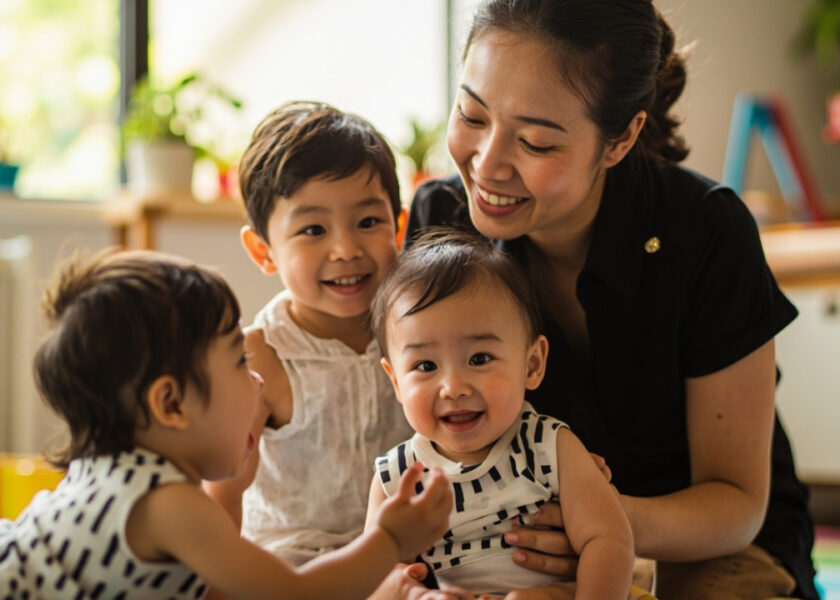
A quality handover looks different. In a quality handover, the caregiver is already attending. Before you arrive, they have prepared the space. When you walk through the door, they greet you and your child together, and their greeting is unhurried.
They come to your child’s level, not to yours, and they speak directly to your child, not over them. They use your child’s name. They acknowledge what your child has brought with them this morning — whether it is a favourite toy or a particular mood or the way they are clinging to your leg with a particular intensity.
They receive your child into their arms, or they crouch down to be received, and they do not rush this moment. The parent has time to leave, properly, with words and a gesture that feels complete. And then the caregiver turns their full attention to your child, because that is when the real work begins: helping your child understand that they are safe, that this is a good place, that you were right to trust this person.
What Attunement Looks Like
Attunement is not a feeling. It is a practice. It is the discipline of noticing, in real time, what your child needs in this moment, and responding to that need before the parent leaves.
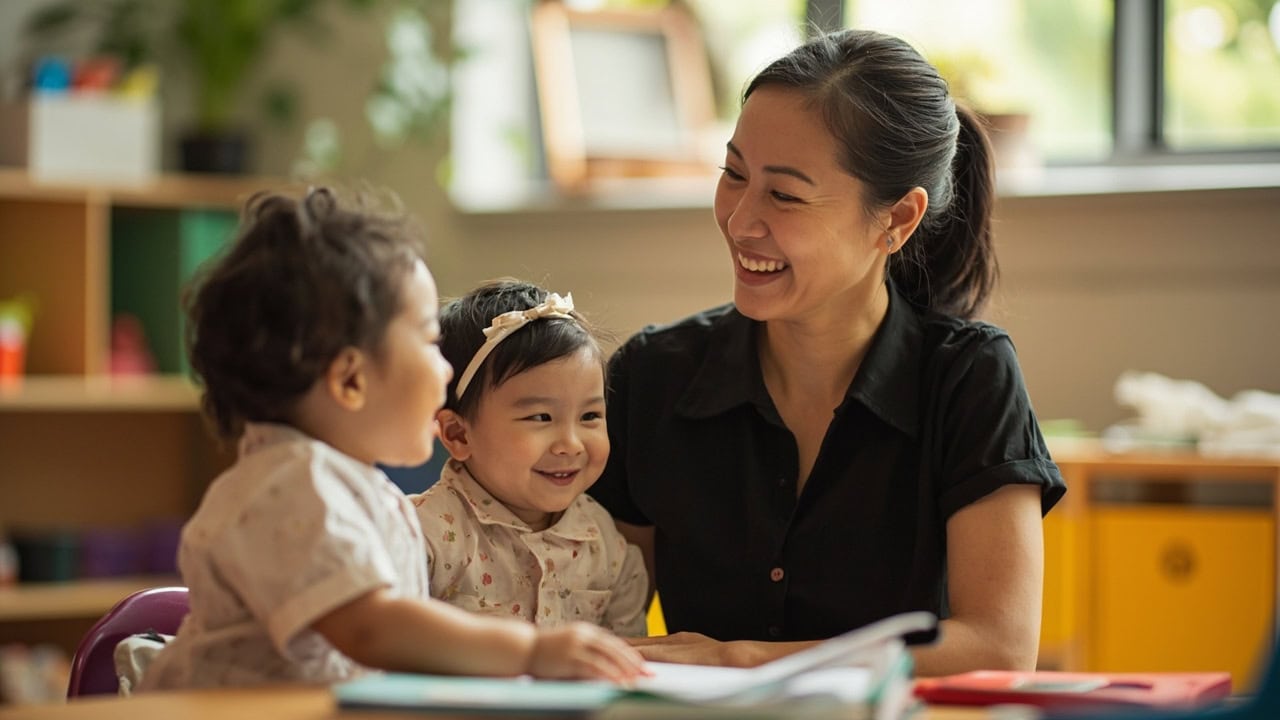
When a caregiver is attuned, you can see it in their body. They are not glancing at the clock. They are not already thinking about the next task. They are with your child, fully, in the way that you yourself would be if you could stay.
In Singapore’s context, where childcare arrangements often involve navigating work schedules, MRT commutes, and the particular pressures of city parenting, the quality of that morning moment matters even more. Whether you are dropping your child at a childminding home, an infant care centre, or with a caregiver who comes to your home, the principle is the same: the caregiver’s presence at the threshold sets the tone for everything that follows.
The First Thirty Seconds: What to Observe
In the first thirty seconds of a handover, here is what you are looking for:
- Physical presence before you arrive. Does the caregiver come to greet you, or are they finishing something else when you walk in?
- Level of engagement. Are they kneeling, crouching, or sitting so that your child can see their face without looking up?
- Quality of voice. Is it warm? Is it directed at your child, using their name?
- Acknowledgment of the whole child. Do they notice your child’s belongings, their mood, anything they have brought with them this morning?
- How they receive your child. Do they reach out to receive your child into their arms, or do they wait for your child to come to them? A caregiver who receives your child is saying, through their body, that they are ready, that they are here, that the child does not have to do the work of approaching.
Ask observational questions that reveal how closely the caregiver has been attending: “What did you notice about my child this morning?” or “What does a typical morning look like when my child arrives?” A caregiver who is attuned will have something specific to say — about your child’s mood, their play, their interaction with the space. What you are looking for is evidence that your child is seen as an individual, not one of a group moving through the day.
Your Child Is Watching You Watch This Person
Your child is not only watching the caregiver. They are watching how you relate to the caregiver. They are reading your body language, your eye contact, your tone of voice. They are asking themselves, in a way they cannot yet articulate: does my parent trust this person?
If your goodbye is rushed and anxious, if you linger too long because you are not sure, if you hover and then pull away abruptly — your child reads that. They may not have the words for what they are observing, but they understand the emotional grammar of the moment. And that understanding shapes their own response to the caregiver, to the space, to the experience of being away from you.
This is why the parent’s role in the handover is so consequential, and why it is so rarely discussed.
Leaving with Confidence
Leaving your child confidently does not mean leaving without feeling. It means leaving with clarity. It means giving your child a goodbye that is complete: a word, a gesture, a look. It means trusting that the caregiver will do what you cannot do in that moment, which is to be fully present to your child’s transition.
And it means leaving before your doubt becomes visible, because your doubt is the one thing that your child will absorb and carry into the rest of their day.
You are not wrong to feel what you feel in that doorway. The anxiety is real. The love is real. The responsibility you carry is real. But the handover is not about you processing your feelings in that moment. The handover is about your child, and what they need from you is a parent who is steady enough to leave them in a place of trust.
When Your Child Hesitates
What about the child who clings, or cries, or turns back to look at you three times before you have even reached the gate?
Resistance at the handover is not always a sign that something is wrong. It is often a sign that something is right. It is a sign that your child has a secure attachment to you, and that leaving you is hard because you are worth leaving reluctantly.
What matters is how the caregiver responds to that resistance. A caregiver who is attuned will not rush the child through their hesitation. They will acknowledge the difficulty: “I know it is hard to say goodbye. Your mummy is coming back. Let us sit together for a moment and then we will play.”
They will not shame the child for crying. They will not make the parent feel that they must leave faster to spare the child further distress. They will be patient, warm, and present.
And the parent, in that moment, must leave. Not because the child does not matter, but because the child needs to learn that goodbye does not mean abandonment — and that learning can only happen if goodbye is followed by return.
Your child may cry every morning for a while. That is not evidence that the arrangement is wrong. It is evidence that your child loves you and that leaving you is hard. What matters is what happens after you leave. Does your child settle? Does the caregiver’s presence become a source of comfort rather than continued distress? That is what you are reading when you check in during the day, and that is what will tell you whether the handover is working.
Why Consistency Builds Trust
The handover that your child experiences today shapes the handover they will experience tomorrow.
When a handover is consistent — when the caregiver is present in the same way each morning, when the parent’s goodbye is complete and confident each morning — your child begins to learn the grammar of this daily ritual. They begin to understand that goodbye is followed by care, and care is followed by return. They begin to trust the rhythm of the day. They begin to feel, in their bodies, that this place is safe because it has been safe before.
When the handover is inconsistent — when some mornings the caregiver is distracted and other mornings they are warm, when some mornings you linger and other mornings you rush — your child does not yet have the framework to understand why. They experience it as uncertainty. And uncertainty, in the body of a young child, feels like danger.
This is why the search for quality matters, and why it is worth being specific about what you are looking for. You are not only looking for a warm person, though warmth is essential. You are looking for a practice. You are looking for someone who understands what the handover is and who treats it with the intentionality it deserves.
That is not a small thing. That is everything.
What EduNanny Singapore Offers
EduNanny by BUTLER is part of something important — a programme that is part of the ECDA Childminding Pilot, designed to address a real gap in Singapore: the need for quality infant and childminding care that is both accessible and trustworthy.
In the EduNanny model, home-based care is at the centre of what we offer, because we believe that young children thrive in environments that feel like home — with small ratios that allow for genuine attention, and with caregivers who are trained and supported to be present in the way I have been describing this morning.
Infant ratios of up to 1:3 mean your child is known, not just supervised. Monday to Friday care blocks support reliable, consistent arrangements — not ad hoc solutions — so your child can build the daily rhythm they need. CDA and Baby Bonus are accepted, because quality care should not be limited to families with significant resources. And where applicable, CCTV provisions offer additional assurance when you leave your child.
Addressing Your Real Concerns
You may still have questions. That is not only natural — it is a sign of the careful thinking that good parenting requires.
What if my child cries every morning? As mentioned earlier, resistance at handover is often a sign of secure attachment. What matters is not whether your child cries, but what happens after you leave. A quality caregiver will help your child settle. Watch for that settling. That is the signal.
How do I know if the caregiver is genuinely attuned, not just performing warmth? Notice whether the caregiver notices your child specifically — their mood, their play, their particular way of being this morning. A caregiver who cannot tell you anything specific has not been attending in the way that matters.
What if I am not sure about my own departure? Your uncertainty is understandable, and it does not make you a bad parent. But the handover is not the moment to process that uncertainty visibly. Give yourself time before you leave — a moment in the car, a breath at the gate — to arrive at the handover steady. Your child will read your steadiness, and it will serve them.
How long does it take for a handover to feel normal? Every child is different. What matters is the direction of travel: Is your child settling more quickly over time? Is the caregiver’s presence becoming a source of comfort? Consistency across weeks and months is what builds the trust your child needs.
The Handover as a Gift
Let me close by returning to where we began, because what happens in that doorway is worth naming fully.
Every morning, you walk into a space with your child. You carry them, or hold their hand, or push their pram through the morning traffic of Singapore. You have probably been awake for hours before this, managing the logistics of your own departure, the weight of the city mornings. You are tired. You are probably also carrying something you cannot put down: the weight of leaving your child in someone else’s care, the knowledge that you cannot be two places at once, the awareness that you are trusting another person with something that cannot be trusted to just anyone.
And then you arrive. And the caregiver is there. And you must leave.
This is one of the most ordinary moments of parenting. It happens every weekday, for years. And it is also one of the most consequential moments, because of what your child learns in it, and because of what you carry away from it for the rest of your day.
The way you leave your child is a gift. Not a perfect gift. Not a gift without anxiety. But a gift nonetheless.
- The gift of a parent who loves them enough to find the right person to receive them.
- The gift of a goodbye that is honest, that acknowledges the difficulty, and that leaves them in hands that are ready.
- The gift of consistency, day after day, until the doorway becomes a threshold they cross with growing confidence.
You are doing something right. The question you carry every morning — am I doing this right — is not evidence of your doubt. It is evidence of your care.
And the fact that you are here, listening, thinking carefully about what quality looks like, means that you are already doing the work that the best parenting requires.
At EduNanny, we believe that every family in Singapore deserves a handover they can feel good about, and a caregiver who meets them at the door ready to receive their child with the presence and warmth they deserve.
We are not here to replace you. We are here to partner with you, beginning in that doorway, every morning, for as long as you need us.
That is what the handover is. That is what it has always been. And now, you have the language for it.
If you are ready to explore what a quality handover looks like in practice — for your child, and for you — we invite you to speak with us. The doorway is waiting.
EduNanny Singapore is part of the ECDA Childminding Pilot, offering quality home-based infant and childminding care rooted in trust, developmental warmth, and professional standards. Learn more about our approach or get in touch to begin the conversation.