What Your Child Is Trying to Tell You Every Day
Understanding What Flourishing Looks Like in a Young Child
There is a particular silence that settles over a parent in the moments after dropping off a child at childcare. It is not empty silence. It is full of things you cannot see—small hands letting go of yours, a threshold being crossed, a world beginning where you cannot follow.
You handed your child to someone else this morning, and now you are walking away, and the only evidence you will receive today is a photograph, a short note, perhaps a smile at pickup that you will spend the evening trying to read.
You are not imagining this uncertainty. It is real, and it is the daily condition of parenting in a world where care is shared. Singapore parents carry this weight with particular seriousness. We plan meticulously. We choose carefully. We want so much for our children that the wanting itself becomes a kind of ache, a perpetual wondering whether what we have arranged is truly right.
This article is for you—the parent who has felt that silence, who has scrutinised every update photo wondering what lies between the frames, who has lain awake translating the fragments of your day into questions about your child’s unseen hours. What follows is a framework for understanding what flourishing looks like in a young child, so that when you pick up your child at the end of the day, you will know what to look for—and why what you see matters.
The Portrait of a Child Who Is Thriving
Imagine a child who has been in quality care for several months—not merely attended, but genuinely well-cared for, in an environment where the ratios are small enough for each child to be known, where the caregivers are trained not only in safety protocols but in the subtler language of infant and toddler development.
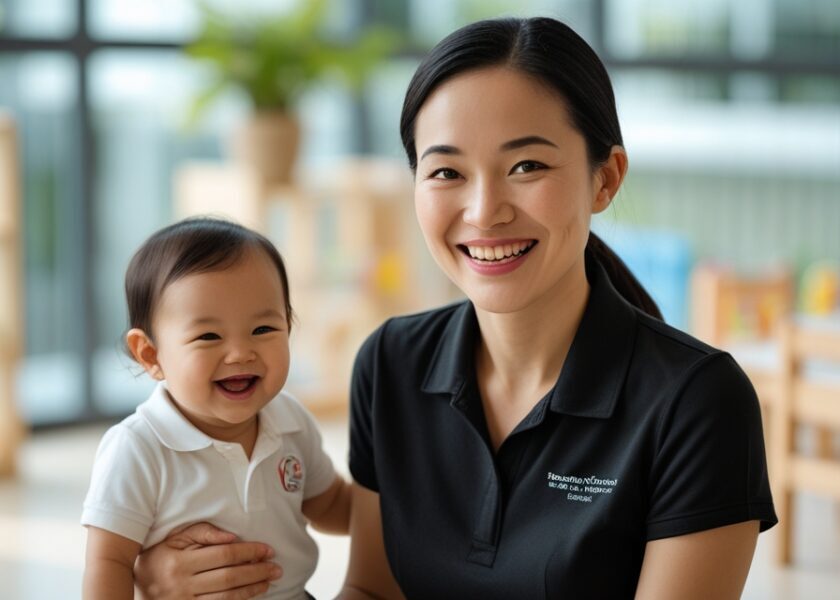
Watch this child at pickup. There is something in the way she moves toward you. Not desperation, not relief that borders on anxiety. Something quieter. She has been in a good place, and she knows it, and she can leave it without grief because leaving does not mean abandonment. She has learned, without words she could ever use, that people who love her sometimes leave and return. That the world holds.
Now watch her on a Saturday morning, a week after this routine has become established. She is playing independently, but she glances up every few minutes—not for reassurance, but for the pleasure of seeing you nearby. She experiments. She pushes boundaries. She returns to you when she needs grounding, and then she goes again, increasingly sure that you will be there when she comes back.
This is not just normal child development. This is the specific result of emotional security being established in her daily care. And it is visible—to eyes that know what to look for—in the quality of her play, in the resilience of her engagement, in the way she holds herself in the world.
What Quality Care Actually Builds
Quality care does not merely keep children safe, though safety is the non-negotiable foundation. It does not merely occupy children, though engagement matters. Quality care builds the internal architecture of a human being—the sense that the world is trustworthy, that other people can be relied upon, that exploration is worthwhile, that one’s own feelings have validity and can be expressed and met with understanding.
This architecture is laid down in the first thousand days of life with particular speed and particular importance. It is built not through lectures or curricula but through the accumulated experience of being genuinely seen and responded to by consistent, attentive, emotionally attuned caregivers.
A child who has experienced this kind of care begins to show it in recognisable ways:
- Security looks like ease—a child who can leave you and return to you without anxiety
- The quality of separation—not dramatic, not filled with prolonged distress, but a child who can trust that parting is temporary
- The quality of reunion—warmth without panic, pleasure without desperation
- The quality of play—deep engagement, creative exploration, willingness to try new things
- The quality of resilience—the ability to recover from minor frustrations, to bounce back, to keep trying
- The quality of connection—a child who can form genuine relationships with caregivers, who speaks of them as real people, who shows evidence of being known
Reading the Signs: What Your Child Is Telling You
Here is what often goes unrecognised: parents are actually receiving signals about their child’s flourishing all the time. They simply lack the context to interpret them.
The evening meltdown that seemed like a regression might actually be a child processing the stimulation of a rich day. The new word that emerged over the weekend might have been absorbed during a caregiver’s patient repetition earlier in the week. The way a toddler points to herself in photographs and says her own name—this is not random. It is evidence of identity formation supported by a caregiver who consistently used that name, who looked at that child and acknowledged her, who treated her as a person with an inner life worth recognising.
A parent who knows what to look for begins to read these signs everywhere:
- The ease with which a child separates at drop-off
- The quality of engagement at pickup—not just excitement but a particular kind of openness, a willingness to share something that happened during the day
- The way a child speaks about or to a caregiver as a real person in her life, not just a function
- The texture of a child’s play—imaginative, curious, sustained
- The child’s willingness to explore new environments and return to familiar ones
These are not guarantees, of course. Children are complex, and behaviour is never simple. But these are indicators, patterns that emerge over time, evidence that the invisible hours are being well spent.
What Trained Caregivers Actually Do
Trained caregivers become irreplaceable not because parents cannot eventually learn to see these signs for themselves—indeed, part of quality care is helping parents develop this capacity—but because the caregiver’s training and daily attention create the conditions in which such signs can emerge.
A caregiver who understands infant and child development, who knows what security looks like in a one-year-old and what curiosity looks like in a two-year-old, who can distinguish between a child’s natural temperament and a child’s emotional state, is not merely supervising. She is actively nurturing the specific processes that lead to flourishing.
Consider what this looks like in practice:
- Keeping notes not because forms require it but because knowing a child is her purpose
- Adjusting her approach when she sees that a particular child needs more quiet, or more physical closeness, or more freedom to move
- Recognising the subtle shifts that indicate a child is progressing versus a child who is merely coping
- Communicating with parents in ways that help them understand what they are seeing at home
- Seeing each child as an individual with their own rhythms, preferences, and developmental trajectory
She is, in the truest sense, in partnership with the child’s family.
The EduNanny Approach: Making Intimacy Possible
Childcare is not a holding service. It is developmental architecture. And it requires, at its foundation, ratios that allow for genuine attention.
In our ECDA Childminding Pilot arrangements, we maintain ratios of up to one to three infants. That is not an administrative preference. That is a deliberate choice to ensure that each child can be known, can be responded to as an individual, can have his or her rhythms respected and nurtured.
Small numbers make intimacy possible. Intimacy makes development possible.
The pathways available through EduNanny—home-based and community or centre-based options—serve different family needs, and that flexibility matters. What matters equally is that whatever the setting, the principles of care remain consistent:
- Trained caregivers who understand child development
- Observed and documented development over time
- Transparent communication with parents
- Caregivers who can tell you not just what your child ate but how she seemed, not just that she napped but how she woke, not just that she played but what captured her attention and why that might matter
In some settings, measures like CCTV offer additional reassurance—and that is a choice for families to make based on their own sense of comfort. But the deeper reassurance comes from the relationship itself, from the caregiver who knows your child, who observes her daily, who can be a genuine partner in understanding her.
Addressing Common Concerns Singapore Parents Have
There is something else that matters in the Singapore context, and it would be dishonest not to name it: the cost of quality care can feel prohibitive.
Singapore parents already carry significant financial weight—housing, education, the sheer expense of raising children in one of the world’s most expensive cities. We believe that infant care and childminding should not be luxuries reserved for families with considerable means.
That is why our pilot fee structures are designed to be affordable, why we help families navigate the use of CDA funds and Baby Bonus contributions, why we believe that the children who benefit most from quality care should not be only those whose parents can pay premium prices. Monday to Friday care blocks provide the consistency that makes development possible, and we work to make those blocks accessible.
Will my child just be adapting or actually flourishing?
This is perhaps the question that haunts parents most. How do you know if your child is merely coping with childcare, or truly thriving in it?
The answer lies in what we have been exploring: flourishing has a texture. It shows up in the quality of a child’s engagement, not just the presence of it. A child who is merely adapting may be compliant, quiet, “good”—but a child who is flourishing will show signs of genuine curiosity, of security, of the kind of ease that comes from being genuinely known.
Over time, you will see evidence of the internal architecture we described—not perfection, but a foundation of trust that allows your child to explore, to connect, to grow.
What if I still cannot tell?
You may not yet have the framework to read these signs. That is not a failure—it is simply a matter of context. This is why communication with your caregiver matters, and why we build time for that communication into our approach.
A good caregiver will help you develop this capacity. She will point out what she sees. She will help you understand what is happening during those invisible hours. Over time, parents in quality care arrangements often find that they become more confident interpreters of their child’s signals, more attuned to the subtle evidence of flourishing that was always there but required context to recognise.
From Anxiety to Attention: What to Look For
If you are currently researching your options, here are some concrete things to observe and ask about:
- Ratio of caregivers to children—smaller numbers allow for genuine attention to each child
- Turnover and consistency—will your child have the same caregiver over time, or a rotating cast?
- Communication practices—how will you learn about your child’s day? Will you receive genuine observation, or just routine updates?
- Caregiver training—do they understand infant and child development, not just safety protocols?
- The environment—is it designed for children, or simply approved for them?
- How they speak about the children—do they describe individual personalities, preferences, developmental patterns?
- How they respond to your questions—do they welcome your involvement, or seem to prefer distance?
Trust your instincts during visits. You may not yet have the framework to interpret everything, but you can notice how the environment feels, how the caregivers interact with the children, whether there is warmth in the relationships you observe.
Let us return to the parent at the end of a workday, waiting at pickup. She has spent the day trusting a process she cannot fully observe. When her child arrives, she looks. She has learned, over time, to look with a different kind of attention.
She notices not just whether her child is clean and fed but how she is. Is there ease in her child’s body? Is there curiosity in her eyes? Does her child reach for her with confidence, knowing she will be caught? Does her child let go again easily, ready to re-enter the world because trust has been established?
These are the signs. They are not dramatic. They are quiet, everyday, cumulative. They are what flourishing looks like when a child is truly well-cared for—not performing, not achieving, simply living securely enough to grow.
You are not a passive recipient of updates. You are your child’s first and most important interpreter. You are the one who knows the baseline, who can notice deviations and consistencies, who can tell when something has shifted. Quality childcare does not replace this role. It supports it. It gives you a partner in the work of understanding your child—a trained, attentive partner who sees what you cannot see during your working hours and who can help you learn to see more yourself.
This is the invitation: to move from anxiety to attention. From the helpless wondering of those first drop-offs to the quiet confidence of someone who knows what to look for and has learned to trust the process because the evidence accumulates.
Your child is telling you something every day. She is telling you through how she plays, how she sleeps, how she reaches for you and then reaches for the world. The task is not to interrogate her. The task is to create the conditions in which her flourishing becomes visible—and then to see it.
There is a phrase I keep returning to when I think about what we are doing here: the evidence your child leaves behind. It sounds almost archaeological, as if the child is leaving artifacts of a life we can learn to excavate.
In a sense, that is exactly what is happening. Every child in quality care is leaving evidence—in their behaviour, in their speech, in the quality of their attachment and the shape of their curiosity.
Perhaps you have not yet had the framework to recognise what you are seeing in your child. Perhaps today, you begin to see.
Your child is flourishing. You just needed someone to show you where to look.
Ready to Learn More About EduNanny’s Childminding Services?
If you are considering childcare options in Singapore and want a partner who understands what quality care looks like—and why it matters—EduNanny welcomes the opportunity to speak with you. Our ECDA-approved Childminding Pilot offers both home-based and centre-based arrangements, with trained caregivers and ratios designed to ensure your child is truly known.
Contact us to schedule a conversation about what quality childminding can look like for your family.
Learn more about who we are or explore our approach.