Growing Your Village, The Singapore Parent’s Guide to Sibling Care
What You Are Really Feeling
Let us name what is actually happening when you consider enrolling a second child into care.
There is the logistical weight, of course. Two drop-offs instead of one. The coordination of nap schedules that no longer align with anyone else’s logic. The morning choreography that requires the precision of a conductor and the patience of a saint — the snack here, the diaper there, the lost shoe beneath the highchair, the first child insisting she can walk herself today, thank you very much, while the second clings to your neck with the quiet desperation of someone who suspects betrayal.
But beneath the logistics — below the schedule and the lunchboxes and the specific Singapore heat of seven-thirty in the morning — there is something more tender. More complicated.
The Fear: What This Will Do to Your First Child’s World
You worry about your first child. Specifically, you worry about what this new arrangement will do to the world you built for her. She has a caregiver now. She has a relationship that took months to form, that required trust on both sides, that grew through thousands of small moments — the caregiver learning her cues, your daughter learning to be comforted by someone who is not you.
You wonder if a new child in the room will change that. You wonder if your oldest will feel replaced, or overlooked, or somehow less special because suddenly there is someone else who needs the same gentle voice, the same patient hands.
This fear is not irrational. It is not something to be talked out of with reassurances. It is the voice of a parent who has learned, through the experience of raising a child, that relationships are real and that they matter. The fact that you worry about this proves that you understand what quality care actually means.
The Guilt: Repeating a Transition You Know Too Well
And then there is the guilt. Oh, the guilt.
You feel it most acutely in the morning, perhaps. Your oldest child adjusted. It was hard — brutally, heart-wrenchingly hard for those first weeks — and you will never forget the way she cried when you left, the way you walked to the car and sat with your hands on the wheel and sobbed because you were abandoning her, because you were supposed to be the one who made the world feel safe and instead you were handing her to a stranger and walking away.
She adjusted. She found her footing. She now runs through those doors like she owns the place, like the caregiver is her second favourite person in the world, which is simultaneously a relief and a small grief of its own.
And now you are about to put a new child through that. Your new child. The baby you birthed, the one who still fits in the crook of your arm, the one who has never known a world where you are not immediately available. You are about to ask her to do the same impossible thing your first child did, and you wonder if you are asking too much.
Here is what is true: the guilt you feel is not a warning sign. It is evidence of your love. It is the sound of a parent who has been through this before and therefore knows what it means. It is the proof that you are not making this decision lightly, that you have not become immune to the bigness of watching your child learn to belong somewhere that is not home. The guilt is not a reason to stop. It is a reason to proceed with care.
The Hidden Gift of Sibling Care
It gets easier. Not because the children change, but because you do.
You learn, with each child, that the transition is not a permanent wound. It is a bridge — a necessary crossing from the world of home to the world of community, from dependence to independence, from the small family unit to the wider web of relationships that will shape who your children become. The first few weeks are hard — they are meant to be hard — and then something shifts. Your child finds her footing. She makes friends. She starts talking about her caregiver with the casual ownership of someone who belongs.
And something else shifts too. Something you could not have predicted the first time around.
When siblings share a care environment — when they are enrolled with the same caregiver, in the same space or in connected spaces — they develop something that is difficult to name but unmistakable once you have witnessed it. They become each other’s reference points. They see each other succeed. They watch each other navigate the small challenges of being away from home and they learn, from proximity and modeling and the simple fact of shared witness, that this is possible. That being small and away from your parents is survivable. That it can even be wonderful.
Your oldest sees your youngest learn to wave goodbye, and she remembers when she did the same. Your youngest watches your oldest run to the caregiver with open arms, and she understands what that relationship is for. They carry the same stories in their bodies now. They have a shared language that belongs to no one else.
This is what quality sibling care looks like when it works. It is not just two children in the same place. It is two children building a shared narrative of growth.
What Quality Actually Means
There is a difference between enrolment and enrolment, between care and care, and the difference matters more when you are trusting someone with more than one of your children.
Quality sibling care begins with a simple truth that sounds obvious but is rarely practiced: every child is a distinct person, even when they share a family, even when they share a caregiver, even when they walk through the same doors every morning. Your oldest is not your youngest. They have different temperaments, different needs, different rhythms of growth.
A caregiver who understands this — who can hold your two-year-old’s need for independence while simultaneously holding your infant’s need for constant comfort — is not just skilled. She is rare.
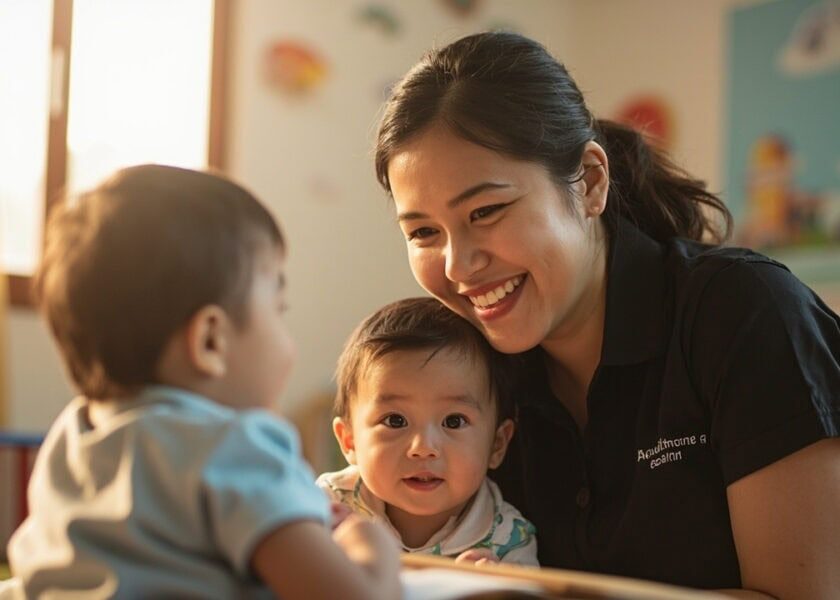
At EduNanny, this understanding shapes everything. Their model is built around small ratios — up to one caregiver for every three infants — which is not simply a logistical feature. It is the foundation that makes individualisation possible. When a caregiver has three children instead of six, or eight, or twelve, she can learn the particular cry of your youngest, the specific way your oldest processes frustration, the exact temperature of comfort that each of your children requires on a difficult day. She can be present to the nuance. She can notice what no one else would notice.
Quality sibling care also means continuity — not just the continuity of a caregiver relationship, but the continuity of a philosophy. When your children are in the same environment, they are absorbing the same messages about how to be in the world. How to treat others. How to solve problems. How to be comforted. How to comfort.
And quality sibling care means communication. Particularly when you are not in the room to see what is happening, you need to know not just what your children did today — though that matters — but how they interacted, how the sibling dynamic played out, whether there were moments of tension or moments of delight. When families are navigating multiple enrolments, they need more information, not less. They need to feel that the caregiver sees each child and sees the siblings together.
Questions Singapore Parents Actually Ask
These concerns come up again and again in conversations with families navigating the second enrolment. They deserve direct answers.
“Will my first child feel replaced?”
Quality care is designed to hold the whole family, not just individual children. A caregiver who has built a relationship with your first child does not simply start over when your second arrives. She builds upon what is already there.
In practice, this means your oldest may actually deepen her sense of the caregiver as a trusted adult precisely because she sees you trusting that adult with someone new. There is a quiet lesson in that — one that says, this relationship is real enough to extend, strong enough to include someone else. Some families find that their oldest child becomes a kind of guide for the younger one, drawing on her own experience in ways that surprise everyone.
“What about the guilt of repeating the transition?”
The transition period will be hard. This is true for every child, every family, every time. But you now have something you did not have the first time: perspective. You know that the first weeks are not a preview of the years ahead. You know they are a passage, not a destination.
The guilt you carry into this decision is evidence of your care. Do not let anyone talk you out of it. Instead, let it inform how you proceed — with attention, with presence, with the same deliberate care you are bringing to this decision right now.
“How do we manage the logistics?”
The morning choreography is real. Two drop-offs, two pick-ups, two sets of schedules that do not naturally align. Here is what families in Singapore discover: the logistics that feel impossible in the first month become routine by the third. You learn which mornings need a fifteen-minute buffer. You learn which caregiver has a gift for calming a fractious toddler before you hand over. You learn that coordination is a skill that develops, like any other, and that the early weeks of learning are not a sign of failure but a necessary passage.
“Is home-based care really enough for two children?”
This question assumes that more children require more space, more staff, more infrastructure. What it misses is the principle of ratio. A caregiver who is responsible for three children in a home-based setting has a fundamentally different quality of attention than one who is responsible for twelve in a centre. That quality of attention does not diminish when a second sibling joins — it extends. Your children are not competing for a scarce resource. They are sharing in a relationship that was designed to include them.
What Success Looks Like
You wake up one morning and realise that the kitchen silence has changed. It is still quiet, still early, still heavy with the logistics of the day. But it is a different kind of quiet now. It is the quiet of a family in rhythm.
Your oldest walks to the car without protest, backpack bouncing. Your youngest reaches for the caregiver before you have finished the goodbye, and you feel — in that moment — a small twist of something that is not quite jealousy and not quite relief but something in between, something that means your child is learning to trust beyond you, and that this is exactly what you wanted.
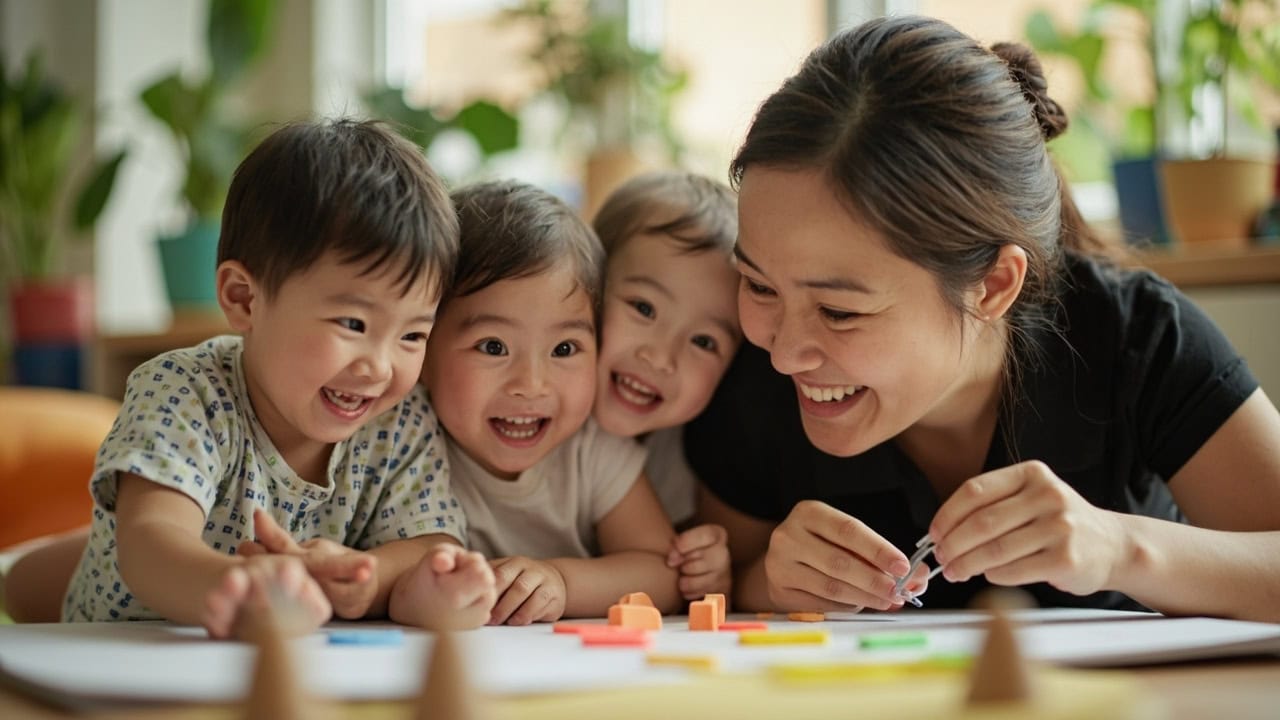
Your caregiver texts you a photo at midmorning. Both children are in the frame. Your oldest is helping your youngest with a puzzle, and the caregiver has captioned it with a small observation — she noticed how patient your firstborn was, how your youngest leaned in to watch, how something shifted between them that was not there yesterday.
This is what sibling care creates when it works: a shared story. A family story, but also a story that includes the caregiver, that extends the family circle to include the people who hold your children when you cannot. Your children grow up knowing that the same hands comforted them both. That the same voice read them stories. That the same person was part of their beginning.
This is not a replacement for family. It is an extension of it. It is the village made real.
And the logistics — that morning choreography that felt impossible? It becomes routine. The guilt, too, softens. Not because it was never real, but because you watch your children thrive and you understand, in your body as well as your mind, that the transition was worth it. That your children are not diminished by care; they are expanded by it.
Building Your Village in Singapore
Singapore has constructed a cultural narrative around parenting that valorises self-sufficiency, that frames extended family support as normal and paid childcare as a concession, that subtly suggests that parents who use childcare are somehow less committed to their children than parents who do not. This narrative is not only wrong. It is harmful.
The truth is simpler and more generous: children are raised by villages. They always have been. The village might look different now than it did two generations ago — it might include paid caregivers, community-based programs, centre-based pathways alongside home-based options — but the function is the same. Children need multiple caring adults who know them. They need environments that are safe and stimulating. They need routines that are predictable and relationships that are reliable.
If you are a parent in Singapore, you live in one of the most expensive cities in the world. You are likely working, or planning to return to work, or navigating the complex calculus of whether to work and what that means for your family. You are not less-than for needing care. You are a parent who is building a village.
And the village you are building matters. The decisions you make about who holds your children, who teaches them and comforts them and watches them grow, who partners with you in the enormous project of raising small humans — these decisions are not incidental. They are formative.
EduNanny’s Childminding Pilot, registered with ECDA, is one expression of this village. It is built on the understanding that home-based and community-based care can offer something that large centres sometimes cannot: intimacy, continuity, the kind of individual attention that shapes a child’s early sense of the world. The pilot structure makes this care accessible within a framework of affordability, with options that allow families to use available government schemes to ease the financial weight.
This is not charity. It is infrastructure. It is the recognition that children need care, that parents need support, and that the way we structure this matters for everyone.
Your Next Step
If you are sitting with this decision right now — if you are the parent at the kitchen counter with two lunchboxes, weighing something that feels too big to weigh alone — here is what to keep in mind.
- Name the specific fears you are carrying. Whether it is your first child’s relationship with the caregiver, the logistics of coordinating two drop-offs, or the guilt of repeating a transition — naming the fear makes it manageable. A good childcare provider will be able to address each of these concerns directly.
- Ask about how the caregiver handles individual attention across multiple children. This is the question that separates quality from adequacy. A caregiver who can articulate how she differentiates her approach for different temperaments and developmental stages is a caregiver who understands what she is doing.
- Look for communication that reflects the sibling relationship, not just individual children. Daily updates should tell you how your children are together — how they interact, where the tensions arise, where the moments of collaboration happen.
- Trust that the transition period is temporary and meaningful. The first few weeks are hard. They are meant to be hard. But they are a bridge, not a wound, and the other side of the bridge is worth reaching.
- Remember that you are building a village, not making a compromise. The language you use about this decision matters. When you frame it as an extension of your family’s care network rather than a substitution for your own presence, the weight of it shifts.
EduNanny has walked this path with many families. They have seen the fear and the guilt and the logistical chaos and the early morning exhaustion. They have also seen what is on the other side of those things: families who have found a rhythm, children who have found their footing, sibling relationships that have been deepened by shared experience, parents who have found, in the caregiver partnership, something they did not know they needed.
EduNanny’s purpose is not simply to provide childcare. It is to walk alongside families through the full arc of this journey — from the first tentative enrolment to the deeper, stickier, longer relationships that form when families stay. When siblings grow up together in the same care environment. When the caregiver knows not just your child but your family.
That is what this work is for. That is why it matters.
The decision to enrol a sibling is not a smaller decision than the first. It is a bigger one, in some ways, because you now know what is at stake. You understand the importance. You have been changed by the experience of trusting someone else with your child, and the idea of extending that trust to include another child — and to ask your first child to share that trust with a sibling — feels enormous.
But here is what has been observed, again and again, across the families who have crossed this threshold: the enormousness of the decision is matched by the enormousness of what is possible on the other side.
Your children will be okay. You will be okay. And the family you are building — with all its complexity, with all its logistical demands, with all its moments of doubt and all its moments of fierce, aching love — will become something that you could not have imagined when you were standing at the kitchen counter alone.
The sibling transition is not a moment to be survived. It is a threshold to be crossed — with eyes open, with support around you, with the understanding that what is on the other side is not just another childcare enrolment but a deeper integration of your family into a community that will hold your children as they grow.
EduNanny is here for that crossing. For the first child and the second. For the morning choreography and the afternoon updates and the small moments of sibling collaboration that no one else will ever see except you and the caregiver who witnessed them. For the full arc of your family’s story.
And that is why, when you stand at that kitchen counter with two lunchboxes, you are not alone.
Ready to explore what sibling care looks like for your family? Speak with EduNanny and take the first step toward the village your children deserve.