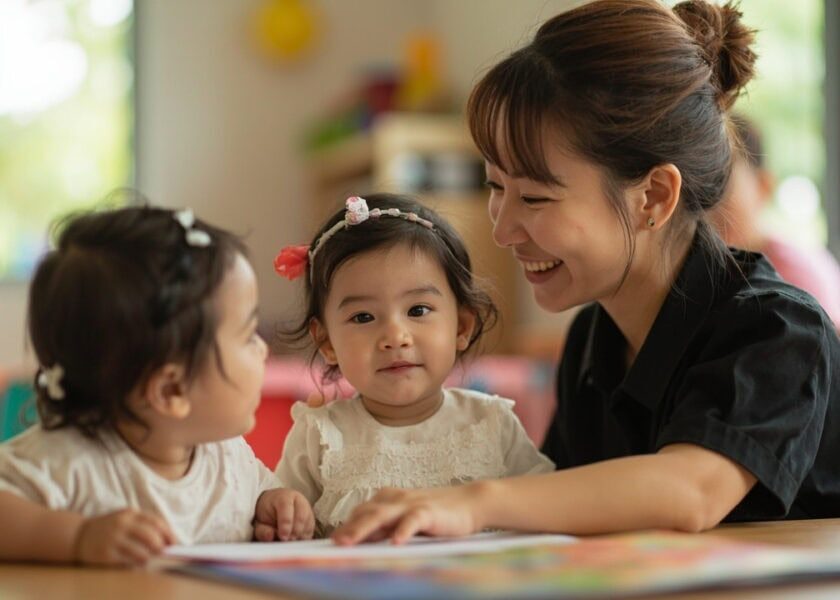
How Singapore Parents Can Evaluate Childcare Quality Beyond the Brochure
The Honest Challenge: How to Evaluate Childcare Quality in Singapore
We live in an age of curated perfection. Every centre has a website with high-resolution photographs, a curriculum framework, and a promise that children are their priority.
What we do not often receive is the harder, more honest guidance: how do you distinguish between a centre that looks excellent and a centre that actually is? How do you read the signals that marketing cannot manufacture? How do you develop the confidence to trust your own judgment when everything around you is designed to reassure?
Evaluating childcare is genuinely difficult. Not because the information is secret, but because quality leaves traces that require a certain kind of attention to notice. At EduNanny Singapore, we have walked alongside hundreds of families through this decision. We have seen what parents look for, what they miss, what reassures them prematurely, and what eventually proves to be the truest indicators of whether a child is genuinely thriving in care.
This article is our attempt to share that accumulated wisdom with you—not as a checklist, but as a way of seeing.
What This Guide Will Help You Find
- Quality signals that cannot be manufactured by a polished tour
- Observable child and caregiver behaviours that reveal real care quality
- Smart questions to ask during your visit
- Why relational continuity matters more than impressive facilities
- What Singapore’s regulatory framework does—and does not—tell you
- How to shift from uncertain consumer to confident evaluator
The Art of Observation: What Remains Visible When They Are Not Trying
When you visit a childcare environment, you are, in a sense, being performatively evaluated. The centre knows you are coming. The caregivers may be prepared. The children may be engaged in their most presentable activities. This is not cynical—it is simply human.
But it means that the question is not what the centre shows you, but what remains visible even when they are not trying to show it.
Watch the Children Themselves
Watch how children move through the space. Not whether they are sitting neatly or smiling on cue, but the quality of their ease. A child in genuinely good care has a particular comfort about them. They are not performing calm; they are actually calm.
Watch a child approach a caregiver. Watch how the caregiver responds—not with the rehearsed warmth of greeting a visitor, but with the quieter, more distracted warmth of a person who has already been attending to this child for hours.
That familiarity, that unselfconscious comfort—it is not easy to fake. It is the residue of hundreds of days of consistent, attentive care.
Listen to the Spontaneous Language
Notice the language you hear around you. Not just the planned circle time or the teacher-led activity, but the spontaneous exchanges. The way a caregiver speaks to a child who has just fallen and wants comfort is a more revealing signal than any curriculum document.
Ask yourself:
- Are children spoken to with patience and respect?
- Are their frustrations met with genuine curiosity?
- Are they seen as complete human beings who deserve explanation, or as small people who must simply comply?
These small moments reveal the philosophical underpinnings of how the centre understands your child’s inner life.
Making the Most of One Visit: Transitions, Questions, and What to Look For
A common question from parents: how do I evaluate quality when I am only visiting for an hour?
The honest answer is that one visit cannot give you complete certainty. But one visit can give you enough—if you know where to look, and if you accept that what you are looking for is not perfection but consistency.
Request to See a Regular Day
Ask specifically to witness transitions—between activities, between indoor and outdoor time, between teacher-led and free play. These moments are where consistency reveals itself.
In a centre with genuinely trained caregivers, transitions are managed calmly and predictably, with children who know what comes next because they have experienced this sequence hundreds of times before.
In a centre that has polished its tour experience but not its daily practice, transitions can be chaotic, loud, and marked by reactive management rather than proactive care.
Ask About Caregiver Continuity
Ask directly: Who will be the primary caregiver for your infant? How long have they been in this role? What is the turnover rate?
These questions feel uncomfortable to ask, and parents often worry they will seem intrusive. But they are among the most important questions you can raise.
Your infant does not simply need competent care. They need relational continuity. The attachment your child forms with their caregiver is the developmental foundation upon which their sense of security, exploration, and later social and emotional learning will be built.
Questions That Reveal Philosophy
How do you assess warmth without a crystal ball? Ask questions that reveal philosophy. Not “do you love the children”—because every centre will say yes.
Instead, ask questions like these:
- What does a difficult morning look like here?
- How do you handle a child who is struggling to settle?
- What happens when a caregiver is having a hard day—how does the team support each other?
- What is your approach to a child going through a developmental leap who is more clingy than usual?
These questions do not have perfect answers. What you are listening for is not perfection but depth—evidence that the caregivers have thought carefully about their work, that they understand development, that they see children as complex beings rather than tasks to be managed.
Listen to How the Centre Speaks About Parents
A truly excellent childcare environment understands itself as a partner with families, not a replacement for them. Consider asking:
- How do you handle bedtime routines when a child has two different approaches at home and at school?
- How do you communicate developmental concerns?
- What does a typical parent update look like?
The language used here is revealing. A centre that speaks about “partnership,” “collaboration,” and “transparency” is gesturing toward the right framework—but you want to hear specifics. What does transparency actually look like in daily practice?
Beyond the Building: Why Facilities Are Not the Point
Singapore is a city that values quality. Our parents are discerning. Our standards are high. And this is reflected in the childcare sector, where facilities have become increasingly impressive: indoor gyms, sensory rooms, outdoor play spaces with climbing structures.
None of this is wrong. Good physical environments matter. Safety matters. Space for children to move and explore matters.
But here is what years of working with families has taught us: a beautiful facility can never substitute for the quality of the human relationship at its centre.
We have seen children in modest, older centres who were radiant with development, whose caregivers knew their families by name, who spoke about their charges with a specificity and affection that revealed deep, daily investment.
We have also seen children in stunning facilities who were somehow flat, whose caregivers moved through the day like staff in a production, whose warmth was performed rather than felt.
What you are ultimately choosing is not a building. You are choosing a developmental environment—a set of human relationships that will shape, in ways both visible and invisible, how your child understands the world.
The toys can be replaced. The curriculum can be revised. The paint on the walls can be refreshed. But the quality of attention your child receives from the adult who holds them when they are upset, who celebrates their small victories, who notices when they are not quite themselves—that is irreplaceable.
Understanding Singapore’s Regulatory Landscape
Singapore parents navigating the childcare landscape encounter a particular set of choices that parents in other countries may not face in the same way.
We have a robust regulatory framework through the Early Childhood Development Agency (ECDA). Centres operating under ECDA oversight meet established standards for safety, curriculum, and caregiver qualifications. If a centre is ECDA-registered, you can have baseline confidence in certain structural elements.
But we want to be honest: regulatory compliance is a floor, not a ceiling. It tells you minimum standards are met. It does not tell you whether this particular environment is the right developmental fit for your particular child.
| Consideration | What It Means for You |
|---|---|
| ECDA Registration | Baseline safety and curriculum standards met—but not a quality guarantee |
| Staff Qualifications | Required training exists, but experience and temperament vary widely |
| Childminding Pilot | Smaller ratios and home-based options exist for families seeking intensive individual attention |
Finding the Right Fit—and Trusting Your Child’s Response
The search for childcare is ultimately about not finding the objectively best option, but finding the right fit for your child and your family.
The centre with the international curriculum and the stunning facility may be perfect for one family and overwhelming for another. The home-based childminder may offer warmth and individualized attention that a large centre cannot replicate, while a centre may offer enrichment programming that a smaller setting cannot match.
There is no universal answer. There is only the honest, sometimes uncomfortable work of knowing what your child needs, knowing what your family values, and finding the environment that aligns.
Your Child Is Giving You an Ongoing Report
Your child cannot tell you, in words you can understand, what their experience was today. But they are telling you in other ways:
- Thease or agitation at drop-off
- Their language development and curiosity
- Their sleep patterns and appetite
- The way they speak about their caregiver
- The quality of their play
Over weeks and months, your child is giving you a report card on the care they are receiving. When you know what to look for, you become fluent in reading that report. And that is perhaps the most powerful evaluation tool of all—not what you see on a single tour, but what you observe over time as your child’s daily reality unfolds.
We understand that this process can feel like a lot to hold. Parents come to this decision at a vulnerable time. They are often exhausted. They may carry guilt that has nothing to do with logic and everything to do with love.
Here is what we want you to know: the shift we have seen in parents who have moved through this process well is not a shift from anxiety to certainty. It is a shift from uncertainty to confidence. And that shift comes not from finding perfect assurance, but from developing the capacity to see clearly.
A Different Model Worth Considering
For families in Singapore seeking something different, there are pathways worth understanding. The ECDA Childminding Pilot offers a model rooted in smaller ratios, home-based or community-based care, and a philosophy of caregiver relationship that can be profoundly valuable for infants and young toddlers who thrive in lower-stimulation environments.
EduNanny Singapore participates in this pilot. Our approach offers up to a one-to-three infant ratio—meaning your child receives attention that is simply not possible in larger group settings. Our care is designed around working families’ real schedules, and CDA and Baby Bonus funds are usable where applicable.
We share these details not as selling points, but as part of a transparent conversation about what options exist and how they might serve different families’ needs.
Our communication approach is built around the understanding that parents need to feel connected to their child’s day—not just receive a summary of meals and naps, but genuine insight into their child’s mood, discoveries, and moments of struggle and triumph. This is not accidental. It reflects our core belief that childcare, when done well, extends rather than replaces the parent-child relationship.
If you are beginning your search for childcare in Singapore and would like to explore whether a childminding approach might suit your family, we welcome the conversation at EduNanny Singapore.