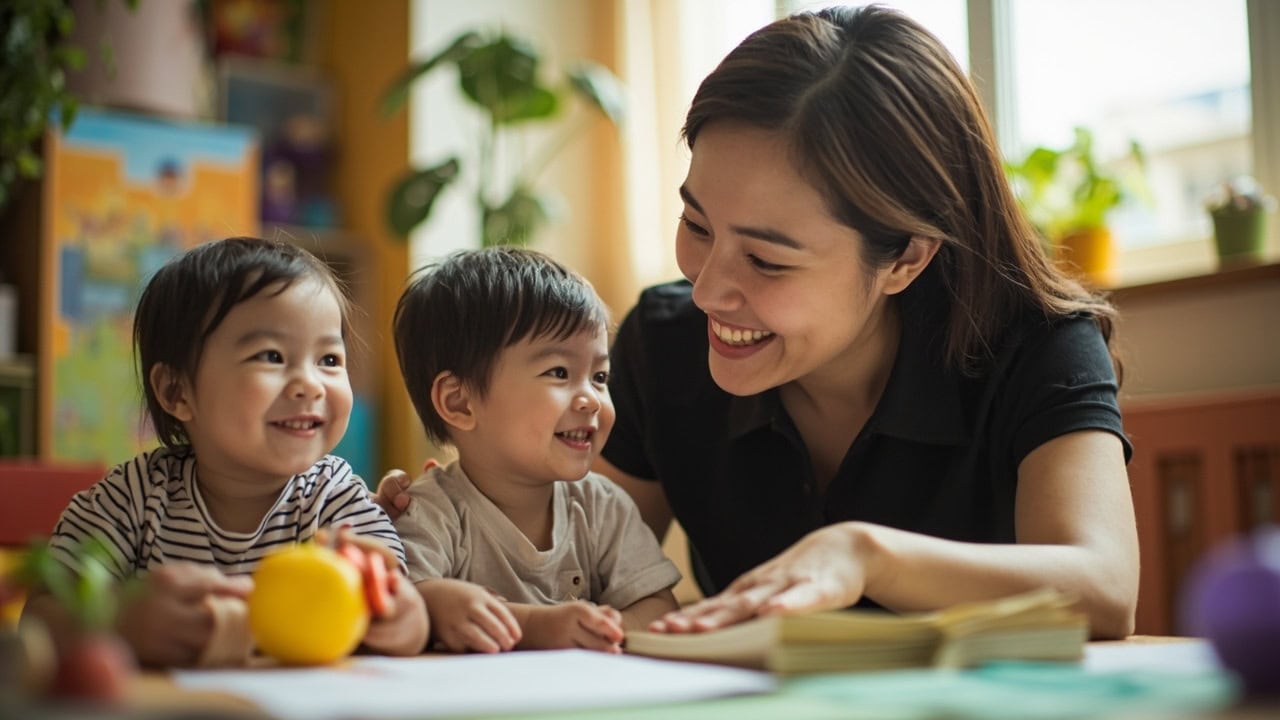
How Singapore Parents Read Quality Childcare With All Their Senses
What Great Childcare Feels Like: A Sensory Framework
If you are pressed for time, here is what to look for when evaluating any childcare environment in Singapore:
- Light that reaches the corners — warmth that falls where children gather and play
- Sound that has texture — a natural rise and fall, not an exhausting roar of competing voices
- Materials with warmth — wood, fabric, real books, surfaces that invite touch
- A caregiver who notices — who reads a child’s body language before a situation escalates
- Children at ease — not performing comfort, but genuinely absorbed in play
- An edited space — curated rather than cluttered, with room to breathe
These are not abstract ideals. They are observable signals. Once you know what to look for, you cannot unsee them.
The Room Speaks Before Anyone Says a Word
Walk into a room where children are truly present, and you will notice something immediate. The room has a quality of attention. It is not merely clean, though it is that. It is not merely organised, though it carries that too. It has a kind of intentional calm, a sense that every element has been considered not for how it photographs but for how it serves a child moving through it, learning within it.
Notice the Light
Not the overhead fluorescents that flatten everything into sameness, but the quality of illumination that reaches the corners of the room, that falls on the play surfaces where children gather. Good light is not a luxury in a childcare environment. It is a signal. It tells you that someone considered whether the children would be comfortable spending hours in this space.
Notice the Acoustics
In a room where quality is prioritised, the sound is managed. Not silenced — children need to make noise, to laugh, to argue over a toy truck. But the noise has texture. It rises and falls naturally. There are no sudden sharp sounds that make you wince. The acoustic environment serves the children rather than exhausting them.
Notice the Materials
Notice that they are warm. That the wooden toys have grain and weight. That the books are real books, not plastic-coated replicas. That the fabrics are soft and the surfaces are varied — smooth and rough, cool and warm — because children learn through touch as much as through sight. A sensory-rich environment is a curriculum written in texture and temperature.
Notice What Is Absent
Notice the absence of clutter that serves no purpose. Notice the absence of visual noise — the overloaded bulletin boards, the competing colours, the signs that try to enforce behaviour rather than shape it naturally. A room that speaks quality has edited itself. Children need space to breathe, to move, to create their own order. Less, in a great environment, is genuinely more.
The Caregiver at the Centre
The caregiver stands at the centre of everything, but not in the way you might expect. She is not commanding attention. She is not the loudest voice in the room. There is a quality of ease in how she inhabits the space, a calm authority that comes not from position but from genuine competence.
Watch her for a few minutes without announcing that you are watching. You are a parent evaluating the most important environment your child will inhabit besides your own home. You have every right to observe.
Responsiveness That Cannot Be Faked
What you will see, if you are watching with new eyes, is responsiveness. Not the performative responsiveness of someone who knows they are being observed — the exaggerated eye contact, the theatrical kneeling-to-child-level that some training programmes teach as techniques.
You will see a caregiver who notices. Who notices the child who is about to take a toy from another before it happens, and who intervenes not with a sharp word but with a gentle redirection that preserves the child’s dignity and teaches the lesson simultaneously. Who notices the child who is quiet when the room is loud, and who adjusts — who lowers her own voice, who creates a pocket of stillness near that child without making a production of it. Who notices the child who needs to be held, and who holds them, and who knows the difference between holding because it is easier than dealing with a meltdown and holding because that child genuinely needs the contact and the comfort it provides.
This is the observable quality that cannot be faked in a brochure. It is the quality of a caregiver who has been trained not just in procedures but in perception.
How She Speaks to Children
Notice how the caregiver speaks to the children. Not just what she says, but how she says it. A great caregiver speaks to children the way you speak to someone you respect, not the way you speak down to someone you are managing. Her voice carries warmth without condescension. When she corrects a child, she does not shame. When she praises, she does not flatter insincerely.
How the Children Respond
Notice how the children respond to her. Not with the manufactured enthusiasm of a room that has been primed for a visit, but with the easy familiarity of children who feel safe. They approach her when they need something. They include her in their play. They do not seek her constant approval, because they have already internalised the security of her presence. They are, in the most literal sense, at ease.
What the Children Are Telling You
This is perhaps the most powerful tool in your new sensory vocabulary, and it is one that most parents are never taught to use. Children are not capable of sophisticated self-presentation. They cannot manufacture emotions they do not feel. They cannot maintain a performance of comfort when they are secretly anxious — at least not for long, and certainly not in the unguarded moments when they do not realise they are being watched.
The Quality of Play
What you are looking for is not just that children are playing, but how they are playing. In a great environment, children play with depth. They become absorbed. They solve problems, negotiate roles, experiment with outcomes. They do not need constant redirection because the environment has been arranged to capture their natural curiosity. They play in a way that tells you their nervous systems feel safe enough to explore.
Watch Their Bodies
A child who is genuinely comfortable moves with a kind of loose-limbed freedom. A child who is anxious, even if they are not crying or acting out, will move differently — hesitantly, with one eye on the exits, ready to flee. A child who is thriving will sit and stand and run and climb with the confidence of someone who knows that their body is safe and that their movements will not bring harsh consequences.
How They Relate to Each Other
Not that there are no conflicts — children conflict, it is part of learning social skills. But watch how the conflicts are handled. In a great environment, children are given tools for negotiation, not just rules for compliance. They are helped to use their words, to understand another child’s perspective, to find solutions that honour everyone’s needs.
The Emotional Temperature
Watch the emotional temperature of the room. This is harder to define but easier to feel. A room full of children who are fundamentally well-cared-for has a quality of ease, of genuine happiness that is not performed. It is the settled contentment, a low hum of wellbeing that permeates everything.
Trust What You Are Already Seeing
If you are evaluating childcare options right now, if you are juggling the impossible logistics of two careers and two commutes and the cost of living in this city, if you have sat across from coordinators and nodded at explanations of ratios and curricula and certifications, and walked away feeling no wiser, no more confident — please hear this.
The confusion is not your fault. You have been given the wrong tools. You have been asked to evaluate something as abstract as quality using abstract instruments — pamphlets and conversations and structured visits designed to show you the best version of an environment rather than the true version.
But you are not without resources. You have something that no brochure can capture and no coordinator can manufacture. You have your own sensory intelligence, the same intelligence that told you something felt right or wrong as you walked out of that visit, key in hand, unable to name what you knew.
What we are doing here is giving that intelligence a language. What you felt was real. The signals you picked up were real signals. The quality that registered beneath your conscious awareness was real quality — or the absence of it.
What Quality Childminding Actually Looks Like
There is a meaningful difference between centre-based childcare and home-based childminding, and for infants in particular, this difference matters.
In a home-based setting, the ratios are different by design. Up to one caregiver for every three infants means that each small person is not a number in a room but a named individual with preferences and rhythms and needs that are known and honoured. The caregiver can notice the subtle shifts — the first signs of tiredness, the hunger that is building before it becomes distress, the child who is about to become overwhelmed by stimulation.
For Singapore families, this matters in practical ways too. A home-based setting offers a domestic warmth that larger centres often cannot replicate — the space feels like someone’s home, which means it feels like a place where a child can settle rather than merely attend. The transitions are fewer. The routines can be more individualised. The relationship between caregiver and family can become a genuine partnership rather than a transactional arrangement.
EduNanny: Childcare Built Around the Child
EduNanny by BUTLER was built on a simple conviction: that Singapore families deserve childcare that meets them at the level of their intelligence, not beneath it. Parents are not looking for someone to take their child off their hands — they are looking for a partner in care, an extension of the values they hold, an environment where their child will not merely be safe but will genuinely thrive.
We are part of the ECDA Childminding Pilot, and we take that responsibility seriously. The pilot exists because Singapore recognises that childcare is not a one-size-fits-all proposition, and that home-based care, with its intimate ratios and its warm domestic setting, offers something that larger centre-based environments sometimes cannot: the conditions for the kind of individualised attention that allows each child to be truly seen.
Our care blocks are structured around the working week — Monday through Friday, the hours that actually fit a family’s life. We have made it possible to use the Child Development Account and Baby Bonus for eligible families, because we believe that the financial architecture of childcare should serve families, not create additional barriers.
Transparency is built into everything we do. Where CCTV is deployed, it is not deployed as surveillance but as an extension of openness — a way of saying to parents, we have nothing to hide, and we welcome your confidence because we have earned it through the quality of what we do every single day. You will receive updates about feeding and sleeping and development throughout the day, not just when there is a problem. Your child’s ordinary moments are also extraordinary moments, and they deserve to be shared.
Questions Every Singapore Parent Should Ask Before Enrolling
“How do I know if a caregiver is genuinely attentive or just performing?”
Watch for what happens when no one is paying attention to the caregiver — when a coordinator is speaking to you, when another parent is asking a question. What does the caregiver’s body do? Does she stay present with the children, or does she relax into the knowledge that she is not being observed? True attentiveness is not situational. It is a habit of being.
“What if my child seems fine during the visit but is different at home?”
Children can often manage brief periods of adjustment. What matters more is the trajectory — how does your child seem over weeks, not hours? Ask the caregiver about your child’s patterns, their rhythms, the moments of difficulty and how they were handled. A great caregiver will have stories to tell, because they have been paying attention.
“Is home-based care really as good as they say?”
It depends entirely on the specific home and caregiver. The same principles apply: observe the environment, watch the interactions, notice whether the caregiver notices. The setting is less important than the quality of attention within it. A mediocre centre can be worse than an excellent home-based arrangement, and vice versa.
“How do I bring up money without feeling awkward?”
Ask directly. What are the fees? What is included? Are there any additional costs? Can I use CDA or Baby Bonus? Any provider worth your consideration will answer these questions clearly and without hesitation. Awkwardness is a sign that something is being obscured.
A Framework for Your Next Visit
When you walk into a childcare environment — whether centre-based or home-based — here is a simple framework to guide your observation:
- Stand still for two minutes before you engage anyone. Let the room speak to you. Notice the light, the sound, the temperature, the general feeling of the space.
- Find a corner and watch. You are not there to be entertained or impressed. Watch the caregiver when she thinks no one is watching. Watch the children when they think no one is watching.
- Ask one specific question. Instead of “What is your curriculum?”, ask “Can you tell me about a child who was struggling this week and what you did?” The answer will tell you more than any brochure.
- Notice what you feel. Not what you think you should feel, but what you actually feel. Your sensory intelligence is data. Trust it.
- Visit twice if you can. At different times of day, if possible. The morning and the afternoon can look very different.
You will walk out of a childcare visit again. You will stand beside your car with your keys in your hand. The Singapore afternoon will press in around you, humid and bright, and the sounds of the city will resume their ordinary rhythm.
But this time, I want you to know something. This time, you will have a different resource. You will be able to look back and notice the quality of the light in that room, and what it told you about who designed it and why. You will be able to recall the sound atmosphere, whether it felt managed or chaotic, whether the children’s voices rose and fell naturally or crashed against each other.
You will be able to watch the caregiver and see not just activity but responsiveness, not just presence but attention. You will be able to observe the children and read in their bodies and their play the emotional truth of the environment — whether they were merely safe or genuinely thriving.
And you will be able to trust what you see, because you now understand what you are looking at. Not because you have memorised a checklist, but because you have developed a sensory literacy, a capacity to read environments and people and children with the intelligence that was always yours.
The room speaks. The children speak. The quality of care communicates itself in a thousand small moments that brochures cannot capture and coordinators cannot perform all day long. You have been given the ability to hear that speech, to see those moments, to understand what they mean.
Trust it. Trust yourself.
And if what you are looking for is exactly this kind of environment — one that has nothing to hide, that invites exactly this kind of observant, intelligent scrutiny, that is designed around the reality of what infants actually need — we would welcome the chance to show you what we have built at EduNanny.
Your child deserves to be in a room that speaks beautifully. And now, so much more than before, you know how to listen.