What Your Child Is Really Learning When You Are Not There
The Silence After the Gate
There is a particular silence that follows the moment you walk away from the school gate. You have kissed them goodbye. You have lingered just a little longer than necessary. You have turned back once, perhaps twice, to catch one last glimpse through the window. And then you are in your car, on the train, or walking toward the office, and a quiet question settles somewhere deep beneath your ribs: What are they doing right now? Are they okay? Are they happy? Are they growing?
This is not an irrational fear. It is the most rational thing in the world. Every parent who entrusts their child to someone else’s care carries this question, and it is one of the most profound acts of faith that modern parenthood demands. You are choosing to be apart at the very moment when every instinct tells you to stay close.
These questions deserve real answers. Not reassuring platitudes, but an honest, evidence-informed understanding of what actually happens when your child is in the care of someone who understands the extraordinary work of early childhood development. Because what years of watching children grow have taught us is this: the most important things happening in your child’s life are often the ones you cannot see.
The Invisible Architecture of Child Development
When we speak about quality childcare, we often default to the visible markers: Is the environment clean? Is the ratio good? Are the teachers qualified? Is my child eating well, sleeping enough, not crying too much? These are reasonable questions, and they matter. But they describe the surface of something far deeper.
What quality childcare does, in its truest form, is build. It constructs. It lays foundations that will bear weight you cannot yet imagine, in years and decades you cannot yet foresee. This is the invisible architecture of child development — and understanding what it looks like when it is done well changes everything about how you view the hours you are apart.
What Is Actually Happening in Your Child’s Brain
Consider, for a moment, what is happening in your child’s brain during the first three years of life. These years are extraordinary. The brain is building itself at a pace it will never match again. Neural connections are forming faster than they will at any other point in the human lifespan. The circuits that will eventually govern language, emotional regulation, social intuition, and cognitive flexibility are all being laid down, pruned, and strengthened — primarily through experience, through interaction, through the quality of care a child receives.
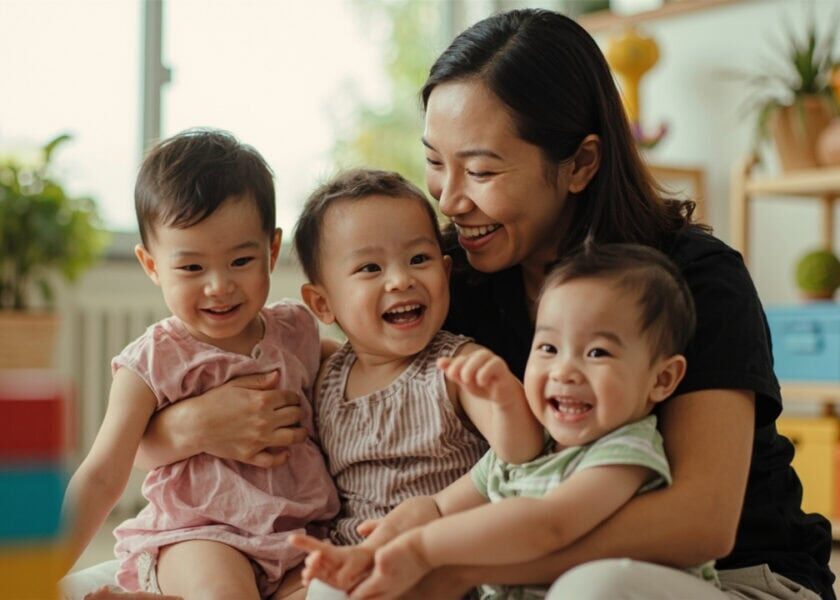
When your child is in a responsive, attentive, developmentally informed environment, something remarkable is happening. Every warm exchange. Every gentle response to a cry. Every moment a caregiver narrates what a child is feeling and doing — “You seem frustrated that the tower fell. Let’s try again together” — these are not just kind gestures. They are scaffolding. They are the invisible hands shaping the architecture of a human being.
This is why the best childcare is not a service you purchase. It is a developmental environment you enter into. The difference is profound. A service keeps a child safe, entertained, and comfortable. A developmental environment grows a child — in ways that compound over time, in ways that become visible only years later.
The Difference Between Safe and Growth-Promoting
Not all childcare builds this architecture. Some environments keep children safe, fed, and entertained — and this is not nothing. It is genuinely important. But safe is not the same as growth-promoting. Entertained is not the same as stimulated in ways that develop neural pathways. Supervised is not the same as cared for by someone who understands the profound developmental work of these early years.
This is why choosing childcare is not simply a logistical decision. It is a developmental one. And it is also why that quiet anxiety you feel after dropping off is not a sign of weakness or overthinking. It is a sign that you understand, on some level, that what happens in these hours matters. You are right. It does.
The Visible Signs of Invisible Foundations
You cannot always see this work, but you can learn to recognize its results — not immediately, not in a single day, but over months and years. Here are the visible markers of the invisible architecture being built.
1. Language Development
Children who are in language-rich environments — where caregivers narrate their experiences, name their emotions, and engage them in back-and-forth exchange — develop vocabulary and communication skills that outpace those who are not. You may not see this happening during the school day. But months later, when your eighteen-month-old is pointing at a bird and saying bird, or your two-year-old is telling you a story in their own pidgin language, that is the invisible architecture expressing itself.
2. Social Confidence
Children who have had positive peer experiences — who have learned to share, to wait, to read the facial expressions of other children, to feel the pleasure of cooperative play — tend to enter social situations with a different quality of ease. They are not necessarily more outgoing than other children. But they are more secure in social contexts. They trust that other children can be interesting, and that they themselves have something to offer.
3. Emotional Vocabulary
A child who can say I am sad or I am frustrated or I need help is a child who has been seen, heard, and mirrored by attentive caregivers. This capacity for emotional naming is not innate. It is taught, in the moment, through countless small interactions where a caregiver says, “I see you are feeling big feelings right now. Can I help?” Over time, this becomes internalized. The child learns that emotions are manageable, that they can be articulated, that adults will help them regulate. This is the foundation of emotional intelligence, built one conversation at a time.
4. Resilience
Not the resilience of being tough or unfeeling, but the resilience of trying again. A child who falls down and gets back up. A child who fails at a puzzle and asks for help instead of giving up. A child who can tolerate the frustration of not being first, or not being chosen, because they have learned that these moments pass and that the world still holds good things for them. This resilience is not born in children. It is cultivated in environments where failure is not punished but reframed as part of learning.
Why This Matters Now: The Singapore Reality
In Singapore, these questions carry particular weight. We live in a society where dual-income families are not the exception but the norm. Where the demands of work, career, and financial security often require parents to return to professional life within months — sometimes weeks — of welcoming a new child. Where extended family networks that once provided informal support are increasingly stretched, or simply not available in the way they once were.
This is not a failing. It is a reality. And the question is not whether parents should feel guilty about it — they should not — but whether our society has developed the infrastructure to support families in this reality. Whether there are care options that do more than fill the gap, that actually serve the developmental needs of the youngest and most vulnerable members of our community.
Singapore has made significant strides in this area. The Early Childhood Development Agency (ECDA) has expanded pathways for infant care and childminding, recognizing that the first thousand days are not a luxury concern but a national priority. Home-based care models, centre-based settings, and innovative pilot programmes have emerged to meet the diverse needs of Singapore families.
And yet — recognition at the policy level must be matched by execution at the ground level. This is where thoughtful, developmentally-informed care models enter the picture. Not as a replacement for parental love, but as a complement to it. Not as a compromise, but as a genuine developmental choice.
Releasing the Guilt You Should Not Carry
There is a kind of guilt that attaches to the decision to use childcare — especially infant care. It is the guilt of being perceived as choosing work over children. It is the guilt of not being there for the first word, the first steps, the first social exchange. It is the guilt of trusting someone else with the most precious thing in your life.
Here is what years of evidence and observation have taught us: this guilt is often misplaced. Not because your children do not matter — they matter more than anything — but because the binary it assumes is false. It assumes that parental presence and quality care are in opposition. That you must choose between your career and your child’s development. That leaving your child in someone’s care is a subtraction from their life rather than an addition.
But this is not what the evidence shows. Quality early childhood care — warm, responsive, developmentally informed, and consistent — can be a profound gift to a child. It can supplement parental love with additional attachment figures. It can provide developmental experiences that complement what happens at home. It can build social skills, emotional resilience, and cognitive flexibility in ways that benefit children throughout their lives.
The guilt we feel is often not a moral indicator. It is an emotional artifact of cultural narratives that mythologize parental presence and pathologize parental absence. The reality is more complex, and more hopeful. You are not failing your child by returning to work. You are providing for your child, in multiple senses of the word. And if you have found a care environment that genuinely serves your child’s development, you have not abandoned them — you have enrolled them in something that is building their future.
What EduNanny Singapore Builds
EduNanny represents an approach to infant care and childminding built on the understanding that what happens in the invisible hours matters most. Beginning as an ECDA Childminding Pilot, it has evolved into a model that recognizes both the logistical realities of modern parenting and the developmental imperatives of early childhood. At its core, EduNanny is designed for families who want more than supervision — who want a genuine partner in their child’s growth during these foundational years.
The Architecture of Care
Ratios that allow responsiveness. In infant care, the ratio of caregiver to child is not a bureaucratic number — it is a developmental parameter. When there is time to respond, time to observe, time to notice the subtle shift in mood that precedes a meltdown or the quiet curiosity that precedes a breakthrough, something changes. There is time to talk to each child individually, in the unhurried way their developing brains require. This is not a luxury. This is the substrate of quality.
Environments designed around developmental needs. EduNanny offers both home-based and community or centre-based pathways, recognizing that every family has different needs, different configurations, different comfort levels. Home-based care provides the warmth and intimacy of a family setting. Community and centre-based options provide structure, resources, and peer interaction that also have their developmental place. Both are valid. Both are thoughtfully designed.
Caregivers as developmental partners. Every caregiver is not just a supervisor but a developmental partner. Communication with parents is not an afterthought but a priority — a genuine, ongoing dialogue about what is being observed, what is being built, and where your child is on their unique developmental journey.
Making the Invisible Architecture Legible
EduNanny has made a commitment to making the invisible architecture legible to parents. Through ongoing communication, developmental documentation, and transparent practices, parents are not just informed — they are educated. They are invited into the understanding of what is happening and why. They are given the vocabulary to recognize quality, and the language to ask meaningful questions.
This is the difference between trust that is asked for and trust that is earned. Trust that is asked for is fragile — it depends on goodwill and hope. Trust that is earned is robust — it depends on understanding, on seeing enough of the architecture to know that it is solid.
Innovative tools like the Thomas AI Chatbot support this transparency in practical ways. This is not technology for its own sake. It is technology in service of the parent experience — giving families instant access to information about their child’s day, answering developmental questions, and creating a continuous thread of connection between home and care environment. When parents can ask, at any time, What did my child do today? What did they learn? How are they developing? and receive thoughtful, informed responses, something changes. The invisible becomes a little more visible. The anxiety of not-knowing is met not with platitudes but with genuine information.
A Framework for Choosing Quality Infant Care in Singapore
If you are researching childcare options, here are the questions worth asking — questions that go beyond the surface to probe the architecture beneath.
- What is the caregiver-to-child ratio, and why does it matter? Smaller ratios allow for more responsive, individualized care. Ask how this ratio enables the kind of attention your child’s developing brain requires.
- How does the environment support developmental goals? Look for evidence of intentional design — spaces that encourage exploration, language-rich interactions, and age-appropriate challenges.
- What is the approach to communication? Ask how you will be kept informed about your child’s day, development, and growth. Look for ongoing dialogue, not just incident reports.
- How are caregivers trained in early childhood development? Understanding the science of early development should inform daily practice, not just be a tagline.
- What does quality look like over time? Ask to see evidence of developmental progress — not just photographs, but language development, social skills, and emotional growth documented across months.
The Answer to the Question You Carry to Work
Let us return to that opening moment. The silence after the school gate closes. The question that follows you to work: What are they doing right now?
Here is a genuine, evidence-informed answer.
They are in a space designed around their developmental needs. They are with caregivers who understand the extraordinary significance of these early years — who are not just supervising but building. They are interacting with peers, learning the social dance of early childhood. They are being observed, documented, and supported in ways that will compound over time into resilience, curiosity, emotional intelligence, and the quiet confidence that comes from knowing the world is a place where they can thrive.
They are growing in ways you will only fully see years from now. In the way they handle disappointment. In the way they make friends. In the way they approach learning. In the way they relate to adults, to authority, to their own children someday. The architecture being built now will bear weight then. It is invisible to you today. But it is real. And it is being built with intention, with care, with the kind of thoughtful professionalism that quality infant care represents.
Whether you are a parent still deciding, a parent in the midst of the childcare search, or a parent already enrolled and quietly wondering if you made the right choice — you are not failing by needing care. You are not choosing money over your child. You are not abandoning your role as parent. You are, if you have found the right environment, making a profound developmental choice on behalf of your child — a choice that will shape them in ways you cannot fully see, in ways they will carry for the rest of their lives.
The most important growth is not what you witness in a moment, but what compounds quietly across months and years when the right foundations are in place.
EduNanny Singapore was built for this moment. For this family. For this child, with all their unique potential, waiting to be discovered and nurtured in the hours you are not there to see it happen.
The architecture is being built. Trust the work.
To learn more about how EduNanny approaches early childhood development and care, visit EduNanny Singapore or explore their story and values. For families ready to take the next step, conversations are welcome.