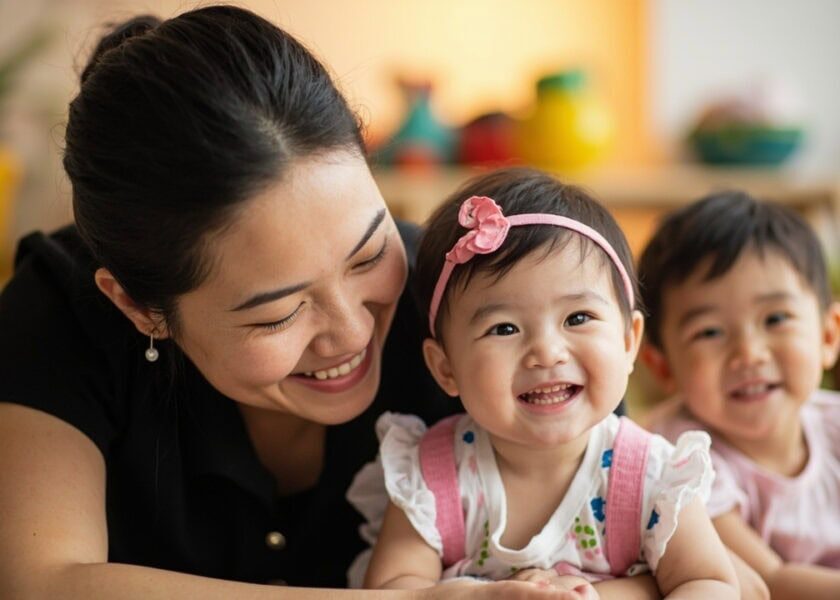
What Your Child Comes Home Telling You Every Day
The Silence at Six O’Clock
There is a particular quiet that fills a Singapore home at six in the evening. You have just returned from work. Your child has been in someone else’s care for the better part of nine hours. The door opens, and there they are—small, changed, full of a day’s worth of experiences you were not present to witness.
You kneel down. You ask how the day was. They offer you something partial—a three-minute monologue about a red ball, a song they learned, the way light fell through a particular window. And you find yourself holding all of this in your hands, wondering what it actually means.
This is not a failure of parenting. This is the universal condition of working parenthood in Singapore, and it is the starting point for understanding something most parents never learn: your child is speaking to you constantly. The question is whether you have the framework to hear them.
What follows is that framework. By the end of this article, you will know how to read your child’s daily homecoming as reliable evidence of what happened during those hours—and why the conditions that produce these signals matter deeply.
You Are Already Equipped to Know
No parent has a window into every hour of their child’s day. That is not the goal. What you can have is something far more powerful: the ability to read your child’s daily homecoming as reliable evidence of care quality.
What years of working with families and observing child development have taught us is this: quality childcare is observable. Not in grand moments, but in small, consistent signals that accumulate over weeks and months. Once you know how to look, you cannot unsee it.
Your child is not keeping secrets from you. They are communicating constantly—in behaviour and expression and the way their body settles when you walk through the door. You have always been equipped to hear them. This framework simply sharpens the lens.
When you pick up your child at the end of the day, four domains will tell you everything you need to know about the quality of care they received. Each one is observable. Each one matters. Together, they form a picture that no single daycare report or footage can replace.
The Four Observable Domains of Quality Care
1. Emotional Regulation at Homecoming
By far the most obvious signal—and the one most parents learn to read quickly—is emotional regulation. But let us be precise about what this means, because it is often misunderstood.
Emotional regulation does not mean the absence of all tears. Children cry. Children have hard mornings. Children sometimes protest at transitions. What it does mean is this: by the time your child reaches you, can they settle? Can they move through their big feelings and find their way back to equilibrium?
A child who has been in a responsive, consistent care environment will often show remarkable resilience by day’s end. They may have cried at drop-off. They may have struggled with a transition. But by homecoming, they have been soothed, soothed again, and soothed a third time by caregivers who understand that regulation is not a single event but a process.
When your child runs to you, settles into your arms, or begins to chatter about the day with a settled body—you are seeing the result of hours of co-regulation. That is not small. That is profound evidence of what happened in your absence.
What to watch for:
- Can your child calm down within a reasonable time after you arrive?
- Do they seem to have been held and comforted throughout the day, even when you were not there?
- Are big emotions still present but manageable, rather than overwhelming?
2. Language and Narrative
Here is where Singapore parents often underestimate their children. A child who has been in a rich, language-drenched environment will often come home with something to tell you.
Not just “I played.” But: “I played with the blocks and made a tower and it fell down and then I made it again.”
Not just “we sang.” But: “we sang the one about the wheels on the bus and then Mei-mei sang it wrong and everyone laughed.”
These details matter. They are not random. They are evidence that your child was present, engaged, and included in the social texture of the day. They were paying attention because something held their attention. They were participating because participation was welcomed.
A child who has been passively supervised—kept safe but not truly engaged—will often have very little to offer when you ask about the day. The silence is not necessarily a problem. It may be developmental. But a child who has stories to tell, who strings events into sequences, who connects their experience to people by name—this child is showing you something about the quality of their day.
What to watch for:
- Does your child offer spontaneous accounts of the day, not just responses to your questions?
- Are there details—names, colours, sequences of events—that suggest active engagement?
- Is your child interested in telling you about their experience, or do they seem disconnected from it?
3. Physical Ease
Watch how your child moves at homecoming. Not just whether they are tired—children tire after full days—but whether they are comfortable in their body.
Are they moving freely? Are they seeking physical closeness, or are they stiff, guarded, withdrawn? A child in excellent care will often come home with a particular kind of physical ease—a looseness in the shoulders, a willingness to be held that speaks to security. You will notice it in how they breathe more deeply.
You will also notice it in their sleep patterns. A child whose nervous system has been regulated all day will often fall asleep more easily at night. They are not carrying tension from unresolved stress. They have been tended to physically, not just supervised.
Conversely, a child who seems perpetually tense, who resists being touched or held after care—this is not automatically a sign of poor care. It can be developmental. It can be temperament. But it is worth paying attention to. It is worth asking whether the physical environment of care is supporting your child’s wellbeing.
What to watch for:
- Does your child seem physically comfortable in their own body at homecoming?
- Are they seeking closeness or seem guarded about physical contact?
- Is their sleep consistent, or are they perpetually overtired or restless?
4. Relational Confidence
This one is particularly telling. Observe how your child behaves with familiar adults at homecoming. Observe how they respond to a caregiver they know when that caregiver is still in view.
A child who has been in quality care will often show what researchers call secure-base behaviour: they will use the caregiver as a home base from which to explore, and then return to for connection. At homecoming, this might look like your child glancing at the caregiver with warmth, or calling out a greeting, or showing no anxiety at all about your arrival because they trust the transition completely.
More importantly, observe how your child responds to you. A child who has been securely attached throughout the day will often seek you out not in desperation but in quiet confidence. They will show you something. They will want to include you in their world.
That openness, that willingness to share space and experience, is one of the clearest signals that your child has felt held all day. They are not damaged by the separation. They are not anxious about it. They trust that you will return, and they trust the caregivers who hold them until you do.
What to watch for:
- Does your child show warmth toward familiar caregivers, not anxiety?
- Do they greet you with confidence rather than clinging desperation?
- Are they open to including you in their world, or seem shut down emotionally?
Reading Patterns Over Time
All of these signals exist on a spectrum, and not every signal points definitively to care quality. Children are individuals. They have bad days. They have developmental phases. A quiet evening does not automatically mean your child was neglected. A fussy afternoon does not automatically mean the caregiver was unresponsive.
What you have is not a checklist but a framework. Over time, across weeks and months, patterns emerge.
A single data point means very little. A consistent pattern of data points means everything.
This is where many parents go wrong: they look for one grand signal that tells them whether care is good or bad. But care quality reveals itself in accumulation—in the texture of your child’s days, in the gradual unfolding of trust and language and physical ease that you can observe if you know how to look.
| Observation | Normal Developmental Variation | Possible Care Quality Signal |
|---|---|---|
| Occasional difficult mornings | Separation anxiety phase, teething, tiredness | Persistent distress that never resolves during the day |
| Sometimes quiet after pickup | Overstimulated, hungry, tired from the day | Chronic disconnection from the day’s experiences |
| Selective storytelling | Normal memory limitations for their age | Complete inability to recall or engage with daily activities |
| Normal tiredness at end of day | Full day of learning and activity | Exhaustion that seems disproportionate to the day’s activities |
What to Do With What You See
If you are seeing positive signals—regulation, narrative, physical ease, relational confidence—trust them. That feeling you have is not just a feeling. It is data. Your child is confirming it every single day.
Noticing is not failure. Looking closely and finding cause for concern is not overreaction. It is the most responsible thing a parent can do. If you are seeing persistent patterns that worry you, consider these steps:
- Track the pattern. Is this a one-day observation or a consistent trend over weeks?
- Have a conversation. Speak with your caregiver directly about what you are observing. Quality providers welcome this dialogue.
- Observe the response. Does your concern create openness or defensiveness?
- Consider the fit. It may be that the environment is not the right match for your child’s temperament. That is simply a mismatch worth resolving.
Your child’s wellbeing is not a luxury. It is the priority that makes everything else possible.
How Quality Care Creates These Observable Results
If these four domains represent what excellent care produces, the question becomes: what creates those conditions in the first place?
At EduNanny, the observable signals you are learning to read are not accidents. They are the result of specific, intentional practices built around your child’s developmental needs.
Ratios That Allow for Genuine Attunement
You cannot attune to a child if you are responsible for too many. Attention is not a divisible resource. It requires presence, and presence requires time and space.
EduNanny maintains ratios that allow caregivers to know each child deeply—not just their name, but their rhythms, preferences, and subtle signals. When you drop your child at EduNanny, they enter an environment designed not just for their safety but for their recognition.
Caregivers Trained to Read Cues
EduNanny caregivers are early childhood professionals trained to understand that a child’s furrowed brow at three in the afternoon is not just fatigue but a signal about the pacing of the day.
They know how to co-regulate. They know how to match a child’s emotional state and gently guide them toward equilibrium. They do not simply supervise. They attune.
Language as Infrastructure
The research here is unambiguous: the first thousand days of a child’s life are when neural pathways are laid down at their fastest rate, and language exposure during this period has measurable, lasting effects on cognitive development.
EduNanny builds every day around language-rich interaction: conversations with infants, narration of activities, singing, rhyming, responding to babbling as if it were the most important communication in the world. Language is not treated as a luxury. It is treated as infrastructure.
Physical Wellbeing as Development
A child’s body is not separate from their development. It is their development. Nutrition, sleep, movement, outdoor time where possible—these are tended to with the same attention given to cognitive stimulation.
When you pick up your child from EduNanny and notice that settled physical ease, that looseness in their shoulders, that ease in breathing—it is because their bodies have been tended to all day.
Communication That Empowers Parents
EduNanny documents the day and shares observations. Transparency is one of the most powerful antidotes to parental doubt.
We want you to know what happens during those hours because there is something meaningful to share. We invite you to test us against the framework you have just learned.
The ECDA Childminding Pilot: A National Commitment to Quality
EduNanny operates within the ECDA Childminding Pilot, which means we are part of a deliberate national effort to provide Singapore families with flexible, high-quality care that respects both the developmental needs of children and the practical realities of working parents.
We offer home-based and community-based pathways because families are not uniform, and neither are their needs. Some children thrive in a home environment that mirrors the intimacy of family. Others benefit from the richer peer environment of a centre setting. We do not believe in a single correct answer. We believe in matching families with the right fit.
EduNanny’s fee structures are designed to be accessible within the pilot framework. We accept CDA and Baby Bonus, which means for many families the cost of care is a planned, manageable investment rather than a barrier. Monday to Friday care blocks align with the realities of working parenthood.
We are not simply offering a service. We are offering a structure that acknowledges the full context in which Singapore families are raising their children.
Your Child Is Speaking. Are You Ready to Listen?
Here is what we want you to carry with you from this article.
You are not passive. You are not waiting for reassurance to arrive like a gift you hope someone will give you. You are equipped. You have always been equipped.
Your child is speaking to you every single day, in a language made of behaviour and expression and the way they hold their body when you walk through the door. And now, with this framework, you have the means to hear them clearly.
This is what quality childminding deserves: a parent who is paying attention. Not anxious attention, not hypervigilant attention, but the steady, informed attention of someone who knows what they are looking for.
And this is what EduNanny offers: care that invites observation. Care that is accountable to the child, to the parent, and to the standard of what children actually need to thrive in their earliest years.
We do not ask you to trust us blindly. We ask you to watch. To listen. To notice.
Observe EduNanny in action. Ask us about our caregiver training. Ask us about our ratios. Ask us about how we document and communicate the day.
Then go home and watch your child. Listen to their stories. Notice how their body moves. See how they respond when you walk through the door.
That is the test we welcome. That is the evidence we trust.
And when you do—when you see regulation and narrative and physical ease and relational confidence reflected in your own child’s behaviour—we hope you will feel something deeper than reassurance.
We hope you will feel the quiet, certain knowledge that comes from evidence: that your child is in the right place. That they are known. That they are safe. That they are growing.
The silence at six o’clock does not have to be a wondering. It can be a confirmation. Your child has been telling you about their day all along.
Now you know how to hear them.
EduNanny is a Singapore-based childcare and childminding service committed to responsive, development-focused care. Connect with us to learn about our placements, our approach, and how we can support your family. You can also learn more about EduNanny and what we stand for.