What Your Child Actually Feels in Singapore Quality Childcare
The Invisible Hours: Understanding What Your Child Actually Feels in Quality Childcare
There is a particular moment at pickup that every parent in Singapore knows.
You arrive. You see your child. And you spend those first few minutes reading a face like it is the most important document you have ever held. You are looking for something. A smile, a frown, a cling, a run toward you. You are trying to understand what those hours felt like from the inside — for a person who cannot yet tell you in words.
You will never be inside those hours. Not really. That is the nature of this act of love and trust that you have undertaken, and it is worth naming clearly: the hours your child spends in childcare are largely invisible to you. You make the decision. You pay the fees. You read the signals at pickup. You build partnerships with caregivers. But your child’s full experience — the sensory world, the emotional texture, the inner life unfolding in your absence — remains unseen.
And yet, it is the thing you care about most.
This article describes that invisible world with care and honesty. Not because you can ever fully step inside it, but because understanding what it is designed to feel like changes how you choose, how you trust, and how you rest at night knowing your child is somewhere you cannot watch.
The Sensory World: Where Your Child’s Day Actually Begins
When your child walks into a quality childcare environment in Singapore — whether a home-based setting, a community space, or a centre-based programme — the first thing that meets them is not a lesson or a schedule. It is a sensory world.
The quality of the light. The temperature. The sounds: not just voices, but the particular acoustic texture of a space designed for small ears and developing nervous systems. The smell of a clean but not antiseptic environment. The feel of materials that are warm to the touch, varied in texture, sized for hands that are still learning what things are for.
Your child does not think about these things. They feel them — the way you feel when you walk into a home that is calm versus a home that is frenzied, even before anyone speaks. For a young child, whose sensory systems are still the primary way they understand the world, this environment is not background. It is the experience.
In quality care, this sensory world is not accidental. It is considered. The rhythm of the day — when there is music, when there is quiet, when there is movement, when there is stillness — is the emotional architecture of the child’s day.
Why Rhythm Is Your Child’s Emotional Architecture
For a child, rhythm is not just routine. Rhythm is the thing that tells their nervous system: this is safe, this is predictable, I know what comes next, I can relax into being here.
When your child knows that after snack time comes story time, and after story time comes outdoor play, they are not just following a schedule. They are building an internal sense of security. They are learning that the world can be trusted to be consistent. That the adults around them have thought about what they need.
This is the foundation of everything else — not just comfort, but the emotional space to grow. A child whose nervous system is calm can explore. A child who feels safe can be curious. A child who trusts the rhythm of their day can put their energy into learning, not into managing fear.
For parents in Singapore, this has practical meaning. Many families live in apartments where indoor space is limited, where outdoor play is not always accessible, where the rhythm of the day can feel dictated by logistics rather than development. Quality childcare fills that gap — not with screen time or worksheets, but with a deliberately constructed daily architecture that your child’s body and mind can rely on.
The Caregiver: Your Child’s First Relationship Outside the Family
Now let us talk about the most important person in that invisible world: the caregiver.
Not the idea of a caregiver. The actual person. The one whose face your child learns to recognize before they learn to say her name. The one whose voice is the first thing that registers, sometimes even before your child registers yours, because she is the one who is there in the morning when the world feels new and uncertain.
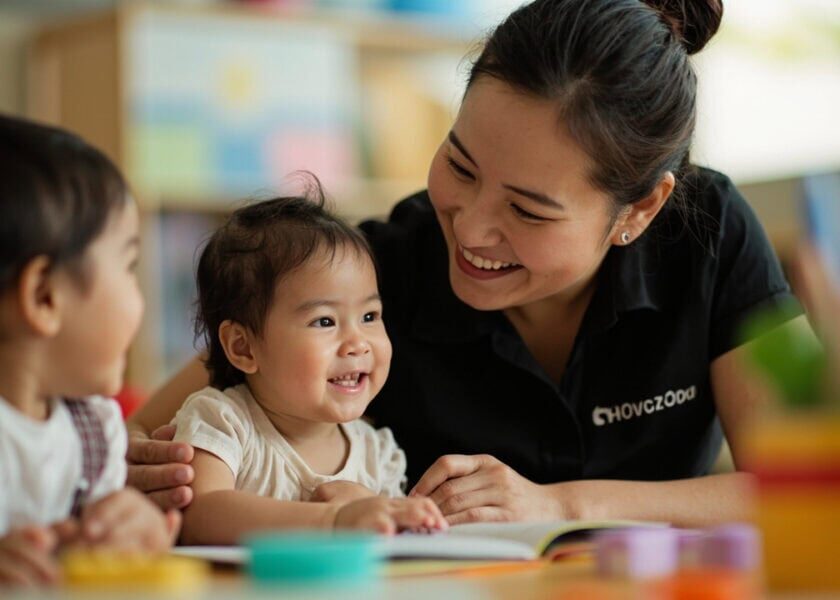
The bond between a young child and their primary caregiver in quality childcare is not a professional arrangement. It is a relationship — in the full and developmental sense of the word.
From Stranger Anxiety to Secure Attachment
It begins, for every child, with stranger anxiety — that very real, very appropriate fear that humans are born with, which tells a baby that this new person is not yet safe. This is not something to push through quickly or dismiss. It is a sign of healthy attachment systems. Your child is meant to be cautious with new people. It means their emotional architecture is working as designed.
What quality care does is create the conditions for that anxiety to dissolve — not by rushing it, but by being consistently present. By being warm. By responding when the child cries, rather than waiting for them to stop. By showing up again and again in the same way, until the child’s nervous system accepts what their words cannot yet say: this person is safe, this person will be here, I can let myself be held by this relationship.
Over days and weeks, you begin to see the evidence of this shift:
- A child who once cried at drop-off begins to look toward the caregiver when you leave.
- A child who was watchful and withdrawn begins to explore.
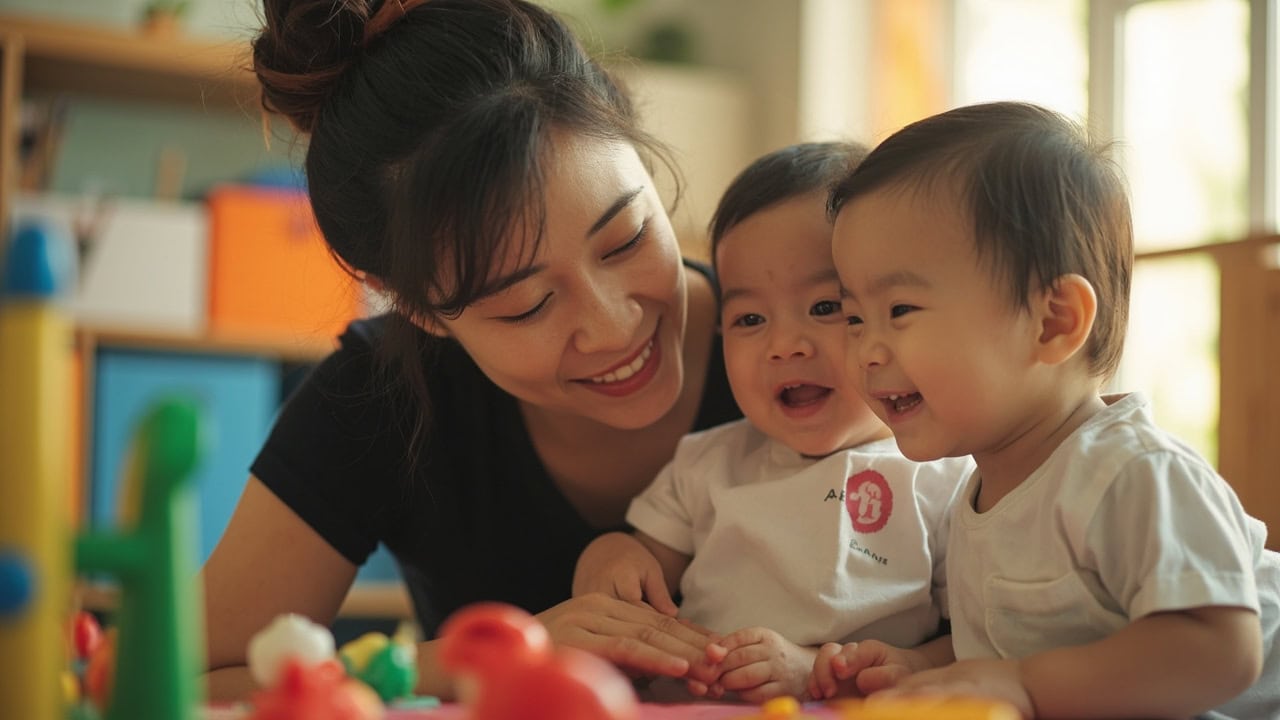
- A child who was uncertain begins to laugh.
These are not just emotional moments. They are developmental milestones, signs that the child is building the internal working model of what relationships feel like — a model that will shape how they trust, how they attach, how they love, for the rest of their lives.
Over time, as this emotional security deepens, something else begins to emerge. Your child stops simply tolerating childcare. They begin to look forward to it. They develop preferences — for a particular toy, a particular song, a particular caregiver. They begin to talk about the day in the fragments that toddlers and infants offer: a word, a gesture, a name. They begin to extend the trust they have built in the childcare relationship to other children, to other adults, to the wider world.
This is the arc: from stranger anxiety to confident familiarity. From uncertainty to security. It is built in the small, ordinary moments of a thousand mornings, in the consistency of the same face, the same rhythm, the same warmth.
Signs You Can Recognise as a Parent
- Watch the goodbye. If your child is old enough, notice how they wave to you now. Is it something that looks less like fear and more like trust?
- Listen for names. Do they speak about the caregiver? Do they reach for her when they are upset?
- Observe the play. How do they use dolls or stuffed animals at home? Do they feed them, put them to bed, return to them? These are the rituals of care being internalised.
These are the signs of a thriving inner world. Not manufactured happiness. Not the absence of all difficulty — because children will still have hard moments, still have days when separation is hard. But a child who is genuinely secure in their care environment carries something quiet and real with them. A confidence. A curiosity. A sense that the world, or at least this corner of it, is reliable.
Being Held vs. Being Cared For
There is a difference — and it is an important one — between a child being cared for and a child feeling held.
Caring for a child means meeting their physical needs. Feeding them, changing them, keeping them safe from harm. Any environment can do this, in theory.
Feeling held is something else. It means the child’s emotional experience is being witnessed. It means that when a child is frustrated, someone names what they feel and stays with them in it. It means that when a child is curious, someone follows their lead and deepens their engagement. It means that when a child is tired, the rhythm of the day shifts to meet them where they are, rather than demanding they keep pace with a group.
This is what meaningful engagement looks like from the inside. It is not children sitting passively, being watched. It is children being met — in their interests, their developmental stage, their emotional state — and supported to grow from that real, individual place.
It is play that is not just fill-time, but the substance of learning. For a young child, play is not a break from real work. It is the work. Through play, a child explores cause and effect, builds language, tests social boundaries, and makes sense of their world.
When you see a child at pickup who is flushed from running, whose hands are stained from paint or dough or soil, whose face carries the particular brightness that comes from genuine engagement — you are seeing the residue of being held. Of having spent the day in a place that understood what they needed and gave it to them.
What Quality Childminding Actually Looks Like
If you are researching infant care in Singapore, you deserve clarity about what quality looks like in practice — not just in philosophy, but in the daily decisions that shape your child’s experience.
Quality childminding is not defined by fancy facilities or impressive curricula. It is defined by the attention given to the invisible world we have been describing: the sensory environment, the daily rhythm, the caregiver relationship, the quality of engagement.
The Elements That Matter
- Small group ratios. For infants, a one-to-three ratio means the caregiver can be fully present with your child — responsively, humanly present — rather than stretched across too many small lives.
- Consistent caregiver relationships. The same faces, day after day. Not a rotating cast of strangers, but the relational continuity that allows your child to build from yesterday’s trust into today’s exploration.
- Intentional daily rhythm. Predictable sequences that signal safety to your child’s nervous system. Not rigid schedules, but reliable flows that children can internalise.
- Responsive engagement. A caregiver who notices when your child is frustrated, curious, or tired — and meets them there, rather than maintaining a one-size-fits-all pace.
- Developmental respect. Understanding that infants and toddlers learn through sensory experience and play, not through worksheets or structured lessons.
What Transparency Looks Like
You should not need to trust blindly. Look for environments where communication keeps you connected to your child’s day — where what is happening in those invisible hours is not fully invisible. Where you can know what your child feels, because the environment has worked to make sure you can see what your child does.
Addressing What Parents Actually Worry About
“Will my child feel abandoned?”
This is the fear that lives beneath every drop-off, and it deserves a direct answer. In quality care with consistent, warm caregivers, children do not feel abandoned. They feel, gradually and then completely, that this new place is safe.
The stranger anxiety you see at the beginning is not a sign that your choice is wrong. It is a sign that your child’s attachment systems are working correctly. What you are watching, in those early weeks, is the first chapter of a longer story — one that, with consistent care, ends in your child looking toward their caregiver with trust when you leave.
“How do I know what’s actually happening all day?”
This is a fair question, and the answer is not “trust us blindly.” The answer is: look for the signs, over time. Watch the arc. Notice if your child is building preferences, expressing affection for the caregiver, playing out rituals of care at home. These are not guarantees, but they are evidence.
“Am I failing my child by needing childcare?”
You are not failing your child by needing care. You are not choosing childcare over your child. You are making a decision that millions of parents make every day, with love, with hope, and with the best information you have.
The research on child development does not suggest that quality childcare harms children. It suggests that quality matters — and that is exactly why understanding what quality looks like matters so much.
“What if my child has a hard day?”
Children will have hard days. This is not a sign that care is failing. It is a sign that your child is human, with a full emotional range. What matters is not the absence of hard moments, but the presence of a caregiver who witnesses them, stays with your child in them, and helps your child feel held even in frustration or sadness.
A child who has occasional hard days but consistently feels safe, seen, and held is a child who is developing properly.
For Parents Who Are Still Deciding
If you are reading this while your child is still in your arms, if you are weighing options, if you are caught between the desire to return to work and the ache of that first separation — this is for you.
The fact that you are reading an article like this, trying to understand what your child will feel, what quality looks like from the inside — that fact tells me something important. You care deeply. You are not rushing into this. You want to get it right.
That instinct — to understand before you choose — is exactly what quality childcare providers want to see in parents. Because it means you will notice the things that matter. You will read the pickup face. You will watch the arc over weeks and months. You will ask the questions that keep caregivers honest.
Choosing childcare is not about finding a place that will replace you. It is about finding a place that will partner with you — that will be inside those invisible hours with your child, doing the same work you are doing at home: building security, fostering curiosity, helping your child feel held.
When you find a place that understands this, you will know. Not because your child never cries at drop-off — that takes time. But because the caregivers speak about your child as a person, not a schedule. Because they notice what your child is interested in, what makes them laugh, what they need more of and less of. Because they treat your child’s inner world as something worth understanding.
Understanding this invisible world — and building around it — is the reason EduNanny Singapore exists.
EduNanny operates within the ECDA Childminding Pilot, part of a deliberate national effort to recognise childminding not as a stopgap or a convenience, but as a form of care that deserves structure, quality, and support. We are committed to standards that are not just regulatory, but developmental — because we understand that what happens in these early years, in these invisible hours, shapes the trajectory of a human being.
EduNanny offers pathways that serve the realities of Singapore families. Whether home-based, community, or centre-based, we have designed our approach around what children actually need and what parents actually face:
- Up to a one-to-three infant ratio means that your child’s caregiver is not stretched across too many small lives. She can be present — fully, responsively, humanly present.
- Monday to Friday care blocks mean that families have the consistency they need to build the rhythms that matter.
- Affordability within pilot fee structures, with the ability to use CDA and Baby Bonus, means that this quality of care is not reserved for those who can pay premium rates. It is for every family that needs it.
Tonight, when you pick up your child, watch their face again. Watch the way they move. Notice what they carry with them from those hours you were not inside.
And know that somewhere beneath what you can see, there is a world being built — a sensory world, an emotional world, a world of rhythms and relationships and growing security.
That world is not invisible by accident. It is invisible because your child lives inside it, and because you love them enough to trust that it is good, even when you cannot see it.
Our work at EduNanny is to make that world worthy of your trust. To build it with intention, with warmth, with the deepest respect for what your child feels and needs. To be the ones who are inside those hours with your child — not just caring for them, but holding them.
Day after day. Until they no longer need us to, because we have given them the security to walk confidently into the world.
That is what quality childminding is. That is what EduNanny is.
And that is what your child deserves.
Learn more about who we are or get in touch to begin the conversation about your child’s care.