What Your Parents Really Wanted in Your Childcare Decision
That Quiet Moment Before the Decision
There is a moment, quiet and rarely spoken, that happens in many Singapore homes before the childcare decision is even made. It is the moment a parent pauses—childcare centre brochures in hand or search results open on a phone—and thinks not about curriculum or ratios or facilities, but about their own mother. Their father. The grandmother who raised them.
It is the moment of wondering whether choosing something different, something new, means turning away from everything those people gave them.
If you have felt that, I want you to know something. You are not alone. And you are not wrong.
Beneath every childcare search, every centre visit, every conversation with a spouse about arrangements, there is often a deeper question—one that has nothing to do with curriculum frameworks or developmental milestones. The deeper question is this: Am I honoring my family by choosing this? Or am I betraying it?
That question lives in the space between generations, and it is heavy. In Singapore, family is not just who you go home to—it is the architecture of how children are raised, who feeds them, who sings them songs, who teaches them which grandparent they are named after and why that matters. The extended family is not a footnote in a child’s life. It is part of the story.
This article offers you validation, a reframe, understanding, clarity, and ultimately, confidence—that your choice, made with love, is the right one for your family.
When Every Search Carries the Voice of Your Mother
When we speak about Singapore’s childcare landscape, we often speak in numbers. Infant-to-caregiver ratios. Centre capacities. Subsidies and eligibility. Curriculum frameworks and developmental outcomes. All of this matters.
But it is not where most parents actually begin.
Most parents begin with a feeling—a feeling shaped by their own upbringing, by the specific textures of their family life, by the voice of their mother or mother-in-law that lives somewhere in the back of their mind. By the photographs on the wall and the recipes passed down and the way certain things were done because that is simply how they were done.
In Singapore, this is not sentimentality. It is inheritance. And it is deeply held.
For many families, grandparent involvement in childcare is not just common—it is expected. Grandparents offer their time, their experience, their presence. They offer continuity across generations in a way that feels irreplaceable.
And so when a parent today considers quality childcare—when they walk into a centre, or meet a caregiver, or read about an approach that differs from how they were raised—there is a reckoning that happens. Not with the childcare provider. Not with the system. But with something inside that says: What will they think? What will my mother say? What does it mean that I am choosing this for my child when no one chose this for me?
The Fear That Is Really Love
There is fear in that. Fear of judgment. Fear of disappointing the people who have given so much. Fear of being seen as a parent who does not trust family, who has been swayed by modern ideas, who is somehow abandoning the village in favor of something cold and institutional.
These fears are not vanity. They are love wearing a worried face. They are the way care for your own parents and grandparents becomes tangled up with care for your child.
And so parents wait. They delay the search. They tell themselves they will figure it out, that grandparent care has worked for generations, that they are perhaps overthinking it.
Some parents carry guilt before they have even made a decision—rehearsing justifications for a choice they have not yet made, preparing to defend something that does not need defending.
If this is where you are, let me say something clearly: the fact that you feel this weight is not a sign that you are doing something wrong. It is a sign that you care enormously about getting this right. It is a sign that you understand that childcare is not just logistics—it is identity. It is legacy. It is the place where family stories continue or diverge.
The Tradition Is the Love, Not the Method
Here is where I want to offer a different way of seeing this. Because the tension you feel—between tradition and modernity, between your family’s way and your child’s future—is not a problem to be solved by choosing one over the other. It is a doorway into something deeper. And what lies on the other side might surprise you.
Consider for a moment what your parents and grandparents actually wanted for you. Not the specific methods, not the exact routines, not the particular foods or songs or ways of soothing. But the core. The heart of it.
What were they actually trying to give you?
They were trying to give you safety. Protection. The feeling that you were seen, that someone knew you, that you belonged to people who would not let you fall.
They were trying to give you confidence—confidence built from being responded to, being held, being told you mattered. They were trying to prepare you for a world that would ask much of you, and to give you the foundation to meet it.
They wanted you to be loved. To be known. To be ready.
That is not just what your family wanted for you. That is what families have wanted for children across every generation, in every culture, in every form of care that has ever existed. Love. Attention. Development. The sense that you matter.
The values your family raised you with are not in opposition to quality childcare. They are precisely what quality childcare is trying to honor.
The tradition is not the method. The tradition is the love. And the love does not belong to one decade, one arrangement, one specific set of hands. The love is the part that travels.
Singapore’s Changing Context Does Not Mean Abandoning Tradition
In Singapore, the decision to use formal childcare is made in a society where multigenerational households are common, where grandparents often play a central role in children’s lives. Singapore families have a particular way of raising children together, and it is beautiful, and it works for many families.
But it is also true that Singapore is changing. Parents today are often working longer hours, navigating different careers, living in different arrangements than their parents did. The pressures are different. The options are different. And what was available to your parents is not always what is available to you—or what fits the life you are actually living.
This is not a failure. This is adaptation. This is what every generation does: they take what was given to them, they look at what their children actually need, and they make choices that reflect both.
Your parents made choices that were right for their time. You are making choices that are right for yours.
That is not abandonment of tradition. That is what it means to carry a tradition forward—to tend it, to grow it, to let it bear fruit in new soil.
You are not the first person in your family to navigate change. You are continuing a long line of people who adapted, who chose, who did their best with what they had.
What Quality Childminding Actually Looks Like
There is another fear that lives beneath this conversation, and it deserves to be named too. Many parents worry that choosing quality childcare outside the family means their child will somehow lose something essential—that they will not learn family culture, that they will not carry forward the language or the stories or the particular warmth of who they come from.
I understand this fear. It comes from a real place, and it is rooted in genuine love for your family and your child’s identity within it.
But I want to gently push back on it, because it underestimates both what family identity is and what quality caregivers actually do.
Family Identity Is What You Create, Not What You Delegate
Family identity is not primarily about who feeds your child breakfast. It is about:
- What your child hears in the stories you tell at bedtime
- The names you call them
- The family photographs you point to and say, “That is your great-grandmother, and she worked so hard so that we could be here.”
- The festivals you celebrate
- The food you share
- The values you discuss
It is about the thousand small moments of belonging that you create as a parent—not the hours of care during the workday.
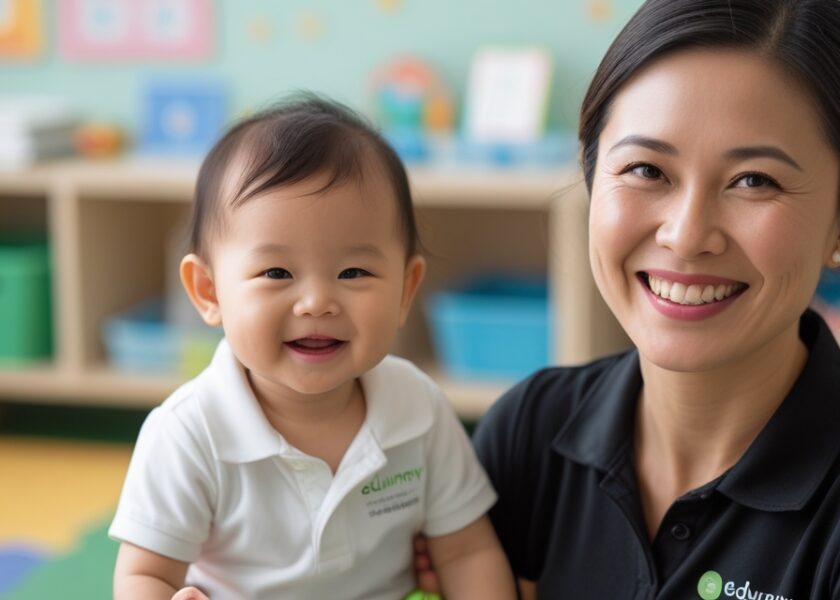
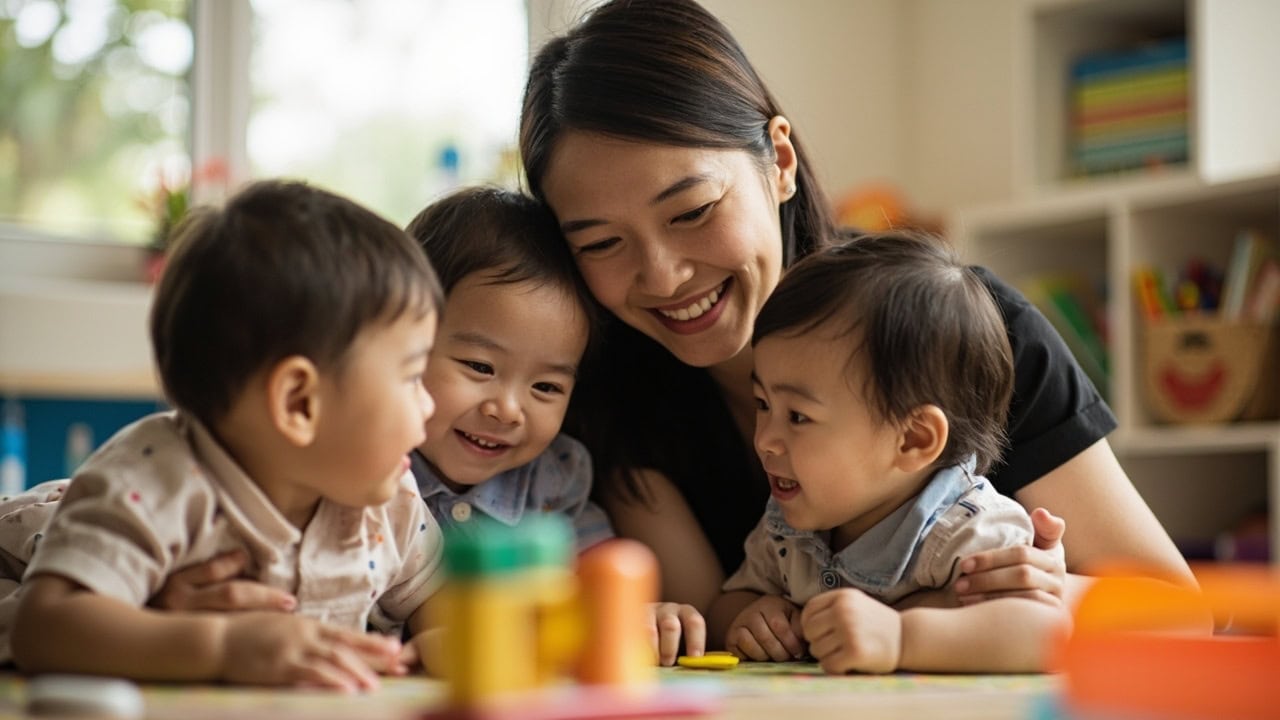
A quality caregiver does not replace that. A quality caregiver is an extension of your family’s care during the hours you are not there. Not a replacement for your family, but a complement to it. The best caregivers ask about your child’s routines, your family’s preferences, the words you use at home. They learn your child’s specific laugh, your child’s particular fears, the thing that always makes them calm.
Trained Caregivers Transmit Warmth
The idea that trained caregivers cannot transmit warmth, belonging, and culture misses something important about what caregiving actually is.
A skilled caregiver is someone who has learned how to be genuinely present to a child, how to respond to a child’s needs, how to create the conditions for a child to feel safe and seen. That is not a technical skill. That is a human one. The training just makes it more reliable, more consistent, more attuned.
Your child can have a grandmother who sings them the songs you grew up with, and a caregiver who holds them with warmth during the day, and still know exactly who they are and where they come from.
The Markers of Quality You Can Look For
When evaluating care options, here is what matters most:
Small caregiver ratios. For infants, the quality of care is intimately connected to how many children each caregiver is responsible for. When ratios are low—ideally one caregiver for every two or three infants—each child receives the attention they need. Those first thousand days are about building the foundations of trust, of language, of emotional regulation. That requires presence. It requires attunement.
Transparent communication. Parents need to know what is happening with their child during the day—not in a way that creates anxiety or constant interruption, but in a way that builds trust and keeps the connection between home and care alive. Regular updates, thoughtful handover notes, the ability to ask questions and receive honest answers.
Family partnership. Quality care means caregivers who ask about your family’s preferences, who learn your child’s specific needs, who see themselves as an extension of your family’s love rather than a separate system.
EduNanny: Designed for This Moment
EduNanny by BUTLER is part of the ECDA Childminding Pilot, and that matters because it means the programme has been designed with attention to Singapore’s specific context. The pilot offers both home-based and centre-based pathways, because families are not all the same, and the right fit depends on your particular circumstances, your child’s particular needs, and what works for your household.
For infants, EduNanny maintains ratios of up to one to three, which means your child receives the kind of individual attention that is so important in those early years. The pilot structure also means that fees are designed to be affordable, and that families can access support through mechanisms like the Child Development Account and Baby Bonus where applicable.
Quality care should not be available only to families with unlimited resources. Every child deserves attentive, warm, developmentally informed care, and the pilot is designed with that principle in mind.
Communication is something EduNanny takes seriously. Parents need to know what is happening with their child during the day—not in a way that creates anxiety or constant interruption, but in a way that builds trust and keeps the connection between home and care alive.
For parents navigating the questions and decisions that come up—not just before enrollment, but throughout the journey—EduNanny offers support that feels present and thoughtful. Parenting is not a problem to be solved once. It is an ongoing conversation, and finding the right support matters.
Addressing Your Real Concerns
Even with all of this said, you may still have questions. That is reasonable. Let me address some of the most common concerns Singapore parents share.
“What if my parents are hurt by this choice?”
This concern is rooted in love—for your parents, for your child, for the relationships that matter to you. The answer is not to avoid the choice but to approach it with care. Many families find that once grandparents understand the quality of care being provided, and once they see the child’s happiness and development, the initial concern transforms into trust.
Some grandparents, freed from the physical demands of full-time childcare, find they can enjoy their grandchildren in a different way—as playmates, as storytellers, as the ones who share Saturday mornings and festival traditions.
“Will my child forget where they come from?”
Your child will not forget your family because they spend time in quality childcare. Your child will not forget your family’s language because they also hear other words.
Children are remarkably capable of holding multiple sources of love, multiple traditions, multiple ways of being in the world. What they need is consistency, warmth, and the sense that they belong. You provide that. Your extended family provides that. And quality caregivers can be part of that too.
“What if I can’t afford quality care?”
This is a practical concern, and it deserves a practical answer. Subsidies, schemes like the Child Development Account, and pilot programmes designed with affordability in mind mean that quality care is increasingly accessible.
The right question is not just “Can we afford this?” but “What is the value of the foundation we are building for our child?” That foundation—in trust, in language, in emotional regulation—pays dividends that extend far beyond the early years.
Your Decision, Made With Love
Let me offer you a simple framework for thinking about your childcare decision—one that honors both your love for your family and your love for your child.
Ask yourself: What did my parents actually want for me?
Not the specific methods. The heart of it. The safety. The attention. The preparation for a world that would ask much of me. The sense that I mattered, that I was known, that I belonged to people who would not let me fall.
Now ask: Is this choice I am considering—quality childcare, with trained caregivers who see my child as a whole person—does it move toward that vision or away from it?
If you are considering care that is warm, attentive, developmentally informed, and designed to see your child as someone worthy of everything good—then you are not betraying your family’s wisdom. You are fulfilling it.
You are saying: I see what my parents gave me. I want that same care, that same warmth, that same attention for my child. Not despite my love for my family, but because of it.
The very qualities that make this decision difficult are the qualities that will make you a wonderful parent. The fact that you care so much. The fact that you are willing to feel the tension rather than dismiss it. The fact that you are searching for something that is truly good for your child, and not just something that is easy or familiar or free from judgment.
Your parents raised you with everything they had. They made mistakes and they got much more right than wrong, because you are here, and you are the kind of person who sits with brochures feeling the weight of what love requires.
That is their legacy. That is what they gave you.
Now you are raising your child with everything you have. You are making choices they did not have to make, navigating a world that is different from the one they knew, and doing it with the same love at the center, even when the details look different.
That is not a departure from what they gave you. That is the continuation of it.
Quality childcare is not a rejection of family wisdom. It is the way family wisdom travels forward into a new time.
You are not abandoning your roots. You are planting new ones.
And the tree that grows from that planting will have roots that go down deep—into your family’s love, into your own choices, into the hands of caregivers who see your child as someone worthy of everything good.
That is the decision you are making.
And it is a good one.
If this article has resonated with you, and you are ready to explore what quality childminding could look like for your family, we are here to walk this road with you.
EduNanny offers both home-based and centre-based pathways through the ECDA Childminding Pilot—designed for Singapore families, built with attention to what infants and young children actually need, and priced to be accessible.
Whether you have a specific question or simply want to understand your options, our team is ready to listen. You have carried the weight of this decision with love. Let us help you find clarity.
Learn more about EduNanny and the principles behind our approach.