What Your Baby Feels When You’re Not There
Will My Child Feel Safe? The Question Every Parent Carries Into Childcare
There is a moment, perhaps just before your child’s first morning at a new care arrangement, when the weight of what you cannot see settles heavily on your chest. You look at your child — small, trusting, entirely unaware of what the next few hours will hold — and something inside you asks a question you may not even have words for yet.
It is not really about schedules or routines or whether the caregivers will follow your instructions. It goes deeper than that. It is a question about experience. About what it will feel like inside your child’s skin when you are not there to explain, to comfort, to make sense of the world.
Will it feel like safety? Or will it feel like something else — something you are not willing to name but cannot stop imagining?
This is the question that lives beneath the surface for every parent who entrusts their child to professional care. And it is the right question to ask.
What Your Child Actually Feels in Those First Weeks
Before we talk about ratios and regulations, before we explain approaches or describe caregivers, we want to take you somewhere important. We want to go, together, into your child’s inner world.
Because understanding what happens there — what children actually feel when they enter quality care, how their hearts and minds respond to new faces and unfamiliar rooms — is the foundation upon which every other decision rests.
The Internal Working Model: Your Child’s Invisible Foundation
Children are far more emotionally aware, far more tuned in to the people around them, far more affected by the quality of care they receive than we have historically given them credit for. Your infant does not have the words to tell you what she notices. But she notices everything.
Developmental psychologists call this the internal working model: the mental template a child develops for what relationships feel like, built from every interaction in the first years of life. Think of it as your child’s first mental map of how the world works emotionally.
She notices the tone of voice a caregiver uses when she fusses. She notices whether the arms that pick her up feel steady or hurried. She notices, in ways that will not show up as measurable data for years, whether the person caring for her is genuinely present or performing the motions of care.
When that template is built on consistency, warmth, and responsiveness, children develop secure attachment — a quiet, unshakable sense that they matter, that their needs will be heard, and that the people around them can be relied upon.
You are not sending your child into a void. You are placing them into an environment that will — for better or worse — teach them something profound about what it means to be human.
Separation Anxiety: Why It’s Not the Problem You Fear
Let us paint a picture. You are three years old. You have been brought to a room you have never seen before, filled with toys that do not belong to you and faces you do not know. Your parent — your whole world, the person who makes everything safe — has just disappeared through a door.
This is not weakness. This is your child’s brain working exactly as it was designed to work. Separation anxiety is not a problem to be medicated away or trained out. It is evidence of a healthy attachment system — your child’s proof that they love you, that you matter, that losing you would be catastrophic.
Here is an important reframe: the children who show no distress at separation are not the most secure children. They are often the children who have learned, through experience, that their distress does not bring reliable comfort. Their apparent calm is not peace — it is protection.
What Quality Care Does With Distress
So what does a quality care environment do with this distress? It does not ignore it. It does not let your child cry until they stop, as if the silence of resignation is the same as the peace of security.
Instead, it meets the distress with presence. It says, in every language available — voice, touch, facial expression, consistent routine — we see you. We know this is hard. You are not alone in this feeling, and we will stay with you until you feel ready to explore again.
When a caregiver does this consistently over weeks and months, something remarkable happens. The child’s nervous system begins to calibrate. It learns, through lived experience, that difficult feelings can be survived, that comfort is available, that the world contains people who will respond when they call.
This is the neurological process by which children develop the capacity for emotional regulation — the ability to feel big feelings without being overwhelmed by them, to recover from setbacks, and to approach new experiences with curiosity rather than fear.
The Brain Building Itself for a Lifetime
The neural pathways being formed in these early years — the connections between the emotional centers and the thinking centers, the patterns of response and recovery — will be drawn upon again and again throughout childhood and beyond.
Emotional security in early care lays the groundwork for:
- Confidence — the quiet assurance that they can handle new situations
- Resilience — the ability to bounce back from disappointment and frustration
- Healthy relationships — the template for trust, intimacy, and connection
- Willingness to take thoughtful risks — the courage to try, fail, and try again
Are Your Child’s Tears Normal — or a Warning Sign?
You are wondering whether those tears at drop-off are normal — a passing phase to be weathered — or a sign of something deeper. You are wondering whether your child will eventually seem okay because they have truly processed the transition, or simply because they have learned to hide their distress from adults who do not seem able to help with it.
These are not the questions of a nervous or overprotective parent. These are the questions of a parent who cares about what is actually happening inside their child.
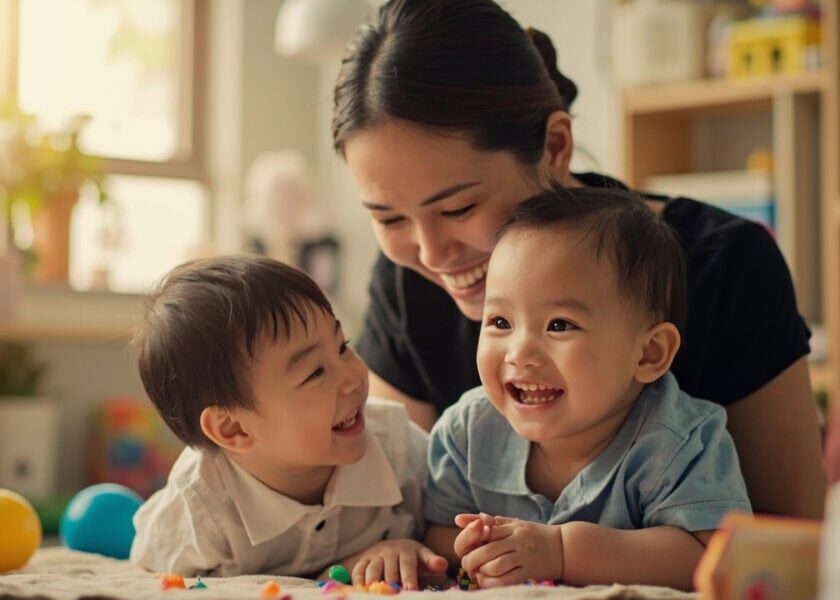
In a quality care environment, those tears are acknowledged. Your child is not left to cry alone. A caregiver sits with them, or holds them, or simply stays close enough that your child can feel their presence while the storm of emotion moves through them.
Within minutes, your child begins to settle. They look up. They notice a toy. They allow themselves, tentatively, to become interested in something. This is not a child who has given up. This is a child who has received the message that they are safe, that the caregiver is trustworthy, that they can survive this.
Contrast this with an environment where tears are met with dismissal, prolonged isolation, or the cold reassurance that the child will stop crying eventually. That child may indeed stop crying. But what they have learned is not security. They have learned that their feelings are too big for the adults around them, that they must manage on their own, that vulnerability is not safe.
This is the invisible curriculum of poor quality care, and it is taught not through words but through the texture of daily experience.
What Quality Care Actually Looks Like
Let us be specific. What does the difference between adequate and excellent care actually look like when you are making decisions for your infant in Singapore?
Signs of Quality Emotional Care
- Responsiveness over speed: Caregivers who take time to respond to your child’s cues rather than rushing through tasks
- Warm physical presence: Holding, rocking, and gentle touch that goes beyond what’s necessary for feeding and changing
- Voice and eye contact: Caregivers who speak to infants as if they are real people with real thoughts and feelings worth acknowledging
- Consistent routines: Predictable rhythms that help children know what comes next — a cornerstone of early security
- Calm during distress: Caregivers who remain centered and warm when a child is upset, rather than becoming frustrated or dismissive
- Respect for individual temperaments: Recognition that every child settles differently and that there is no single “right” way to adjust
Why Home-Based Care Can Be Particularly Suited to Emotional Development
In a home environment — as opposed to a large institutional setting — your child does not enter an institution. They enter someone’s home. This matters in several ways:
- Scale: A space organized around the needs of a small number of children, not the logistics of a large operation
- Warmth: A domestic setting with the textures and rhythms of real daily life
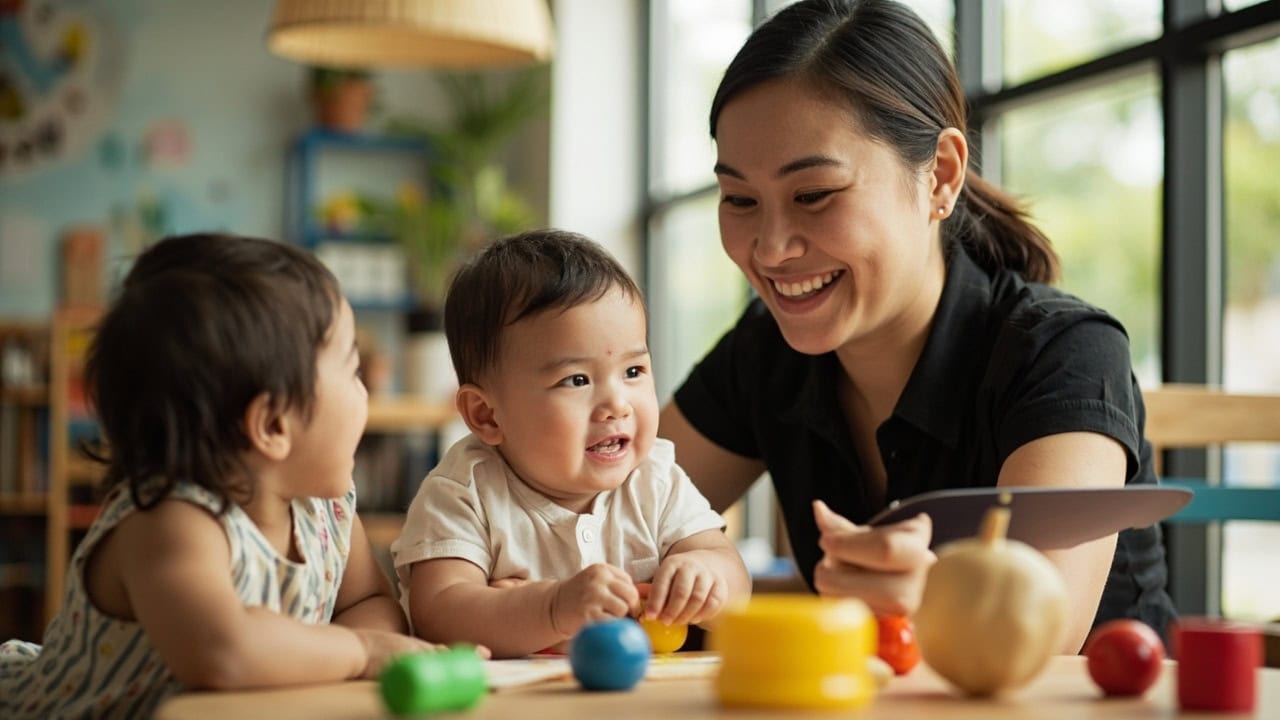
- Attention: Caregivers who have the capacity to notice what is really happening, not just manage a crowd
- Consistency: The same physical space, the same caregiver, the same routines that build familiarity over time
Just as a building’s architecture determines how people move through space, how they feel in certain rooms, whether they experience warmth or cold, openness or confinement — the emotional environment your child enters in those first weeks of care shapes the internal architecture of their developing self.
Questions to Ask When Visiting a Childcare Arrangement
- How do you handle a child who is very upset at drop-off?
- What does a typical morning routine look like from when a child arrives?
- How do you communicate with parents about their child’s emotional state during the day?
- What training have your caregivers had in child development and emotional attunement?
- What is your child-to-caregiver ratio, especially for infants?
- Can I see how caregivers interact with children during my visit — not just when they know they are being observed?
EduNanny Singapore’s Approach
This is what we have designed our entire approach around — the belief that every child deserves to feel genuinely safe, not just supervised.
The ECDA Childminding Pilot Framework
EduNanny Singapore operates within the ECDA Childminding Pilot, a framework that reflects Singapore’s recognition that childminding — quality childminding — is not a stopgap or a fallback. It is a profession with its own demands, its own expertise, and its own vital contribution to the wellbeing of children and families.
Our caregivers are trained not just in the logistics of infant care but in the subtler, more demanding work of attunement. They understand separation anxiety because they have seen it hundreds of times, and because they know that the child crying in front of them is not a problem to be solved but a human being in the midst of an enormous experience.
What Our Care Model Provides
| Feature | What It Means for Your Child |
|---|---|
| Home-based care | A warm, scaled environment designed around small groups of children |
| Ratio of up to 1:3 for infants | Every child is known. No one is just a face in a crowd. |
| Daily communication | You stay connected to what is happening in your child’s day |
| Trained caregivers | Attunement skills built into training, not just assumed |
| Monday–Friday care blocks | Predictability and consistency for working parents |
Transparency as a Core Value
We understand that you need more than philosophy. You need practical assurance that what we describe is real, that it can be verified, that you will not be asked to trust blindly.
This is why transparency is built into every layer of our service. We communicate with you daily, not because we are required to, but because we know that your peace of mind is inseparable from your child’s wellbeing. When you feel informed and connected, you bring a different quality of presence to your own time with your child.
The ecosystem of care works best when parents feel like partners, not just recipients of a service.
CDA and Baby Bonus funds can be used for our services. This is one practical way we work to remove barriers between families and the quality of care every child deserves.
How to Choose Infant Care With Confidence
Choosing care for your infant is not a decision you make once. It is an ongoing relationship, one that requires trust, communication, and the willingness to adjust as your child’s needs evolve.
Steps You Can Take Today
- Trust your instincts during visits: You will not be able to observe every interaction, but you will get a feel for the environment. Does it feel warm? Are the caregivers genuinely engaged with the children present?
- Ask about emotional approach specifically: Do not just ask about schedules and food. Ask how caregivers handle distress, how they build relationships with new children, how they communicate with parents about emotional adjustment.
- Observe the ratios: For infants especially, smaller numbers matter. A caregiver with time to notice your child’s subtle cues is a caregiver who can respond to them.
- Look for consistency: Will your child have the same caregiver most days? Or will they face a rotating cast of faces? Consistency is a cornerstone of security.
- Check for transparency measures: How will you know what your child’s day looks like? Daily updates? Communication channels? These are signs of a provider who values your partnership.
- Pay attention to the children who are already there: Do they seem comfortable? Curious? At ease in the space? Children are honest barometers of whether an environment is truly nurturing.
What to Watch For After Enrolment
- Does your child show signs of genuine settling — increased comfort, curiosity, engagement — within the first few weeks?
- Does drop-off become easier over time, even if it does not disappear entirely?
- Does your child show a range of emotions, or does he seem flat or withdrawn?
- Do caregivers seem to know your child’s cues, preferences, and rhythms?
- Do you feel informed about your child’s day — not just logistical details, but emotional tone?
Every Child Deserves a Safe Emotional Harbor
Every child who enters quality care carries with them a profound opportunity. It is the opportunity to discover, in the earliest days of life, that the world contains people who will meet them with patience and warmth. That difficult feelings are survivable. That new experiences, even frightening ones, can lead somewhere good.
This is not a small thing. This is the beginning of everything.
We believe that every child deserves to feel safe — not just physically, but emotionally. Not just supervised, but genuinely cared for in the deepest sense of that word. And we believe that parents deserve to leave their children with that kind of care and walk away with their hearts at least partially at rest, knowing that what their child is experiencing is not abandonment but a different kind of belonging.
EduNanny Singapore was founded on this belief. Not as a slogan, but as a daily practice, woven into the training of every caregiver, reflected in the design of every home environment, embodied in the relationships our team builds with the families we serve.
When you entrust your child to us, you are not handing them over to a system. You are placing them in a network of attentive, trained, genuinely caring adults who understand what is at stake in these early years.
You are giving your child the chance to build the internal architecture of security — the foundation from which they will eventually venture forth into the world with confidence, curiosity, and the deep-down knowledge that they are worthy of love.
If you are ready to explore what quality infant care can feel like — for your child and for you — we invite you to speak with our team. We are here to answer your questions, address your concerns, and walk this path alongside you.
The right care is out there. And your child’s emotional world — now and for all the years to come — is worth finding it.
At EduNanny Singapore, we understand the weight of this decision. Learn more about our approach to quality childminding, or explore how we support families across Singapore.