The Secure Base Every Singapore Child Needs and How Quality Childcare Builds It
The Tension You Carry
When Singapore parents begin looking for childcare, they carry with them a weight of concern that is deeply understandable and deeply specific to this moment in their lives. You are navigating one of the most demanding professional environments in the world. You are balancing the expectations of careers and the realities of cost, of housing, of the long, practical calculus of raising a family in a city that moves fast and expects more.
You are also, and this is the part that no checklist captures, carrying the knowledge that these early years matter in a way that science has only recently been able to articulate.
You want your child to be safe. Of course you do. But that is the floor, not the ceiling. What you actually want, when you let yourself sit with it honestly, is something much more ambitious. You want your child to be alright. Not just physically present and accounted for, but genuinely alright. You want them to be growing. You want them to be curious. You want them to arrive at school ready to learn, ready to make friends, ready to raise their hand and try things that are hard.
And here is the tension that so many of you hold without being able to name it: you are worried that childcare, however excellent, is a compromise. That the hours your child spends away from you are hours spent managing, rather than thriving. That every separation is a small wound, and that the best you can hope for is that the wound is not too deep.
You deserve to know that there is a different way of seeing this.
Because the science of early childhood development tells a story that is more hopeful and more empowering than that compromise narrative. It tells us that quality childcare, thoughtfully designed and consistently delivered, can be one of the most developmentally generative experiences your child has.
What the Science Tells Us About Secure Attachment
The psychologist John Bowlby, working through much of the twentieth century, proposed something that at the time felt radical and is now simply accepted science: that human beings are born with an innate drive to seek proximity to their caregivers. This is not learned behavior. It is biological, hardwired into the architecture of the developing brain. A child’s sense of security is not a luxury or an indulgence. It is the organizing principle of their entire psychological development.
His colleague Mary Ainsworth took this further by studying what she called attachment patterns. Through careful observation, she identified that children develop different internal working models of relationships depending on how consistently and responsively their caregivers meet their needs. Children who experience their caregivers as reliable, warm, and attuned develop what she called secure attachment. They carry within them a deep, felt sense that the world is trustworthy, that other people can be relied upon, and that they themselves are worthy of care.
This is not abstract theory. Brain imaging studies have shown that children with secure attachment patterns develop more integrated neural pathways, particularly in the regions associated with emotional regulation, stress response, and executive function. They show lower cortisol reactivity to mild stressors. They recover more quickly from moments of distress. They are, in the most literal neurological sense, more resilient.
And here is what is so important for us to understand: These patterns do not only develop in the hours a child spends with their parents. They develop in every significant caregiving relationship the child has. Which is precisely why the quality of your child’s childcare environment is not a secondary concern. It is a primary one.
At EduNanny, we do not see ourselves as providing a service that parents reluctantly need while they are at work. We see ourselves as partners in your child’s developmental architecture. The hours your child spends in quality care are not hours subtracted from their growth. When they are in the right environment, they are hours added to it.
What Quality Childcare Actually Looks Like
Let me describe what that environment actually looks like, because this is where so much of the confusion lies. Singapore parents are often presented with childcare options that emphasize safety, curriculum, facilities, and credentials. These are not irrelevant. But they are not the core. The core is something more subtle and more demanding.
There is childcare that supervises.
It keeps children safe, occupied, and managed. It is not malicious. But it does not actively build anything except perhaps a certain institutional compliance.
There is childcare that cultivates.
It creates the conditions in which a child feels secure enough to wander, to experiment, to fail, to try again. It responds to a child’s distress not by managing it away but by soothing it and then gently, encouragingly, pointing the child back toward the world.
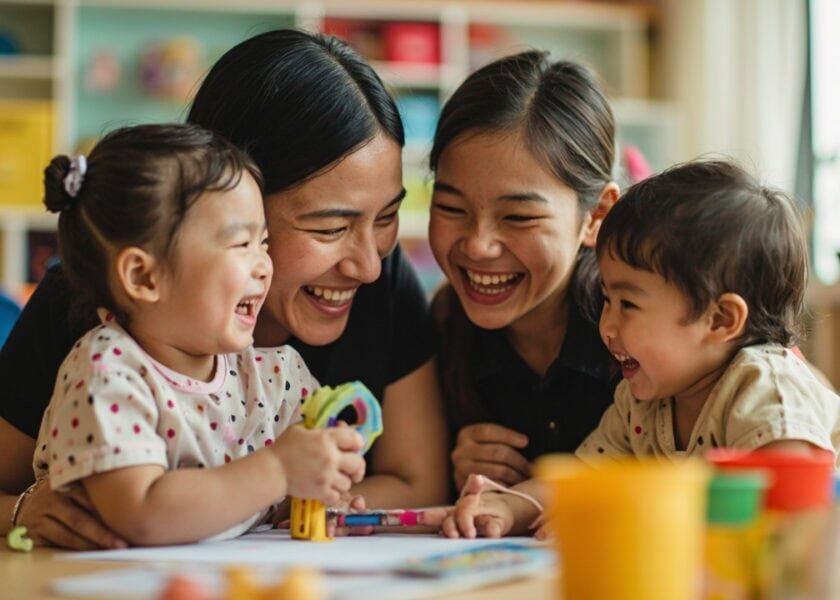
A childcare environment that builds the secure base is one where the adult presence is experienced by the child as a source of comfort and constancy rather than change. The same faces, day after day. The same voices. The same rhythms of feeding, sleeping, playing, and being held.
Research consistently shows that infant and toddler brains are not confused by routine. They are organized by it. When a child knows, in their body and in their trust, that the person caring for them will be there tomorrow and the day after, something profound becomes possible. That child begins to relax into exploration.
When your child is in the right environment, you will observe these changes over time:
- Quieter, more confident arrivals at drop-off
- Faster recovery from the initial separation
- More engaged play with both caregivers and other children
- Greater persistence at challenging tasks
- Less anxious checking-in and more bold exploration
- A child who seems genuinely glad to be at their childcare environment, not just resigned to it
This is not your imagination. This is the secure base doing its work.
How EduNanny Builds the Secure Base
The single most powerful factor in a young child’s childcare experience is not the curriculum, not the facility, not even the educational philosophy. It is the presence of at least one consistent, warm, responsive adult who knows that child.
When you choose EduNanny, you are choosing an approach to childcare that has been thoughtfully designed around this developmental insight. Our caregivers are not rotating staff who cycle through on unpredictable schedules. They are consistent figures who build knowledge of your child over time. They learn your child’s rhythms, your child’s signals, your child’s particular ways of expressing hunger, tiredness, joy, or discomfort. They respond with attunement, which is simply the fancy word for really paying attention and taking what they see seriously.
Our infant ratios are kept intentionally low: up to one caregiver for every three infants. This allows a caregiver to notice when one infant is becoming quietly frustrated, to intervene before the frustration becomes distress, to hold and soothe and name the feeling and then help the child return to play.
Quality childcare grounded in secure base principles includes:
- Consistent caregiver relationships: Your child sees the same familiar faces every day, not rotating staff on unpredictable schedules.
- Responsive attunement: Caregivers learn your child’s rhythms, signals, and particular ways of expressing needs.
- Low infant-to-caregiver ratios: One caregiver for every three infants at most, allowing genuine responsiveness.
- Soothing through distress: When a child is upset, the caregiver soothes them, names the feeling, and gently helps them return to play.
- Predictable rhythms: Consistent daily patterns of feeding, sleeping, playing, and being held.
- Encouragement of exploration: Once a child feels secure, the caregiver actively encourages them to wander, experiment, and engage.
We also understand that you, as parents, need to trust what is happening when you are not in the room. We know that Singapore parents are thoughtful and attentive, and that you deserve transparency without having to ask for it. Depending on the arrangement and location, our services include communication practices that allow you to stay connected to your child’s day. We believe that informed parents are confident parents, and that confident parents transmit that confidence to their children.
The ECDA Childminding Pilot: A New Pathway for Singapore Families
For too long, the childcare landscape in Singapore has presented parents with a limited set of options that do not always fit the reality of how Singapore families live and work. The ECDA Childminding Pilot broadens that landscape.
The Pilot creates pathways for home-based care, where your child can be cared for in a familiar domestic environment with a consistent caregiver, and community or centre-based arrangements that offer different structures for different needs. What unites these pathways is a shared commitment to quality standards that put the secure base at the center.
EduNanny is proud to participate in this Pilot. We believe it represents the future of childcare in Singapore: not a one-size-fits-all system, but a flexible ecosystem that recognizes the diversity of family needs while maintaining rigorous standards around what matters most.
The practical elements of the Pilot are designed with real family life in mind:
- Fee structures that are affordable and accessible
- CDA and Baby Bonus funds can be used where applicable
- Monday to Friday care blocks aligned with working life
- Consistent caregiver assignments
This is not simply about convenience. It is about creating the conditions for consistency. And consistency, as the science tells us, is not a soft, sentimental preference. It is the foundation on which everything else is built.
Your Questions Answered
“Will my child really be okay?”
Yes, if they are in the right environment. Research consistently shows that children in high-quality, consistent childcare environments develop secure attachment patterns and demonstrate strong developmental outcomes. The key is not whether your child attends childcare, but whether the childcare they attend is designed to meet their developmental needs.
“Won’t time away from me weaken our bond?”
When your child is in an environment that is genuinely secure, something unexpected happens. The bond between you and your child deepens. This sounds counterintuitive. Shouldn’t more time apart mean a weaker bond?
The answer, supported by decades of research, is no. What it actually means is that your child is internalizing a sense of security that is not contingent on your physical presence. They are carrying you with them. They know, in their bones, that you are their home. And because they know this, they can be away from you without that knowledge being threatened.
This is what secure attachment looks like in practice. It is not a child who clings harder because they are afraid. It is a child who can venture farther because they trust the line.
When your child runs to the caregiver at drop-off with something that looks almost like eagerness, do not mistake it for indifference to you. It is evidence that your child has learned to trust the world enough to engage with it. And that trust was built, brick by brick, by the consistent, warm, responsive care that you chose for them.
“How do I know if a childcare arrangement is really good for my child?”
Ask these questions when evaluating any childcare option:
- How consistent are the caregivers? Will my child see the same person every day?
- What is the infant-to-caregiver ratio?
- How do caregivers respond when a child is distressed?
- What does a typical day look like? Is there predictable routine?
- How will I know what is happening during the day?
- How long have caregivers been in their roles? What is staff turnover like?
What You Are Building: The Long-Term Picture
You are not simply buying childcare hours. You are making a decision about the kind of foundation your child is building. You are choosing to invest in the slow, patient, daily work of creating a human being who feels secure enough to explore, brave enough to fail, and resilient enough to recover.
That is not a small thing. It is the most important thing.
The child who knows where their base is can go anywhere. This is not poetry. It is developmental science. Children with secure attachment patterns show:
- Greater school readiness: They arrive at preschool and primary school able to engage with learning rather than being consumed by anxiety
- Stronger peer relationships: They have the internal security to form healthy friendships and navigate social challenges
- Better emotional regulation: They can manage their feelings and recover from setbacks
- Increased persistence: They try difficult tasks rather than giving up when frustrated
- Long-term resilience: They carry this foundation through every transition: to preschool, to primary school, to the messiness of friendships, to the challenges of learning
We know that Singapore parents carry a great deal. You carry the weight of expectation, of professional pressure, of financial planning, of wanting to be present and knowing you cannot always be. We do not want to add to that weight with guilt or doubt. We want to give you something else: confidence. Not the shallow assurance that everything will be fine. The deep, evidence-based confidence that comes from understanding what your child actually needs and knowing that you are providing it.
EduNanny was built for this. We were built to be the consistent, warm, responsive presence that your child deserves. We were built to be partners in the work of raising a generation of children who know where their base is, and who therefore have the freedom to run toward everything the world has to offer.
That little child on the playground slide. The one who looked back, and then looked forward, and slid into the world. That is the child we are working to raise, one consistent day at a time. That is the child you are raising, too.
And when you make the choice to give your child that kind of care, you are not choosing between your career and your child. You are choosing both. You are building a life in which your child thrives and you are present, not despite the demands of modern Singapore, but in dialogue with them.
The secure base is a gift you give your child that they will carry into every room, every relationship, every challenge, for the rest of their lives. It is the foundation on which everything else is built.
If you are ready to explore how EduNanny can support your family, we would be glad to hear from you. You might also learn more about our approach or read about our participation in the ECDA Childminding Pilot.