What Your Baby Cannot Say Body Signals Every Parent Needs
The Body Speaks First
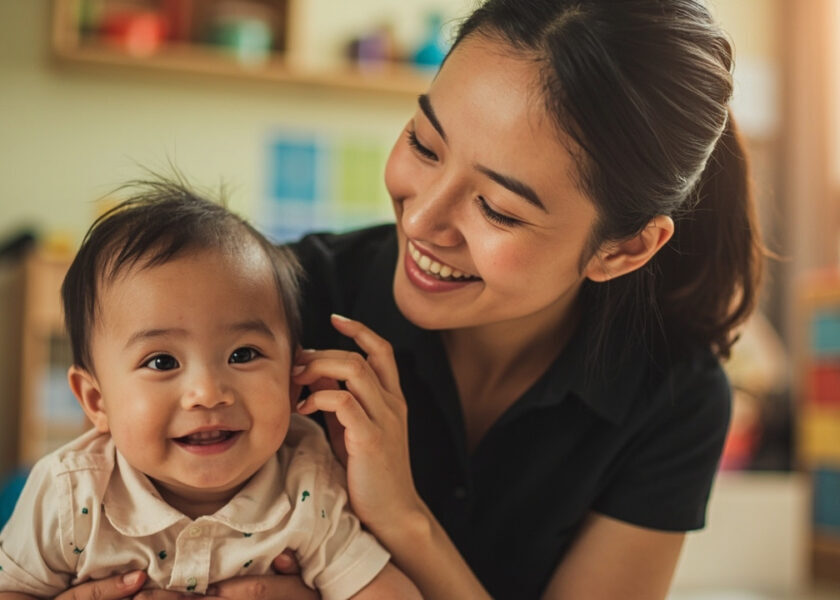
There is a moment that happens quietly, every day, in car parks and lobbies and lift lobbies across Singapore. A parent arrives to pick up their child. The child is handed over, or comes running, or is lifted from a highchair. And something is different.
The parent cannot name it at first. It is not a word the child says, not a drawing brought home, not a milestone announced. It is something in the body. A fluidity of movement. A softness in the shoulders. An openness in the way the child leans toward the parent. The child is different in their body, and the parent feels it before they think it.
This is the moment I want to talk about today. Because it is in this quiet, almost unremarkable moment that the most important truth about infant care reveals itself: your child cannot yet tell you what their day was like. They cannot describe whether their caregiver noticed them, challenged them, held them when they needed holding, or gave them space when they needed to explore. Language is years away.
But the body has been speaking all along.
In the first thousand days of life—from before birth through the second birthday—the body is the primary instrument of learning, communicating, and understanding the world. Before children have words, they have movement. Before they can describe how they feel, their posture tells us. Before they can articulate what they need, their sensory responses speak clearly to anyone trained to listen.
When a baby reaches for a face, that reaching is language. When a toddler shifts weight to step over a threshold, that decision is language. When an infant tenses and then releases, that rhythm of tension and ease is the earliest grammar of emotional regulation.
The body is not a separate domain from cognitive or emotional development. It is the medium through which all development unfolds. This is not a metaphor. It is neurobiology. The infant’s brain develops in direct response to sensory input and motor exploration. Every time a baby grasps an object, rolls across a mat, or turns toward a sound, neural pathways are being formed that will later support language, attention, and social-emotional skills. The hand and the mind grow together. The moving body teaches the developing brain how to organize itself.
What This Means for Singapore Parents
Singapore parents are surrounded by information about academic readiness, feeding schedules, and sleep training. But the physical and sensory domain—the very foundation of early development—is rarely illuminated. Parents do not know what to look for. They do not know what their child’s body is saying during those hours apart.
The body speaks. But who is listening?
How Caregivers Read the Body
A trained caregiver does not simply manage the sensory environment of a childcare setting. They read it. They observe:
- How a child responds to a particular texture—does the child reach for it, explore it with fingers and mouth, or does the body stiffen and turn away?
- How a child moves through the space—with curiosity and expanding confidence, or with hesitation and contracted posture?
- The child’s sensory thresholds—the point at which stimulation becomes engagement, and the point beyond which it becomes overwhelm.
Untrained caregivers may keep children safe, fed, and amused. But the child who is quietly overstimulated, whose nervous system is registering more input than it can process, will not show this in words. The child will show it in the body—in rising tension, in gaze aversion, in a kind of frozen compliance that is often mistaken for good behavior.
If no one is reading that signal, the child’s experience of the day becomes one of silent dysregulation, accumulating without acknowledgment or intervention. Trained caregivers read that signal. They learn to distinguish the child who is processing from the child who is struggling. They adjust the environment—the noise level, the activity, the physical proximity of caregivers—to keep the child in that optimal zone of engagement where development flourishes.
Motor Development as Cognitive Growth
When a caregiver reads the body, motor development becomes visible as a coherent narrative rather than a checklist of milestones. Rolling leads to crawling leads to pulling to stand leads to walking—but each of these stages is not merely a physical achievement. It is a revelation of how the body is learning to organize itself, how balance is emerging, how coordination is developing.
In the infant’s first thousand days, these motor achievements are not separate from cognitive growth. They are cognitive growth. They are how the brain learns to plan, to sequence, to problem-solve.
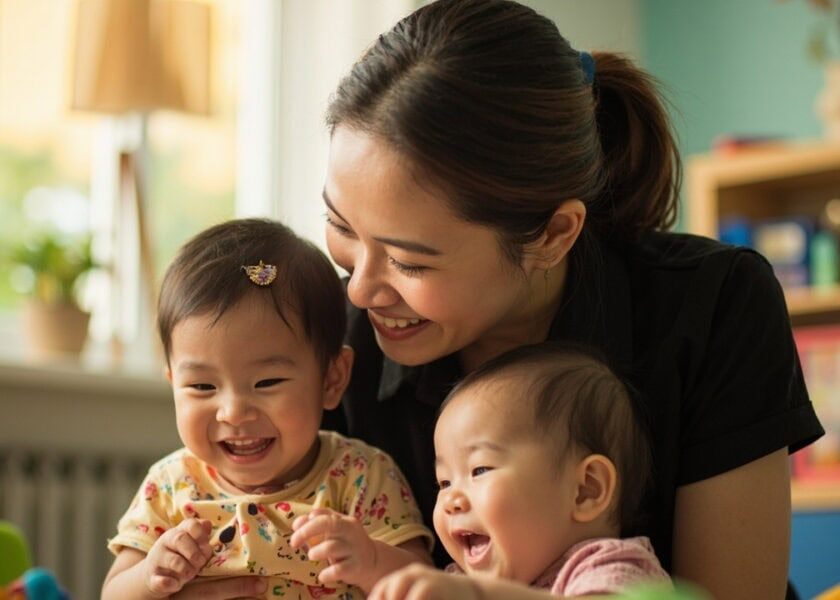
The child who has space and time to move, who is supported in reaching for objects just beyond grasp, who is held in ways that strengthen emerging muscles, who is placed on the floor in safe spaces where rolling and crawling can be practiced—this child is not merely developing physically. The child’s brain is developing, shaped by the quality and quantity of movement experience.
The child who is confined to a chair or a playpen for long stretches, who is kept in one position because it is easier to manage, who is not given the sensory richness of varied surfaces and objects to explore—this child is not developing at the expected pace, not because something is wrong, but because the body has not been given what it needs to speak its full language.
Physical Confidence as Emotional Foundation
A toddler who has learned to climb is a toddler who has learned something profound about their own capacity. A toddler who has been allowed to fall and get up again has learned about resilience in the most bodily way possible.
Physical confidence is not a luxury of early childhood. It is the foundation upon which emotional regulation, attention, and social confidence are built. When the body feels capable, the whole self feels more capable.
You see this in children who have been in high-quality infant care. They move differently. Not because they are inherently more gifted, but because their bodies have been given the experience and the encouragement to develop their physical intelligence. They are more likely to approach new challenges with curiosity rather than fear. Their posture is more open. Their movements are more fluid. They are at home in their bodies.
And this is what parents are seeing at that pickup moment—perhaps without being able to articulate it. They are seeing a child who has spent the day in an environment that understood what the child’s body was trying to say.
What Singapore Parents Need to Know
Here is what we know about Singapore parents in the infant and toddler years: you are doing something extraordinarily difficult with very little information. You are trusting someone else with the care of your child during the hours when your child is most rapidly developing.
You cannot be there. You cannot observe. And you have been given almost no framework for understanding what quality looks like in the physical and sensory domain.
The uncertainty is real. It lives in the gap between dropping your child at the door and picking them up at the end of the day. It is the wondering: What did they do? Were they happy? Was anyone really seeing them?
Not because uncertainty will ever fully disappear—parenting always involves trust, always involves moments we cannot witness—but because parents can be given tools to read what is observable, and thereby to participate more fully in understanding their child’s experience. The child’s body is one of the most reliable indicators of care quality. Not because children are always expressive, but because the body cannot hide everything.
The Questions Worth Asking
When you pick up your child, consider asking:
- How was their movement today? Did they try anything new?
- How did they respond to the different activities and spaces?
- Were there moments when they seemed overwhelmed or needed calming?
- How did they settle when they were tired?
A caregiver trained in body literacy will have observations to share. A caregiver who cannot answer these questions may not be watching closely enough.
Common Concerns Parents Carry
“I’m worried I won’t know if something is wrong.”
You are right to worry—and that worry itself is useful. Parents are exquisitely attuned to their children, even when they don’t yet have the framework to articulate what they are noticing. The body literacy framework gives you words for what you may already be sensing. Trust that instinct. If something feels off, ask questions. A quality caregiver will welcome the conversation.
“Isn’t all childcare basically the same?”
No. The difference between supervision and genuine developmental care is the difference between keeping a child safe and understanding what that child needs to develop. The child who is confined to a chair for long periods and the child who has space and encouragement to move are not having the same experience—even if both are technically “supervised.” The child whose signals go unread and the child whose signals are responded to are not developing the same way.
“My child seems fine. Is body literacy really that important?”
Physical and sensory development is the foundation upon which everything else is built—language, attention, emotional regulation, social confidence. A child who seems “fine” in the short term may be missing the motor and sensory experiences that will support their development for years to come. The pickup moment that opened this article—the fluidity, the openness, the ease—that is what flourishing physical development looks like. That is what you want to see.
Signs You Can Read in Your Child’s Body
Between the extremes of obvious distress and obvious joy, there is a whole language of observation available to any parent who knows what to look for. Here is what trained caregivers learn to notice—and what you can learn to see too.
At Pickup: What the Handover Tells You
The child’s posture is open or closed. A child who is picked up with open arms, who reaches toward the parent without tension in the shoulders, who transitions from caregiver to parent with ease—this child’s body is reporting something. A child who arrives stiff, who turns away, who seems contracted in posture, whose body closes at the door—this child’s body is reporting something different.
The quality of movement is fluid or stiff. Notice how your child moves when they see you. Is there a natural unfolding, an ease in their limbs? Or does movement seem effortful, guarded?
The face shows engagement or vacant compliance. A regulated child shows alertness, interest, genuine emotion. A dysregulated child may appear flat or strangely passive.
The body shows the marks of a day spent moving and exploring—slightly tired in the good way, pleasantly spent—or the flatness that comes from hours in a chair.
At Home: Evening and Night Signals
Parents can also notice whether the child:
- Sleeps well—a regulated nervous system settles into rest more easily.
- Plays with concentrated engagement—sustained, focused play indicates a regulated nervous system.
- Moves through the evening with ease or persistent fussiness.
- Physical skills are expanding—new ways of grasping, new ways of moving, new confidence in the body.
Over Time: Developmental Trajectory
Over weeks and months, track whether your child is becoming more physically capable and confident, or whether development seems stalled. New milestones emerging at a steady pace is a positive signal. A child who seems to plateau deserves a conversation with your caregiver about what they are observing.
These are not diagnostic criteria. They are signals. When you learn to read these signals, you gain something invaluable: the ability to ask informed questions of your caregiver, to notice when something is not quite right, and to feel confident when everything is going well.
What to Look For and What to Ask
In the ECDA Childminding Pilot, the standard being built toward is this: caregivers who are trained to observe not just what children do, but how they do it—the quality of their movement, the regulation of their responses, the signals their bodies send about their inner experience. This is the kind of expertise that makes the difference between supervision and genuine developmental care.
Structural Elements That Enable Observation
Real body literacy requires real attention. And real attention requires conditions that make it possible:
- One-to-three infant ratios—so caregivers can observe individual children, not just manage groups.
- Caregiver training that develops body literacy as a professional competency.
- Time and space built into the day for observation, not just activity management.
- Communication practices that keep parents informed about what was noticed, not just what was done.
Questions to Ask During Your Search
- What is the caregiver-to-infant ratio?
- How do caregivers observe and track individual children’s development?
- What training have caregivers received in infant development?
- What does a typical day look like for an infant in your care?
- How do you handle overstimulation or sensory dysregulation?
- How do you communicate with parents about their child’s day?
- Can I see the space where my child will spend their time?
What to Look For When You Visit
- Do the children move freely and with variety throughout the day?
- Are caregivers interacting with children’s physical exploration, not just supervising safety?
- Do children seem to have choices about their movement—to explore, to rest, to be held, to be set down?
- Is there evidence of sensory-rich environments—different textures, temperatures, sounds, light qualities?
- Do caregivers get down to the children’s level and watch them move?
- Can caregivers describe what they have observed in your child’s movement and behavior?
- Does the environment feel calm but engaged—not chaotic and not eerily quiet?
Visit at pickup time if possible. Watch the handoff. Read the children’s bodies. Notice whether they seem regulated, curious, open—or stiff, flat, withdrawn. Ask yourself: if I were that child, would I feel seen?
EduNanny: Our Approach to Listening
We started with a question that most childcare providers do not ask: What if the child’s body were the primary text we were reading?
What if every caregiver were trained to observe not just behavior but the quality of movement, not just milestones but the sensory experience that makes milestones possible? What if parents were given the tools to read their child’s body as fluently as they read their child’s cry?
The ECDA Childminding Pilot is our answer to that question. It is a commitment to a standard of observation and care that we believe every infant and toddler deserves.
What We Have Built
In our home-based care model and our community-based pathways, we have built in the structures that support this kind of attention:
- One-to-three infant ratios that make real observation possible.
- Caregiver training that develops body literacy as a professional competency.
- Monday through Friday care blocks that align with real family rhythms.
- Communication practices that keep parents informed without overwhelming them.
- Transparency measures including CCTV where applicable, because we believe parents should be able to move from wondering to knowing.
Because we believe quality care must be accessible, we have designed our pilot with fee structures that make this kind of attention possible for families across Singapore. CDA and Baby Bonus funds can be used where applicable, because the first thousand days should not be a privilege available only to those who can afford premium pricing.
Come and See the Difference
Come and observe an EduNanny caregiver at work. Notice not just what she is doing, but how she is doing it. Notice how she reads the child’s body. Notice how she responds to the child’s sensory signals. Notice whether the children in her care are open or closed, regulated or dysregulated, moving toward the world or away from it.
Ask to see our communication practices. Ask to understand our observation methods. Ask us what we are watching for in your child’s motor development, in your child’s sensory processing, in your child’s physical confidence.
We will have answers—not because we have all the answers, but because we have trained ourselves to ask the right questions.
The heart of what we offer is this: we believe the body speaks first. And we have built an organization committed to listening.
The Body Speaks First
Before language, before academics, before the milestones that are tracked on charts and compared at playgrounds—the body speaks. The body speaks in the way a baby reaches, in the way a toddler climbs, in the way a child settles into sleep after a day of meaningful movement and appropriate challenge.
What we do in these early years—what we do with a child’s sensory experience, what we do with a child’s motor development, what we do with a child’s physical intelligence—echoes forward into everything. Emotional regulation. Attention. The capacity to learn. The ability to connect with others. All of these are built on the foundation of physical and sensory development that unfolds in infancy and toddlerhood.
This is why infant care matters. Not as a convenience for working parents, though it is that too. Not as a precursor to schooling, though it is that too. It matters because it is the environment in which the child’s body is learning to be a body—to move, to sense, to regulate, to be at home.
And this is why the quality of that care matters so profoundly. The child who is seen—whose body is read, whose sensory experience is understood, whose physical intelligence is supported—that child is building something that will last a lifetime.
The child who is merely supervised—kept safe, kept fed, kept occupied—is building something too. But not the same thing.
Ready to learn more about how EduNanny approaches infant care? Schedule a consultation to discuss your family’s needs and observe our caregivers in action.
Explore More