What Singapore Parents Sense Before They See in a Childcare Centre
What Your Senses Tell You Before You See Anything
When you walk into a childcare centre, you are not a passive visitor receiving information. You are entering a living environment, a small society, and everything in it is communicating. The air, the sound, the space, the bodies moving through it — it is all saying something. Most parents are never shown how to listen. So let us begin there, in the place where every visit truly starts: with what you can hear before you see anything at all.
Sound Is Not Background. Sound Is Data.
Close your eyes for a moment if you can do so politely, and simply listen. Not to any single conversation, but to the texture of the room itself.
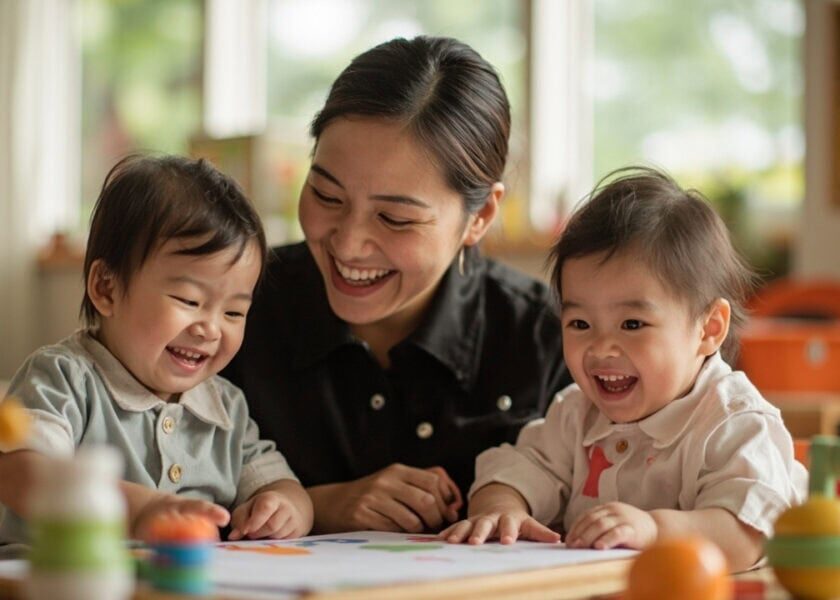
What is the relationship between the children’s voices and the adults’ voices? In a high-quality environment, you will hear something remarkable: children are not speaking into a void. When a three-year-old makes a comment, when an infant coos, when a toddler expresses frustration, there is a response. Not immediately punitive. Not adult-controlled. But present. Human. Warm.
The noise level matters far less than most parents assume. Children are supposed to be noisy. They are supposed to laugh, to protest, to exclaim, to negotiate. What matters is whether the noise has a kind of order to it — not the silence of compliance, but the hum of a community that is being held with intention.
When you hear shouting, listen to what follows. Does an adult arrive? Do they get down to the child’s level? Do they name what they see? The quality of a caregiver’s response to noise is one of the most honest things you can hear in a centre, because it cannot be staged for a tour. It happens in real time, whether you are watching or not.
- Do children sound like they are waiting for permission to speak, or like their voices naturally belong in the space?
- When a child vocalises, is there a response within seconds?
- Do adult voices sound warm, curious, and calm — or sharp, hurried, and procedural?
- Is there a sense of back-and-forth conversation, or mostly adult direction?
The Smell of a Centre
The smell of a childcare centre is one of the most revealing things you will encounter — not in a clinical, diagnostic way, but in a human one.
When you enter a quality environment, it should smell clean — not of industrial bleach, but of a space that is cared for daily. There should be no lingering odours from nappy changes, from poorly maintained toilets, from food left out. The presence of pleasant, neutral-smelling air is evidence of consistent hygiene standards, of attention to the small details that no one talks about in brochures.
If it is near a mealtime, notice whether the space smells of food being prepared rather than food that has been sitting. A centre that cooks on-site, or that times meals so food is fresh and present, communicates something important: this place thinks about the ordinary rhythms of a child’s day with care.
In Singapore’s climate, where humidity and warmth can accelerate the pace at which environments deteriorate, maintaining a consistently clean, fresh-smelling space requires daily commitment. A centre that smells stale or musty is telling you something about how it manages the conditions that are hardest to control.
What You See When You Look at the Children First
Step into a room and look. Not at the toys, not at the furniture, not at the decorations. Look at the children first. Watch how they move.
In a quality environment, children are not all doing the same thing at the same time. They are moving independently, making choices about where they go, what they reach for, how they use their bodies.
- Materials are within reach.
- Floor space is available.
- There are not rows of chairs facing a whiteboard.
- There are invitation points throughout the room — a low shelf with open-ended materials, a cosy corner with soft furnishings, a table with something tactile and interesting.
A room that is designed for the child looks chaotic to an untrained eye and is actually thoughtfully arranged. A room designed for adult supervision convenience looks orderly and impressive but can feel strangely empty of childhood.
Look at how materials are displayed. Are they arranged at children’s eye level, inviting touch and choice? In quality infant and toddler environments, you will often see natural materials — wooden blocks, fabric pieces, metal bowls — alongside carefully chosen toys. These are not random choices. They reflect an understanding that young children learn through sensory exploration, through real objects that do things, not through plastic toys that flash and beep.
What Caregiver Body Language Communicates
Now, watch the caregivers. Not what they say — you will hear plenty of that during a tour. Watch what their bodies do.
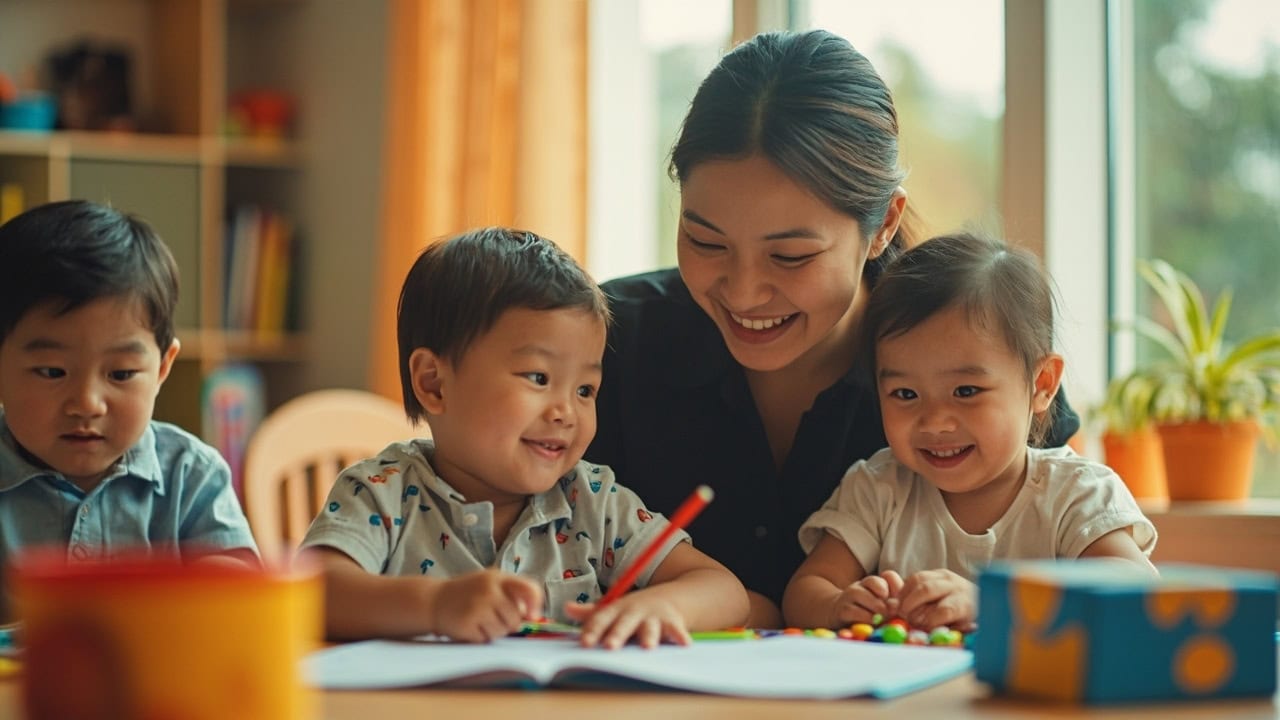
A caregiver in a quality environment is not standing at the periphery with a clipboard. They are in the room with the children. They are physically present.
- How they position themselves so they are at or below children’s eye level when they speak, rather than looming over.
- How they place themselves near enough to notice but far enough to allow independent movement.
- How they use touch — a hand on a shoulder, a brief embrace — in ways that are appropriate and warm.
- Whether they are looking at the children or looking at their phones, looking at you, looking at the door.
Watch whether a caregiver notices when a child’s face changes — when curiosity flickers, when frustration builds, when something goes wrong between two children. The best caregivers notice before behaviour escalates. They are reading the room not as a supervisory task but as an act of genuine attunement.
Singapore’s spatial constraints are real. Many centres work with limited square footage. But within those constraints, you can still see whether the environment has been thought about for the child or whether the child has been asked to fit into a space designed for other purposes.
When you are visiting a centre in Singapore, pay attention to how they manage our climate. Is the space properly ventilated? Is there airflow, natural light where possible, careful attention to air quality? Singapore’s heat and humidity are not excuses. They are constants that a well-run centre accounts for every single day. A centre that feels stale, that has closed windows and no movement of air, is a centre that has not prioritised the child’s physical comfort and wellbeing in the most basic terms.
What Excellent Infant Care Actually Looks Like
The sensory observations above are not isolated details. They are windows into something deeper: whether a centre understands what infants and toddlers actually need during the first thousand days of life.
During this period, the brain is building itself at a speed that will never be repeated. The care an infant receives during this time is not a background condition. It is the medium through which their sense of the world as safe or unsafe, interesting or dull, trustworthy or unpredictable, is being formed.
What this looks like in practice:
- Responsive interaction: An infant does not simply need supervision. They need someone who can read their cues, who can respond in the way that builds secure attachment.
- Intentional caregiver ratios: When care is provided at lower ratios, every interaction is more personal, more attuned. There is time to notice, to respond, to be present.
- Physical attunement: Watch how a caregiver holds a crying infant. Do they move with calm purpose? Do they name what they think the infant might be feeling? This is not scripted warmth. This is the real thing.
- Respect for the child’s pace: There is no rush to meet milestones on schedule. There is patience, observation, and responsiveness to where each child actually is.
Questions to Ask and Concerns to Address
Use these questions not as a test to catch centres out, but as a way to understand their philosophy and practice:
- What happens when a child is upset? Can you describe what that looks like?
- How do you handle feeding and sleeping routines?
- How do you communicate with parents during the day?
- Can I see the spaces that are not on the standard tour route?
- What does a typical day look like for an infant here?
- How do you manage ventilation and air quality in Singapore’s climate?
A centre that welcomes these questions, that answers without defensiveness, that shows you the things that happen when no tour is happening — that centre is telling you something true about itself.
Common Concerns Parents Carry
“How do I know what really happens when I’m not there?”
You ask. You observe. You notice the things that cannot be faked — the sound of the room, the smell, the way caregivers move, the way children look when they are at ease. And you ask to see beyond the tour route. A centre that has nothing to hide will welcome this.
“I don’t have a background in early childhood development. How can I possibly judge quality?”
You do not need a degree. You need permission to trust what you already sense. You have been paying attention to your child since birth. You know what warmth sounds like. You know what stress looks like. You know when something feels off. The sensory framework in this article is simply a way to name what you already know.
“The centre looked so polished. Why do I still feel uncertain?”
Polished surfaces and impressive facilities are not signals of quality. They are signals of investment in appearances. What you are looking for is harder to fake: the texture of caregiver-child interaction, the independence of children moving through space, the felt sense of whether this place has been designed for the child. Trust that uncertainty. It is asking you to look more closely.
“Is home-based care as good as centre-based care?”
The question is not which is theoretically superior. The question is which setting is right for your child and your family. Both can be excellent. Both can be inadequate. The quality of care does not come from the setting — it comes from the people, the ratios, the philosophy, and the attention brought to each interaction every day.
What EduNanny Singapore Offers
When EduNanny Singapore was designed, we started with a belief that may seem simple but is actually rare: a quality centre does not need you to be passive. A quality centre wants you to look closely, to ask questions, to notice.
EduNanny operates under the ECDA Childminding Pilot, which means our caregiver-to-child ratios are designed for infants and very young toddlers — not as a regulatory checkbox, but as a structural commitment to responsiveness. When care is provided at these ratios, every interaction has the space to be intentional, attuned, and warm.
We offer both home-based and centre-based pathways, because families are not all the same. Some children thrive in the intimacy of a home environment. Others benefit from the social texture of a community setting. What matters is not which setting is theoretically superior, but which setting is right for your child, your family, your circumstances. Our role is to provide both with the same standard of intentional care.
We understand that parents need to feel confident in what is happening when they are not in the room. Daily updates, open channels, honest conversation when there are concerns — this is the adult side of the trust that children need us to model. Where CCTV measures are deployed, they are there not as surveillance but as reassurance — a quiet infrastructure that allows parents to trust that what we say is happening is actually happening.
For families navigating the very real financial pressures of raising children in Singapore, we have designed our pilot fee structures to be affordable, with eligibility for CDA and Baby Bonus payments applied where applicable. Excellent infant care should not be accessible only to families with significant resources. Every infant in Singapore deserves responsive, warm, developmentally rich care.
Questions do not only arise during centre hours. Our AI-powered chatbot, Thomas, provides parents with accessible, responsive support when they need it — offering guidance, answering questions, and helping parents feel connected to information and resources. Thomas means those questions that arise at seven in the evening do not have to wait until the morning.
Our Monday to Friday care blocks are structured around the rhythms of working family life. The parents who bring their children to us are often managing demanding schedules, navigating the complex logistics of dual-income households. We are not here to add to that pressure. We are here to be a reliable, warm, trustworthy part of your village.
The Decision You Are Really Making
Here is what most parents miss: your own felt sense — the way a space makes you feel, whether you feel calm or tense, welcome or assessed, comfortable or on edge — is not superstition. It is data.
If you feel uneasy and cannot name why, do not dismiss that feeling. Sit with it. Ask yourself what your body noticed before your mind caught up. Perhaps it was the way one of the caregivers spoke to a child. Perhaps it was a particular sound, or a smell, or the way the light fell in a room. Your discomfort may be the most honest information you collect all day.
Choosing infant care is not just a logistical decision. It is a statement about what you believe your child deserves during the most critical period of their development.
The first thousand days are not a rehearsal. They are the story. And every day of that story, your child deserves to be in an environment that knows how to listen, how to respond, how to attune, and how to love them back with the same seriousness and tenderness that you do.
A centre that welcomes your observation, that answers your questions without defensiveness, that shows you the things that happen when no tour is happening — that centre is telling you something true about itself. And a centre that is polished on the surface but somehow feels hollow when you leave, that does not invite you to look closely, that makes you feel like a consumer rather than a partner — that centre is telling you something true as well.
We do not want parents who choose us on the basis of a brochure or a brand name. We want parents who choose us because they visited, they observed, they sensed, and they felt something that told them this was a place where their child would be seen, held, and cherished — not as a slogan, but as a daily practice.
Come and See for Yourself
That feeling you had — the one that was not quite clarity and not quite confusion — is not a problem to be overcome. It is a signal that you are paying attention.
We invite you to visit EduNanny Singapore. Walk through our doors and use everything you have learned in this article. Listen to what you hear. Breathe in what you smell. Watch how the children move. Watch how our caregivers position themselves, how they respond, how they attune.
We will not tell you what to feel. We will simply give you the space, the openness, and the transparency to notice what is already there.
You already know how to do this. You are already doing it. We are simply here to confirm what your instincts have been telling you all along.
EduNanny Singapore offers infant and childminding care under the ECDA Childminding Pilot. We provide both home-based and centre-based pathways, with caregiver ratios designed for responsiveness and warmth. Visit us to see what quality looks like when you know how to look.
#ChildcareSingapore #InfantCareSG #EduNanny #FirstThousandDays #ChildmindingSG