From Impressive to Excellent: A Singapore Parent’s Eye for Childcare Quality
What Quality in Childcare Actually Looks Like
Quality in childcare is not mysterious. It is not something that only experts can perceive, hidden behind credentials and jargon and years of training. Quality is observable. And more importantly, it is something that any parent can learn to see clearly—once they know where to look.
This is not about developing doubt. It is about developing sight.
The childcare industry benefits from the idea that quality is hidden, that only experts can evaluate it, and that parents must rely on credentials, branding, and marketing to guide their choices. But this is not true.
Quality in early childhood care is visible to anyone who knows where to look.
The Observation Windows Every Parent Can Learn to See
Morning Arrival
When you bring your child to a childcare setting in the morning, what do you actually notice?
Most parents, in those first moments, are focused on logistics. The bag, the bottles, the handover. They are thinking about the day ahead, the meeting at work, the deadline that is waiting. The observation window opens and closes without being fully opened.
But the morning arrival is one of the most revealing windows into the true nature of a childcare environment. Not the curated tour version. Not the presentation-ready moment. The actual arrival, when children are half-asleep or fully awake, when parents are hurried or present, when the room is still becoming itself for the day.
Watch your child’s face as they enter. Is there recognition? Anxiety? Eagerness? Confusion? Notice whether the caregiver offers genuine attention when your child arrives, or whether there is professional acknowledgment—the polite nod, the efficient greeting.
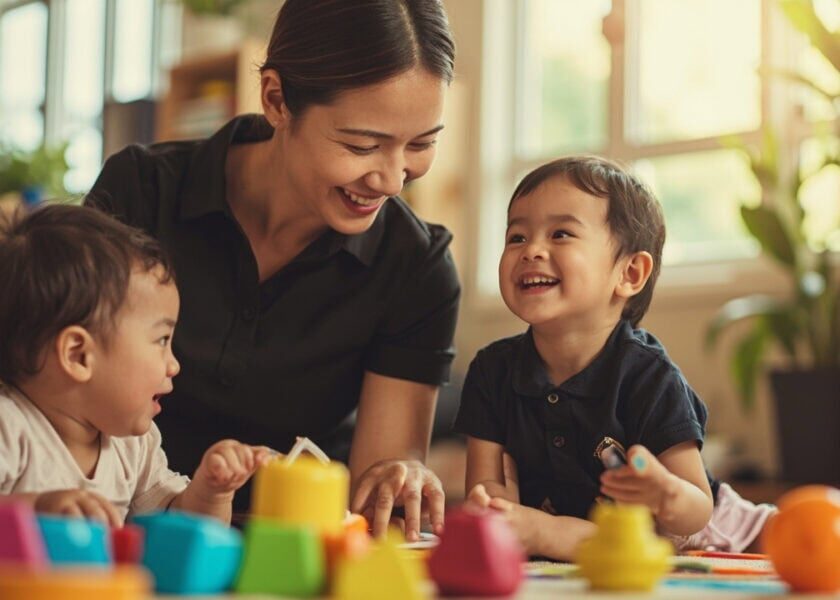
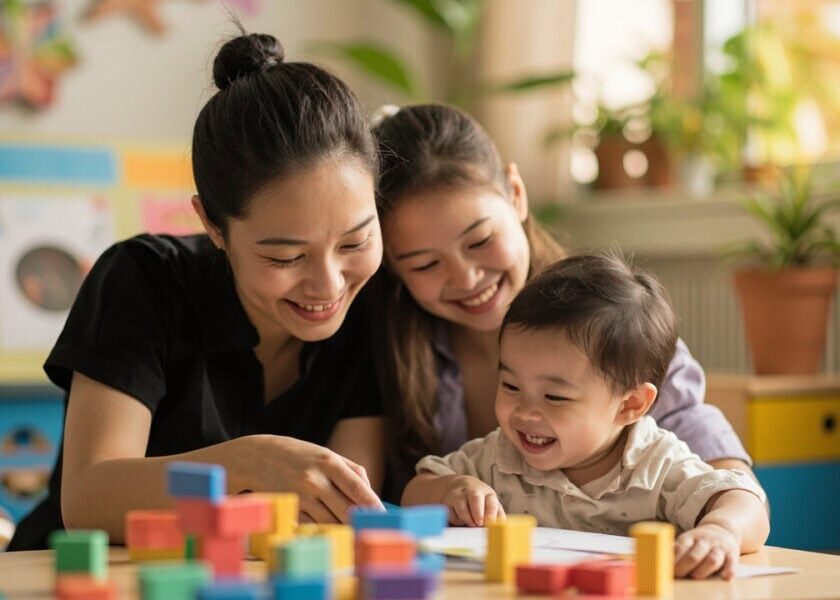
A caregiver who truly sees your child will kneel down to their level. They will greet the child by name, with attention that is not rushed. They will notice something about the child that day—the shoes they are wearing, the way they seem, a question they asked yesterday and now want to follow up on.
This takes seconds. But those seconds tell you something important: whether the adults in this room are managing a schedule or are genuinely in relationship with the children.
Departure
When you return at the end of the day, watch what happens in those last ten minutes.
Notice whether your child is absorbed in something or simply waiting. Notice whether they rush toward you or hesitate. Notice whether they look back at the room as they leave, or whether they do not look back at all.
A child who lingers, who is reluctant to leave a place, who continues building something or playing something before being gently redirected—that reluctance is not stubbornness. It is evidence. It tells you that the environment has become a place of genuine engagement for your child, not merely a place of supervision.
Children are not skilled at pretending. When they do not want to leave, it is because something real is happening there.
Ask yourself: when I pick up my child, do they seem whole? Are they finishing something, or just waiting for me? Do they speak about the day with energy, or do they seem to have shut down somewhere inside?
The Space Between
Quality childcare does not announce itself. It is present in the small, unhurried moments that no tour is designed to show you.
It shows up in the forty-five seconds after a caregiver has just finished an activity with one group of children and a toddler approaches with a question.
In a polished environment, that toddler might be redirected to wait, gently but firmly. “Just a moment, okay?” And the moment stretches. And by the time the caregiver returns, the toddler has moved on to something else, and the question is lost.
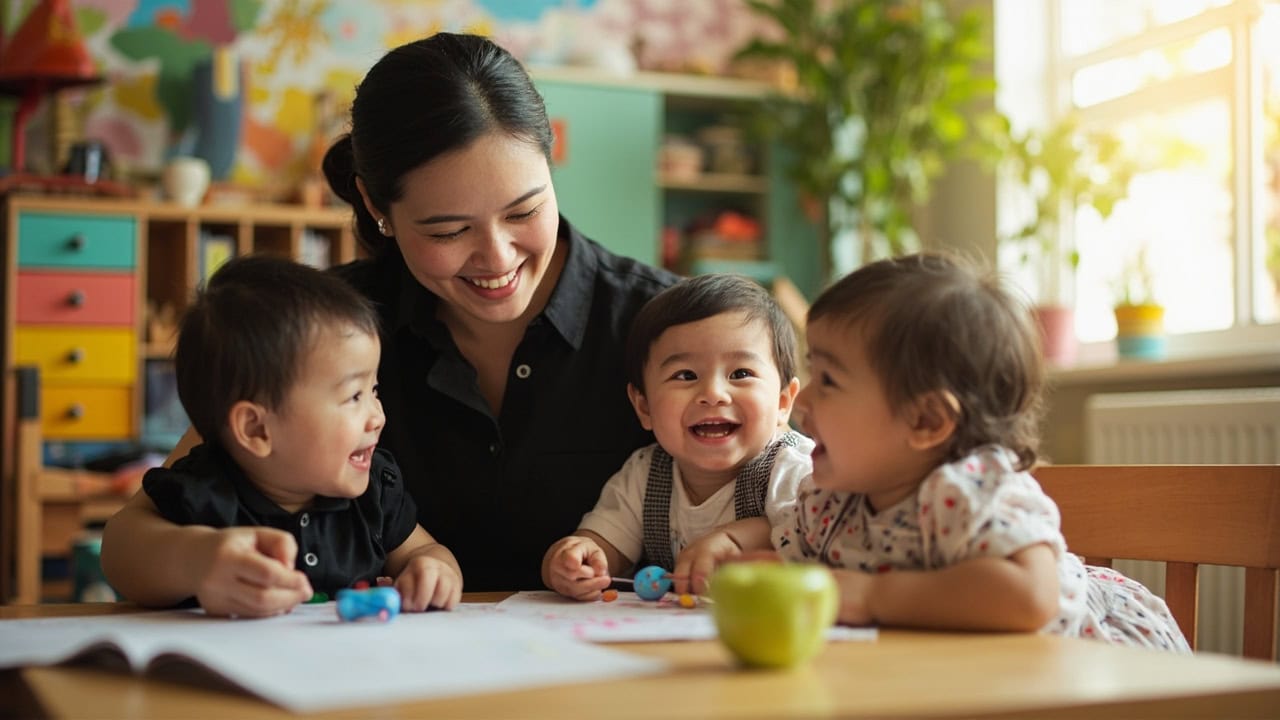
In a genuinely responsive environment, the caregiver pauses. Kneels down. Gives the toddler their full attention. They listen. They respond. They make the child feel that what they wanted to say mattered.
This is not about perfection. No caregiver is available every moment of every day. But the frequency and quality of these pauses reveal something: the difference between managing a schedule and being genuinely in relationship with the children.
Reading the Environment: What the Room and Language Tell You
There is something specific that every parent can learn to hear: the way caregivers speak to children when they do not know a parent is listening.
The language of a childcare environment is one of its most honest indicators. You can learn a great deal by simply standing near a room—not entering, not interrupting—and listening to the quality of speech directed at the children.
Listen for questions rather than commands. Listen for explanations rather than corrections. Listen for a tone that treats the child as a person with inner states—frustration, curiosity, exhaustion, wonder—rather than a small person who needs to comply.
In genuinely excellent care, you will hear caregivers narrating what they observe rather than only directing what they expect. You will hear language that expands a child’s world:
- “I see you found the blue one.”
- “You worked so hard on that.”
- “Can you tell me what you’re feeling right now?”
This is not scripted warmth. This is a caregiver who genuinely understands that speech is a primary tool of development, and who uses it accordingly.
In contrast, environments where the dominant mode is commands and corrections—”No,” “Stop,” “We don’t do that here”—reveal an underlying philosophy that prioritizes order over understanding. Language is not a decoration. It is the medium through which your child’s cognitive and emotional world is being shaped, eight or nine hours a day.
The Children Show You
When you walk into a childcare space—any childcare space—before you look at the walls, before you look at the materials, before you read the parent handbook, look at the children.
Are they comfortable in their bodies? Do they move through the space with a kind of ease, or do they seem watchful, restrained, waiting to be told what to do next?
Watch for genuine play—sustained, focused, imaginative. Not just children in a room, but children who are invested. Children who return to the same activity day after day because it means something to them.
Curiosity is one of the most reliable signals of healthy development in the early years. A child who approaches new materials, who experiments, who asks questions with their whole body—that child is in an environment that supports growth.
Watch for ease with the caregivers. Do the children move toward the adults when they need something, or do they avoid them? Do they seek eye contact, or do they look away?
The child-caregiver relationship in the early years is the template for all future relationships. If your child is afraid of the people who care for them, that is not a small problem.
When you visit a childcare setting, ask to simply observe. Not to be given a tour. Not to be shown the best room on the best day. To sit, if only for ten minutes, and watch the children. They will tell you everything you need to know.
What Genuine Excellence Looks Like
There is a distinction that I want to make carefully, because it is one of the most common places where parents are misled. It is the difference between impressive and excellent.
What Impressive Looks Like
An impressive childcare environment shows you beautiful rooms. Immaculate surfaces. Children in neat uniforms who sit quietly when they are asked to sit quietly. A curriculum that can be explained in polished terms. A director who speaks confidently about outcomes and milestones.
All of this can be real. But it can also be performance.
What Excellent Often Looks Like
An excellent childcare environment may look less impressive on first glance. The rooms may be well-used rather than pristine. The children may be noisy and absorbed in ways that look chaotic until you understand that they are deeply engaged. The caregivers may not have a presentation prepared for you, because they are busy being present with the children.
This is not to say that impressive environments cannot also be excellent. But the risk is that parents evaluate what they can see and measure—the facility, the schedule, the credentials—and miss what is actually happening in the relationships and the room.
Quality in early childhood care is often quiet. It shows up in freedom, not just structure. It shows up in a child’s genuine engagement, not their compliance. It shows up in caregivers who are warm and attentive, not just professionally courteous.
If you are evaluating a setting, ask to visit at an unscheduled time. After rest time. During outdoor play. During a transition that did not go smoothly. The real nature of an environment reveals itself in the moments that have not been prepared for you.
And if a centre is hesitant to allow this, that is itself information.
Giving Language to What You Already Know
There is often a gap between what you sense and what you can articulate. You have a feeling about a place, but when someone asks you why, you struggle to put it into words.
I want to tell you that this feeling is not a weakness. It is intelligence. Your nervous system is registering data that your conscious mind has not yet organized. The problem is not that you cannot trust yourself. The problem is that you have not yet been given the language to translate what you already know.
When you learn the specific things to look for—the observation windows, the quality of caregiver speech, the children’s ease, the difference between impressive and excellent—you are not replacing your instincts. You are completing them.
And here is what this changes: it changes your relationship with the people who care for your child.
A parent who cannot articulate what they observe is limited to vague concerns and general impressions. A parent who has developed their observational skill can say specifically: “I noticed that during arrival yesterday, my child seemed hesitant in a way that was different from usual. Can we talk about what happened that morning?”
That is not a complaint. That is partnership. When you develop your eye for quality, you do not become a critic. You become a collaborator.
How EduNanny Singapore Was Built for This Kind of Care
EduNanny Singapore was built around what we believe quality childcare can be. EduNanny by BUTLER operates as part of the ECDA Childminding Pilot, and that reflects a philosophy of genuine responsiveness—not just a regulatory designation.
In the pilot structure, EduNanny maintains ratios that are designed for genuine attention—up to one caregiver for every three infants in some care configurations. This is not an accident. It is the architecture of responsiveness.
It is what makes the observation windows described in this article possible, because there is actually time and capacity to be present. When a caregiver has twelve children to manage, the forty-five second pause becomes impossible. When a caregiver has three, it becomes natural.
EduNanny offers pathways that include both home-based care and community or centre-based settings, with care blocks available across the working week. For families navigating the real logistics of Singapore life—dual-income households, long commutes, work schedules that do not bend easily—this practicality matters.
EduNanny is structured to be accessible within pilot fee frameworks, with CDA and Baby Bonus support available, so that quality care is not only available to families with unlimited resources.
Equipping Parents to See
But what EduNanny most believes is this: they do not ask you to trust them blindly.
EduNanny operates with communication practices and transparency measures designed to keep parents informed. Where CCTV measures are deployed, they are deployed so that parents can see what is happening—not to surveil, but to connect. To know. To have the evidence that allows your observations to align with what is actually occurring in your child’s day.
This is the difference between asking parents to believe and equipping parents to see. EduNanny believes that when parents can see clearly, they make better decisions, they become better partners, and their children benefit.
Common Concerns, Addressed Directly
What if I visit and still cannot tell? A visit where you feel confused or uncertain is still data. It tells you that the environment was not transparent enough for you to read it clearly. A genuinely excellent environment should feel readable, even if you do not have expert training.
What if my child seems fine but something is wrong? Children adapt. They can seem fine in environments that are not serving them well, especially in the short term. This is why observing over time matters. Changes in behavior at home—regression, anxiety, changes in sleep or eating—can be signals that something needs attention. Trust your observations across time, not just in single visits.
What if the centre seems great but my child does not want to go? Your child’s response is data. Some separation anxiety is normal. But persistent reluctance, dread, physical symptoms of distress—these are not things to dismiss. A good centre will take your concerns seriously and work with you to understand what is happening.
How do I know if the caregiver is genuinely warm or just professionally warm? Professional warmth is not bad. But it is different from genuine relationship. Watch whether the caregiver responds to your child the same way when you are there and when you are not. Watch whether your child seeks out the caregiver or avoids them. Over time, the difference becomes clear.
Your Action Steps for Evaluating Childcare in Singapore
Armed with what you now understand about quality, here is how to put it into practice:
- Visit at unscheduled times. Request to observe during outdoor play, after rest time, or during transitions. The unpolished moments reveal the true nature of an environment.
- Sit and watch the children for at least ten minutes. Before asking questions, before taking a tour. Observe body language, engagement, and the quality of play.
- Listen to caregiver speech from outside the room. Notice whether you hear questions, explanations, and warmth—or primarily commands and corrections.
- Notice arrival and departure. How does your child enter and leave? What is the quality of the caregiver’s greeting and farewell?
- Ask specific questions. Instead of “Is my child happy?” ask “What does a typical morning look like for my child?” or “What happens when my child is frustrated?”
- Trust your nervous system. If something feels off, it may be. Ask yourself what specifically feels off, and observe whether others notice it too.
- Return for a second visit. First impressions can be misleading in both directions. A second visit gives you more data.
You Are That Anyone
Every parent in Singapore is more capable of recognizing excellent childcare than they have been led to believe.
You do not need to be a teacher. You do not need a degree in child development. You need only to develop your own capacity to observe—deliberately, patiently, and with attention to what actually matters.
The observations described in this article are not complicated. They are learnable. And the parent who learns them gains something that no brochure can provide: the ability to know, with genuine confidence, whether their child is in a place that deserves the trust they are placing in it.
This is not just about choosing childcare. It is about engaging with your child’s development over the years ahead. The parent who observes well asks better questions. Notices changes sooner. Partners with caregivers more effectively. Understands their child’s inner world more completely.
The skill of seeing quality compounds. Month by month, year by year, you become a more perceptive observer of what your child needs and who they are becoming.
And that attention—your attention—is the most powerful thing you will ever bring to your child’s life.
Not because you will be perfect. Not because you will never worry. But because you will no longer be guessing. You will be seeing.
And when you see clearly, you can act with wisdom. You can trust with knowledge. And you can give your child the one thing that no curriculum and no centre can provide alone: the experience of being truly seen by someone who knows what to look for.
Quality childcare is not a mystery to be solved by experts. It is a living reality, happening every day, in rooms across Singapore, that is visible to anyone willing to look.
You are that anyone.
And your child is counting on you to see.
Ready to explore what quality care looks like in practice?
Learn more about EduNanny Singapore—where ratios are designed for genuine responsiveness, transparency is built in, and parents are equipped to see what matters. You can also read about EduNanny’s approach to infant care and childminding within the ECDA Childminding Pilot, or connect with the team to discuss what your family needs.
#ChildcareSingapore #InfantCareSG #EduNannySingapore #ChildmindingSG #QualityChildcare