What Singapore Parents Notice in Quality Childcare
Trusting Your Observations: What Parents Already Know
Here is what most parents do not realize: you are already capable of recognizing quality when you see it. You have always been an observer. You noticed the way your mother’s voice changed when she was worried versus when she was simply tired. You read your partner’s moods before they spoke a word. You know when your child is genuinely happy versus performing happiness for an audience.
These are not instincts you invented. They are capacities you have been developing your entire life.
The question is not whether you can observe quality. The question is whether you have given yourself permission to trust what you observe.
In Singapore, you have access to more reviews, more comparisons, more advice than any generation before you. What you may be underserved in is the skill of discernment—the ability to look at what is in front of you and to trust what you see.
That is what we want to help you build today. Not a replacement for your care, but a sharpening of your attention.
What to Look and Listen For
Walk into any childcare environment and your eyes will take in far more than you consciously process. The arrangement of furniture. The height of shelves. Whether the books are organized or chaotic. Whether there are more plastic toys or natural ones. Whether the lighting is fluorescent and harsh or warm and considered.
These details matter not because they are decisive on their own, but because they reveal something about the philosophy that governs the space.
Watch Caregiver Bodies
But the most important thing you will see is not a thing at all. It is bodies.
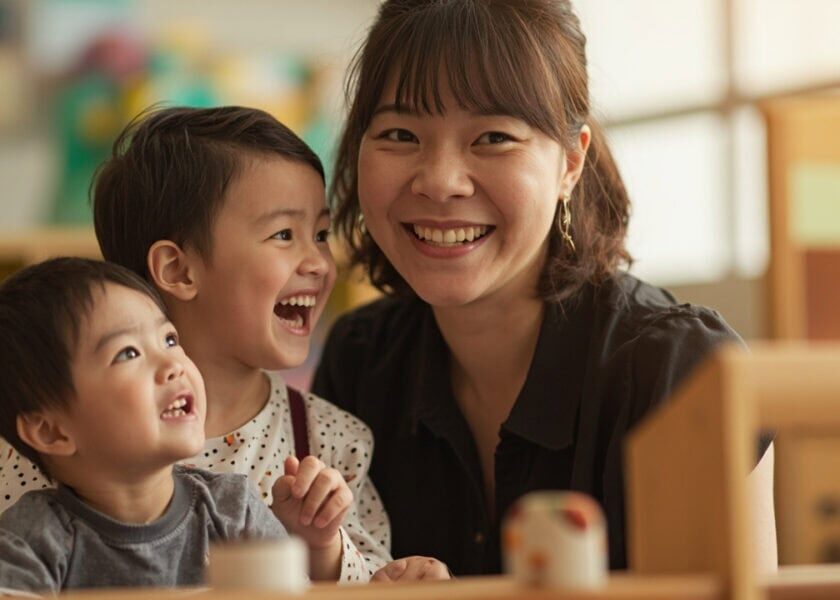
Watch a caregiver kneel. Not bend, not crouch from the waist while remaining mostly upright, but truly kneel, bringing herself to the eye level of the children in her care. When an adult kneels to speak with a child, she is not performing respect. She is practicing it. She is making a physical choice to stop being an authority and to become a companion.
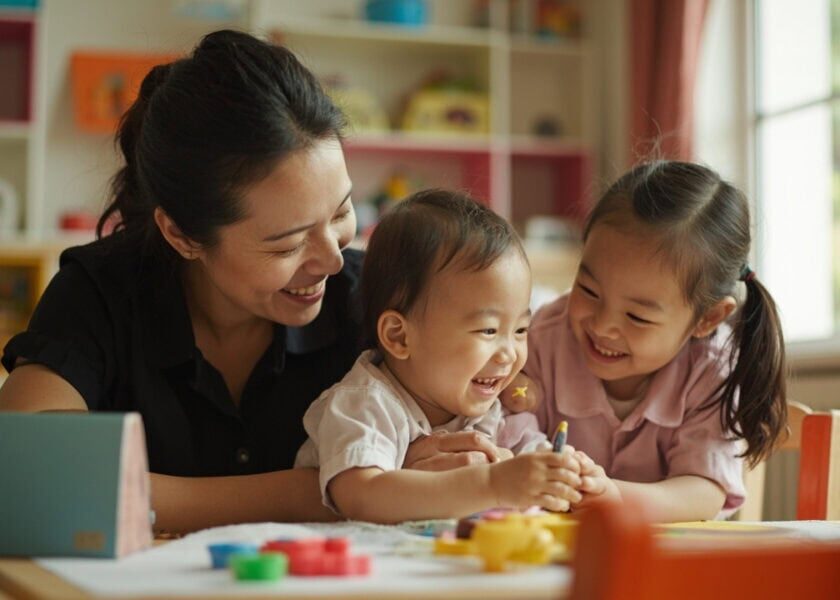
Notice her hands. Are they gesturing broadly while her eyes are somewhere else? Or are her hands quiet, purposeful, currently resting on a child’s shoulder or helping a small body navigate a step? Hands that are truly present with children are often the most still. They are not conducting an orchestra of tasks. They are responding to what is actually happening in front of them.
Observe her face. Watch for the micro-expressions. When a child approaches, does her face shift in recognition? Does she register the child, even the small ones who have not yet learned to speak? Or does she offer a reflexive smile that is aimed at you, the visiting parent, and then flickers away the moment your attention moves?
Listen to the Room’s Rhythm
The acoustic environment tells you a great deal about the rhythm of care that is practiced there.
A room that is too quiet—where the only sounds are the commands of adults and the compliance of children—is a room where children’s voices have been subdued. That suppression can be subtle. It does not require shouting or punishment. It requires only that children learn, over time, that their spontaneous sounds are not welcome.
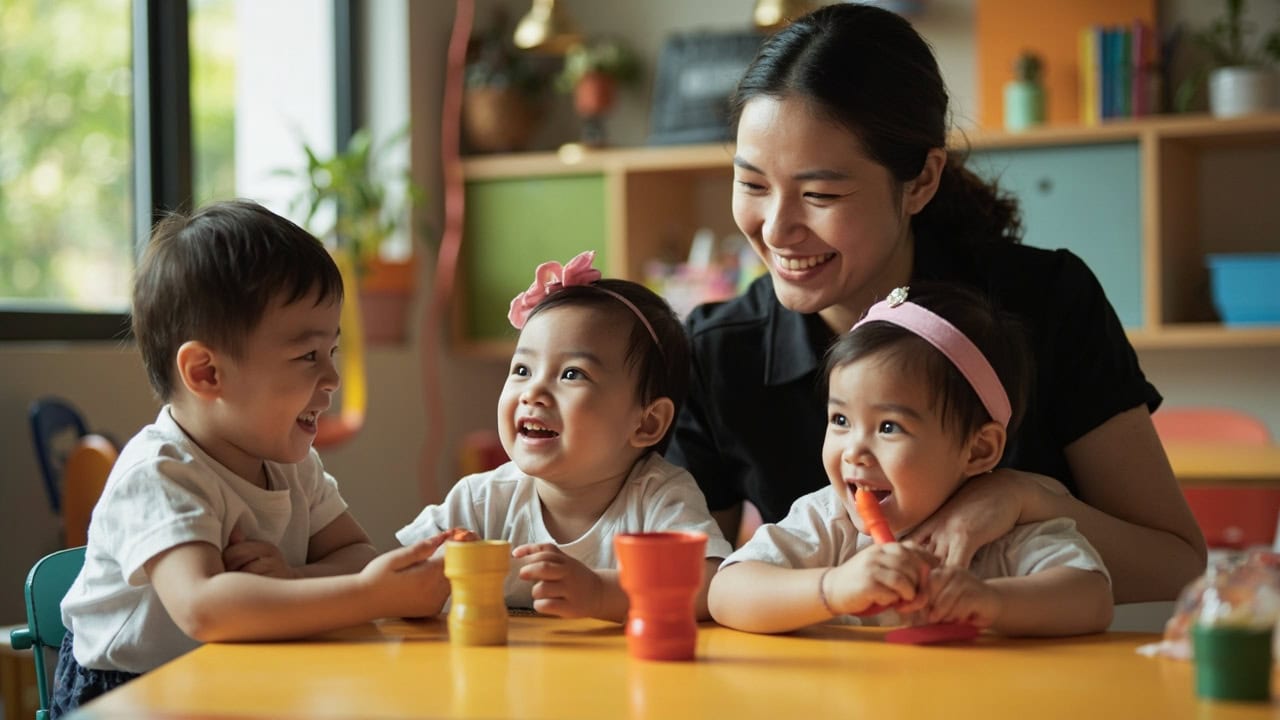
A room with healthy sound is not necessarily loud. It is varied. You will hear children negotiating. You will hear a caregiver narrating what she is doing rather than commanding what others should do. You will hear laughter that is not prompted, and you will hear the particular silence that falls when a child is genuinely absorbed in something.
Listen for the difference between “Stop that” and “I see you want to roll the ball, but this is the book space. Would you like to roll it over there?” One communicates control. The other communicates relationship.
Feel the Room’s Energy
This is the most undervalued sense in the evaluation of childcare, and yet it may be the most reliable.
You walked into a room and something shifted in your body. Perhaps your shoulders dropped. Perhaps you felt a small release of tension that you did not realize you were holding. Or perhaps you felt something tighten—a subtle alertness, a sense that something in the environment was not quite as it appeared.
That feeling is data. Trust it. Not blindly, not without investigation, but as a starting place. The nervous system is exquisitely calibrated to detect safety and its absence.
Spend time in the space. Do not rush. If possible, return more than once, at different times of day. A space that holds its warmth only during your scheduled observation is a space that is performing. A space that feels genuinely warm across different moments is a space that has likely cultivated that warmth as a practice, not a presentation.
Performance Versus Genuine Care
There is a distinction that separates genuine quality from polished presentation, and it is the distinction that most parents struggle to articulate.
Performance is what you see when the caregiver knows she is being observed. Performance is the scripted warmth, the excessive enthusiasm, the careful positioning of bodies for your benefit.
Performance is easy to spot once you know what you are looking for: it is consistent in a way that genuine attunement is not, because genuine attunement is responsive to what is actually happening and therefore varies. Performance does not vary. It holds.
Genuine care, by contrast, is observable in its imperfection. You will see moments of frustration, though hopefully managed well. You will see a caregiver who does not have every answer. You will see interactions that are not optimized for your approval but are instead optimized for the child’s actual needs in that moment.
This imperfection is not evidence of poor care. It is evidence of real care—care that is oriented toward persons rather than appearances.
A Framework for What to Look For During a Visit
Not as a checklist, but as a map.
1. Observe the caregiver with a child who is not seeking attention
In every room, there are children who are happily occupied and children who are demanding. The untrained observer watches the demanding child and the caregiver’s response. The trained observer watches the caregiver’s response to the child who does not need anything in that moment.
Does she intrude on the independent play? Or does she hover at the periphery, available but not intrusive, honoring the child’s focus?
2. Observe transitions
Transitions are where quality is most revealed, because they are where the most must be managed and where routines either hold or collapse.
Watch how children move from one activity to another. Watch how a caregiver manages the group without managing it through force. Is there a song? A routine? Does the caregiver notice the child who is struggling and offer individual support? Or does she simply move on?
3. Observe the caregiver when she is not interacting with a child
What does she do during the in-between moments? Does she scroll through her phone? Does she have quiet conversations with other adults? Or does she use those moments to prepare the next activity, to observe the children at rest, to simply be present in the space?
The way a caregiver inhabits her own presence tells you a great deal about how she inhabits her work.
4. Observe how the caregiver responds to distress
Not the controlled, managed distress of a minor upset, but genuine distress—the kind that a child brings when something has genuinely gone wrong in his small world.
Does the caregiver meet that distress with impatience or with patience? Does she attempt to extinguish it quickly, or does she allow the child to feel what he is feeling while offering steady companionship?
The goal is not a child who never cries. The goal is a child who learns that his feelings are safe to have and that a trusted adult will stay with him while he has them.
What Your Child Is Telling You
Notice how your child responds to being in the space. This is not about whether your child cries at drop-off.
Children cry at drop-off in excellent childcare environments because they are human beings with legitimate attachments and legitimate separations. What matters is what happens after the initial separation:
- Does your child settle?
- With whom?
- Toward what activities does your child gravitate?
- Does your child seek out specific caregivers or specific corners of the room?
- Does your child’s body look relaxed or tense in the way it moves through the space?
Your child’s body is telling you something. The skill is learning to listen.
Perhaps you are sitting with all of this information and feeling slightly overwhelmed. Here is what I want you to hear: you do not need to be a childcare expert to recognize quality. You need to be a person who is paying attention. And you are already paying attention. That is why you are reading this.
What we are offering you here is not a replacement for your care. It is a sharpening of your attention. It is a way of organizing what you already know how to see so that you can trust it.
EduNanny’s Approach to Quality Childminding
EduNanny was built with this parent in mind.
Our approach begins with partnership, not prescription. When you work with EduNanny, you are not simply hiring a childcare service. You are entering into a relationship with professionals who understand that the long-term quality of your child’s care depends not just on what we do, but on how well you learn to evaluate what we do.
We want you to watch us. We want you to notice. We want your scrutiny to make us better, and we want your observations to make you more confident.
Our Model
Our childminders are trained not only in the practical requirements of infant care, but in the philosophy of attunement. When you see one of our caregivers with your child, you should see what we see:
- A person who has learned to kneel
- Who has learned to wait
- Who has learned to notice before she responds
- Hands that are still when stillness serves the child, and active when activity is needed
- A voice that narrates rather than commands, that asks rather than instructs
What This Means Practically
| Aspect | What We Maintain |
|---|---|
| Ratios | Home-based settings: up to 1 caregiver to 3 infants, because we believe the relationship cannot be healthy when diluted by numbers |
| Pathways | Home-based, community-based, and centre-based options, all applying the same principles of attentiveness |
| Schedule | Monday to Friday care blocks, because predictability serves children better than fragmentation |
| Accessibility | CDA and Baby Bonus usability, because quality childcare should not be available only to those who can afford premium pricing |
| Accountability | Transparency measures including communication practices and CCTV where deployed, because trust must be built on evidence, not faith |
We are part of the ECDA Childminding Pilot, which means our model has been reviewed and recognized for its commitment to quality at ratios that allow for genuine attention.
The Future You Are Building
In the first thousand days of your child’s life, the architecture of connection is being laid down in ways that will influence not just this year, but every year that follows. The quality of care your child receives during this period shapes the capacity for relationship, for learning, for resilience that your child will carry into adulthood.
But here is what we believe equally strongly: the quality of care your child receives is not something that happens to you. It is something you participate in.
The parent who observes, who questions, who develops the skill of noticing, who refuses to settle for performance when she knows what genuine care looks like—that parent is not a passive consumer of childcare services. She is a collaborator in her child’s development.
She is someone who is teaching her child, by example, what it means to be present, to be attentive, to be the kind of person who truly sees other people.
When you choose childcare with your eyes open, you are not just choosing a service. You are modeling for your child the value of discernment, the courage to trust your own observations, and the humility to keep learning.
The fear that you feel in the drop-off moment—the worry that you will miss something, that you will choose wrong, that something terrible will happen while your child is away from you—that fear is not a weakness.
It is the expression of love in a form that our modern lives require us to manage rather than resolve. You cannot eliminate the vulnerability of handing your child to another. You can only build the capacity to evaluate who deserves that trust.
You are not just choosing childcare. You are becoming the kind of parent your child needs.
Ready to experience childcare where your observations are welcomed?
Schedule a conversation with EduNanny — so you can visit, watch, and trust what you see.
Learn more about EduNanny’s approach