From Play to Readiness: How Quality Childcare Shapes Executive Function
The Silence Every Singapore Parent Knows
There is a particular kind of silence that every Singapore parent knows.
It is the silence of the morning handover. The moment you pass your child from your arms to someone else’s, and for a brief, ordinary instant, your child disappears into a world you cannot follow. You trust the hands you are leaving them with — you have done your research, asked your questions, perhaps visited the space more than once. But trust, as every parent knows, does not silence the wondering.
What happens in those hours? What are they learning? Are they growing? Are they safe — truly safe — and is safe enough?
This question does not arrive with alarm or crisis. It arrives in the quiet of your workday, in the middle of a meeting, in the moment your phone buzzes with a photo you requested but cannot fully interpret. It arrives in the soft anxiety that has no name, the wondering that feels almost unfair to voice because you have chosen this, you believe in this, and yet.
And yet.
This article is for every parent who has stood in that silence. Who has wondered what their child is doing in the hours they are not there. Who has felt, beneath the confidence and the logistics and the very real gratitude for quality care, a small persistent question: is this time well spent? Is my child learning something that matters?
Here is what we want you to know. That question is not a sign of doubt. It is a sign of discernment. And the answer — the real one, the substantive one — is this: yes. Your child is learning. And what they are learning in quality childcare may be the most important education they ever receive.
Quality Childcare Is Not a Waiting Room
Let us begin with a reframing, because the way we talk about childcare has obscured what childcare actually does.
We speak of childcare as a service. A solution to the problem of working parents. A safe place where children are kept occupied while adults do what adults must do. This framing is understandable — it is practical, it is true in the most surface sense, and it has served the industry well enough. But it has hidden something extraordinary in plain sight.
Quality childcare is not a place where children wait for their parents to return. It is a place where children grow.
We do not mean growth in the abstract, aspirational way. We mean growth in the precise, measurable, scientifically documented sense. We mean the architecture of the developing brain — still among the most extraordinary phenomena in human biology — being actively shaped by every interaction, every routine, every moment of responsiveness, in the hours you are not watching.
This is what quality childcare actually builds:
- Executive function — the cognitive skills that allow a child to regulate thoughts, emotions, and behaviors, developed through responsive relationships and guided play, not worksheets.
- Emotional regulation — the ability to carry feelings across contexts, transition smoothly, and find equilibrium in new environments.
- Foundations of attention — the ability to focus, persist, and manage frustration; skills that matter more for school success than early academic knowledge.
- Social intelligence — perspective-taking, cooperation, and the recognition that other people have thoughts and feelings that differ from your own.
The most important learning in quality childcare does not look like education. It looks like a child playing. And that is precisely the point.
What Children Actually Learn in Those Hours
Consider what actually happens in a morning at quality childcare.
A child arrives. There is a transition — from the energy of the home drop-off, the parent’s lingering attention, into the social space of the group. This transition, which might last ten minutes or twenty, is not downtime. It is a lesson in emotional regulation. The child learns that feelings can be carried from one context to another, and that it is possible to arrive in a new place and find equilibrium there. This is absorbed. It becomes part of the child.
Then there is the rhythm of the morning — free play, guided activity, snack time, movement. At each transition, something is being built. The child who learns to transition smoothly is building the foundations of attention. Attention, as neuroscientists have confirmed across decades of research, is not a fixed trait. It is a skill, and like all skills, it develops through practice. The classroom of quality childcare provides that practice, hour after hour, day after day.
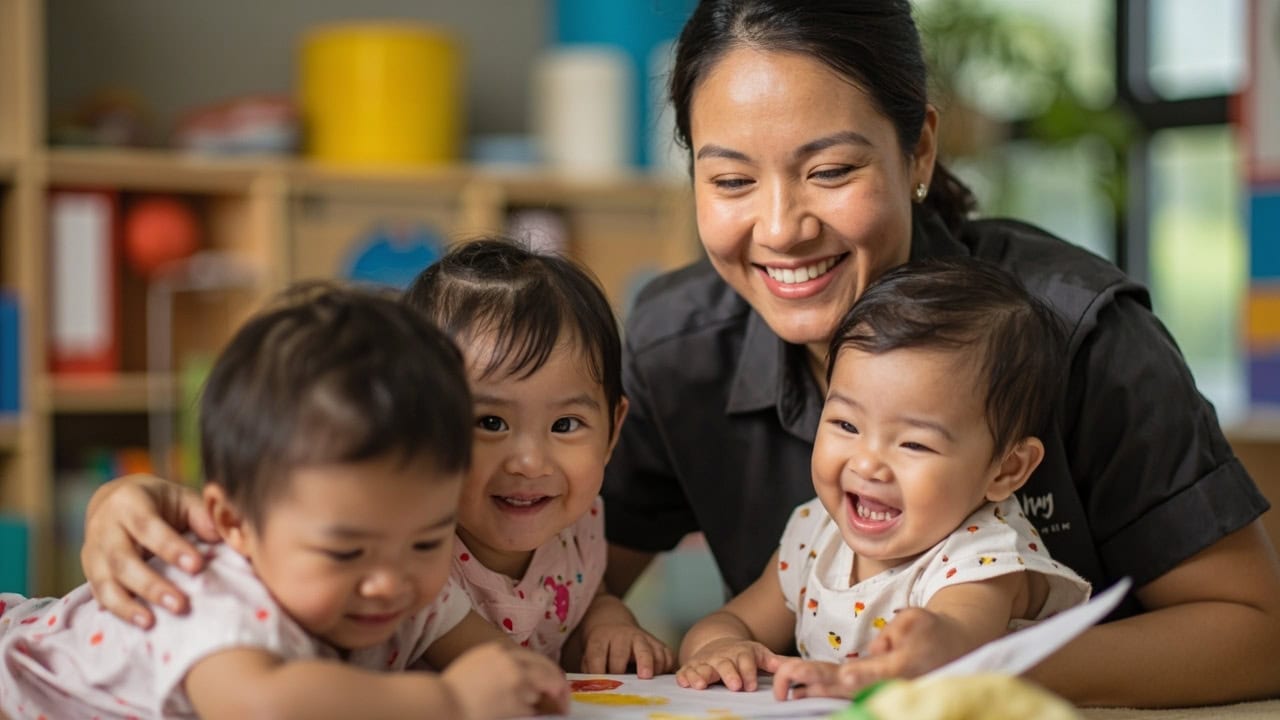
During free play, the child is not merely occupying time. A block tower that falls teaches physics and persistence. A play dough conversation with another child teaches perspective-taking. A caregiver who narrates what the child is doing — “I see you’re building a bridge” — is not simply commenting. They are modeling language, validating the child’s thinking, and signaling that the child’s inner world matters to someone outside the family.
This is the hidden curriculum of quality childcare, and it is invisible precisely because it does not look like education. There are no worksheets. No textbooks. No formal instruction. There is a caregiver who understands child development deeply enough to create an environment where learning happens as naturally as breathing — because for the developing child, it does.
The Invisible Classroom: Why Executive Function Matters
There is a concept in child development that Singapore parents should know, because it explains something essential about why the early years carry such weight.
Executive function.
Executive function is the set of cognitive skills that allows a human being to regulate their own thoughts, emotions, and behaviors. It includes:
- Working memory — the ability to hold information in mind and use it
- Inhibitory control — the ability to resist impulses, to pause before acting
- Cognitive flexibility — the ability to shift attention, to adapt to changing demands, to see problems from multiple angles
These skills do not appear in school reports. They do not show up on assessments in any formal, standardized way. And yet, researchers who study school readiness — who have followed children from early childhood into adolescence and adulthood — have found something remarkable. Executive function in the early years is a stronger predictor of academic success than IQ. It is a stronger predictor of social competence, emotional resilience, and long-term health outcomes than almost any other measurable factor.
Why? Because executive function is what allows a child to sit still and listen. To hold a set of instructions in mind while beginning a task. To manage the frustration of not knowing something immediately. To notice when they have made an error and correct it. These are not academic skills. They are pre-academic skills. They are the skills that make learning possible.
They are built in the moments when a caregiver notices that a child is becoming frustrated and offers just enough support to help them through — not solving the problem, but staying close enough that the child feels safe to keep trying. In the moments when a routine creates predictable structure that allows the child to invest attention in the present. In the moments when a peer conflict arises and a skilled caregiver guides children toward a resolution that validates everyone’s feelings.
This is education. It is the deepest, most consequential education a child will receive, and it happens in the years before anyone would call it school.
What to Look For: Recognizing Quality in Practice
So how do you know? How do you recognize the invisible classroom when you are standing in it, on a tour, with a toddler tugging at your hand and a checklist you are not quite sure how to use?
Responsiveness
Watch how caregivers interact with children when a child approaches with a question, a need, a small distress. In a quality environment, the response is warm, immediate, and appropriate. The caregiver comes down to the child’s level — not literally, perhaps, but in spirit. They acknowledge what the child has communicated. They take the child’s perspective seriously. This is not mere kindness. It is the fundamental transaction of secure attachment, and it is the soil in which all learning grows.
Language
Not the scripted language of routines, though routines matter, but the spontaneous, responsive, conversation-rich language that flows between caregiver and child throughout the day. When you visit a childcare environment, listen. Is there conversation? Are children being spoken to as thinking, feeling human beings, or are they being managed?
Play
Watch how children use the space. Are there materials that invite investigation, creation, imagination — blocks, art supplies, natural materials? Is the environment arranged to encourage both independent exploration and social interaction? Is there room for mess, for noise, for the productive chaos that signals genuine learning?
Ratios
The number of children per caregiver in an infant room is not an administrative detail. It is the single greatest determinant of whether your child receives the individualized responsiveness that early development requires. When ratios are appropriately low, every child can be known, seen, and responded to as the individual they are.
Trust as Practice
This means communication. This means knowing, at the end of each day, what your child did, how they felt, what they explored. Trust in quality childcare is not a feeling. It is a practice, built through daily transparency.
When you visit, observe:
- How do children move between activities? Smooth transitions indicate strong foundational development.
- Are caregivers talking with children, not at them? Is there back-and-forth conversation, or mostly commands?
- When a child approaches a caregiver, what happens? Is the child seen, heard, and responded to with warmth?
- Ask about infant ratios specifically. Low ratios mean individualized attention.
- Check communication systems. How will you know what your child did today?
- Trust your instincts. If something feels warm, attentive, and alive — pay attention to that too.
Addressing What Singapore Parents Actually Wonder
Singapore parents face pressures that are, in many ways, unique. The demands of dual-career households. The intensity of academic expectations. The high cost of living. The social context in which education is understood as the primary pathway to opportunity. These pressures shape everything — the decisions parents make about childcare, the criteria they use to evaluate options, the guilt they carry when those decisions feel like compromises.
These concerns are valid. And they deserve honest answers.
“Am I choosing convenience over my child’s development?”
You are not. The research is unambiguous: quality childcare provides developmental experiences that complement and, in some respects, exceed what can be provided at home alone. Children in quality care environments build social skills, emotional regulation, and executive function through peer interaction and skilled guidance. These are not things you are trading away by returning to work. They are things you are investing in.
“What does quality childcare have to do with school readiness?”
The conversation about school readiness typically focuses on what a child knows. Letters, numbers, colors, shapes. And these things matter — quality childcare programs do cultivate them, often in ways that are more effective than premature formal instruction.
But what predicts a child’s success in Primary One is not primarily what they know. It is who they are.
The child who enters Primary One with strong executive function — with the ability to attend, to persist, to manage frustration, to navigate social dynamics, to adapt — will learn what they need to know. They will catch up on content that other children arrived knowing. They will not be derailed by the cognitive demands of formal schooling because their foundational capacities are intact.
“How do I know if I’m making the right choice?”
The parent who wonders, who questions, who feels the weight of the hours they are not present — this parent is paying attention. This parent is taking the long view, thinking about what is truly best, refusing to settle for the merely adequate.
That anxiety does not have to be a source of guilt. It can be a source of clarity. Because the anxiety is pointing you toward something real: your child’s early years matter enormously. The hours in which you are not present are not lost hours. You have a choice about how your child spends those hours, and that choice is one of the most important you will ever make.
Singapore’s Commitment to Quality Early Childhood
Singapore has produced something remarkable in its approach to early childhood. The government has recognized, with increasing clarity over the past decade, that the early years are not merely a precursor to formal education. They are education.
The ECDA Childminding Pilot is one expression of this recognition — an acknowledgment that childcare is not a private family concern but a public good, and that supporting quality in this sector is an investment in the kind of society Singapore wants to become.
Within this ecosystem, EduNanny offers families thoughtful pathways through Singapore’s early childhood landscape — both home-based and community-based options, because every family is different, and the best childcare is the one that fits your life rather than requiring your life to fit it.
What distinguishes quality providers in this space goes beyond philosophy. It shows up in concrete ways: infant ratios kept low because the ratio is not a technical specification but a statement about values; care schedules aligned with the rhythms of working family life; fee structures designed to be accessible so that quality is not a privilege available only to those who can afford premium private arrangements. For those who qualify, CDA and Baby Bonus funding can be applied, because the administrative realities of childcare should be as manageable as possible.
Then there is communication. Parents should know what their child did today, how they felt, what they explored. The invisible classroom should not be invisible to you. And caregivers — they are not staff to be managed. They are educators, and quality providers understand that their selection, training, and ongoing support is not overhead. It is the product. The child whose caregiver is respected, supported, and skilled is the child who thrives.
The Early Years Are Not a Waiting Period
Let us close with what matters most.
The early years are not a waiting period. They are not a gap to be filled until real school begins. They are the years in which everything that matters is being built — the neural architecture, the emotional patterns, the social capacities, the curiosity and the confidence that will carry your child through a lifetime of learning.
You cannot be present for all of it. No parent can. But you can choose who is present in your absence. You can choose an environment that sees your child as a learner, not just a child to be supervised. You can choose a place that understands what is happening in those hours, and that is actively shaping it.
When parents ask what quality childminding does, one honest answer is this: it teaches. In the way that matters most — in the moments no one labels, in the interactions no one documents, in the quiet accumulation of a thousand small experiences that add up, over time, to a human being who is ready. Ready to learn. Ready to grow. Ready for whatever comes next.
That is the invisible classroom. And it may be the most important place your child will ever be.
If you are researching infant care or childminding in Singapore, explore what quality looks like up close. Visit. Ask questions. Watch. Trust the discernment that brought you this far.
The silence you carry when you drop your child off does not have to be a source of quiet worry. It can be the beginning of something else — a recognition that the hours apart are not lost hours, but meaningful ones. That the invisible classroom is real. That your child is not waiting for you to return.
They are growing.
Learn more about EduNanny’s approach to infant care and childminding in Singapore. The early years matter more than most parents realize — and finding the right support can make all the difference.