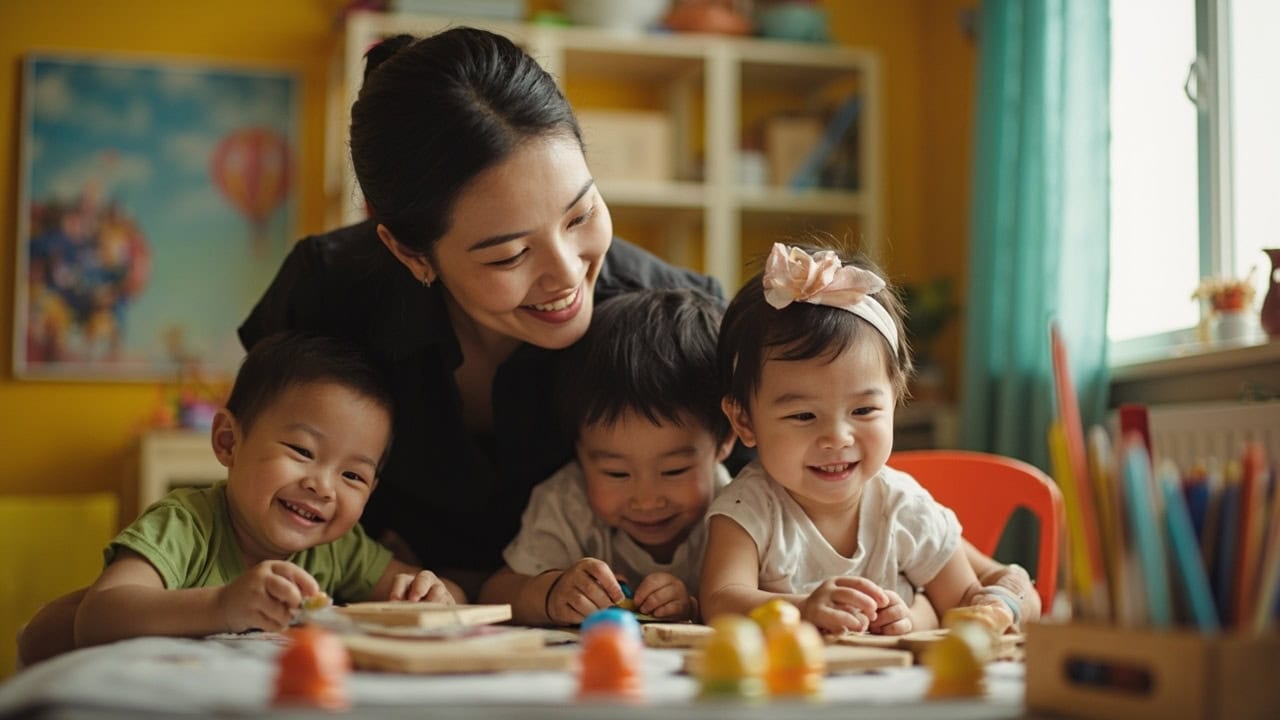
What Singapore Families Build After Enrolling in Childcare
The Quiet Season After Choosing Childcare: What Smart Singapore Parents Do Differently
There is a moment that arrives quietly after you have made your choice. The enrollment forms are signed. The visits are complete. The decision, which once felt like the weight of the world, is behind you.
And yet something lingers. A wondering. A quiet question that does not announce itself loudly but sits there, just beneath the surface: what now?
You chose well—or at least you chose with care. But the forms are signed, the deposit is paid, and your child will be in someone else’s arms tomorrow morning. And suddenly the research forums and the comparison spreadsheets feel very far away.
What replaces them is something more human and more honest: the wondering of a parent who has made a big decision and is not quite sure what to do next.
This is the season most guides skip over. They help you choose. They do not tell you how to live in that choice. This article is about what comes after—because that is where most of the story lives.
Why Singapore Families Excel at Choosing—Yet Feel Unprepared for After
In Singapore, we have built an impressive ecosystem to help families find childcare. Parent forums and centre reviews. Frameworks for evaluating teacher qualifications, student-to-caregiver ratios, and curriculum structures. CompareTheScholarship. KiasuParents. Friends who have been through it and want to share everything.
This ecosystem is genuinely useful. But it is almost entirely focused on one phase: the choosing. Once you sign the form and take your child home from the orientation visit, most families are on their own.
There is no guide for the daily practice of showing up as a parent in a relationship that extends beyond your home. No framework for building trust with the person who holds your child when you cannot. That gap is real. And it leaves many parents quietly adrift, wondering if they should be doing something more—or something less—without any language for what that looks like.
The families who feel most confident and connected in their childcare arrangements are rarely those who simply chose the “right” programme. They are the ones who understood that care is not a product you purchase and leave to function on its own. Care is a living thing. It breathes and shifts and deepens with attention.
Choosing well matters. But choosing is not an ending. It is an invitation. And what you do with that invitation—the way you tend the relationship, the rituals you build, the honesty you bring to the partnership—will shape not only your peace of mind but the quality of care your child actually receives.
The Silent Weight: Naming the Anxiety That Follows Enrollment
There is something I want to name before we go further, because I think it is the silent weight that many of you carry.
When you placed your child in care for the first time—or made the transition from one arrangement to another—there was likely a mix of emotions. Relief that the search was over. Gratitude that you found something that felt safe and warm. And alongside those feelings, perhaps, a small thread of doubt you have not quite been able to put down:
- Am I doing the right thing?
- Should I be here more?
- Should I step back and trust them?
- Am I interfering if I ask too many questions?
- Am I disengaged if I do not?
This is the anxiety-adjacent territory nobody warns you about. It is not dramatic. It does not announce itself in crisis. It is the quiet uncertainty that hovers on the edges of your days. The wondering, after you drop your child off, whether you should have kissed them longer. The question, at pickup, of whether you are reading the cues correctly. The slight hesitation before you send that message to your caregiver, wondering if it sounds micromanaging.
Here is what I want to tell you clearly: these feelings are not signs that something is wrong. They are signs that you care deeply. They are the natural companions of love and responsibility. The parent who feels nothing after enrollment is not more evolved. The parent who feels the full weight of this transition is simply paying attention.
But that quiet anxiety, when left without language or framework, tends to do one of two things. It either pulls you toward over-involvement—the daily check-ins, the excessive documentation requests, the need to know everything at every moment—or it pushes you toward withdrawal—the deliberate stepping back, the reluctance to communicate, the hope that silence means everything is fine.
Neither of these is inherently wrong. But neither is a practice. They are reactions. What I want to offer you is a different way: a path from reaction to intention, from uncertainty to grounded engagement.
Common Concerns Parents Carry
“Am I a bad parent for putting my child in care?”
No. The love you have for your child is not measured by the hours you spend with them. The families who raise connected, secure, thriving children are not the ones who never delegated any aspect of care. They are the ones who chose thoughtfully, engaged actively, and built a village that surrounded their child with attention.
“What if the caregiver and I disagree about how to do things?”
Disagreement is not dysfunction. It is the natural result of two people who care deeply about the same child. The key is not agreeing on everything. The key is having enough trust and communication to navigate differences with respect. “I have noticed she responds better when we do it this way at home—would it work to try it here too?” is a conversation, not a confrontation.
“I feel awkward imposing or being a bother. Should I just trust that they’ll tell me if something is wrong?”
Trust and communication are not opposites. A good partnership means both parties feel empowered to speak. If you are wondering whether to raise something, raise it. If you are unsure whether a question is too much, ask it. Partners ask questions. That is what partnership means.
“How do I know if the arrangement is actually working for my child?”
Look at your child. Not at the programme’s credentials or the reviews or the curriculum framework. Look at your child. Are they settling into routines? Do they show warmth toward the caregiver? Are they meeting developmental milestones? The best signal of a good care arrangement is a child who is thriving in it.
The Mindset Shift: From Consumer to Partner
The first shift I want to invite you into is this: stop thinking of yourself as the parent who chose a service and start thinking of yourself as a partner in a care ecosystem.
This reframe matters more than it might first appear. When you think of yourself as a consumer, the transaction feels complete once you have paid and enrolled. Your role is to evaluate and, if necessary, withdraw and re-choose.
But when you understand yourself as a partner—as a co-architect of the care experience—something opens up. You begin to see your participation as generative. Not burdensome. Not micromanaging. Not intrusive. But actively helpful to the people who are caring for your child.
The caregiver in your child’s life is not a replacement for you. They are an extension of the village it takes to raise a child. And like any village, its health depends on communication, respect, and shared purpose.
When you bring that energy to the relationship—when you approach the handover conversation as a meaningful exchange rather than a transactional one—you signal that this is a partnership of two people who both love the same child and who both want what is best for them.
This does not mean you need to become best friends with your caregiver. It does not mean you need to agree on everything. It does not mean the relationship will always be easy or seamless. Partnerships require work. They require forgiveness, patience, and the willingness to repair when things go wrong.
But the orientation matters. When you orient toward partnership rather than transaction, you create the conditions for something deeper than mere service. You create the conditions for genuine care.
Daily Rituals That Build Trust Without Adding Burden
Let me speak about the daily rituals that make this partnership real. Because this is where philosophy meets practice, and where many parents feel lost.
The Handover: More Than a Drop-Off
There is the handover. That brief window at the beginning and end of each day when your child’s care is literally being transferred between hands. In many arrangements, this moment is rushed. You are running late. The caregiver is managing the morning chaos. The exchange is a hurried report that nothing unusual happened.
But this moment deserves more than efficiency. It deserves intention. Not elaborate ritual. Not lengthy debriefs that add stress to already busy mornings. But a genuine, even if brief, presence. A moment where you and your caregiver meet as two people who care about the same small human.
Ask a question. Not “how was she?” but something specific:
- “Did she seem hungry before her nap today?”
- “What was she most drawn to in the morning?”
- “Is there anything I should know about how she’s been?”
These questions signal that you are paying attention. That you are not simply dropping off and forgetting. But they also invite your caregiver into a conversation that is about your child, not about logistics.
And when you receive information, receive it without judgment. When your caregiver shares something about your child’s day—the fussy afternoon, the new sound, the moment of wonder—listen with curiosity, not evaluation. You are not receiving a performance review. You are receiving a gift of observation. Another set of eyes on your child’s world.
When you honour that gift, when you receive it with openness, you build trust. Not dramatic trust that is announced and celebrated. But the steady, daily accumulation of trust that deepens over months and years.
Co-Observation: Sharing What You Notice
You are an expert on your child. No one knows their rhythms, their preferences, the meaning behind their cries, the texture of their joys. But your caregiver sees your child in a different context. In your home, your child is one version of themselves. In the care environment, surrounded by other children, they may reveal aspects less visible in the family context.
Co-observation is the practice of bringing these perspectives together. It is not about one person being right and the other being wrong. It is about recognizing that together, you have a more complete picture of the child.
When your caregiver notices that your child reaches for blocks in a particular way, or that they seem most settled after a certain routine, or that they have been working on a physical milestone with focus—that information belongs in your shared understanding. It enriches how you both respond to the child.
And the reverse is also true. When you notice something at home—a new word, a developmental leap, a change in sleep or appetite—sharing that with your caregiver allows them to meet your child in that moment with awareness. They are not starting from scratch each morning. They are continuing a story that you have been writing together.
This is not observation as checklist. This is not filling out developmental forms with anxiety. This is the natural, curious exchange of two people who love and know the same child. When it is oriented this way, it is not extra work. It is simply what partners do.
Reading the Health of Your Care Partnership—and Navigating Change
After months of partnership, you will develop an intuition about the health of your arrangement. But in the beginning, it helps to know what to look for.
Signs That Your Partnership Is Thriving
- Handover conversations feel like exchanges between two invested people, not routine reports
- Your caregiver shares observations proactively, without being prompted
- You feel comfortable raising a concern—and equally comfortable receiving an honest answer
- Both parties adapt when something is not working, rather than defaulting to silence or blame
- Your child shows signs of security—ease in transitions, genuine warmth toward the caregiver
- Information flows both directions; you are learning from each other, not just receiving updates
Signs That Something Needs Attention
- Handover becomes a checklist rather than a conversation
- You consistently feel anxious at pickup but cannot articulate why
- Your caregiver stops volunteering observations or seems guarded in responses
- Routines shift without any discussion
- You find yourself avoiding communication rather than engaging with it
If these signs appear, it does not mean the arrangement has failed. It means the partnership needs a conversation. The families who are most skilled at navigating this are not the ones who never face difficulty. They are the ones who have built the relational foundation to name what is not working and to co-create a new arrangement that serves everyone better.
Flexibility as Your Child Grows
As your child grows, this partnership will be asked to flex. New phases bring new needs. The infant who needed constant physical comfort becomes the toddler who needs autonomy and exploration. The child who slept easily begins to resist rest. The routines that worked last month begin to need adjustment.
And alongside these developmental shifts, there are life changes—new jobs, relocations, family adjustments, the arrival of siblings.
The families who navigate these transitions most smoothly are not those who never face difficulty. They are the families who have built the relational foundation to turn to when the ground shifts. When something changes, you need to be able to say:
- Here is what we are noticing.
- Here is what we think might help.
- What do you observe?
- How can we adjust together?
This is the hallmark of a mature partnership. Not the absence of friction. But the capacity to name what is not working, to offer what you need, and to co-create a new arrangement that serves everyone better.
The transition from infant to toddler care, from one caregiver arrangement to another, from home-based to centre-based pathways—these are not failures if approached with honesty. They are evolutions. And the families who understand this are not the ones who found the perfect, unchanging arrangement. They are the ones who built the relationship muscles to navigate change with grace.
What Quality Childminding Actually Looks Like in Singapore
I want to speak directly to something that sits in the background for many families: the cost and logistics of quality care. The tension between what you want for your child and what fits within the reality of your budget and your work schedule. The guilt that can accompany the decision to place an infant in care, or to return to work, or to choose an arrangement that is practical rather than ideal.
Here is something plainly: the love you have for your child is not measured by the hours you spend with them. The care you provide is not diminished by the fact that you have partners in that care. And the quality of your child’s development is not determined by a single choice but by the cumulative environment of love, attention, and opportunity you create over time.
What Genuinely Good Care Requires
When evaluating any childcare arrangement—whether centre-based or home-based—these structural elements matter most:
| Element | Why It Matters |
|---|---|
| Low infant-to-caregiver ratio | Babies need responsive, attentive care. Responsiveness is only possible when numbers allow for it. A one-to-three ratio in infant care is not a marketing feature. It is a recognition of what babies actually need. |
| Transparent communication | Parents cannot observe every moment. Arrangements that build in structured communication—daily handover, regular updates, accessible channels for questions—create trust without requiring intrusive monitoring. |
| Shared observation language | Caregivers and parents who observe the same child with curiosity and exchange what they see create a richer developmental environment than either could build alone. |
| Flexibility within structure | Children change. Routines shift. Quality care adapts without requiring families to find entirely new arrangements every time a phase changes. |
| Professionalism with warmth | You want a caregiver who is trained and who takes their work seriously. You also want someone who genuinely enjoys being with children. Both matter. |
How EduNanny Singapore Approaches the Partnership Model
What EduNanny by BUTLER has understood, through its work and the ECDA Childminding Pilot, is that families need options that are both excellent and accessible. The home-based pathways available through this programme offer something that many Singapore families find invaluable: intimate care settings with low infant ratios, in environments that feel familial rather than institutional.
The one-to-three ratio in infant care is not a marketing feature. It is a recognition that babies need attentive, responsive care, and that responsiveness is only possible when the numbers allow for it. When care is structured this way—when it is affordable within pilot fee structures, when CDA and Baby Bonus funds can be applied, when Monday to Friday care blocks align with the rhythms of working families—something shifts.
The anxiety of “can we afford this?” recedes enough that you can focus on what matters: building the partnership. When communication is built into the model—when there is clarity about what happens in the hours you are apart, when transparency measures offer an additional layer of trust—you can breathe. You can show up to the handover present, rather than frantic with worry.
EduNanny has built this not as a service that simply fills a need, but as a recognition that families thrive when they are supported, not just served. The difference is in the orientation. You are not a problem to be solved. You are a family with a growing child, and you deserve a care ecosystem that works with you, not around you.
You Are Not a Passive Observer. You Are an Architect.
Let me leave you with this.
You are not a passive observer of your child’s care. You are not a consumer who made a decision and now waits to see if it was correct. You are an architect. Every day, you are shaping the ecosystem in which your child grows. The questions you ask at handover. The observations you share. The adjustments you propose. The trust you extend and the boundaries you hold.
These are not small things. These are the daily building blocks of a care experience that is not merely adequate but exceptional.
The families who look back on their early years of parenting and feel a sense of peace and connection are rarely the ones who found the perfect, frictionless arrangement. They are the ones who showed up, again and again, to the imperfect and human work of partnership. Who communicated when it was hard. Who trusted when it was scary. Who adapted when circumstances changed. Who understood that the relationship with their caregiver was not separate from their parenting but woven into it.
Your sustained engagement is itself a form of developmental support. When you are present, curious, and honest in this partnership, your child feels the stability of a connected village. When you model respect for the people who care for them, you are teaching something that no curriculum can cover. When you show up to the handover with attention and care, you are not just transferring information. You are communicating love.
This is the ongoing practice that makes exceptional care possible. Not perfection. Not the absence of uncertainty. But the willingness to stay in the relationship. To keep building. To keep showing up.
The Question That Changes Everything
If you take one thing from this article, let it be this: the question after enrollment is not “did I choose well?” The question is “what will I do with this choice?”
Because the families who thrive are not the ones who found the perfect arrangement. They are the ones who chose, and then chose again—every single day—to show up, to engage, to partner, to build.
You have already chosen. Now comes the work—and the gift—of what you build after.
Explore Your Options
If you are a parent in Singapore looking for a care arrangement that is designed around the partnership model—where trust, communication, and developmental value are built into the structure itself—EduNanny by BUTLER offers home-based childminding pathways that may be worth considering. Reach out to learn more about what is available and whether it fits your family’s needs.
Because the right choice is not just the one you make on enrollment day. It is the one you live, every day, after.