What Really Happens During Your Baby’s First Year in Near-Home Care
A Year in Near-Home Care: What Actually Happens
Choosing infant care is not a single moment. It is a commitment that unfolds across the same twelve months during which your baby will transform from a creature of pure reflex into a walking, communicating, fiercely individual person. And the care you choose must be able to transform alongside them.
What follows is the year as it actually happens—not as a guide to milestones you will find in parenting books, but as a lived experience in near-home care. This is the journey your baby will take, and the journey you will take alongside them.
| Months | Developmental Focus | What Near-Home Care Provides |
|---|---|---|
| 1–3 | Adjustment, routine formation, early attachment | Consistent caregiver, predictable rhythms, parent communication |
| 4–6 | Mobility emergence, cognitive leaps, object permanence | Safe exploration spaces, one-to-one attention, responsive interaction |
| 7–9 | Stranger wariness, secure base formation, motor skill expansion | Known caregiver as secure base, emotional scaffolding, safety during new skills |
| 10–12 | Walking, early language, individuality emergence | Communication celebration, preparation for transition, confidence building |
The First Months: Adjustment and Early Attachment
In those first weeks of near-home care—often called the settling period, though settling suggests a conclusion, and nothing about the first months with a newborn concludes—something important happens that may surprise you. The separation anxiety you feel is not a weakness, and it is not something to be quickly overcome. It is love, made manifest as reluctance. The weight you feel when you hand your baby over is the weight of how much they have come to mean to you in such a short time.
Your infant, meanwhile, is not yet capable of the kind of separation distress you fear. In those early weeks, your baby lives primarily in the present tense. The childminder’s arms are not a replacement for yours; they are simply where he is, right now. The routines of feeding, of holding, of the particular way this particular caregiver has learned to soothe your child—these become the architecture of the days.
By the second and third months, something shifts. Your baby begins to develop what developmental psychologists call a discriminative social smile. He looks at faces now, and he prefers certain faces. He is learning, in the deep and wordless way that infants learn, that there are specific people who appear when he cries, and specific people who bring milk, and specific people who sing to him in a voice he is beginning to recognize.
This is not abandonment of the bond with you. This is the expansion of his world.
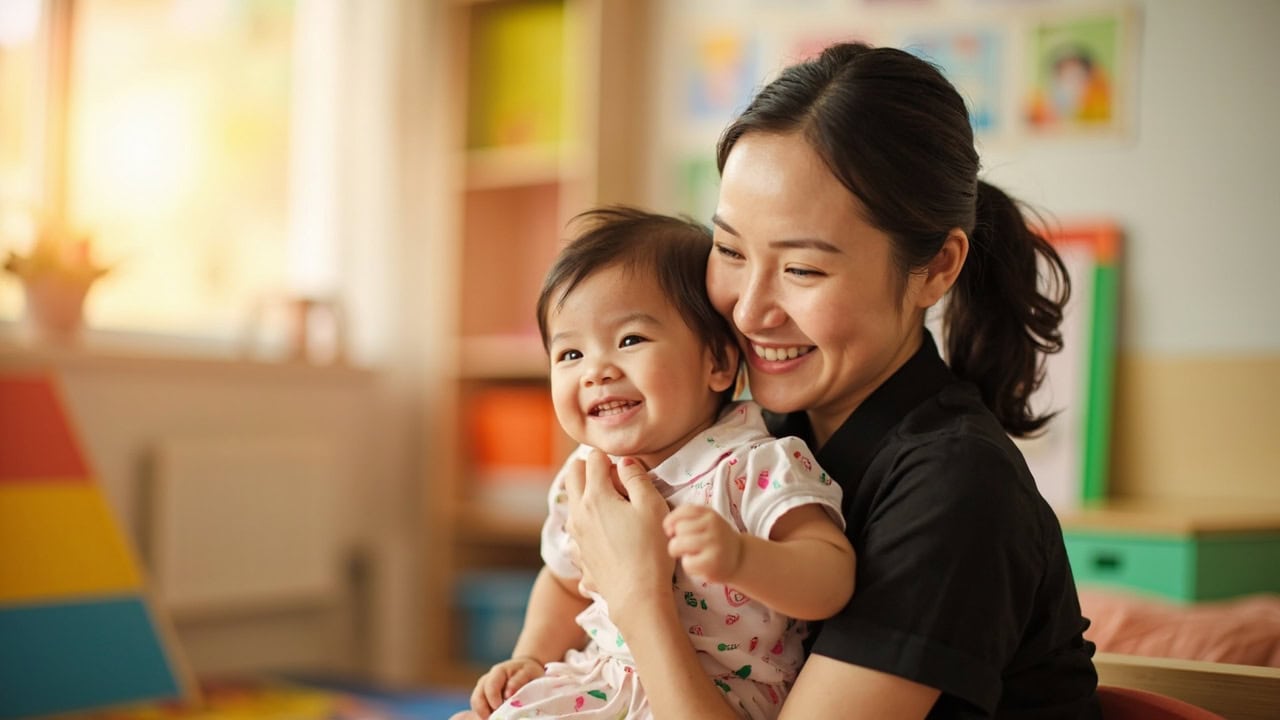
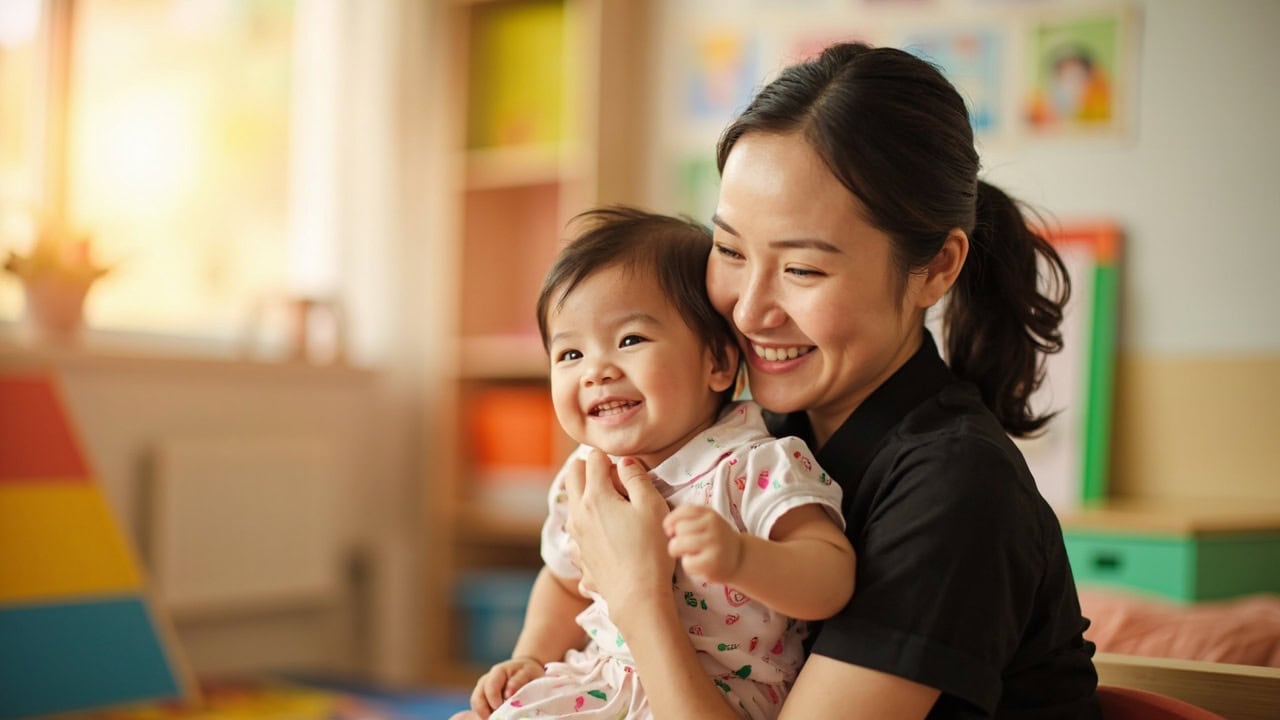
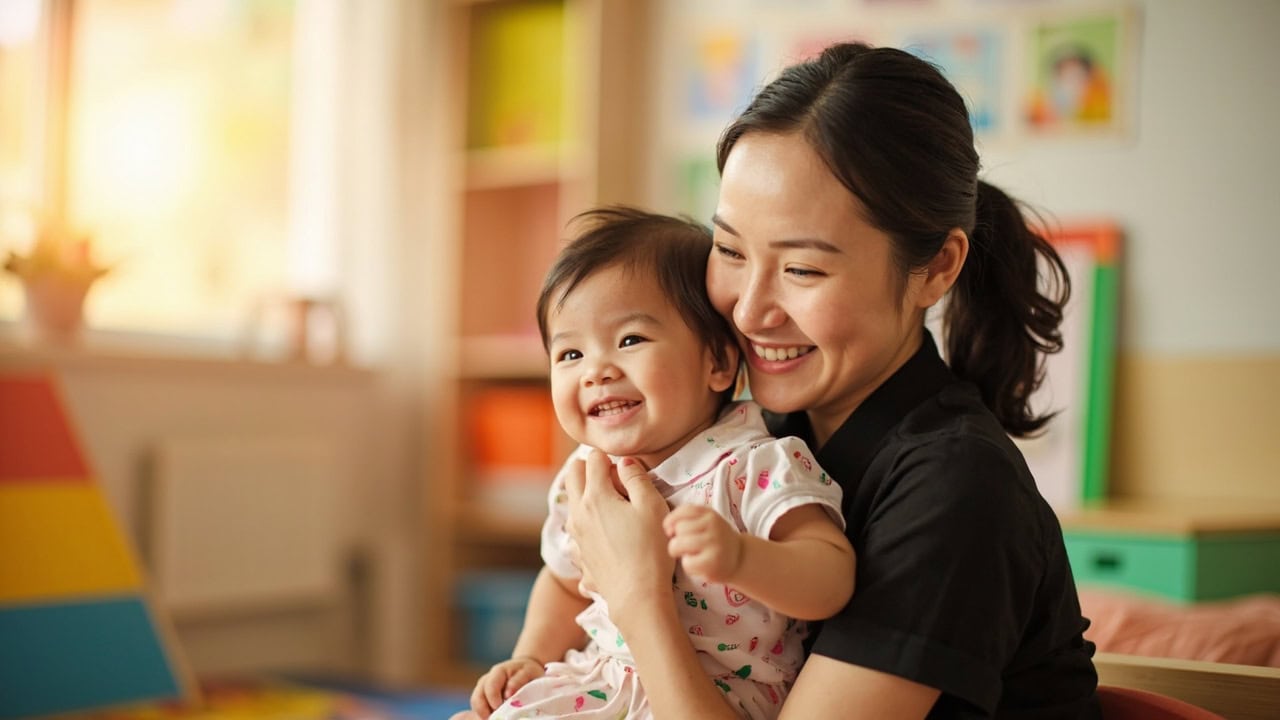
The childminder, by now, has learned your baby’s cues. She knows the exact pause before a hungry cry. She knows the hand signal that means he wants to be held facing outward, so he can watch the light change on the walls. She has become, in the language of attachment science, a secondary attachment figure—not replacing you, but joining the small constellation of people your baby knows he can rely upon.
You will receive updates. Photographs of your baby mid-giggle, or asleep in that particular position he likes. You will notice, perhaps with relief, perhaps with a strange pang, that he smells different when you pick him up. The faint scent of another home. The scent of belonging, because that is what he is learning to do—belong in more than one place.
Months Four Through Nine: Exploration, Security, and Growing Independence
This is when your baby becomes mobile in ways that go beyond kicking and swiping. He is reaching, grasping, bringing objects to his mouth with purpose. He is beginning to understand that he is a separate being from the people who care for him—a realization that sounds philosophical, but for the infant is visceral and sometimes distressing.
The near-home environment, with its contained, predictable spaces, becomes essential. There is no need for constant vigilance against a dozen crawling toddlers in a sprawling centre. Here, your baby can explore a safe room, a familiar garden, the kitchen where the childminder prepares meals. He can pull himself up on furniture that has been checked, again and again, not because safety is a checklist but because safety is a habit of attention.
This is also when cognitive leaps arrive with startling speed. Your baby will suddenly be fascinated by a box that fits inside another box. He will watch the childminder’s face with new intensity, studying expressions as if memorizing a language. She will respond to this curiosity—not by interrupting it with adult explanations, but by narrating his world in simple, warm language.
“You found the ball. It’s blue. Can you hold it?”
These are not lessons. They are the invisible scaffolding of early cognition, and in near-home care, they happen naturally, in the spaces between the day’s rituals, because there is time and attention for this kind of engagement. The ratio of one caregiver to three infants at most means that your baby is not competing for attention. He is receiving it.
By month seven, you may notice something that can alarm parents who don’t know what they’re seeing. Stranger wariness. Your previously easygoing baby now clings when a new face appears. He may cry at the pediatrician’s office, at a family gathering, in any context where his known world is disrupted.
This is not regression. This is development. Your baby has formed specific attachments, and he now knows the difference between the people in his attachment circle and everyone else. The wariness is proof that the attachment is working.
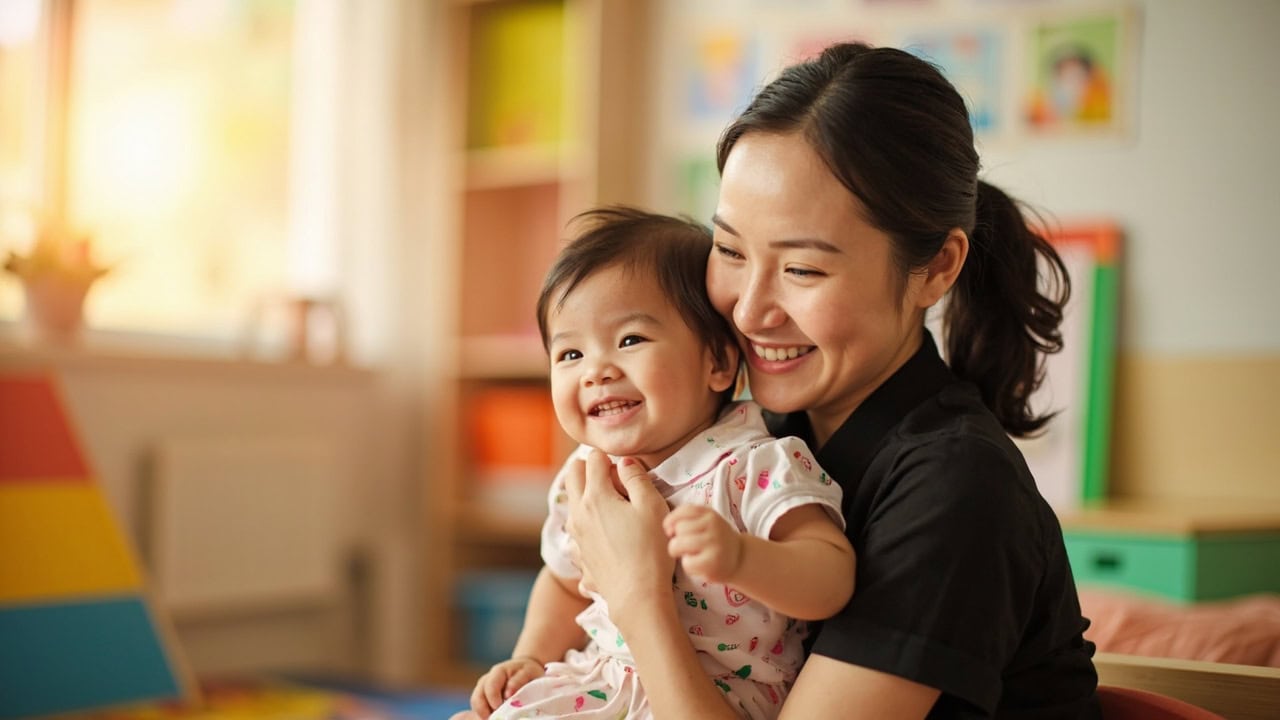
And here is where the childminder’s role becomes something beautiful, if it is allowed to be. She has been with your baby for seven months. She is not a stranger. She is, in fact, a known person—the person your baby runs to when you drop him off, the person whose voice he follows around the room, the person he watches for cues about whether new situations are safe.
She has become his secure base. From her, he is willing to venture. To her, he returns. This is not a bond that competes with your bond; it is a bond that teaches your baby that the world can be safe, that people can be relied upon, that separation is not permanent and reunion is sure.
You will notice this at drop-off. The clinging that once happened at month one or two may resurge, briefly, then resolve as your baby looks to you for confirmation, looks to her for welcome, and then—sometimes quickly, sometimes after a moment of negotiation—settles into the day. This is the dance of secure attachment playing out in real time, and it is one of the most important things your baby will learn in his first year.
These months also bring new motor skills, new fears, new fascination with textures and temperatures and the physics of how things fall. Your baby may be pulling to stand now, cruising along furniture, beginning to understand that mobility is possible even if walking is not yet here. The childminder’s role expands again. She becomes a safety guide, a calm presence when a new skill goes wrong, a cheerleader when it goes right.
Months Ten Through Twelve: Becoming a Person
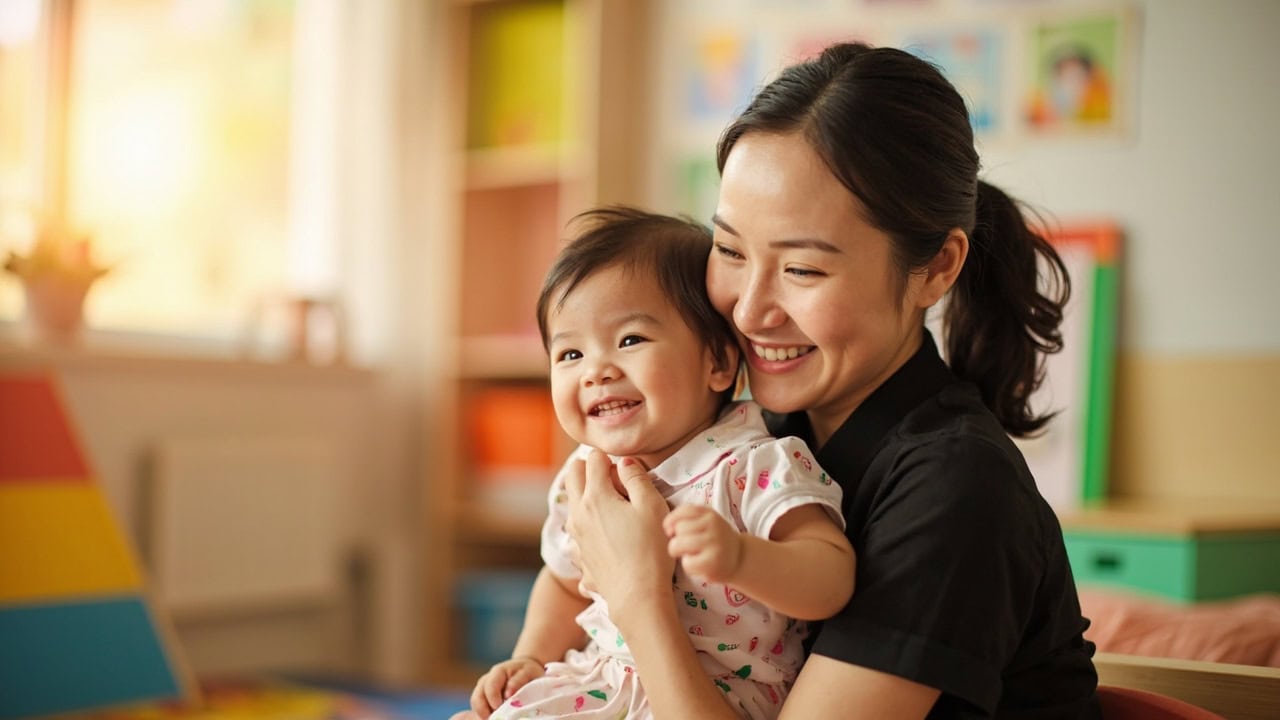
Now we arrive at the final trimester. The year is almost complete, and your baby is becoming, in the most literal sense, a toddler. He may be walking now, or close to it—those first wobbly steps that you will remember forever, perhaps the first time he walked not toward you but toward the childminder, laughing.
He is beginning to understand words, to follow simple instructions, to point at what he wants and shake his head at what he doesn’t. He is becoming a person with preferences, with opinions, with a personality that is entirely his own.
The near-home care has prepared him for this. In a small, consistent environment, he has learned that his communications matter. When he points at the water cup, someone responds. When he says “ba” or “da” or that particular sound that is his word for his childminder, someone celebrates. He has learned that the world is responsive to him, that his needs are valid, that people will listen.
This is the foundation of early confidence—not the absence of struggle, but the presence of being heard.
And now, something else begins. The conversation about transition. Because near-home care, by its nature, is time-limited. It is designed for the first critical years, for the period when attachment is forming and foundations are being laid. At some point—perhaps when your child is two, perhaps when the program naturally evolves into a centre-based pathway—another transition will come.
The childminder will prepare your baby for this. She will gradually introduce more routines that mirror what comes next. She will speak to you, honestly and sensitively, about what this change will mean. And your child, secure in what he has learned, will meet this transition the way he has met others: with the confidence that comes from knowing he has survived change before, and come through it.
The year ends, as years do. But what has been built inside it does not end. The neural pathways that formed in a brain learning, month by month, that the world is safe and people are reliable—those pathways remain. The habits of engagement, of curiosity, of secure attachment—those remain. The relationship between you and the childminder does not simply stop; it transforms. You will carry her with you, in a sense. She was part of your child’s first year, and that year is now part of who he is.

What Quality Near-Home Care Looks Like
After understanding the developmental journey, you may be wondering: what does quality actually look like in near-home care? How do you know when the care is meeting your baby’s needs?
Quality childminding is not about impressive facilities or elaborate programs. It is about the small, consistent things that happen every day. In a near-home setting with a low ratio—typically no more than one caregiver to three infants—these conditions become possible because attention is not divided.
The Indicators of Quality
- Responsive interaction: Your childminder narrates your baby’s world in simple language, celebrates discoveries, and responds to cues before they become cries.
- Predictable routines: The day has a rhythm your baby can anticipate—feeding times, nap times, outdoor time, the particular sequence that signals safety.
- Consistent presence: The same faces, day after day. No rotation of caregivers, no surprise changes.
- Safe, contained environments: Spaces designed for small bodies and big curiosity. Furniture checked, hazards removed, but not so sterile that exploration is discouraged.
- Transparent communication: You receive regular updates—not just formal reports, but the small daily reassurances that let you know your baby is seen and held.
- Respect for your parenting: Your childminder learns your baby’s cues from you and builds on your routines, not around them.
Questions to Ask When Choosing Near-Home Care
- What is the caregiver-to-infant ratio? Lower is better for infants. No more than 1:3 should be the standard.
- Who are the caregivers, and how long have they been doing this work? Consistency matters. Ask about turnover and continuity.
- What does a typical day look like? You want to see routines—feeding, napping, play, outdoor time—that feel thoughtful and responsive.
- How will you communicate with me? Regular updates, photographs, and the ability to reach someone during the day are basic expectations.
- How do you handle illness, emergencies, and unexpected situations? Quality providers have clear protocols.
- What is your approach to my baby’s specific needs? Whether your baby has feeding requirements, sleep preferences, or medical considerations, the caregiver should be willing and able to adapt.
- Can I visit before enrolling? Transparency matters. If a provider resists observation, that is a signal.
What EduNanny Singapore Offers
What I have described is not a theoretical year. It is a real year, unfolding in real homes, with real children and real families, supported by the ECDA Childminder Training Programme that has made near-home care a recognized and regulated pathway in Singapore.
EduNanny, a service of BUTLER, is part of this ecosystem. It is not a centre, and it is not the informal childminding of generations past. It is a structured, supported, quality-assured model that brings together the intimacy of home-based care with the accountability that parents need and deserve.
The EduNanny Difference
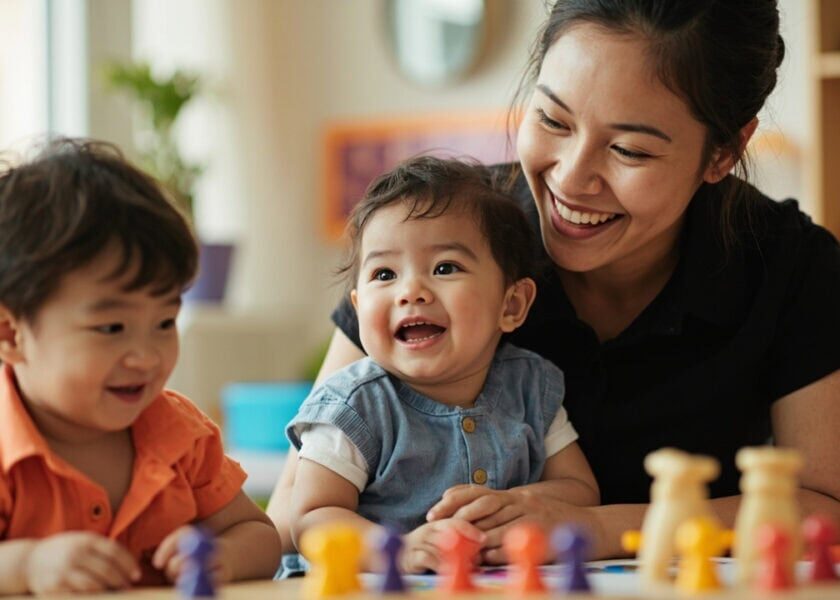
- Small ratios: No more than one caregiver to three infants at most. When your baby is learning to stack blocks, someone is there to celebrate. When your baby falls, the response is immediate and personal.
- Monday through Friday care blocks: Singapore parents need predictability. You will know, from enrollment, when your child is in care and when he is with you.
- Affordable pathways: The structure of the program makes it accessible for families, with payment mechanisms including CDA and Baby Bonus integrated, so you are not navigating a separate financial system.
- Transparency built in: Communication tools ensure you can see your child’s day. Where deployed, additional measures provide assurance in those early weeks when the adjustment is yours as much as your baby’s.
- Ongoing support: Thomas AI Chatbot is available within the EduNanny ecosystem for the questions that come at 2 a.m., alongside the human relationship with your childminder.
But the technology is a support. The regulations are a floor. What actually transforms your baby’s first year is the relationship—between you and your childminder, between your baby and his caregiver, between your family and the small, trusted world that EduNanny creates around you.
This is not a product you purchase. It is a partnership you enter, and the partnership deepens over the same months that your baby deepens—month by month, ritual by ritual, until the care is not something external to your family but something woven into its fabric.
Your Questions, Answered
You may still have questions. That is reasonable. Here are some of the concerns parents in Singapore most often bring to this decision.
Will my baby feel abandoned?
Your baby is not yet capable of the kind of separation distress you fear in those early weeks. He lives in the present tense, and the childminder’s care becomes part of his routine—not a replacement for you, but an expansion of his world. The separation anxiety you feel is yours, and it is love. Over time, as you observe your baby settling more quickly, turning toward his caregiver’s voice, reaching for her when you drop him off—you will see trust taking shape.
How do I know the childminder is qualified?
EduNanny’s childminders are part of a regulated ecosystem with ECDA training and ongoing professional development. They are not randomly assigned caregivers; they are selected, trained, and supported. Beyond credentials, they are observed over time in their work with your child—and you can observe them too, through the transparency measures built into the model.
What if something goes wrong?
Quality near-home care is designed with safety as a habit of attention, not a checklist. Low ratios mean your child is not competing for supervision. The contained environment means risks are managed without restricting exploration. And the communication systems mean you know what is happening in your child’s day, not just after the fact, but as it unfolds.
Will my baby remember this?
Your baby will not remember specific days or specific moments in the way you will. But what he is building in this year—the neural pathways that say the world is safe and people can be trusted—those remain. The habits of secure attachment he learns now will inform how he relates to the world for the rest of his life.
What about when it’s time to transition?
Near-home care is designed for the first critical years. When the time comes to move to a centre-based program or other pathway, your childminder will prepare your baby for this. The transition will be gradual, and your child will face it secure in the knowledge that he has survived change before. That confidence comes from what he has learned inside this care.
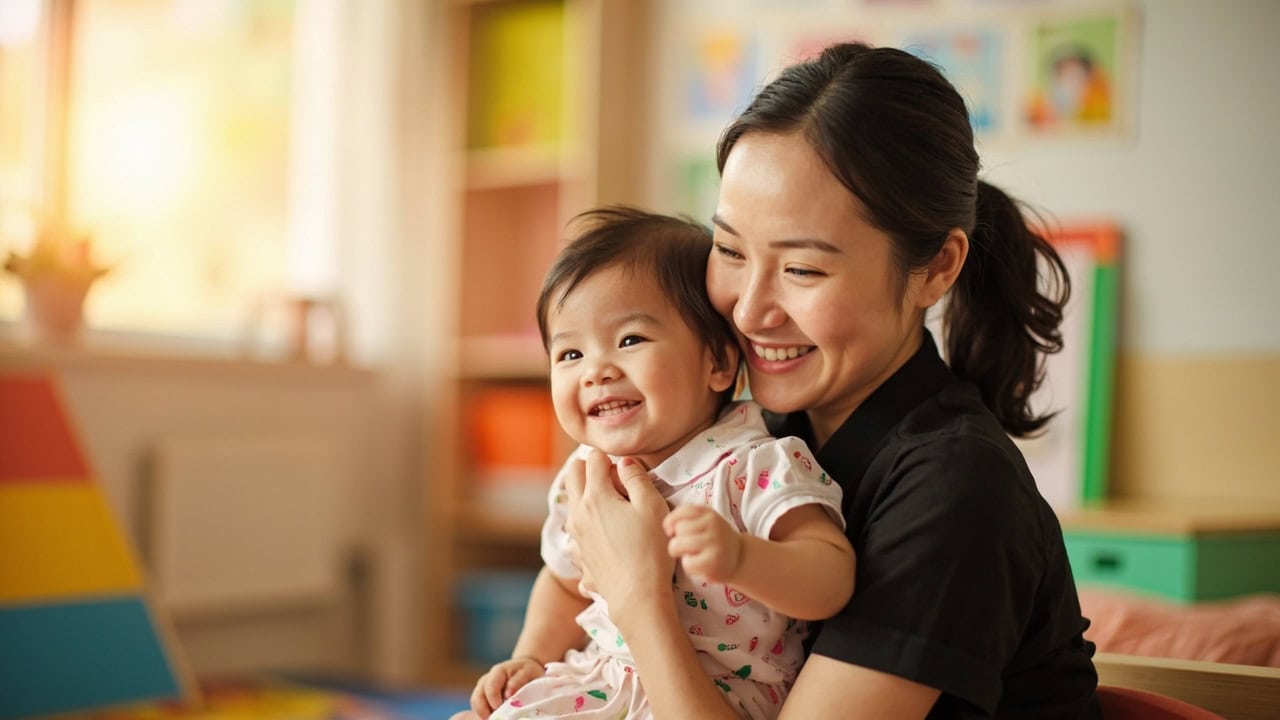
At the Threshold
You are there now. At the threshold. Holding the weight of a decision, and perhaps the weight of your baby, and perhaps the weight of all the questions you don’t yet have answers to.
Will he be safe? Will he be happy? Will he know that I love him, even when I’m not there?
The answer to all of these questions is yes. Not because near-home care is perfect, and not because any single childminder is perfect, but because the model is designed around what developmental science has shown us matters most in the first year: consistent, responsive, warm relationships in an environment that feels like home.
The year will be hard in some ways. The months will be beautiful in other ways. There will be mornings when drop-off feels impossible and evenings when your baby falls asleep in your arms smelling of another home, and you will wonder if you made the right choice.
And there will be moments—perhaps when your baby takes his first steps toward his childminder, perhaps when he signs “more” for the first time in her arms, perhaps when you receive a photograph of him laughing and you can see, in his face, that he is home—that will convince you, if proof were needed, that the choice you made was the choice your family needed.
This is what near-home care can be. This is what EduNanny, within Singapore’s supported childminding ecosystem, is working to make possible for more families. Not a compromise. Not a convenience. A genuine choice, grounded in evidence, supported by quality standards, and built on the simple truth that infants need consistency, that toddlers need safety, and that parents need to be able to trust someone else with the most important work of their lives.
The year is waiting. And it happens, here, with us.
Explore EduNanny Singapore’s near-home infant care options and take the first step toward your family’s next chapter.
#nearhomecare #infantcareSingapore #childminding #attachmentparenting #firstyear #EduNanny #earlychildhooddevelopment #newborncare #secureattachment #parentinginsingapore