What Siblings Teach Each Other in the Right Childcare Environment
The Quiet Intelligence of Siblings in Care
We talk so much about what children learn from adults—from caregivers, from teachers, from the careful scaffolding of skilled professionals who understand child development. And that is real. That matters enormously.
But what children learn from each other—from the particular, irreducible dynamic of being siblings in the same care environment—is something we have not given enough language to, and that silence matters.
Because parents in Singapore are making decisions right now about whether to have more than one child, whether to enrol siblings together, whether the childcare they choose will genuinely serve the relationship between their children or merely house it.
And they deserve to understand what is actually at stake.
Mutual Regulation: The Foundation of Emotional Resilience
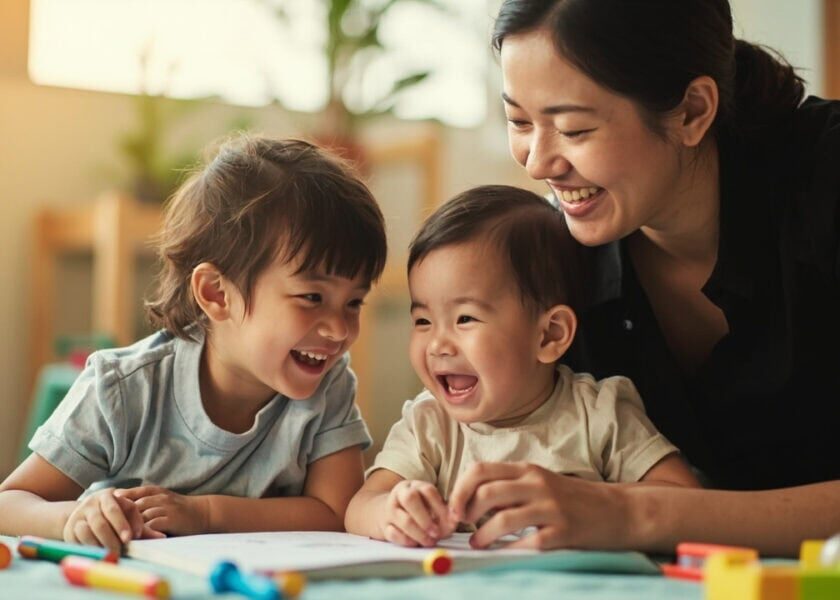
When siblings share a quality childcare environment, they are not just spending their days in proximity. They are building something together that no curriculum can design and no adult can replicate.
They are learning mutual regulation—that extraordinary capacity to calm another human being not through instruction but through presence.
You have seen a toddler in distress quiet almost instantly when an older sibling sits beside them. That is not magic. That is neurobiologically meaningful. The younger child’s nervous system registers the sibling’s calm as information. It says, in the language that predates words: this space is safe, this person is here, you can come back.
That is the foundation of emotional resilience, and it is being built in care settings across Singapore, between children who have not yet learned to read, between children who will carry that capacity into every difficult room they ever enter.
Collaborative Intelligence: Building a World Together
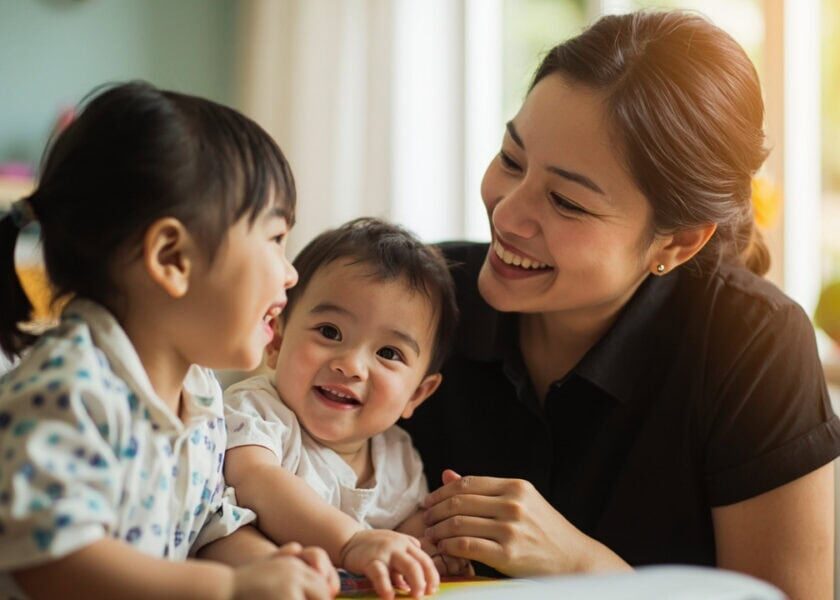
Siblings in shared care develop a collaborative intelligence that is entirely their own. They develop shared language—not just words, but the private grammar of how they negotiate, how they signal, how they divide the work of play.
An older sibling will adjust their pace without being asked, will wait without being reminded, will find a way to include that no adult would have designed.
A younger sibling will stretch toward challenges they would never attempt alone, simply because the model is right there, warm and familiar and within reach.
This is not imitation in the simple sense. It is something more alive—two minds noticing each other and building a world that belongs to both of them.
The Developmental Architecture of Age-Appropriate Roles
In any mixed-age group of children in care, older children take on what researchers sometimes call quasi-caregiver roles. They comfort, they guide, they demonstrate.
And the developmental research here is consistent and underappreciated: the child who gives the comfort grows as much as the child who receives it.
The older sibling who learns to notice a younger one’s hunger or fatigue or frustration is building executive function, building empathy, building the capacity to read another person’s inner life.
Sibling relationships in a rich care environment are a genuine developmental system—a living architecture that both children are constructing together, every day. Quality childcare does not manufacture this. What it does is create the conditions where it can unfold.
For Families With One Child
There are families in Singapore for whom this picture looks different. Families with one child. Families who have chosen one child, or who are still deciding, or who have not been given the option they hoped for.
The only-child question deserves a real answer, not a deflection.
The truth is that quality childcare addresses this directly—not by pretending siblings exist but by building something structurally similar.
In a mixed-age care environment, a child without a sibling at home encounters the same developmental dynamics: the older child who models, the younger child who stretches, the peer who negotiates and shares and conflicts and resolves.
The peer village that quality childcare creates is not a consolation prize for the only child. It is a genuine developmental analogue.
Children in these settings develop sibling-like bonds with peers across age ranges. They learn mutual regulation with children who are not their siblings by blood but who occupy a similar cognitive and emotional space.
Any parent who has watched their only child form a deep, protective bond with an older peer in care knows exactly what this looks like. It is the same intelligence finding a different path to the same destination.
What Quality Childminding Looks Like
Not all childcare environments are created equal when it comes to sibling development. Here is what to look for—and what to ask about.
Small Ratios and Attentive Observation
When a care environment is too large or too crowded, sibling dynamics get compressed. There is not enough space, enough time, enough attention from caregivers to witness what children are building together.
Small ratios matter because they allow caregivers to do something essential: observe, name, and protect the sibling relationship as it unfolds.
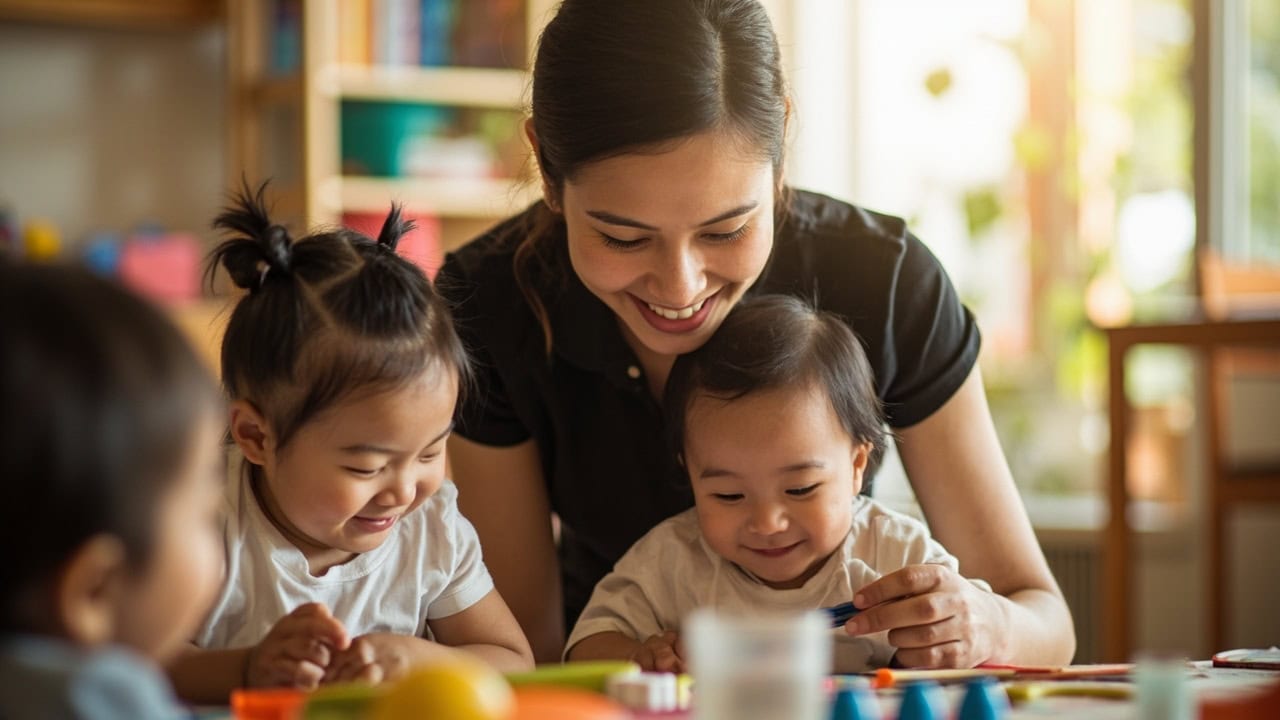
An older child can hand a block to a younger one, and a caregiver can witness it, name it, and protect the conditions that allow it to keep happening.
Continuity and Predictability
Sibling intelligence requires time to develop. It requires consistent faces, consistent spaces, consistent rhythms. Children need to know that tomorrow will look enough like today that they can build on what they built yesterday.
Ask about caregiver consistency. Ask about how long children typically remain in the same care group. These are not secondary details—they are the conditions under which sibling bonds deepen.
Physical Environment
Quality childminding environments are designed for sibling interaction, not just supervision. Look for:
- Open spaces where children can work alongside each other
- Materials that invite collaboration—blocks, art supplies, dramatic play resources
- Quiet corners where siblings can retreat together
- Outdoor spaces that allow mixed-age play
Questions to Ask Any Provider
Beyond the tour, beyond the brochure, here are questions worth asking:
- How do you think about sibling relationships? Listen for whether they see siblings as a dynamic to nurture or a logistics to manage.
- What are your caregiver-to-child ratios? Smaller ratios mean more room for sibling interaction to be witnessed and supported.
- How consistent is the care team? Consistency builds the predictability that sibling bonds need to deepen.
- What does a typical day look like? Look for environments that allow mixed-age collaboration, not just parallel play.
- How do you handle conflicts between children? The best caregivers know when to step back and let siblings work things out.
The best childcare settings do not just manage children. They witness them. Caregivers who understand sibling development know how to step back at the right moment—to let the older sibling work out a conflict without intervening, to let the younger sibling struggle productively before stepping in.
What EduNanny Was Built For
EduNanny was built to be the kind of care environment where sibling relationships—and sibling-like relationships—have room to become what they actually are.
We are part of the ECDA Childminding Pilot, and that is not simply a regulatory designation. It reflects a commitment to a particular vision of what early childhood care can be: small, relational, intentional.
Our Model
In our home-based pathways, the ratios matter enormously—up to one to three infants in our care, which means every child is known. Not observed. Not managed. Known.
In that kind of environment, sibling dynamics have space to breathe.
Practical Clarity for Singapore Families
We understand that Singapore parents need more than a philosophy. They need practical clarity:
- Monday to Friday care blocks
- Fees within the pilot structure designed to be accessible
- Community Development Authority subsidies apply
- Baby Bonus can be used
For families navigating the real arithmetic of childcare—and every family in Singapore is navigating that arithmetic—these are not secondary details. They are the conditions under which a good decision becomes possible.
Communication and Transparency
We take communication seriously, because parents in this city are making decisions about their children’s inner lives based on what they can observe and trust.
Where CCTV measures are deployed, they are deployed not as surveillance infrastructure but as transparency infrastructure. You should know what your child’s day looks like. You should have windows into the moments that matter—the block being handed over, the younger one reaching, the older one responding.
Not because you need proof, but because what is happening in good childcare deserves to be seen.
The Lasting Imprint: Why the Early Years Matter Beyond the Early Years
When siblings share a quality childcare environment, they are building relational intelligence that stays with them. Not just through primary school. Not just through adolescence. But into the adult they become.
The capacity to notice another person’s need. The instinct to adjust, to wait, to include. The quiet knowledge that another human being’s distress is information, not an inconvenience.
These are not soft skills. These are the hardest and most valuable capacities a person can develop, and they are being built in the early years—in the spaces between blocks and mat time and lunch, in the moments when no adult is narrating what is happening and two children simply are together.
Quality childcare does not just supervise that. It gives it the conditions it needs to become what it truly is.
Walking This Decision With You
For many Singapore families, the question of childcare is entangled with larger questions: Should we have another child? Is our family complete? What kind of relationship do we want our children to have?
These are profound questions, and they deserve more than logistics. They deserve an understanding of what is actually at stake developmentally.
Sibling relationships in quality childcare are not a logistical convenience. They are a genuine developmental environment—one of the most consequential environments a young child will ever inhabit.
And sibling relationships within that environment deserve to be understood, protected, and intentional. Not as an afterthought. Not as a bonus feature. As the living curriculum it actually is.
If you are a family in this city deciding how to care for your children, or whether to grow your family, or what kind of care environment will serve the people your children are becoming—we would like to walk that decision with you.
Not as a vendor. As a partner who has watched what children build together, and who takes that watching seriously enough to have built something designed for it.
If you would like to explore what EduNanny can offer your family—learn about our home-based childminding approach, understand how siblings thrive in our small-ratio environments, or simply talk through what kind of care might best serve your children’s relationship—we invite you to reach out.
We would be glad to walk this decision with you.
If you found this article helpful, you might also enjoy learning more about how EduNanny approaches childminding through the ECDA Pilot, or reading about our philosophy and the team behind our care.