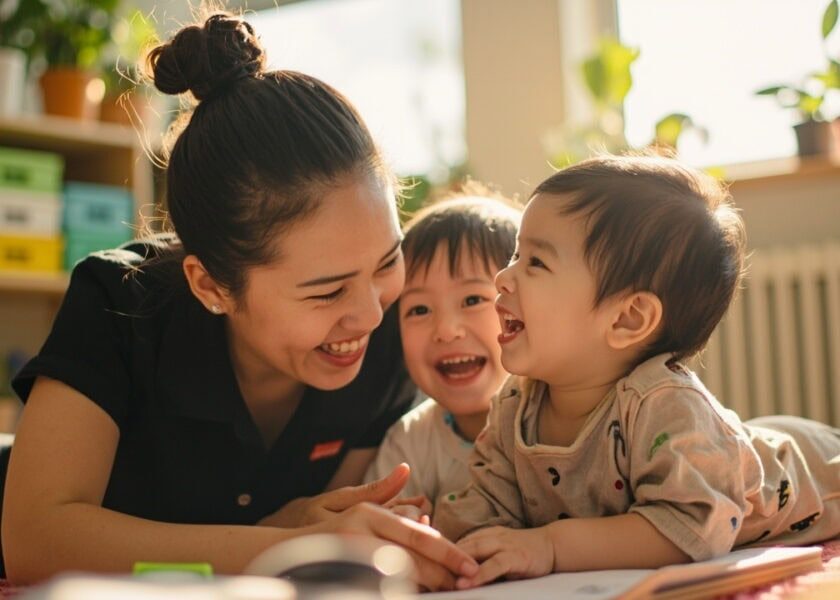
Why Singapore Parents Are Expanding the Village with Premium Childcare
Understanding the Singapore Childcare Dilemma
Today’s Singapore parents often find themselves stretched across professional commitments, long commutes, and the pressure of giving their children every possible advantage. They want to honour their parents. They also want to make choices that reflect their own understanding of what their child needs.
And when those two desires pull in different directions, the result is a tension that can feel isolating. You may have wondered whether choosing professional care means you are somehow betraying the very people who raised you.
If this sounds familiar, we want you to know: you are not wrong to feel what you feel. And you are not wrong in your choice.
The conversation we rarely have — because it is too raw, too personal, too layered with decades of family history — is about what premium childcare actually is when placed alongside grandparent care. Not in opposition. Not as a replacement. But in relationship.
Here is the reframe that changes everything: choosing professional care is not a rejection of family. It is an expansion of the village.
When the Village Changed Shape
For generations, the village that raised a child was literal. Grandparents, extended family, neighbours, community elders — they formed the ecosystem in which a child grew. In Singapore, this pattern held strongly through the mid-twentieth century. Grandparents were not just visitors or occasional helpers; they were co-architects of a child’s earliest years.
The wisdom they carried — practical knowledge, cultural continuity, the intimate understanding that comes only from having loved and raised before — was woven into the fabric of a child’s world. That wisdom is real. It matters. And it would be a mistake to speak about modern childcare as though we are correcting something that was broken.
What has changed is not the value of family. What has changed is the world in which families now operate.
Singapore has transformed in a single generation. Our parents raised us in a context fundamentally different from the one we now navigate — different work patterns, different housing structures, different demands on time and attention. A mother in 1985 did not face the same calculus as a mother in 2025. Not because she loved her children less, but because the landscape was different.
This is not a criticism of how we were raised. It is an acknowledgement that the village has evolved — and that evolution deserves to be embraced rather than mourned.
What Children Actually Need
Research and experience both tell us: children do not flourish because of a single source of love. They flourish because their world is rich with it.
A child who knows the embrace of grandparents — who hears the stories, tastes the food, absorbs the dialect of three generations — carries something precious. Nothing professional replaces that. Nothing should try.
But a child also benefits from the structured attention that comes with smaller ratios, caregivers trained in developmental stages, and environments designed to support exploration and growth. These are not contradictions. They are complements.
The grandparent who takes a child on Saturday mornings while parents work is not in competition with a weekday caregiver. They are both part of the village. The difference is not in the love — it is in the function. And function is not an insult to love. It is an expression of love in a different form.
When a parent chooses professional childcare, they are not saying that grandparents could not do the job. They are saying that they want their child to have something specific — and that this does not diminish the role of those who raised them.
What Quality Childminding Looks Like
For parents researching options in Singapore, it helps to be clear about what “quality” or “premium” care actually means — because these terms are used frequently and understood inconsistently.
Quality childminding means:
- Smaller caregiver-to-child ratios — allowing for genuine individual attention rather than managing groups
- Caregiver training in developmental stages — understanding how children grow, learn, and need different things at different ages
- Structured environments that support exploration — spaces designed for a child’s physical and cognitive development, not just supervision
- Consistency and continuity — the same caregiver over time, so the child builds trust and security
- Open communication with families — regular updates, transparency, and genuine partnership between caregiver and parents
- Home-based care where possible — where children are most comfortable, in an environment familiar to them
None of this replaces what a grandparent offers. But it adds something different — something that serves specific developmental needs in ways that complement rather than compete with family involvement.
How Families Navigate This With Confidence
So how does this actually work? How do families in Singapore navigate the conversations, the logistics, the emotional weight of making premium childcare part of a multi-generational family?
We have seen it done well, and we have learned from families who found a way through.
Starting the Conversation
There is a conversation that some parents have learned to initiate — not as a negotiation, but as an invitation. It begins with appreciation: letting your parents know that what they gave your child — and gave you — is irreplaceable. Then it becomes an invitation to be part of something new.
The frame that helps: we are not choosing between family and quality care. We are asking how both can be part of our child’s world.
When a grandparent understands that they are not being replaced but extended — that professional care is not a judgment of their capability but an addition to their gift — something shifts. The concern does not vanish immediately, but it begins to transform. It becomes curiosity. Sometimes it becomes pride.
We have seen grandparents who, once assured that their role was honoured and protected, became the strongest advocates for a childcare arrangement. They saw that their grandchildren were thriving. They saw that family bonds remained central. And they came to understand that the village had simply grown.
What a Working Arrangement Can Look Like
In practical terms, families often find that weekday professional care and weekend grandparent involvement work together naturally:
- Monday to Friday: Professional childminder providing structured developmental care while parents work
- Weekends and evenings: Grandparent time — unhurried, culturally rich, relationship-deepening
- Communication: Regular updates from the caregiver, shared so everyone stays connected to the child’s daily life
- Flexibility: Arrangements that adapt as family needs change, without anyone feeling replaced or dismissed
Common Questions Parents Ask
“Will my child feel the difference between family and professional care?”
Children are remarkably perceptive. They know the difference between the warmth of a grandparent and the warmth of a caregiver — and they benefit from both. What matters is consistency, responsiveness, and love. Quality professional care provides these in a different register, not at a lower level.
“How do I explain this to my parents without hurting them?”
Start with appreciation. Let your parents know that what they gave your child — and gave you — is irreplaceable. Then share your reasoning not as a defence but as an invitation. The conversation may take time. That is normal.
“Is professional care really better than grandparent care?”
This is the wrong question. They are different. Grandparent care offers cultural continuity, deep emotional bonds, and the wisdom of personal history. Professional care offers structured development, trained attention, and a consistent environment designed for growth. Your child needs both — and you do not have to choose one at the expense of the other.
“What if my child has attachment issues or special needs?”
Quality childminding is especially valuable for children who need individualised attention. Smaller ratios and trained caregivers mean that developmental concerns can be identified early and addressed with consistency.
Why Families Choose EduNanny
This is what EduNanny was built to recognise.
We are not an alternative to your family. We are an extension of it.
When we designed our approach, we understood that in Singapore, family is not a peripheral consideration — it is the centre. Every decision a parent makes about childcare is made within a web of relationships, obligations, histories, and loves. A childcare provider that ignores this is providing a service. A childcare provider that understands this is becoming part of your family’s story.
EduNanny operates within the ECDA Childminding Pilot, which means we are part of a carefully structured framework designed to bring quality care into the home environment where children are most comfortable — and where family involvement is not an interruption but a given.
Our caregivers work with ratios that allow for genuine attention, the kind of attention that is only possible when a child is not one of many. We do this within a structure that keeps care accessible, including pilot fee structures and the ability to use CDA and Baby Bonus where applicable.
We also know that transparency changes everything. When parents can see what is happening in the care environment, when communication flows freely between caregiver and family, the anxiety that often accompanies trusting someone new begins to dissolve. Where our service includes measures such as CCTV access and regular updates, it is not because we doubt our caregivers — it is because we understand that trust is built through openness.
What we offer is Monday to Friday care in structured blocks, time that allows parents to work with confidence and children to grow with consistency. This is not about filling a gap. It is about creating a rhythm that works for the whole family — and that includes grandparents who can be present on weekends and evenings, not in spite of our care but alongside it.
You Do Not Have to Choose Between Them
If you are a parent navigating this right now, here is what we want you to carry with you:
You are not wrong to feel what you feel. The tension you experience is not a sign that you are making a poor decision. It is a sign that you care deeply — about your child, about your parents, about getting this right. That care is itself a form of love.
You are not wrong in your choice. Choosing professional childcare because you believe it serves your child’s development is not a rejection of family. It is an expansion of what family can offer. The love your parents gave you and the love you give your child are not in competition. They are the same love, expressing itself differently across time.
Trust your judgment. Not blindly. Not without conversation. But genuinely. You know your child. You know your family. And you are capable of making a decision that honours both the past and the future without betraying either.
The village has always raised children. It is simply taking new forms now, and that is not something to mourn. It is something to embrace.
Your child will know the warmth of grandparents. Your child will also know the richness of professional care — environments designed for curiosity, held with consistency and attention. Your child will know that their family chose them — all of them, together — and that is the greatest gift any child can receive.
That is what EduNanny stands for. Not against the family. With it.
When you are ready to explore how quality childminding can become part of your family’s story, we welcome the conversation. We are here to answer your questions, address your concerns, and help you find an arrangement that feels right for everyone.
To learn more about EduNanny and how we support families in Singapore, visit our homepage or read about our approach.