What Secure Attachment Science Reveals About Your Child’s Development
What Secure Attachment Actually Requires
Before we explore the science, let us sit with the feeling itself for a moment. Because that tightness in your chest, that hesitation at the threshold—it is not irrational. It is not weakness. It is the physical experience of loving someone whose world you cannot fully control.
You have spent your child’s first months building something invisible but profoundly real: a relationship where your baby learns that when they reach out, you reach back. That when they cry, you come. That the world is a place where their needs matter and someone will be there.
That is not a small thing. That is everything.
And now, because life in Singapore demands your presence elsewhere—whether for work, for family, or simply for the sustainability of your household—you are considering who else might hold your child in those hours. Does introducing another caring adult into your child’s world mean you are diluting what you have built?
The short answer, backed by decades of research, is no. But let us go deeper, because the longer answer is far more hopeful than you might expect.
The Secure Base Your Child Needs
The science of attachment has been building for decades, and its findings are remarkably consistent. When researchers study how children develop the capacity to feel safe, to explore the world with curiosity, and to form healthy relationships, they find something that might surprise you.
What children need for secure attachment is not a single person. What they need is a secure base.
A secure base is not a location. It is a quality of experience. It is the experience of being responded to when they reach out, of having their feelings acknowledged when they are distressed, of learning that the world is a place where their needs matter and someone will be there.
This is what builds the neural architecture of emotional regulation. This is what allows a child to eventually separate from their caregiver without anxiety, to return without guilt, and to move through the world with the quiet confidence that comes from knowing they are held.
The primary caregiver is irreplaceable in this process—absolutely. But here is what the research tells us with increasing clarity: children can form multiple secure attachments. When they encounter caregivers who are warm, consistent, and responsive, the same attachment systems activate. The same neural pathways strengthen.
Your child is not dividing their love or their trust. They are multiplying their sense of security.
How This Works in Practice
Think about what happens in a home where a child feels truly secure. The child plays confidently, knowing a parent is nearby. They venture to the edge of the room, glance back, and return to confirm: yes, you are still there. They begin to test boundaries because the foundation feels solid.
Now consider this: if that same quality of experience—warmth, consistency, responsiveness—exists in another setting, with another familiar caregiver, the same processes activate. The child learns to venture, to check, to return. The secure base expands. The emotional architecture grows another room.
This is not theory. This is what attachment researchers have documented across cultures and decades. And it is the insight that shapes everything we do at EduNanny Singapore.
Separation Anxiety and the Handover Experience
Let us address the moment that causes many parents the greatest anguish: the morning handover.
You kneel down, your child clings to your leg, and every fibre of your being wants to pick them up and take them home. This feeling is so difficult that some parents begin to wonder if childcare is simply not right for their child.
But here is what separation anxiety actually tells you: your child has formed an attachment strong enough to feel its absence. It tells you that you have done your work. It tells you that your child knows what secure feels like—and notices when it shifts.
Separation anxiety is not evidence that childcare is wrong for your child. It is evidence that what you have built together matters enough to miss.
What it also tells us, as caregivers, is what your child needs from us in those first moments and those first weeks: patience, consistency, and the slow, patient work of earning trust so that what you have built at home has a natural extension in our care.
How Quality Care Navigates Separation
When a child arrives at EduNanny, they arrive into a world thoughtfully prepared for them. The caregiver they will come to know is introduced gradually. The space is familiarised in stages. Routines are established not as schedules for the sake of structure, but as the scaffolding that helps a child predict what comes next and therefore feel safe enough to let go.
When a child knows that after storytime comes snacktime, and after snacktime comes outdoor play, they begin to trust that the world is organised and reliable. That trust is the foundation of emotional regulation. That trust is the platform from which they begin to explore.
And what happens in those moments of transition, when a parent hands their child to a caregiver and steps away? These moments are designed as gentle bridges, not sharp edges. Parents are welcomed in. They are not rushed out. The handover is collaborative. We share what the child’s morning was like at home, what they ate, how they slept, what seemed to interest them.
This exchange of information is not administrative. It is relational. It tells your child, through our actions, that their two worlds are connected. That Mummy and the EduNanny caregiver speak the same language. That there is continuity here, not disruption.
What Quality Childminding Actually Looks Like
We have talked about the science. Let us now be specific about what this means in practice, because understanding the principle is one thing—and seeing how it translates to daily life is what helps parents make confident decisions.
Emotional Attunement Cannot Happen in Volume
Consider the simple act of noticing. When a baby shifts from hungry-cry to frustrated-cry, an attuned caregiver notices. When a toddler hesitates before reaching for connection, there is a pause that invites warmth. When a child needs reassurance, the response is immediate; when they need space to try again, the space is given.
Emotional attunement is not possible in volume. It requires presence. It requires the ability to notice the subtle shift in a baby’s cry, the quiet signal of a toddler who needs a hand, the moment a child needs comfort versus the moment they need challenge.
In a room where one adult is responsible for six children, that noticing becomes impossible. In a setting where one adult is responsible for three—as we maintain at EduNanny for infants—that noticing becomes the centrepiece of everything we do.
The Role of Consistency and Daily Nourishment
Attachment does not develop through one-off interactions. It develops through accumulated trust. It develops through the slow, patient, daily experience of knowing that the same person will be there, and that the way they make you feel will not change from one day to the next.
This is why caregiver consistency matters so profoundly. We are not rotating staff unpredictably. We are not assigning whoever is available to your child’s room. We are building familiarity. We are ensuring that your child has the same faces, the same voices, the same gentle hands, day after day after day.
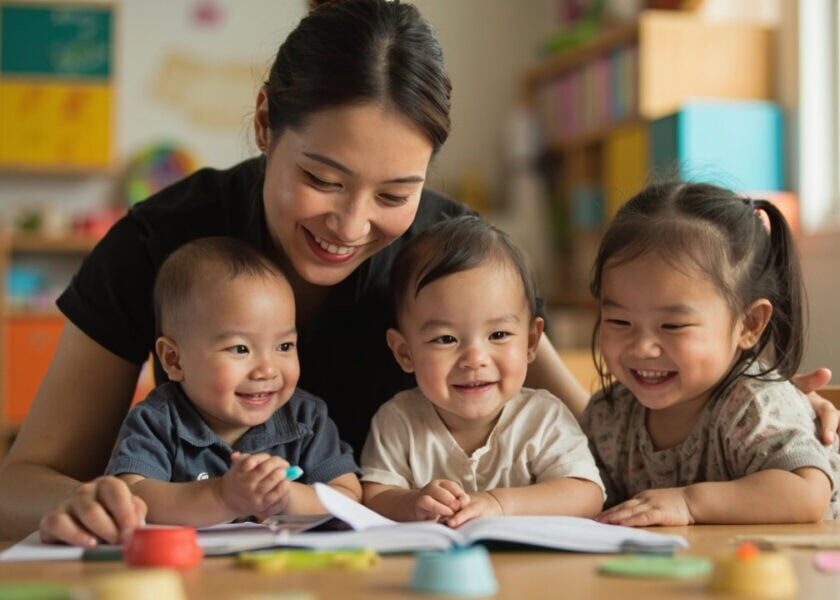
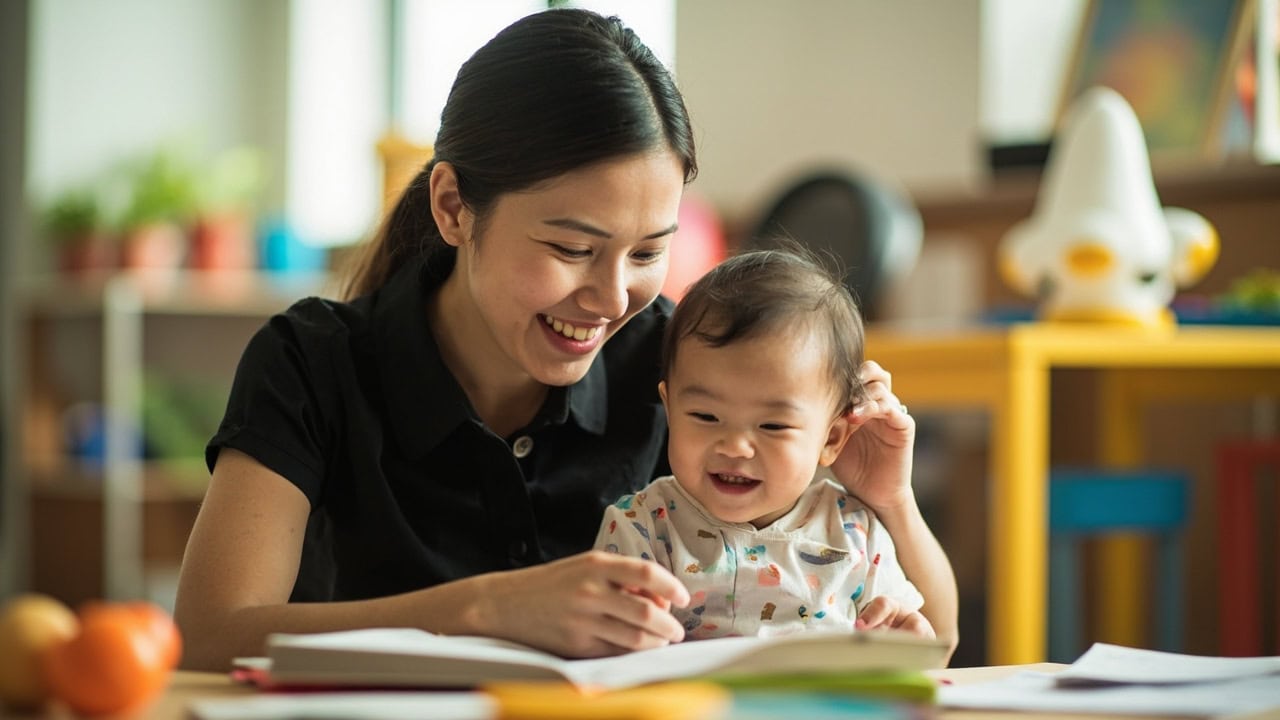
What does a day look like in quality childminding? It looks like caregivers sitting on the floor and following the child’s lead. It looks like noticing when a child is frustrated and helping them name what they feel: “You feel angry because the tower fell.” It looks like celebrating small victories with genuine enthusiasm. It looks like co-regulation—staying calm when a child is dysregulated, so their nervous system learns what calm feels like.
It looks like reading cues before they become meltdowns. It looks like respecting a child’s pace of exploration. It looks like creating moments where a child thinks, “When I look up, someone warm is there. When I fall, someone will help me up. When I cry, someone will listen.”
These are not extras. These are not luxuries. These are the core of what we are here to do.
EduNanny Singapore: Our Approach Within the ECDA Childminding Pilot
We want to be clear about where we stand and what we offer—not as a sales pitch, but as honest transparency about the framework within which we operate.
EduNanny Singapore is part of the ECDA Childminding Pilot, a programme that reflects Singapore’s thoughtful commitment to offering families real choice in how their children are cared for. Through this pilot, we provide both home-based childminding and community or centre-based pathways, giving families the flexibility to choose what fits their life while ensuring that every option meets the standards this work demands.
What This Means for Your Family
For infants, we maintain ratios of up to one caregiver to three children. This ratio exists because we know that emotional attunement is not possible in volume. Your child is not a number in a room. Your child is a person whose emotional world requires noticing, and noticing requires space.
We are committed to caregiver consistency. Your child will not encounter a rotating cast of strangers. They will build familiarity with the same caregivers, week after week, which is how trust deepens.
We believe in honest, warm communication with parents. You should not feel that you have handed over a piece of your world and received silence in return. You will hear from us about your child’s day—not in performative updates or meaningless checklists, but in the kind of communication that helps you feel connected to what is happening, that lets you see your child’s joy and progress reflected back to you, and that invites you into the ongoing story of their development.
Accessibility and Affordability
We are mindful that for many families in Singapore, the question of cost is real. The ECDA Childminding Pilot has been designed with accessibility in mind, and EduNanny is committed to remaining affordable within pilot fee structures.
We also know that many families can access support through their Children’s Development Account and Baby Bonus funds, and we are happy to help you understand how these work for your situation. This is not peripheral to our mission. It is central to it. Because we believe that every child deserves the developmental foundation that quality care provides, and we do not want financial anxiety to be what stands between your child and that possibility.
Choosing Infant Care in Singapore: What to Look For
If you are evaluating childcare options—whether EduNanny or another provider—here are the markers that research and experience tell us matter most:
- Caregiver ratios: For infants, ratios of 1:3 or better allow for genuine attunement. Larger groups make noticing and responsive care practically impossible.
- Caregiver consistency: Ask how often your child’s primary caregiver changes. Frequent turnover disrupts attachment and causes repeated transition stress.
- Transition approach: How does the programme handle the first days and weeks? Gradual introduction, collaborative handover, and parent involvement signal an understanding of attachment needs.
- Communication practices: You should feel connected to your child’s day, not disconnected from it. Ask how updates are shared and what they typically include.
- Philosophy on emotional support: Listen for language that reflects warmth, responsiveness, and attunement. Be wary of programmes that focus primarily on schedules, curriculum, or supervision without mentioning the emotional world of the child.
- Routine and predictability: Consistent daily rhythms help children feel safe enough to explore. Ask how the day is structured and whether routines are stable.
- Staff training and values: Caregiver warmth is not accidental. Ask about training in attachment-informed practices and how the organisation supports caregiver wellbeing.
Addressing Common Concerns
Will my child feel abandoned?
What research consistently shows is that children who experience warm, consistent, responsive care—alongside strong attachment to their primary caregivers—do not feel abandoned. They feel held in multiple places. The child who felt safe enough to venture away from you at home begins to feel safe enough to venture away from a trusted caregiver at play. The secure base expands. It does not shrink.
What if my child cries every day?
Some transition periods are longer than others. A child who cries in the mornings is not telling you that childcare is wrong for them. They are telling you that this is hard, and they need you to know it is hard. Our role is to be the warm, patient presence that helps them learn, over time, that you always come back, and that this place is also safe. If your child’s distress persists without signs of settling, we work closely with you to understand what is happening and adjust our approach. You are never a silent bystander in your child’s care.
Is a caregiver really the same as family?
No. And we would not claim otherwise. The primary caregiver relationship is unique and irreplaceable. What we claim is more specific: that quality, consistent, warm, responsive caregiving creates the conditions for secondary attachment to develop. Your child will not love us the way they love you. But they can and often do develop genuine trust, warmth, and security with caregivers who show up for them day after day. And this does not diminish what you have built—it extends it.
The Long View: Why These Early Years Shape Everything
We want to be honest about why we take this work so seriously—because what happens in the first five years of life leaves an imprint that shapes everything that follows.
Children who develop secure attachment carry something with them that transforms their experience of the world. They have a stronger foundation for emotional regulation, which means they are better equipped to manage frustration, disappointment, and stress as they grow. They have greater confidence in social situations, because they have learned that other people can be trustworthy and rewarding. They have a deeper capacity for curiosity, because they have learned that the world is interesting and safe enough to explore.
They have healthier relationships as teenagers and adults, because the internal working model of what connection feels like was built on consistency and warmth.
This is not a soft aspiration. This is documented in developmental psychology across decades and across cultures. The quality of early caregiving—including caregiving that happens outside the family home—has measurable impact on how children navigate their emotional worlds for the rest of their lives.
When we say that EduNanny is investing in your child’s whole development, we are not using language loosely. We are naming a reality. Every warm response, every patient moment of co-regulation, every act of helping a child feel understood, is building something that will serve them in the classroom, on the playground, in their friendships, and in the family they will one day create of their own.
Milestones of Secure Emotional Development
While every child develops at their own pace, research points to certain markers of healthy attachment in the early years. These are not measurements to anxiety about, but signposts to understand:
- 0–6 months: Baby shows clear preference for familiar caregivers, responds to comfort, and is beginning to trust that needs will be met.
- 6–12 months: Baby shows separation anxiety—a sign of strong attachment—and comfort-seeking behaviour. Exploration increases when a secure base (familiar adult) is nearby.
- 12–24 months: Toddler uses caregiver as a safe haven from which to explore, and returns to share discoveries. Wariness of strangers is common and healthy.
- 2–3 years: Child is developing language to express emotions and beginning to show empathy. Separation anxiety may resurge during transitions but typically resolves with consistent care.
- 3–5 years: Child shows increasing emotional vocabulary, can tolerate brief separations with confidence, and begins to form warm relationships with other trusted adults outside the family.
If you have concerns about your child’s emotional development, always consult your paediatrician or a child development specialist. Secure attachment develops over time and with consistent care, and every child is unique.
An Invitation, Not Just an Explanation
We want to close by returning to where we began: with you.
You are considering childcare because you are a parent who takes your responsibility seriously. You are weighing options, asking questions, feeling the weight of decisions that will shape your child’s early years. And beneath all of that thoughtfulness, there is something you already know in your body: that you want your child to be okay. Not just physically safe, but emotionally whole. Not just supervised, but truly seen.
EduNanny Singapore exists to share that work with you. Not to replace what you do, but to extend it. To be the reliable, warm, responsive presence that helps your child understand that the world is a place where they matter. To build, alongside you, the secure attachment that will be the invisible foundation for everything your child goes on to become: their curiosity, their resilience, their capacity for connection, their ability to love and be loved.
The first thousand days are a once-and-only window. They are happening now. And you are not meant to walk through them alone.
We are here, in Singapore, with a programme built on understanding and shaped by the ECDA Childminding Pilot, to walk beside you. To be consistent, so your child can trust. To be warm, so your child can feel safe. To be responsive, so your child can learn that reaching out will be met with being heard. To communicate, so you can remain connected even in the hours apart. And to believe, deeply, that every child in our care deserves the best possible start in emotional life.
That is our commitment to you. That is our answer to the quiet fear you carry. And we would be honoured to help you build the foundation your child needs to flourish, today and for all the days that follow.
If you are ready to explore what EduNanny Singapore can offer your family, we invite you to reach out. Not to pressure a decision, but to answer your questions honestly, to walk you through our approach, and to help you feel confident that whatever you choose is guided by understanding—not just hope.
Your child’s emotional world is being built right now. Let us build it together.
Learn more about EduNanny and the ECDA Childminding Pilot, or read about our approach and values.