Beyond Your Sight: How Singapore Children Thrive in Quality Childcare
The Hours That Shape Everything: Understanding What Your Child Learns When You Are Not There
There is a question that every parent in Singapore eventually asks themselves, usually in the quiet of an early morning, standing at the door of a childcare centre or in the home of a caregiver, watching their child settle into someone else’s care.
It is not a question about safety. You have already satisfied yourself about that, or you would not be here.
The question runs deeper. It is this: in the hours I am not with my child, what is actually happening to them? And more specifically, is what is happening to them good?
This is the right question to ask. And when you understand the answer fully, something shifts. The anxiety does not disappear entirely—parenting never lets us off that easily—but it finds its proper place. And in its place grows something far more valuable: clarity.
The hours your child spends in quality care are not empty. They are full of intentional experiences that build the foundation for everything that comes after—language, social skills, emotional resilience, thinking capabilities, and physical confidence.
The Science Behind Those Hours
Let us begin with what research tells us about early childhood, because what happens in these years is not passive. It is not a waiting period until your child is old enough for “real” school.
The early years—particularly the first thousand days and beyond—are a time of extraordinary, active development. A child’s brain forms neural connections at remarkable speed, and the architecture of thinking, feeling, and relating to others is being built with remarkable sensitivity to the experiences the child is having.
This is not a reason for parental anxiety. It is a reason for parental confidence.
It means that what you are choosing for your child during these hours matters enormously. The care environment your child enters is not simply a place where they are kept comfortable. It is a place where their brain is being shaped, their capabilities are being built, and their understanding of the world is being formed.
Understanding this difference is the first step toward choosing with confidence. The question is not whether the hours matter. They do. The question is whether they are filled with intention, with expertise, with the kind of responsive, growth-oriented care that actually leverages this period of rapid development.
What Learning Actually Looks Like in Quality Care
When we move from the abstract concept of early childhood development to the concrete reality of what a child experiences in quality care, something remarkable becomes visible.
Learning Through Play Is Real Learning
Children learn through play. This is not a softening of the word education. It is education.
In a well-designed childcare environment, what might look like a child stacking blocks, negotiating a turn with a peer, or figuring out how to fit a shape through an opening is actually sophisticated learning occurring. Cognitive development happens when children solve problems, make decisions, and discover how the world works through direct experience.
Language Development in Group Settings
Language development is one of the most striking outcomes of quality group care. Children in settings with rich language environments are exposed to a greater variety of words, more complex sentence structures, and more interactive conversation than they would typically encounter in a one-on-one home setting.
This is simply the arithmetic of group care: multiple caregivers, multiple children, more conversation, more modelling of communication, more stories and songs and back-and-forth exchanges that build language capacity in measurable ways.
Social Skills and Emotional Growth
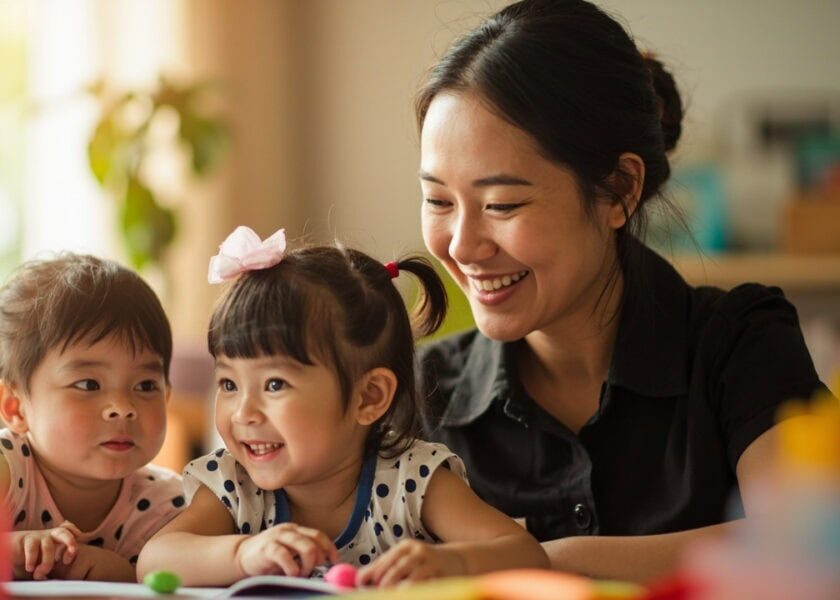
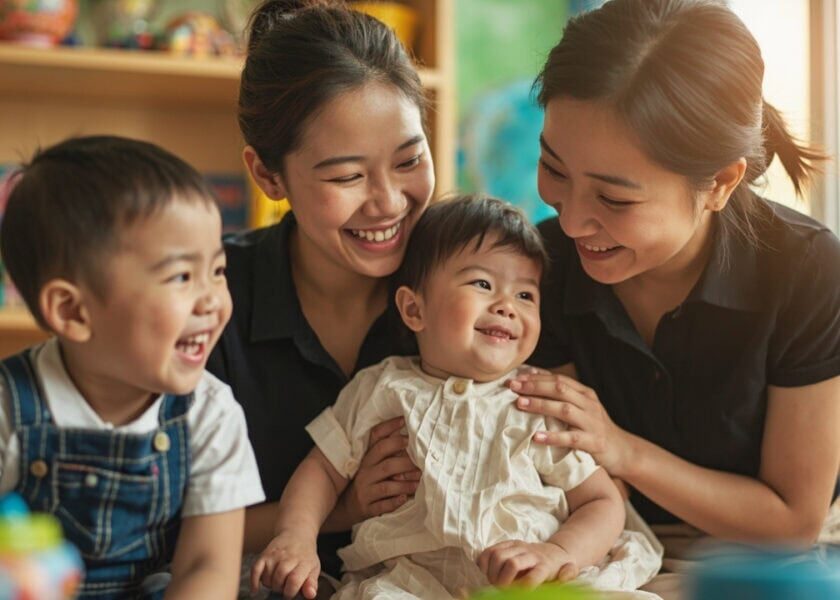
In quality care, children learn to navigate relationships. They encounter other children’s needs, desires, and emotions in a structured environment where trained adults help them make sense of these encounters.
A child learns to share not through a lecture about sharing but through the lived experience of sharing, with guidance that helps them understand why it matters and how it feels. Emotional regulation—one of the most critical and most challenging skills a young child develops—grows through these daily social experiences. Children in quality care learn to name their feelings, to manage frustration, and to read the emotional cues of others.
Physical Development Through Designed Environments
Motor development is supported in intentional ways. The physical environment in quality care is designed to offer challenges appropriate to each child’s stage:
- Climbing structures that build gross motor skills
- Art activities that develop fine motor control
- Open-ended materials that invite exploration and physical problem-solving
A child who spends hours in a stimulating physical environment is not just burning energy. They are building the neural pathways that support coordination, body awareness, and physical confidence.
The Role of Trained Caregivers
Real learning does not happen automatically. It happens when there is trained attention in the environment. In quality care, the caregiver is not simply watching. They are observing with intent—noticing when a child is approaching a developmental threshold, when they are on the edge of learning something new.
Educators call this scaffolding, and it is one of the most powerful tools in early childhood development. A skilled caregiver watching a child struggle with a puzzle does not solve it for them. But they also do not simply leave the child to flounder. They offer exactly the amount of support that helps the child experience the satisfaction of achievement while building the persistence and problem-solving skills that make future achievements possible.
Quality Childminding in Singapore
Initiatives such as the ECDA Childminding Pilot in Singapore represent an important step toward recognizing and supporting quality childminding as a legitimate, valuable option for families. They reflect the understanding that not all children thrive in the same settings, and that home-based and community-based care, when it meets high standards, can offer genuine developmental benefits.
Whether care is delivered in a home setting or a centre-based environment, the principles remain consistent: trained caregivers who understand child development, environments designed for learning, and communication practices that keep parents informed and involved.
The Partnership Between Home and Care
The learning that happens in quality care does not end when you pick up your child at the end of the day. It continues in your home, in your conversations, in the way you build on what your child has been exploring.
When a caregiver tells you that your child has been fascinated by building structures, you can extend that interest during bath time with cups and containers. When you learn that they have been singing a new song, you can sing it together at bedtime. The caregiver’s observations become a map for your own interactions.
When parents understand what their child is learning and actively participate in extending that learning, the benefits multiply. You become your child’s most important teacher—not in competition with the caregiver but in partnership with them.
Choosing With Confidence
The anxiety you feel when leaving your child is not weakness. It is not irrationality. It is love, expressed as vigilance. You are not supposed to feel completely at ease leaving your child with someone else. The question is not whether to feel it, but what to do with it.
The answer is to channel it toward informed action. Ask the questions. Visit the settings. Observe how caregivers interact with children. Ask about their training, their philosophy, their approach to child development.
What to Look For
When evaluating infant care and childminding options in Singapore, look for these indicators of quality:
- Caregiver training: What qualifications do caregivers have? How do they continue learning?
- Group ratios: How many children per caregiver? Is there individual attention?
- Learning environment: Is the space designed for exploration? Are materials age-appropriate and varied?
- Communication: How will you know what your child is learning each day?
- Observation practices: Does the caregiver track developmental progress? How?
- Partnership approach: How does the setting involve parents in extending learning at home?
The right setting will welcome these questions. In fact, asking them is itself a test of quality.
Recognizing Learning at Home
You can observe these developments at home. Watch for the complexity of your child’s sentences and the richness of their vocabulary. Notice whether they can share, take turns, and manage disappointment. Notice whether they show empathy—whether they notice when another child is upset and respond with care.
Observe how your child approaches challenges. Does she persist when something is difficult? Does she try different strategies when one does not work? Does she show curiosity, asking questions, wanting to understand how things work? These are habits of mind that will serve her for a lifetime.
When You Stand at That Door
This is what transforms the experience of childcare from something endured to something chosen with full knowledge of what it offers. When parents approach childcare as a reluctant necessity, they carry an underlying sense that they are somehow failing their child by not being present. But when they understand what quality care actually provides, the narrative changes completely.
You are not failing your child. You are choosing deliberately to place your child in an environment designed for their growth.
So when you stand at that door in the morning, watch your child walk into a space designed for their learning, and trust that what is happening inside matters. Those hours are filled with intentional experiences that build language through rich conversation, develop thinking through purposeful play, nurture emotional resilience through guided social moments, and strengthen bodies through physical exploration.
Every song sung, every puzzle attempted, every small conflict navigated with guidance, every story heard and wondered about, every new word encountered in meaningful conversation—all of it is accumulating. All of it is building something that will last.
That is not a compromise. That is a choice. And it is one you can make with confidence.
Begin With a Conversation
Every family deserves to understand what their child is learning and why it matters. Every parent deserves to leave that door with confidence, not guilt.
EduNanny offers families a pathway that prioritises trained caregivers, small group ratios that allow for responsive individual attention, structured learning environments, and transparent communication with parents. If you are ready to explore what quality care looks like for your family—grounded in developmental understanding, delivered by trained caregivers, and built on genuine partnership with parents—we are here to answer your questions.
The hours are full. The learning is real. And your child is in more capable hands than you might have imagined.