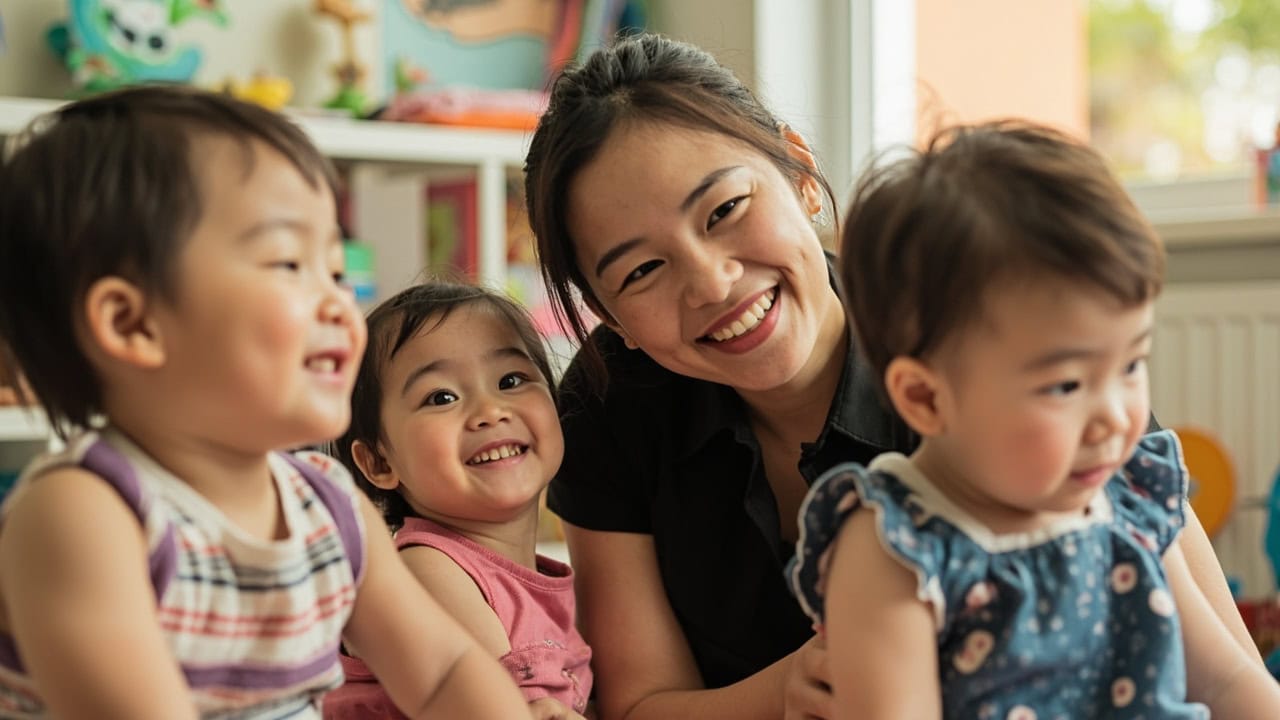
What Quality Childcare Looks Like in Your Child’s Day
What Quality Childcare Actually Looks Like
Before we walk through the day together, here is what you will find in this article:
- How trained caregivers read and respond to each child’s needs from the moment of arrival
- Why transitions—often overlooked—are among the most powerful learning moments in a childcare day
- How sensory engagement, play, meals, and rest are designed with developmental purpose
- What the “invisible curriculum” means and why it matters more than any activity checklist
- How pickup transforms from handover to meaningful conversation
- What to look for when choosing infant care in Singapore
If you are researching childcare options and want to understand what separates quality care from mere supervision, this is for you.
The Morning: Arrival and the Rhythm That Follows
In quality childcare, the arrival of each child is not a transaction. It is a transition—and transitions, when handled well, are among the most powerful learning moments in the child’s day.
The caregiver stands at the door, ready. She has already prepared the space: toys arranged with intention, the morning light considered, an activity at the table that matches where the children are developmentally. When your child walks in, she bends to their level. She greets them by name. She notices:
- Is this child rushing in, still carrying the energy of the morning rush?
- Is that one quieter than usual, still adjusting to a new week?
- Is there a slight redness around the eyes that might mean a poor night’s sleep?
These are not trivial observations. They are the currency of attuned caregiving. A trained caregiver reads a child’s arrival the way a teacher reads a classroom: what does this particular child need from this particular morning?
Singapore-Specific Transitions
In Singapore, this reading happens within a context that matters. A child who arrives flushed from the walk needs a moment to cool down, to have their hair wiped, to drink water before they can settle.
A child who has come from a Mandarin-speaking home and an English-speaking school in the same morning is carrying two linguistic worlds—they need a caregiver who can ease that transition, not ignore it. A child from a multicultural household may be navigating dietary customs or religious observances that the caregiver has noted and respects.
These are not complications. In quality care, they are the fabric.
The Rhythm of the Day
In the first hour after arrival, children are settling. A skilled caregiver will offer activities that are calming but absorbing—sensory play with water or sand or playdough.
These are not just ways to keep children occupied. Sensory experiences help children regulate their nervous systems, providing a kind of internal coherence that allows them to move from the stimulation of arrival into readiness for learning.
Transitions are never abrupt. Moving from the sensory table to circle time, from circle time to free play—the caregiver gives warnings. “In five minutes, we will clean up.” Then she leads the transition herself, with a song or a rhyme that signals the shift.
This is not micromanagement. This is how children learn to move between states. The child who has learned that transitions have rhythm and warning becomes the child who can manage change without anxiety. That is not a small thing.
Play: The Work of Childhood
Perhaps the most misunderstood element of a childcare day is play itself.
In our culture, play is often framed as what happens when work is done. We say: “They played all day,” as if that means nothing happened.
But in quality early childhood environments, play is the work. It is where language explodes, where social skills are rehearsed, where cognitive pathways are built.
A child building a tower is not just playing. They are learning spatial reasoning, persistence, cause and effect, and the physical coordination required to place one block on another without toppling the whole structure.
A child engaged in pretend play with peers is not just having fun. They are practicing perspective-taking, negotiation, emotional regulation, and narrative thinking.
The Caregiver’s Role
The caregiver’s role in this play is not to direct it, but to enhance it. She observes. She occasionally extends: “I see you’re building a road. Where does the road go?” Or she provides a resource that the child has not thought to use—a small wooden figure, a piece of fabric—that opens new possibilities.
This is the difference between a caregiver who is simply present and a caregiver who is intentionally engaged. The trained eye knows when to step back and when to step in. It knows when a child is in a state of deep concentration and should not be interrupted, and when a child is flagging and could benefit from a gentle prompt.
Caregivers are trained not to hover, but to observe. Not to direct play, but to support it. Not to impose adult agendas onto children’s activities, but to follow the child’s lead while subtly ensuring developmental richness.
This is harder than it sounds. It requires patience, knowledge, and the discipline to resist the urge to simplify. But it is how children learn to be curious, to be confident, to be capable of sustained focus. It is how play becomes learning without ever feeling like a lesson.
Meals and Rest: The Nourishment of Body and Mind
Meals in quality childcare are rich with development, even though parents often imagine nothing much is happening beyond the logistics of feeding.
A toddler learning to use a spoon or a fork is refining fine motor skills, building the hand-eye coordination that will later support writing, drawing, and so many other tasks. A child sitting at a table with others, passing the bowl, waiting their turn, is practicing patience and social cooperation.
Bilingual Exposure in Everyday Moments
In Singapore, meals carry another dimension. There is the question of bilingual exposure—caregivers naming foods in English and Mandarin, in Malay, in Tamil, depending on the household. A quality childcare setting works with this linguistic reality rather than ignoring it.
Mealtimes become natural moments for language modeling. “Can you pass me the chopsticks? Or shall we use the spoon?” The caregiver is not conducting a language lesson. She is simply living alongside the children, and language flows through the ordinary moments of the day.
A child’s food preferences, their family’s dietary practices—these are noted, respected, and woven into the experience. A child who sees their caregiver acknowledge their comfort foods develops a sense of security that goes deeper than the food itself. They begin to understand: this place knows me. This place knows where I come from.
Rest: The Quiet Work of Development
Perhaps the most quietly important part of the childcare day is rest.
A child’s brain and body develop during sleep. This is not a metaphor. It is neurobiology. The infant who naps well is building neural pathways that support memory, learning, and emotional regulation. The toddler who has a calm, consistent rest period is developing the internal rhythm that will later help them function in school and social settings.
In quality childcare, rest is not an afterthought. It is designed. The room is dimmed. The noise level drops. The caregiver moves through the space with calm, offering gentle assistance to children who need help settling.
- For infants, there is individual attention—the caregiver bends to each crib, responds to cries with attunement, does not let an infant cry alone and assume they will self-soothe.
- For toddlers, there is the ritual of rest: the story, the song, the predictable sequence that signals safety. “We lie down now. We close our eyes. The quiet is here.”
A caregiver who manages rest well is not just keeping children calm. They are teaching children that their bodies have rhythms, that those rhythms are respected, and that they can trust their environment to honor their needs.
Parents sometimes worry that childcare will disrupt their child’s sleep patterns. In a quality setting, the opposite is true. The consistent rhythm of the childcare day—active play, meals, rest—supports the child’s internal clock.
Being Known: The Difference Between Care and Supervision
In a childcare setting that serves many children, the risk is anonymity. A child becomes a number, a slot, a routine. But in quality care, the opposite happens.
The caregiver knows each child—not just their name and schedule, but their temperament, their current interests, their fears, their joys. She knows that one child is going through a phase where they are obsessed with trucks, and she finds a picture book about construction vehicles for circle time. She knows that another child is struggling with sharing, and she gently introduces a cooperative game that builds that skill without shaming.
What Professional Training Enables
This is what professional training enables. It is not about personality or warmth alone—though those matter. It is about the knowledge to read what a child needs and the skill to respond appropriately.
It is about understanding developmental milestones—knowing what is typical for a child of eighteen months versus two years, knowing when a behavior is a phase and when it warrants attention, knowing how to scaffold learning at exactly the right level: challenging enough to stretch, not so challenging as to frustrate.
Caregivers in quality settings are familiar with local developmental expectations and the kinds of transitions children make as they move from infant care to toddler care to kindergarten. They are preparing children not for some abstract future, but for the specific pathway that lies ahead in the Singapore education system.
The Pickup: From Handover to Conversation
And then there is pickup—the moment that bookends the day, and the moment that tells you everything about what has happened inside.
A quality childcare pickup is not a handover. It is a conversation. The caregiver who has spent the day with your child will share something specific:
- “Mia was so proud of herself today. She built a tower all by herself and then deliberately knocked it down to see what would happen. She laughed and did it again.”
- “Wei Ling was a bit tired this morning. We gave her an earlier nap and she was much brighter after.”
- “Kai told me about the bus he saw on the way here. He wanted to show me his lunchbox too.”
These details are not small talk. They are evidence. They tell you that your child was seen, noticed, known. They tell you that the hours apart were not a blank. And they give you, as a parent, material to work with—to ask questions, to follow up, to continue the narrative of your child’s day.
This is what transparency means in practice. It is a daily commitment to letting parents know that what happens in the hours they cannot see is worth knowing.
The Invisible Curriculum: Building Foundations for the Future
What we have seen, moving through a day in quality childcare, is that the hours between drop-off and pickup are not a gap. They are a curriculum.
It is an invisible curriculum, because most of it does not announce itself:
- A child does not know they are building neural pathways when they splash in water.
- A toddler does not know they are practicing social skills when they navigate a turn-taking game.
- A baby does not know they are developing trust when their cries are responded to with warmth and consistency.
But these invisible lessons accumulate. Over months and years, they become the foundation on which a child’s confidence, curiosity, and security are built.
- The child who has been treated as a person to be known, not a task to be managed, learns to expect that of the world.
- The child who has had their needs met with attunement learns to regulate their own emotions.
- The child who has been in an environment where learning is joyful, where curiosity is rewarded—these children carry that disposition forward, long after they have left childcare.
What This Means for Singapore Families
In Singapore, where the pace is fast and the expectations are high, this matters even more. Our children will grow up navigating a world that is complex, multilingual, demanding. They will need to be adaptable, resilient, emotionally intelligent, capable of sustained effort and creative thinking.
These are not qualities that appear in secondary school or university. They are built in the first years, in the daily rhythms of care, in the hands of people who know what they are doing.
Through the ECDA Childminding Pilot framework, EduNanny represents a clear methodology—a trained team, a framework for daily intentionality that makes the ordinary extraordinary. With attention to ratios of up to one to three for infants, individual attention to each child’s rest needs, cultural responsiveness to Singapore’s multicultural households, and natural bilingual exposure woven into daily routines, EduNanny makes quality care accessible to families across Singapore.
This is not care for those who can afford premium. This is quality care within a pilot structure designed to be affordable, accessible, and accountable.
Questions Every Parent Should Ask
If you are researching infant care or childminding in Singapore, here are the questions that matter most:
- How does the caregiver respond to my child during arrival? Is there attunement, or just routine?
- What does the daily rhythm look like? Is there intentional sequencing from sensory settling to active play to rest?
- How does the caregiver engage with play? Does she observe and extend, or just supervise?
- What happens at pickup? Is there genuine sharing of the child’s day, or just logistics?
- Does the caregiver know my child as an individual? Can she tell me about my child’s specific interests, temperament, and current developmental focus?
- How does the setting honor our family’s cultural and linguistic background?
- What are the caregiver-to-child ratios? Especially for infants, smaller ratios mean more individual attention.
The Doorway, Revisited
So let us return, one last time, to that doorway.
You are standing there, your child’s hand in yours, the humidity pressing against you, the morning already full of everything it demands. You let go. You turn. You walk away.
But here is what you now know: behind that door, the day is already being designed. Someone is watching for your child. Someone is noticing the mood they carry, the words they use, the way they move through a room. Someone has planned the activities, the transitions, the meals, the rest, with the quiet precision of a person who understands that ordinary days are where extraordinary things are built.
Your child is not just being minded. Your child is being held in a rhythm of care that sees them, responds to them, and shapes them.
And when you return, at the end of the day, someone will tell you about it. Not in a report, but in a moment. A detail. A small story that makes the invisible visible.
This is what quality childcare offers. Not just a service. A partnership in your child’s becoming.
That is everything.
Learn More About EduNanny
EduNanny by BUTLER offers quality infant care and childminding through the ECDA Childminding Pilot framework. Our trained caregivers design each day with intentionality, warmth, and professional expertise.
Whether you are exploring your options for the first time or looking for a more intentional approach to childcare, we welcome the conversation. Contact us to learn more about our approach—or to schedule a visit and see the invisible curriculum in action.