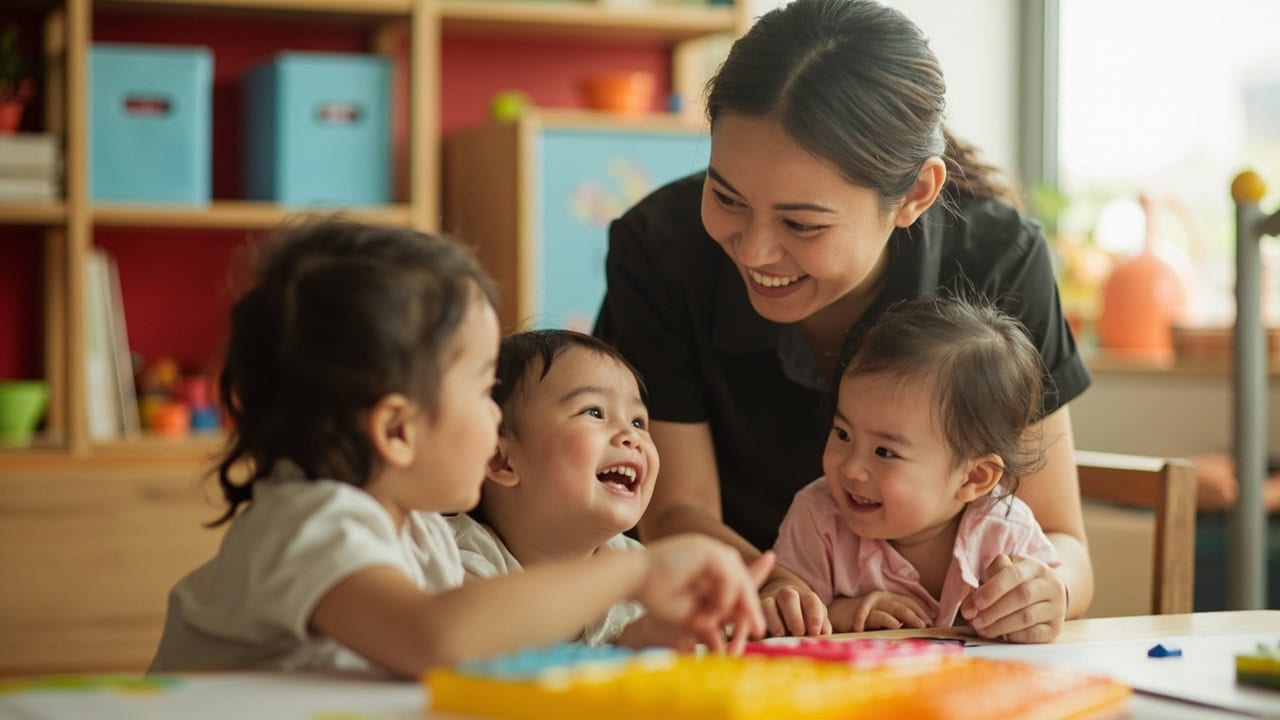
What Happens When Your Child Is Truly Known
The First Hours: Settling, Safety, and What Unlocks
When your child walks through the door of a quality childcare environment in the morning, they do not simply arrive. They arrive carrying everything they are—their temperament, their current fears, the quality of sleep they had the night before, the mood they woke in. And then they encounter a new space, new faces, new rhythms, and a whole new emotional landscape begins to unfold.
The first thing that happens is settling. For some children, this is smooth. For others, it takes time. But even in the smoothest mornings, there is a psychological process happening—your child is taking in the environment, reading the faces, calibrating their nervous system to what is safe and what is unfamiliar.
This is happening beneath awareness, in the deep architecture of their developing brain. Every sensory detail—the sound of a voice, the sight of a particular toy, the smell of a familiar cream—is being catalogued as either threatening or trustworthy.
A child who is greeted not just with a smile but with genuine attunement—who is seen, who is met at their level, who feels that the adult in the room has registered their particular mood this particular morning—begins to settle differently. The stress hormones that spike at separation begin to quiet. The nervous system begins to communicate: this place is safe, these people know me, I can let down my guard here.
As the morning progresses, something remarkable begins to happen. The curiosity that was muted by initial alertness starts to emerge. They reach for a toy. They watch another child play. They respond to a song they half-remember. They begin to explore—first tentatively, then with growing confidence.
This is the developmental system at work. When a child’s nervous system registers safety, the explorative system activates. When a child feels held, they become capable of letting go. By mid-morning, you see a child who is engaged in a way that is qualitatively different from the child who arrived at the gate.
This is what thriving looks like during the day itself—not just at homecoming, when children often show us their best behavior for parents, but in the actual hours when the self that is unobserved is also unperformed.
Being Watched Versus Being Known
Being watched is external. It means someone is observing behavior, monitoring safety, ensuring rules are followed. Being known is something else entirely.
Being known means that the adult in the room has internalized your child’s particular patterns—the way they signal tiredness, the texture they prefer for comfort, the particular sound that calms them, the face they make when they are about to hit instead of speak. Being known means that your child’s internal states are not just observed but understood, anticipated, and responded to with precision and care.
When a child feels known, they feel something far deeper than comfort. They feel recognition. They feel that they exist as a distinct person in the mind of another, and this is foundational to the development of self.
Your child is not just learning shapes and colors in those hours. They are learning, at the most fundamental level, that they are someone worth knowing. This is what shapes a child’s sense of worth long before they have words for it.
This is why the work of quality childcare is not custodial. It is not about supervision. It is about relationship. And relationship, as developmental science has shown us again and again, is the medium through which the brain develops. The early years are not just a period of growth—they are a period of relational construction, where the brain is building its architecture based on the quality of connection it receives.
The Hours That Expand Rather Than Divide
Here is something that is both scientifically important and emotionally reassuring: attachment is not a finite resource. It is not that your child loves you less because they also love their caregiver, or that their bond with you is diluted by their bond with another.
Attachment is expandable. A child who has a secure attachment with their parent is not limited by that attachment—they are built by it. From that secure base, they are capable of forming additional healthy attachments that add to their sense of safety and their understanding of relationship.
Secondary attachment figures—the caregivers in your child’s life—do not replace you. They complement you. They widen your child’s world of trust. When your child has multiple adults who know them, who respond to them consistently, who delight in them genuinely, they are building a more robust internal working model of what relationships feel like. They are learning that the world contains people who can be trusted, and this is one of the most important lessons a human being can learn in the early years.
Think about what this means for your child. They are not dividing their loyalty or their love. They are expanding their capacity for connection. The child who trusts you deeply is the child who can also trust others deeply—not instead of you, but alongside you.
A Day in Your Child’s Internal World
Let me paint a picture of what happens in those hours, because it is worth imagining fully.
The First Hour: Settling. Your child arrives and their nervous system is registering the environment, reading the faces, testing whether this space feels okay. A skilled caregiver does not rush this process or suppress it. They meet your child where they are, offer comfort without pressure, and give your child the dignity of experiencing their feelings while holding the certainty that those feelings will pass.
The Second Hour: Engaging. The settling has done its work. Your child begins to engage. They join an activity, or they create their own. They watch other children. They begin to trust the space enough to move through it. There is a visible softening—in the shoulders, in the eyes, in the way they hold their body. This is not passive. This is the beginning of confidence.
The Deepening Morning: Self-Directed Play. Something extraordinary emerges: play that is self-directed, joyful, and cognitively rich. Your child is not being taught in this moment—they are teaching themselves through the natural language of childhood. They are solving problems, negotiating roles, experimenting with cause and effect, building language, building relationships. This is not downtime between structured activities. This is the work of early childhood, and it requires a safe, stimulating environment to unfold fully.
The Homecoming: Evidence You Can See. By the time you arrive to collect your child, they may be in the middle of this play. Here is where you often see the most telling sign: your child does not want to leave. They want to finish what they were doing. They want to show you what they built. They are not depleted by the day. They are full from it.
The child who arrived anxious or uncertain in the morning has become a child who is oriented toward the world—curious, connected, capable.
What Quality Childcare Actually Looks Like
So how do you choose a childcare that makes this possible? Not just on paper—not just in terms of ratios and credentials—but in the reality of your child’s daily experience?
You choose a place that understands it is in the relationship business. You choose a place where caregivers are not just trained but called to this work. You choose a place that sees your child as the protagonist of their own experience, not as a subject to be managed.
Here are the markers of quality you can look for:
- Genuine attunement at arrival. Does your child feel met at their level each morning? Is their particular mood acknowledged and responded to?
- Space for settling. Is your child given time and dignity to experience their feelings without pressure to suppress them?
- Caregiver knowledge. Do the caregivers know your child’s particular patterns—their comfort textures, their tiredness signals, their unique ways of expressing themselves?
- Self-directed play. Is there time and space for the kind of unstructured, child-led play that builds confidence and cognition?
- Peer interaction. Are children learning to navigate relationships, negotiate, share, and solve problems together?
- Transparent communication. Do you feel genuinely connected to your child’s experience, not just updated on logistics?
- Child wellbeing over efficiency. Are ratios designed for connection, not just compliance?
It is normal to have concerns. These are not signs of doubt—they are signs of love. So let us address some of the most common worries honestly.
Will my child feel abandoned? When children are left in attuned, responsive care, they do not feel abandoned. They feel held by a wider world. A child who feels known—not just watched—experiences the caregiver as a reliable base from which to explore. This is the foundation of healthy development.
Will my child love me less? No. Attachment is not a zero-sum game. Your child does not have a limited supply of love that gets distributed among caregivers. Multiple secure relationships strengthen your child’s capacity for connection, not diminish it.
How do I know what is really happening? You know through the evidence you can observe: How does your child behave when you collect them? Do they want to stay or leave? Do they seem expanded or depleted? Do they reference their caregiver with warmth? These are the real indicators of what is happening in the invisible hours.
The EduNanny Approach: Built for the Hours That Matter
This is the science that EduNanny Singapore understands and embodies. In the EduNanny by BUTLER approach, the caregiver is not a background figure in your child’s story. They are a meaningful character in it—someone who is present, attuned, and invested in your child’s emotional experience not just as a job but as a purpose.
This kind of presence is not accidental. It is cultivated through training, through ratios, through culture, and through a genuine commitment to understanding the child as a full human being, not just a small one.
When you drop your child at EduNanny, you are not leaving them with a stranger. You are placing them in a relationship with someone who has been prepared to know your child—really know them—in the hours you are not there.
As part of the ECDA Childminding Pilot, EduNanny operates across both home-based and community or centre-based pathways, offering families in Singapore real choices in how and where their children are cared for. With infant ratios of up to one to three, the environment is designed not for efficiency alone but for connection. Caregivers have the time and capacity to know each child—not just their routines, but their temperaments, their preferences, their particular rhythms of the day.
Within the pilot fee structures, with subsidies available, and with CDA and Baby Bonus funding options that can be applied, quality childcare becomes a realistic choice for families across Singapore, not just for those who can afford premium pricing. This matters because every child deserves to have their internal world held by people who know them.
EduNanny builds transparency into its approach—through regular communication, through documentation, and through measures such as CCTV where deployed, so that parents can feel genuinely connected to their child’s experience even when they are not physically present. This is not about surveillance. It is about trust—the trust that comes from knowing you are welcomed into your child’s day, not shut out of it.
An Invitation to Confidence
There is one more thing worth sitting with, because it sits at the heart of everything.
The invisible hours are not invisible to your child. They are the most real hours of their day—hours lived fully, felt deeply, and learned from enormously. What happens in those hours shapes who your child is becoming. It shapes their confidence, their curiosity, their capacity for relationship, their sense of the world as a place that is safe enough to explore.
As parents, we cannot be everything to our children. We cannot be their only teachers, their only playmates, their only source of developmental stimulus. We are not meant to be. The healthy child is not the child who needs nothing but their parents. The healthy child is the child who is capable of trusting a wider world—because they were first trusted by the people closest to them, and because they found that trust was warranted.
So the next time you drop your child at the gate and feel that familiar ache, stay with it for a moment. Not to push it away or reframe it away, but to simply acknowledge it. That ache is love. It is the deepest expression of what it means to be a parent.
And now, with this understanding, I hope you can feel something alongside it: confidence. Because you know now what your child is doing while you are not there. They are settling. They are exploring. They are connecting. They are becoming more fully themselves.
In the hours between drop-off and homecoming, your child is having an experience that is worthy of your trust—because you have chosen a place that is worthy of your child.
To learn more about the EduNanny approach to quality childminding in Singapore, visit our website or connect with our team. We welcome the opportunity to answer your questions and show you what thoughtful, development-oriented care looks like in practice.
Because you deserve to know what your child is experiencing. And your child deserves to be known.