Beyond the Guilt: How Singapore Parents Choose With Clarity
Understanding the Tension: Why This Conversation Is Real
Singapore has one of the most complex childcare landscapes in the world. We live in a society where multigenerational families are not a cultural artifact but a living, breathing reality. Our parents watched us when we were small. They made sacrifices we are only now beginning to understand as our own children arrive. They believe, with every part of their being, that they know how to love a child.
And they are not wrong.
The knowledge lives in their hands, in the way they held us before we could hold ourselves. It lives in the lullabies they remember and the comfort they instinctively know how to give. When a grandparent questions your childcare choice, they are not being difficult or old-fashioned. They are expressing love in the only way they know how—by offering what they believe is most valuable.
And when a parent feels defensive, they are not being disrespectful or ungrateful. They are trying to protect something precious while holding space for a different vision of what their child’s future might include.
We are the sandwich generation. We carry the weight of expectations from above and the fierce, protective hopes we hold for the children below. We understand things now that our parents could not have known when they were raising us—neuroscience discoveries about early brain development, attachment research that reshapes how we understand infant emotional needs, and the profound impact of consistent, responsive caregiving on a child’s sense of security.
We are not rejecting what our parents know. We are building upon it with new understanding, new tools, and a different context for what raising a child in Singapore today can look like. The world your child is growing up in is not the same world you grew up in—and that is not a failure of anyone. It is simply the nature of time moving forward.
This tension deserves to be named honestly, because it cannot be resolved by pretending it does not exist. It can only be moved through—together.
The Choice That Feels Right (and the Guilt That Comes With It)
There is a conversation that thousands of Singapore parents have every year. It happens over dinner tables and in WhatsApp groups, in living rooms and across kitchen counters. It begins with a careful announcement—a new childcare arrangement, a professional caregiver, a choice that feels right in every parent cell and yet carries a weight that is difficult to name.
And almost before the words are fully spoken, the question arrives. Not always in those exact words, but the question is there: “Are you sure? We could look after the baby.”
What follows is a silence. The kind that holds decades of love, layers of good intentions, and an unspoken fear that the answer might mean something has changed in the family that cannot be undone. And then comes the guilt. It arrives quietly, sitting down beside you as if it has always belonged there.
It tells you that you are failing everyone. That you are choosing convenience over family. That somewhere in your decision, you have betrayed the very village that raised you.
If you have been in this moment, I want you to hear this first: the guilt you feel is not a warning sign that you are making the wrong choice. It is evidence that you care deeply about the people in your life and the relationships that define your family. The discomfort you carry is not weakness. It is the weight of love navigating terrain that has changed faster than our family conversations have been able to follow.
Reframing the Choice: Partnership, Not Replacement
What we have learned at EduNanny is that this tension does not have to end in stalemate. It does not have to become the quiet wound that families carry. It can become something else entirely—a doorway to a richer, more intentional kind of family partnership.
The word partnership matters here. When we talk about EduNanny as a partner to your family, we are describing a fundamentally different approach to professional childcare—one that was designed with full awareness that Singapore children do not grow up in isolation. They grow up within webs of relationships, with grandparents who visit on weekends and sing songs in languages we may have forgotten, with aunts and uncles who have opinions and memories and stake in the family’s story.
Our children are not ours alone. They belong to a lineage, to a continuity that stretches backward and forward in time.
This understanding shapes everything we do. Where communication measures are deployed, families have visibility into their child’s day. They receive updates that go beyond the perfunctory to the genuinely informative. They hear not just that their child ate, but that they tried a new food with curious fascination and rejected it with dramatic theatricality. They see not just that their child played, but how they engaged with other children, what captured their attention, where they needed extra comfort.
For grandparents specifically, this kind of transparency can be transformative. When a grandmother can see, with her own eyes, that her grandchild is thriving—that they are safe, loved, stimulated, and responding to care that honors who they are as a unique individual—something shifts. The anxiety softens. The skepticism gives way to something closer to respect.
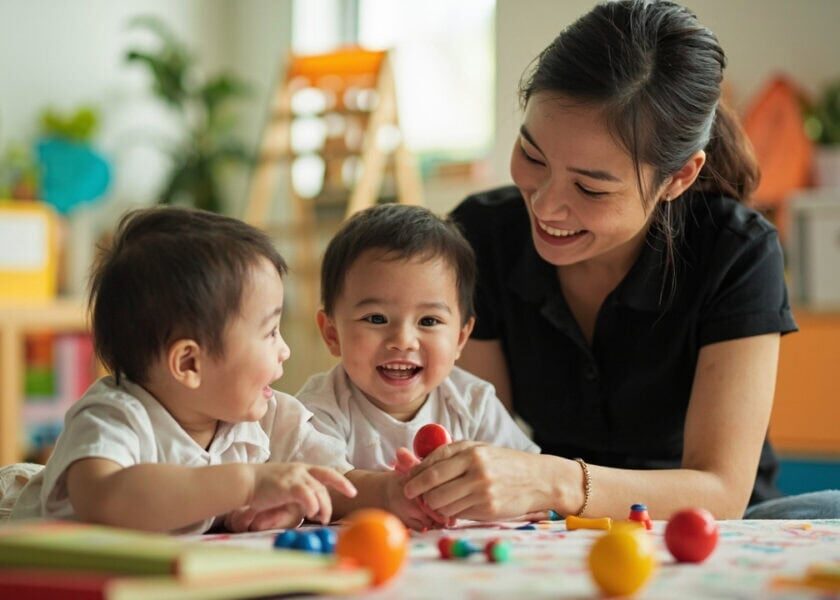
When a grandparent walks into EduNanny and sees a caregiver kneeling at a child’s level, speaking softly, responding to a cry not with frustration but with attention, something changes in how they understand what professional care means. When they see a warm environment designed with an infant’s safety and development in mind, their shoulders relax.
What Quality Infant Care Actually Looks Like
Singapore parents deserve to know what they are choosing, in concrete terms, not marketing language.
Quality infant care is not about impressive facilities or carefully curated photo walls. It is about the ratio of adults to children in a room, and what that ratio makes possible. With up to one caregiver to three infants, there is space to respond when an infant is in distress, to notice when an infant is curious, to provide stillness and warmth and the steady rhythm of breathing that tells a baby the world is a safe place.
These are not small things. In the first thousand days of life, these are the things that shape a person.
Quality care also means open communication with families—not just at pick-up, but throughout the day. It means knowing how your child slept, what they explored, where they needed comfort, and what made them laugh. It means a caregiver who notices the small things: the way a child’s hand reaches for another, the word they said for the first time, the food they finally accepted after refusing it four times.
For families in Singapore, quality care means being part of a system that understands the reality of our context. The ECDA Childminding Pilot offers pathways that recognize different family needs, including home-based care, community-based arrangements, and centre-based options, because a childcare solution that works for one family may not work for another.
Addressing the Concerns You May Be Carrying
Will choosing professional childcare mean my parents feel rejected?
Not if the arrangement is designed to include them. When grandparents are invited into the childcare narrative—through open visits, transparent communication, and genuine respect for their role—they do not experience exclusion. They experience redefinition. They are no longer the sole caregivers carrying full responsibility. They become the grandparents who visit on Wednesday afternoons, unhurried, present, building a different kind of relationship with their grandchild.
Will my child love the caregiver more than they love their grandparents?
Children are not wired to love in limited quantities. A child who feels secure with a caregiver does not love their grandparents any less. What secure attachment does is give your child a stable emotional foundation from which they can explore and form multiple meaningful relationships. Your child has room for many people who love them. That is not a threat to your parents. It is a gift to your child.
What if my parents refuse to accept this choice?
Then the invitation stays open, and the trust-building takes time—exactly as it would in any relationship between adults who see things differently. Share what you have learned about why you are making this choice, not to defend yourself but to invite understanding. Show them who EduNanny is and what happens inside our doors. Give them the opportunity to see what you see. And if they do not understand immediately, that is alright. Trust takes time to build across generations, just as it takes time to build in any relationship.
Is this choice financially accessible for our family?
Cost is a genuine consideration for many families, and it deserves a genuine answer. CDA funds and Baby Bonus provisions exist because Singapore, as a society, recognizes that raising children requires support. We help families understand how these financial tools can support their decision—not as a service add-on, but as part of our commitment to making quality care achievable.
The Unexpected Gift to Everyone Involved
Here is what often surprises families: one of the greatest benefits of quality professional childcare is not what it gives to parents, though the peace of mind is real and significant. One of the greatest benefits is what it gives to grandparent relationships.
A grandparent who was providing full-time childcare is suddenly released from that responsibility. And what they discover, sometimes to their own surprise, is that they get something back that they had forgotten they were missing.
They become a grandparent again, in the truest sense.
They visit and have tea with their grandchild, unhurried, without the weight of full responsibility. They build a different kind of relationship—one defined by joy rather than obligation, by play rather than schedule, by presence rather than pressure. They have stories to ask about—the funny thing that happened at EduNanny this week, the new song the caregiver taught, the friend their grandchild played with at the park. They are included in milestones without carrying the anxiety of being solely responsible for them.
This is what a village looks like when it is working. Not one person doing everything, burning out quietly, resenting the sacrifice they feel they cannot refuse. But a network of people, each contributing what they can, each finding their place, each being seen and valued for what they bring.
This is not a compromise. This is not settling. This is the intentional building of what a family village can actually look like in the twenty-first century.
Practical Steps for Moving Forward
If you are standing at the edge of this decision, here is what we want you to know:
- Name the tension honestly. The conflict you feel is not a sign that something is wrong with your family. It is a sign that you care about everyone involved. That care is a strength, not a liability.
- Separate your parents’ feelings from your choices. You are responsible for the decision you make for your child. You are not responsible for managing your parents’ emotional response to that decision. Those are two different things.
- Invite your parents in, not out. Share what you are choosing and why. Show them the environment. Introduce them to the caregivers. Give them the information that builds trust over time.
- Look for transparency as a non-negotiable. You deserve to know how your child spends their day. Your child’s grandparents deserve to feel connected, not sidelined. Any childcare arrangement worth choosing will make these things possible.
- Trust that change takes time. Grandparent relationships do not shift overnight. But they do shift—often without anyone fully noticing the moment it happened. Slowly, your parents begin to tell their friends about the wonderful place their grandchild goes. They share updates they received with their own sense of pride and inclusion. They visit and see for themselves that their grandchild runs toward the caregivers with genuine delight.
There is a voice in your head that says you are not allowed to want this. That wanting professional childcare means you do not value your parents enough. That wanting space to return to work or to reclaim some measure of yourself beyond parenthood means you are being selfish. That choosing a path that feels right to you, in your specific circumstances, with your specific knowledge of what your child needs, somehow constitutes a betrayal of family loyalty.
I want you to hear me when I say this: that voice is wrong.
Choosing quality care for your child is not a rejection of your parents. It is an act of love directed forward in time, toward the person your child will become. It is an acknowledgment that you have knowledge they do not, and that using your knowledge to make choices they would not have made does not mean their knowledge was wrong. It means the world has changed, and you are adapting to meet it.
Your parents raised you with the best of what they knew. You are raising your children with the best of what you know. These two things can coexist. In fact, they must coexist, if families are going to move forward without breaking.
A Village Worth Building
The conversation that Singapore parents are having is not really about childcare at all. It is about belonging. It is about asking: how do I honor both what my parents believe and what I know to be true for my child? How do I stay connected to the people I love while making a choice that feels right for my family?
The answer is not to avoid the conversation. It is to have it differently. To approach your parents not as people who must be convinced but as people who deserve to be included. To share what you have learned and invite them to see what you see. To keep the doors open, the communication honest, and the welcome genuine.
And slowly, often without anyone fully noticing the moment it happened, something shifts. The tension does not disappear entirely—family love is rarely that simple. But it softens. It becomes something your family can hold together rather than something you carry alone.
EduNanny is designed to make this possible. Not a childcare service that replaces the village, but one that strengthens it. Not a choice that divides families, but one that can, when approached with intention and openness, bring them closer together.
If you are standing at the edge of this decision, carrying the weight of expectation and the fear of judgment and the fierce love that makes the whole thing so complicated, I want you to know that you do not have to carry that weight alone.
You do not have to convince anyone that you are right. You only have to make the choice that you can stand behind with integrity, and then find the partners who will support not just your child but your whole family.
Your child will not remember the tension you felt before you made this choice. They will remember feeling safe. They will remember being held by people who noticed them. They will remember growing up surrounded by family in all its forms—biological and chosen, traditional and modern, imperfect and deeply loving.
That is the village your child deserves. And it is a village you are brave enough to build.
Ready to explore what this looks like for your family?
EduNanny welcomes conversations with parents at any stage of their childcare journey—whether you are exploring options for the first time or looking for a change that better fits your family’s needs. We also welcome visits from grandparents. Seeing is believing, and we believe what we do inside our doors speaks for itself.
Reach out to begin a conversation.