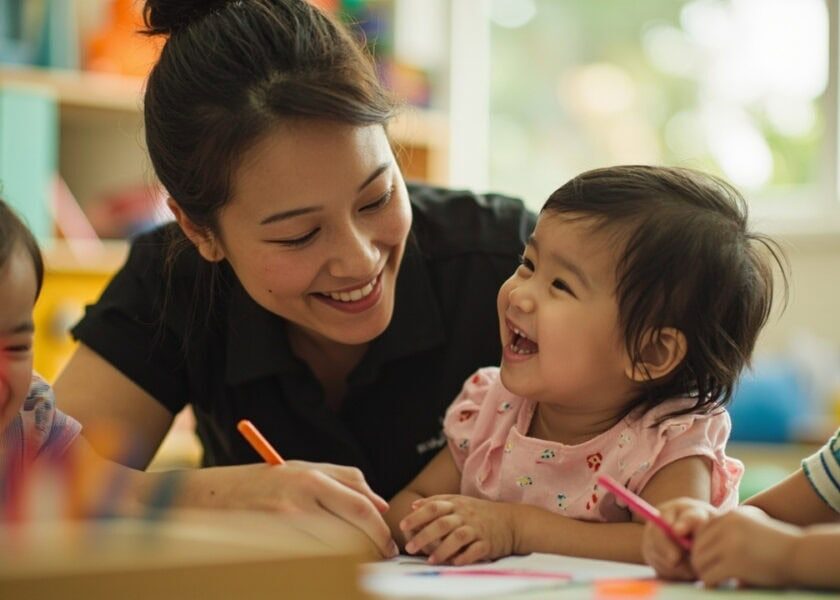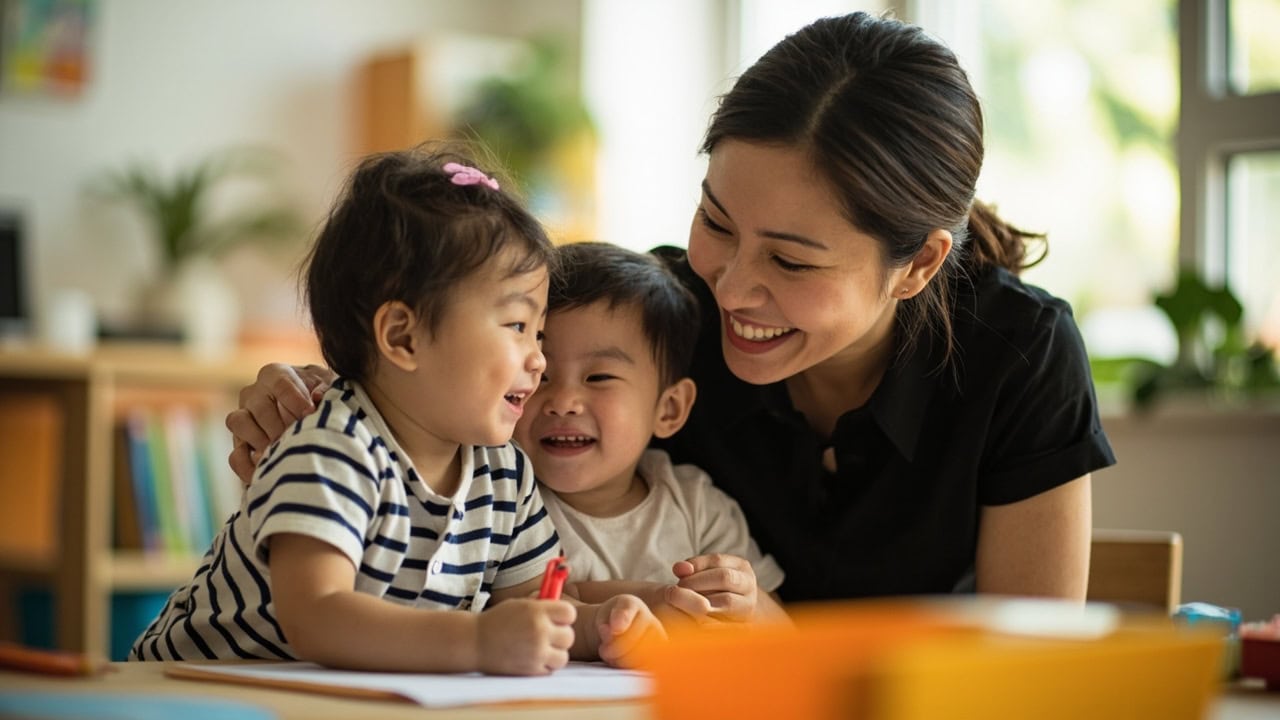
What Actually Transforms in Your Baby’s First Year of Childcare
The First Year in Childcare: What Actually Changes Inside Your Child
This is the story of your child’s first year in childcare. Not the story of your peace of mind, though that matters. Not the story of whether you made the right choice, though we understand why that question lives in you. This is the story of what actually changes inside your child, month by month, and what you might begin to recognize if you know what to look for.
Quick Summary: Your Child’s First Year in Childcare
- Months 1–3: Building an internal map of safety—learning that leaving and returning follow a reliable pattern
- Months 4–5: Social curiosity awakening—noticing other children and understanding they are not alone in the world
- Month 6: Early emotional regulation emerging—the capacity to manage feelings rather than being overwhelmed by them
- Months 7–9: Language precursors blooming; confidence shifting; a new sense of competence in the world outside home
- Months 10–11: Peer awareness developing; sense of belonging to a community beyond caregivers
- Month 12 and beyond: A child fundamentally transformed—one who waves goodbye with enthusiasm and points to childcare as the place where their friends are
Building the Foundation: Months One Through Three
In the earliest weeks, your child is doing something profound and invisible: they are building an internal map of safety. Research tells us that infants and young children are biologically wired to assess whether their environment is trustworthy, whether the adults present will respond when they call, whether the world outside home is a place where their needs will be heard and met.
They cannot articulate this. They do not have words for it. But their nervous systems are taking notes.
When you walk through the door of a childcare setting for the first time with your infant, your child is watching everything. They are watching how you speak to the caregiver, whether your shoulders soften or tighten, whether you make eye contact with the person who will hold them when you leave.
In those moments, your child is not just experiencing separation. They are making a judgment about whether this place is safe enough to return to. And then they return, again and again, and each return adds data to that internal map.
By the second and third months, something shifts that many parents describe as a turning point. The morning goodbye, which may have been difficult, begins to transform. There is a trust that has been earned not through your words but through repeated experience.
They have learned that the caregiver responds when they are hungry. They have learned that someone wipes their face after a spill. They have learned that when they cry, someone comes. This is the foundation upon which everything else will be built.
Social Curiosity and Emotional Growth: Months Four Through Nine
As your child moves into the fourth and fifth months, you may notice a new quality in the way they engage with the world. There is curiosity emerging now—not just in response to you, but in relation to the space itself. The other children moving through the room. The textures of toys they are not used to.
This is social curiosity awakening, and it is one of the most meaningful developmental milestones of the first year. Your child is beginning to understand that they are not alone in the world. There are other small beings like them, with their own sounds and movements and needs.
By six months, many children in quality childcare environments have begun to develop emotional regulation—the capacity to manage their own emotional states rather than being completely overwhelmed by them. Your child is learning this in relationship with caregivers and peers. They are watching how the caregiver calms a crying child. They are beginning to internalize that strong feelings pass, that comfort is available.
Between months seven and nine, you will notice language emerging—not just the first words, which may come later, but the precursors to language. The gestures. The meaningful babbling. The way your child points at things and looks to see if you noticed.
You may notice, one day, that your child is saying a word you have never taught them directly—perhaps the name of a toy they love at childcare, or a song they have learned in circle time. This is the evidence of an invisible process. Your child’s mind has been working while you were apart.
Something else shifts during this period: your child’s growing sense of competence. The child who once seemed fragile and dependent at pickup now has a different quality in their body. They might move more confidently toward the toys. They might point to the caregiver with a kind of easy recognition, as if to say, “This is my person here. I know this place.”
This is confidence. It is the internal experience of a child who has learned, through repeated success, that they are capable of navigating the world outside home. This does not mean they do not need you. It means they are beginning to understand that love and security can exist in more than one place.
Belonging and Expansion: Months Ten Through Twelve and Beyond
By the tenth and eleventh months, something deeper often emerges: a sense of belonging that extends beyond a single caregiver to a community. Your child may begin to notice the other children in ways that feel more intentional. They might reach for a toy that another child is holding, not with frustration but with curiosity about the social dynamic.
They may show preferences—running toward a particular friend, or protesting when a familiar child is not present. These are the early signs of peer awareness, and they matter more than we sometimes realize. Your child is learning that they are part of something larger than themselves.
And then there is the twelfth month, and beyond. This is when many parents describe a child who seems fundamentally transformed from the one they first brought through the door. The child who now runs to the caregiver without looking back. The child who waves goodbye with genuine enthusiasm. The child who, when asked where their friends are, points to the childcare building.
This is not your child forgetting you. This is your child expanding. And the expansion does not diminish your place in their heart. It confirms that you have given them something strong enough to build upon.
Month-by-Month Overview
| Phase | What Is Happening Inside Your Child | What You Might Notice |
|---|---|---|
| Months 1–3 | Building internal map of safety; learning trust through consistent caregiver response | Easier settling at pickup; more alert and curious upon arrival; beginning to feel that leaving and returning follow a pattern |
| Months 4–5 | Social curiosity awakening; noticing other children as separate beings with their own needs | Greater interest in the childcare environment; watching other children; responding to peers’ sounds and movements |
| Month 6 | Early emotional regulation; learning that strong feelings pass and comfort is available | Better recovery from minor upsets; beginning to self-soothe; watching caregivers calm others |
| Months 7–9 | Language precursors blooming; growing sense of competence and confidence | New gestures and babbling; new words (especially from childcare); more confident movement toward toys and people |
| Months 10–11 | Peer awareness developing; sense of belonging to a community | Showing preferences for certain friends; noticing when familiar children are absent; more intentional social engagement |
| Month 12+ | Expanded sense of self; confident navigation of multiple environments | Waving goodbye enthusiastically; mentioning friends by name; pointing to childcare as “their” place |
Reading Your Child’s Evening Cues
Here is what we want you to carry with you, because it is perhaps the most important thing we can offer. You cannot see most of this. You will not be there for the small victories, the moments of breakthrough, the instances when your child’s understanding of the world deepens in ways that will shape them for years.
This is the nature of the invisible distance. And it can feel unbearable, if you let it. So let us offer you something instead—a new way of reading the evidence that is available to you.
The most important data about your child’s internal experience does not come from the childcare setting itself. It comes from the hours after pickup. It comes from the way your child settles in the evening, the quality of their play, the ease or difficulty of their transitions.
When your child comes home and is genuinely glad to see you—not just because they are tired or hungry, but because your presence brings them joy—that is meaningful data. When they fall asleep relatively easily at night, their body still carrying the residue of a day that felt safe enough—that is meaningful data. When they speak about the caregiver with warmth, or mention a friend by name, or hum a song you have never taught them—that is meaningful data.
These evening cues are not trivial. They are your window into the world you cannot see.
What Quality Childcare Actually Looks Like
We want to speak directly about what makes this kind of internal development possible, because not all childcare settings are created equal in this regard, and you deserve to understand the difference.
The kind of deep, healthy development we have been describing does not happen in crowded rooms with overwhelmed caregivers. It does not happen when children are simply supervised but not truly seen.
It happens when the ratio of adults to children is small enough that each child can be known. It happens when caregivers have the time and capacity to notice the small moments—the way a child’s brow furrows before a meltdown, the way another child’s face lights up when they master a new skill. It happens when consistency is prioritized, so that the child knows who will be there to meet them, day after day.
Quality is the ratio of attention your child receives. Quality is the trust your child develops over months of consistent, responsive care. Quality is the difference between a child who merely survives childcare and a child who thrives inside it.
Finding the Right Fit for Your Family
Whether through home-based childminding or community-based pathways, the structure should be designed around the same principle: each child deserves to be known, each child deserves a caregiver who has the capacity to notice them.
In a home-based childminding setting, your child receives care in a smaller, more predictable environment. The caregiver knows your child’s rhythms, their preferences, the cues that signal hunger or fatigue or the need for connection. This continuity matters deeply in the first year, when trust is being built one consistent experience at a time.
In community-based pathways, your child benefits from rich peer interaction while still receiving the individual attention that young children need. The ratio of caregivers to children remains low enough that each child can be seen, heard, and responded to throughout the day.
Questions to Ask When Choosing Infant Care in Singapore
If you are in the process of researching childcare options, here are some questions worth asking—not as checklist items, but as windows into what your child’s experience will actually be:
- What is the ratio of caregivers to children? Smaller ratios mean more individual attention, more responsiveness, more capacity to notice and respond to your child’s cues.
- How consistent is the caregiver arrangement? Will your child see the same faces day after day, or will different people rotate through? Consistency is foundational to the trust your child is building.
- How do caregivers communicate with parents? Is there a system for daily updates? Can you ask questions and receive genuine answers? Is there openness about both the good moments and the challenging ones?
- What does a typical day look like? Are children given space for free play and exploration, or is the schedule rigid? Young children learn through self-directed interaction as much as through structured activities.
- How do caregivers respond to distress? When your child is upset, what happens? You want a setting where distress is met with comfort, not dismissal.
- What training do caregivers have? Not just certifications, but an understanding of early child development and a philosophy of care that aligns with your values.
You also need to feel that the door between you and your child’s day is not completely closed. When you can ask how your child’s day went and receive a genuine answer, when you can hear about the small moment that mattered, when the caregiver knows your child well enough to notice what others might miss—this is what we mean when we talk about quality.
The Bridge Between Worlds
We want to close by returning to where we began: the invisible distance.
You will never fully close it. You were never meant to. The distance between your experience and your child’s experience is the space in which they grow. It is the distance that allows them to become a person in their own right—not an extension of you, but a full human being with their own internal world, their own relationships, their own sense of what it means to be safe and curious and capable.
But the distance need not be a source of anxiety. It can be a source of trust. Trust in your child’s capacity to navigate this world. Trust in the caregivers you have chosen to partner with you. Trust in the process of development, which unfolds over months and years, not in single moments or single days.
Your child is not simply waiting for you. They are becoming someone in your absence, and that someone will come home to you at the end of each day, carrying new pieces of themselves that they will offer to you like small gifts. A new word. A new gesture. A new way of looking at the world.
This is what childcare makes possible. Not just supervision. Not just safety. But the quiet, profound work of a child learning to be human in a world that is larger than home.
And you, in your uncertainty and your love and your persistent showing up, are part of that work. Every pickup. Every evening. Every moment you offer your attention to the cues your child is sending you. You are building the bridge between the world they are learning to inhabit and the love that will always be their home base.
That is not a small thing. That is everything.
Ready to Explore Your Options?
If you are researching infant care or childminding in Singapore and want to learn more about an approach built around small ratios, consistent caregivers, and genuine transparency, we invite you to explore what EduNanny has to offer.
EduNanny by BUTLER is an ECDA-approved childminding pilot committed to thoughtful, development-oriented care. You can learn more about our approach or get in touch to discuss what might be right for your family.
Your child’s internal world matters. And so does yours.