The Unseen Hours That Shape Your Child’s Development in Care
What Is My Child Experiencing Right Now?
There is a moment—perhaps in the morning when you hand your child to someone else, or later in the day when you are at your desk or in a meeting. A question surfaces, one you may never say aloud but that lives in you constantly:
What is my child experiencing right now?
You made a reasoned, careful decision. You weighed options, visited centres, read reviews, asked questions. Yet beneath all that reasoned care, there is something else—a quiet wondering that no amount of preparation fully answers.
The conversation around childcare tends to orbit the adults in the story. We talk about parents who work, the logistics of drop-off, the guilt that surfaces. But the child stands at the centre of this experience and yet remains, in so many ways, invisible.
This article opens a window into what your child experiences in those unseen hours—and why those hours matter far more than you might realise.
The Sensory World of Quality Care
When your child enters a quality care environment, they enter it with their senses first.
The light is different—perhaps softer, perhaps brighter, but certainly not the light of your home. The sounds are different: the hum of other children, the particular echo of a room designed for small voices and smaller bodies, the clatter of something being placed on a shelf. There is a smell—clean materials, perhaps the faint warmth of a cooking activity, the indefinable scent of a space lived in by children.
For a moment, your child is taking all of this in. Their nervous system is calibrating. Their body is asking a question their mind cannot yet articulate: Is this place safe? Is this person safe?
A child’s senses are their first language. Before words, before logic, the body speaks—in the tightening of shoulders, the quickening of breath, the way a small hand reaches instinctively for a familiar face.
This is why the physical environment matters beyond aesthetics. When a space is designed with a child’s sensory reality in mind—when acoustics dampen harshness, when materials invite touch, when the layout allows for both movement and retreat—the child’s body begins to relax.
The Foundation of Trust
Somewhere in this sensory recalibration, a door begins to open. And what comes through it, if the environment is right, is the beginning of trust.
Trust does not arrive all at once. It is built in small moments, accumulated like stones in a riverbed, until one day the weight of them makes a bridge.
The caregiver matters enormously here. Not as a substitute for you—your child knows the difference. But as a steady presence, separate from yours yet complementary to it. A quality caregiver is attuned. They notice when a child’s brow furrows at a new activity, when a small hand reaches out for reassurance, when the smile appears that signals genuine engagement rather than performed compliance.
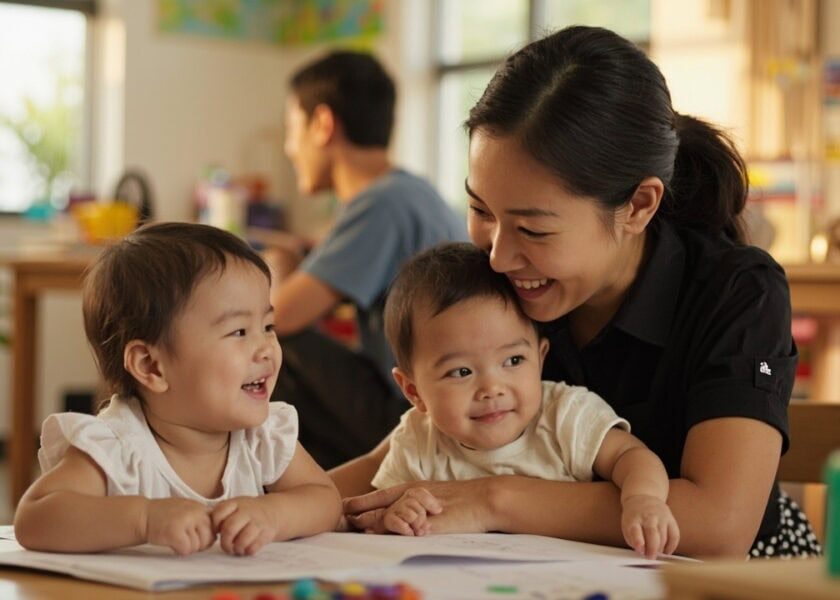
Over days and weeks, something shifts. The child who cried at drop-off begins to look for this person when they enter the room. The caregiver has become a secure base—a launching point from which the child can venture into the world and a safe harbour to which they can return.
Without security, there is no exploration. Without trust, there is no learning. This is not a soft observation. It is a developmental imperative, as real and as essential as nutrition or sleep.
The Peer World
At some point, a new world begins to open. This is the world of peers.
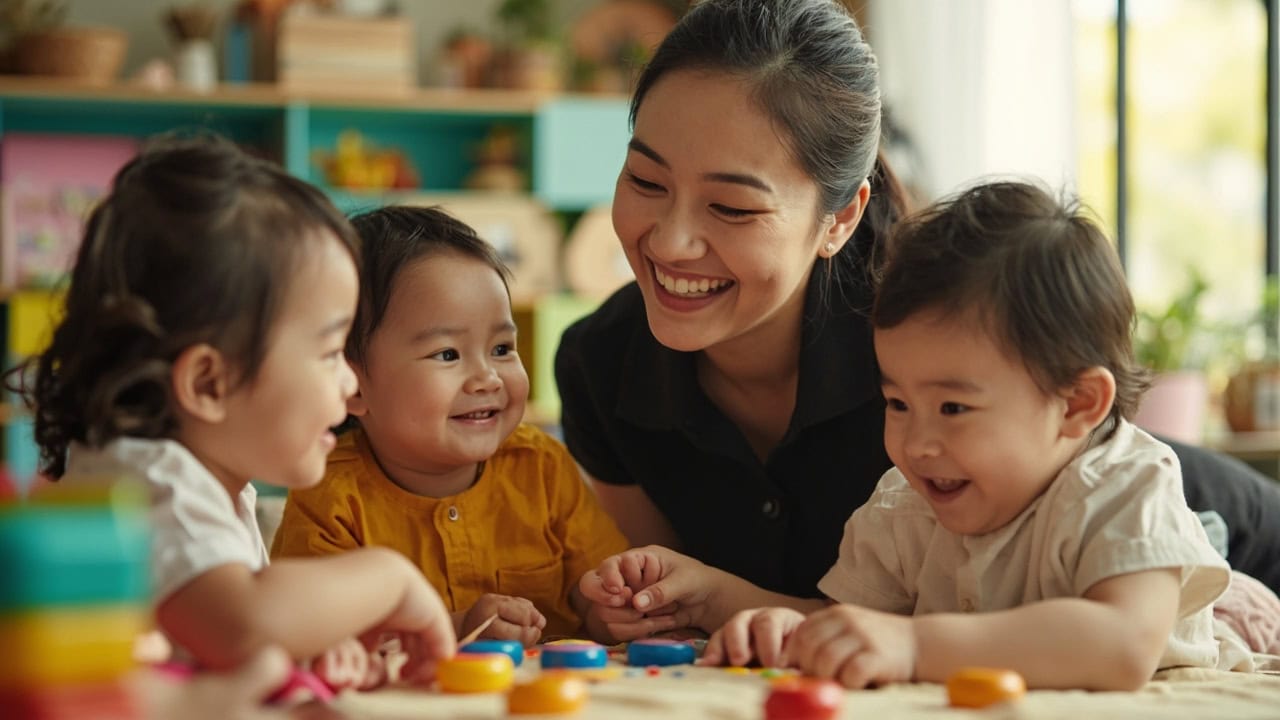
Children in care are not simply children in proximity. They are a small society, inventing their own customs, negotiating their own hierarchies, creating their own language. A two-year-old offers a toy and watches another’s face to see what happens. A slightly older child learns, through trial and error and gentle intervention, that shared toys circulate while hoarded toys create conflict.
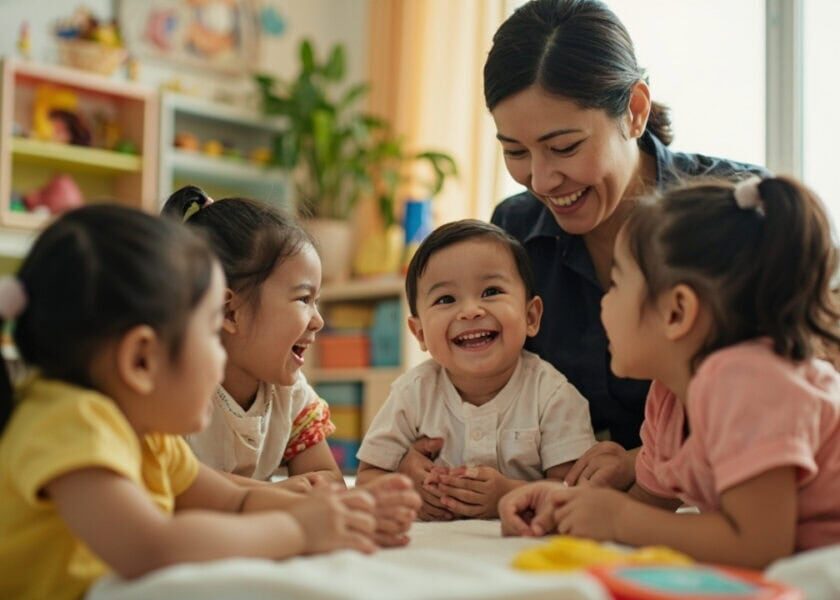
Watch two children who have spent weeks together in quality care and you will see something beautiful: the beginning of genuine social pleasure. The joy of being known by another small person. The comfort of a familiar face. The pride of being chosen as a playmate.
These are capacities that unfold in lived experience, watered by daily contact with other children, tended by caregivers who model warm and respectful interaction. In this peer world, your child is learning:
- How to read intention in a facial expression
- How to navigate complex emotions when someone takes their toy
- How to recover from disappointment
- How to celebrate another child’s success
- How to find their place in a group
These are the competencies that will serve them not only in school, but throughout their lives.
How Children Learn and Grow in Care
Watch a child at play and you are watching a scientist at work. They are forming hypotheses, testing variables, drawing conclusions. That block tower does not fall by accident—it falls because the child wanted to know what would happen if they added one more block, or removed the base, or built it on the rug instead of the hard floor.
Every collapsed structure is an experiment. Every rebuilt tower is a revised theory. The child’s mind is ceaselessly curious, always seeking to understand how the world works.
In quality care, this natural curiosity is not interrupted by rigid curriculum or readiness benchmarks. It is given room to breathe. The environment is designed not to direct the child’s learning but to invite it—to present interesting problems, to provide interesting materials.
A caregiver might notice a child repeatedly dropping objects from a high chair and wonder alongside them: Why do some things make louder sounds than others? Then they step back, trusting the child’s internal drive to explore.
The child who is not worried about whether they belong begins to wonder about everything else.
The Quiet Victory of Growing Capability
Somewhere in this journey—marking a profound shift—your child begins to feel competent.
This is a milestone that no checklist captures. It is not the moment your child walks or speaks or toilet trains, though those things happen too. It is the moment your child looks at something they have done and feels, in the deepest part of themselves: I did that. I made that happen. I am capable.
In quality care, this sense of competence is nurtured at every turn. Children are given opportunities to pour their own water, to put on their own shoes, to help prepare a snack, to resolve a small conflict with a peer.
These are not trivial tasks. They are the building blocks of autonomy, the small victories that accumulate into a child’s sense of themselves as capable, as effective, as worthy of respect.
You may come home to find your child insisting on doing something they never attempted before—a zipper, a puzzle, a new word. You may notice a change in their posture, their confidence, their willingness to try something unfamiliar.
Something has been happening in those unseen hours. Your child has been becoming more themselves.
What Quality Childminding Actually Looks Like
There is a version of this story that focuses only on what parents imagine when they think about their child’s day in care—activities, lesson plans, structured learning.
And there is a place for all of that. But the actual lived experience of a child in quality care is richer and stranger and more nuanced than any schedule can capture.
Your child is not simply being cared for. They are living a life—a small but complete life, full of texture and feeling and discovery—in the hours that you are apart. They are forming preferences: this song, this book, this corner of the room, this friend. They are encountering challenges and learning to navigate them. They are absorbing the world through their senses, their relationships, their play. They are becoming.
Quality childminding looks like:
- Small ratios that allow for attunement. One caregiver to a handful of infants means your child is noticed, responded to, known.
- Environments designed for children’s sensory realities. Soft acoustics, natural materials, spaces that invite both activity and rest.
- Caregivers chosen for their disposition. Not just qualified on paper, but warm, observant, genuinely attuned to children’s emotional worlds.
- Philosophies that prioritise the child’s inner experience. Where children are not managed but accompanied, not just supervised but seen.
- Transparent communication with parents. Because you deserve to know what is happening in your child’s day, not just what was on the schedule.
Addressing What Singapore Parents Really Wonder
We understand the pressures you face. Singapore parents carry a particular weight—the expectations of a demanding economy, the practical realities of two-income households, the cultural context that both values family closeness and demands professional achievement.
“Will my child feel abandoned?”
In quality care with attentive caregivers, the answer is no. What your child feels is the temporary absence of one attachment figure and the gradual presence of another. This is not abandonment—it is differentiation, a healthy and necessary step in development.
“Can my child really form a secure attachment with someone other than me?”
Yes. Research consistently shows that children can form multiple secure attachments. A quality caregiver does not replace you—they become an additional source of security from which your child can explore.
“How do I know what is actually happening during the day?”
This is where choosing a provider committed to transparency matters. Regular updates, photos, open dialogue—these are not extras. They are bridges between your world and your child’s world.
Why the First Thousand Days Echo Forward
The first thousand days of your child’s life are not just a phrase. They are a biological reality—a window in which the architecture of the brain, the foundations of emotional regulation, and the patterns of attachment are being laid down with extraordinary speed.
What your child experiences in care during this time matters. The brain that learns to trust in infancy becomes a brain better equipped to learn in childhood. The child who feels secure in care becomes a child who can venture further into the world.
Consider what your child brings home from quality care:
- The confidence of a child who knows they are capable
- The social ease of a child who has learned to be part of a group
- The curiosity of a child who has been invited to explore
- The security of a child who knows they are loved, even when you are not there
This is not a burden to place on parents. It is a gift to offer them: the knowledge that the hours they cannot witness are hours that matter.
Practical Guidance: Choosing Infant Care in Singapore
If you are considering childcare options, here is what to look for:
- Observe the environment with a child’s senses in mind. How does the space feel? Is it overwhelming or calming? Can a child move freely? Retreat when needed?
- Watch how caregivers interact with children. Are they attuned—responding to children’s cues, not just directing them? Do they get down to the child’s level?
- Ask about ratios. Smaller numbers mean more individual attention. This is not a luxury—it is foundational to the quality of your child’s experience.
- Enquire about the philosophy of care. Is child development central, or is it an afterthought? Do they see children as individuals with inner lives, or as bodies to be managed?
- Ask about communication. Will you know what your child’s day was like? Will you receive updates, photos, observations?
- Trust your instincts during visits. You know your child. Does this place feel warm? Does it feel right? If something feels off, it probably is.
Choosing infant care is not simply choosing a service. You are choosing the world your child will inhabit for a significant portion of their waking hours. That choice deserves careful thought—and it deserves to be made with confidence, not guilt.
We See Your Child
EduNanny Singapore was built on a different understanding. We believe that the hours your child spends in care are not merely hours to be managed or survived. They are hours that form, hours that shape, hours in which a whole interior world is being constructed.
Our approach begins with small ratios—up to one to three infants—which allows caregivers to truly attune to each child. To notice what they need before they need to ask. To build the relationships that make trust possible.
Our caregivers are not just trained. They are chosen for their disposition, their warmth, their genuine love of children and their understanding of child development. They are supported by ongoing professional development and guided by a philosophy that places the child’s inner experience at the centre of everything we do.
We are proud to participate in the ECDA Childminding Pilot, working within a framework that recognises home-based and community-based care as vital pathways for Singapore families. Our commitment to transparency means you will always know what is happening in your child’s day—through regular communication, open dialogue, and where deployed, measures such as CCTV that offer additional reassurance.
We send updates and photos and observations not because we have to, but because we understand how much it means to you to be part of your child’s unseen hours.
We believe that childminding is not a stopgap—it is a calling, a craft, a form of love expressed through professionalism and presence. The caregivers in our community are not babysitters or overseers. They are companions in your child’s story, people who will know your child’s favourite song and the sound of their laughter and the particular way they hold a crayon.
Wherever you are in this story—perhaps you are a parent at the beginning, trying to understand what quality care truly means. Perhaps you are further along, looking for reassurance that the choices you have made were the right ones. Perhaps you are simply a parent who wonders, every day, what your child’s unseen hours contain.
Whatever brought you here, we want you to know this:
We see your child.
Not just their body, their schedule, their milestones. We see their inner life—their fears and their joys, their curiosities and their discoveries, their growing sense of who they are. We see the small person they are becoming in those hours when you are not there to see them yourself.
We believe—with all the conviction that comes from understanding child development, from working with families across Singapore, from the daily privilege of being present in children’s lives—that those unseen hours can be among the most important hours of your child’s life.
Choose them carefully. Choose them with your whole heart. And trust that when you do, your child’s story continues beautifully, even when you are not in the room.
If you would like to learn more about EduNanny Singapore and how we support families through quality, development-oriented childminding, we invite you to connect with us. You can also read more about our approach and the values that guide everything we do.