The Paradox of Presence: How Secure Care Helps Singapore Families Thrive
The Weight of Presence
Every parent in Singapore understands the weight of presence. We know the difference between being physically in a room with our child and being emotionally available to them. We know that a tired parent is not the same as a patient one—that stress reshapes the way we listen, the way we play, the way we respond to a child’s big feelings with curiosity instead of frustration.
We know this because we live it. Some evenings after a long day, we are more likely to scroll through our phones on the sofa than build the block tower again. To say “just a minute” more often than we would like. To notice our own short-temperedness and feel the distance it creates.
This is not a failure of love. This is the reality of parenting without enough reserves.
The demands of modern Singaporean life mean that many parents are running on empty by the time evening arrives. We are managing careers, commutes, household responsibilities, extended family expectations, and the relentless mental load of keeping a small human alive and thriving. By the time we reach our children, we have so little left to give.
We do not want it to be this way. We entered parenthood full of intention and tenderness. And yet somewhere along the way, depletion became the baseline.
What Quality Care Actually Does
Here is what research and experience have taught us about children in consistent, quality care: they learn to explore. They develop what psychologists call secure base behavior—something quiet and profound.
A child who feels safe in one environment is better able to venture out, to test limits, to learn, and crucially, to return. When your child knows they are held in a reliable, responsive place during the day, something shifts in their nervous system.
They are not anxious about your absence because they trust that you will come back. They are not clinging because they have learned what security feels like. And when you walk through the door in the evening, they are ready. Ready to show you what they made. Ready to run into your arms and then run away again, testing the world with you as their anchor.
This is the paradox that quality care offers: the more secure your child feels in trusted hands, the more they are capable of connecting with you when you are together.
The Evening Transformation
Think about what your evenings could look like.
Imagine walking through your door not in a state of exhaustion but with enough left in you to sit on the floor and truly play. Imagine being the parent who makes it to the park on time, who cooks dinner with music playing, who has the patience to read one more story even though you have already read three.
Imagine the difference in your own voice, your own posture, your own ability to be curious about your child’s day instead of simply going through the motions of bedtime routine.
This is not fantasy. This is what happens when parents get their energy back—when childcare becomes the thing that refills the cup rather than empties it.
The same is true for weekends. For family rituals. For the birthday parties and the grandparents’ visits and the Sunday mornings when the whole family is actually present with each other, not because one parent has been run ragged by a week of doing everything alone, but because the rhythm of the week has been sustainable, has had breathing room built into it.
When there is a consistent caregiver who knows your child’s rhythms, your child arrives home settled rather than overstimulated—ready for dinner and bath and storytime rather than fighting sleep because their day was chaotic or their attachment figures kept changing. Quality professional care does not diminish the role of grandparents, either. In many cases, it protects and enriches it.
When a grandparent is freed from the daily demands of full-time childcare, they can return to being a grandparent—which is a different and equally important role. Grandparents bring irreplaceable things to a child’s life: generational wisdom, unconditional love, the gift of time that is given rather than obligated. When professional care handles the weekday structure, grandparents can show up on weekends and holidays with energy and presence, not with the fatigue of full-time caregiving.
What EduNanny Singapore Offers
EduNanny by BUTLER is part of the ECDA Childminding Pilot, which means it operates within a framework designed to elevate the standards of home-based and community-based childminding across Singapore. The pilot reflects a growing recognition that families need diverse, high-quality care options that are both accessible and affordable.
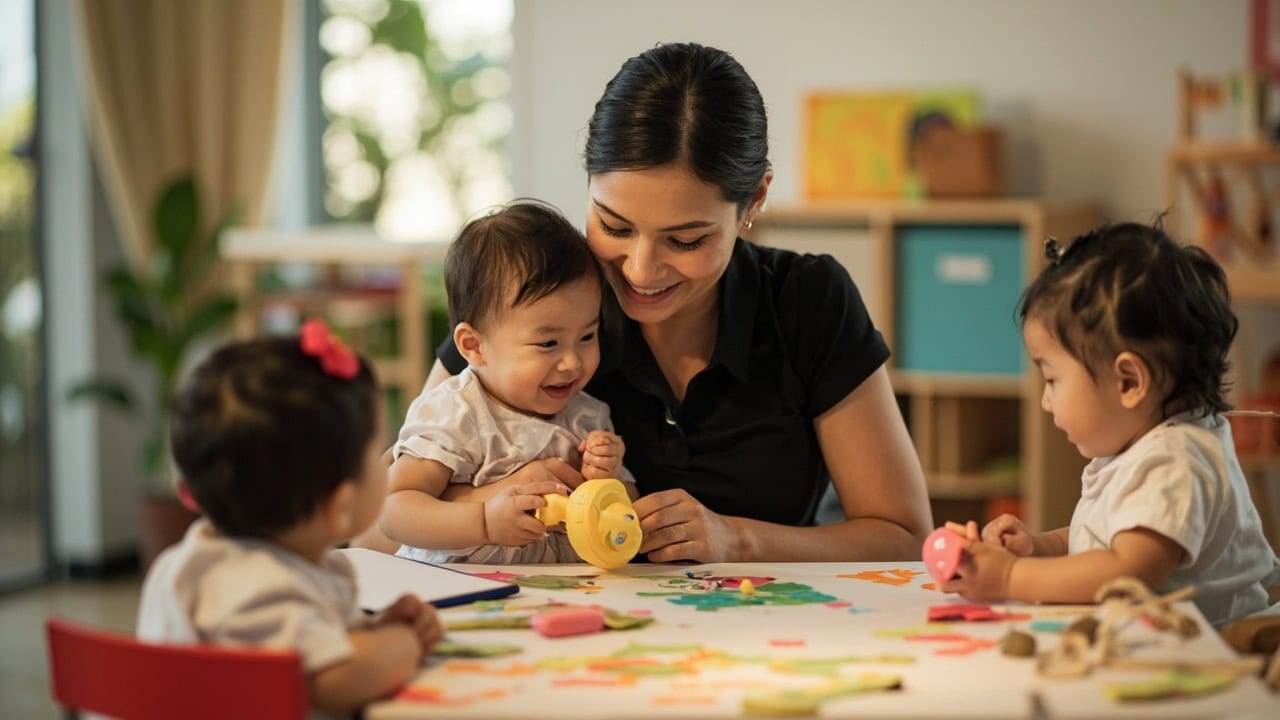
Within this structure, EduNanny maintains small ratios—with up to one caregiver for every three infants—because the evidence is clear that children under three need responsive, individualized attention, and that ratio makes that possible.
The care runs Monday through Friday, in structured blocks that align with typical work schedules, and the fees within the pilot are designed to be within reach for families, with CDA and Baby Bonus funds usable to help manage costs.
Being Known, Not Just Being Kept
Beyond the structural elements, EduNanny has invested in what I would call knowing families, not just keeping children.
There is a difference between the two. Keeping a child safe is the baseline. It is necessary but not sufficient. Knowing a child means understanding their particular temperament, their unique rhythms, the things that soothe them and the things that challenge them.
Knowing a family means understanding what matters most to you, what values you want honored in your child’s day, how you like to communicate and receive updates. EduNanny’s approach extends this knowing to parents as well, creating a partnership where caregivers and families are aligned rather than strangers passing a child back and forth.
This knowing is supported by practical measures: open communication channels, transparency about daily activities, and where deployed, security measures including CCTV that give parents visibility into their child’s environment. These are not surveillance features in a cold sense. They are trust-building tools—ways of saying we have nothing to hide and we welcome your confidence.
Innovation That Supports Real Parenting
EduNanny has developed tools like the Thomas AI Chatbot to support parents in navigating the everyday questions and challenges of parenting and childminding. This is not a gimmick. It is an acknowledgment that modern parenting happens in real time, often outside of business hours, and that parents benefit from having responsive support when questions arise.
Whether it is a concern about sleep patterns or a question about developmental milestones or simply the need for reassurance, having a knowledgeable resource available is part of what it means to be cared for as a family.
Reframing the Fear
The fear that choosing quality childcare means your child needs you less is not only understandable—it is a testament to how much you love your child. That fear comes from a good place.
But it is built on an inversion of what actually happens.
When your child is in capable, loving, consistent care, they do not need you less. They need you differently.
They need you for what only you can provide: your particular voice, your particular love, your particular presence in their life. And because they are secure—because their days are well-structured and their needs are met—they are freed up to need you in the best possible way. They are ready to receive you fully.
This is what quality care gives you back: not just your time, not just your energy, but your capacity to be the parent you want to be. It restores your patience. It restores your playfulness. It restores your ability to be present in the moments that matter.
Childcare as a Family Investment
We talk often about investments in Singapore. We talk about investments in property, in education, in our children’s future. But here is an investment that is often overlooked: the investment in your own parental longevity and wellbeing.
Choosing quality childcare is not an expense that competes with your family’s needs. It is an investment in your family’s capacity to thrive over the long term—in your ability to be present and patient and energized not just this week but this year, this decade, as your child grows.
The cost of childcare is real, and Singapore parents are right to think carefully about it. But so is the cost of burnout, of missed moments, of becoming a version of yourself as a parent that you do not recognize or feel proud of.
When you reframe the decision as an investment in the whole family system, including yourself, the calculus changes.
A Practical Framework for Your Decision
If you are currently researching infant care or childminding in Singapore, here are some questions worth asking yourself:
- Who are the caregivers, and what is their training? Look beyond credentials to understand how they approach a child’s emotional development, not just their physical safety.
- What is the caregiver-to-child ratio? For infants, smaller numbers mean more responsive attention. EduNanny maintains a ratio of up to one caregiver for every three infants.
- How does the care align with your family’s rhythms? Good care should reinforce your household’s patterns, not compete with them. Ask how the program communicates about your child’s day.
- What does partnership look like? You are not outsourcing your parenting. You are inviting someone into a collaborative relationship. Ask how the caregiver involves you in your child’s development.
- How does the cost fit into your family’s financial picture? Understand what supports are available. EduNanny’s fees within the ECDA Childminding Pilot are designed to be within reach, with CDA and Baby Bonus funds usable.
The Invitation
EduNanny Singapore exists because they believe that parents deserve to feel supported, not alone, in this journey. They believe that children thrive when they are known and held and given safe ground from which to explore. They believe that families are strengthened when each member has what they need to flourish.
They believe that the choice to seek quality care is not a compromise. It is an act of love for your entire family—a declaration that you want to be present, that you want to show up well, that you want your child to have not just a capable caregiver but a parent who has enough left at the end of the day to build the block tower one more time.
Every parent I have ever spoken to wants the same thing. They want their child to be okay. They want their family to be close. They want to feel good about the choices they make.
If you have been carrying the quiet worry I named at the beginning of this article, I want to offer you permission to set it down.
Not because the decision is easy or without weight, but because the reframing is true: quality care and family closeness are not in competition. They are companions. The children who thrive in trusted care come home more ready to love. And the parents who are restored by that care come home more ready to give it.
EduNanny Singapore is here to walk this path with you. To know your child. To know your family. To build something together that makes your whole household stronger.
This is not a service you outsource. It is a partnership you choose.
And it is one of the most loving decisions a parent can make.
Ready to explore what quality childminding looks like for your family?
Learn more about EduNanny Singapore and how they can support your child’s development while restoring your capacity to show up as the parent you want to be. You can also read about their approach or get in touch to begin a conversation.
#SingaporeChildcare #InfantCareSG #ChildmindingSingapore #QualityChildcare #EduNannySG