The Twenty Minutes After Pickup That Changes Everything
The Question Every Singapore Parent Carries
Singapore has one of the highest rates of dual-income households in the world. We have some of the most dedicated, hardworking, thoughtful parents anywhere. And we have a childcare system that, for all its growth and improvement, doesn’t always speak to the thing that matters most to these parents.
Not whether their child is safe. Not whether they’re learning.
But whether the choice to leave them — every single morning — is quietly, invisibly breaking something that cannot be repaired.
That fear. That question. That whisper in the dark of a parent’s mind at 2 a.m.: Am I hurting my child by doing this?
It’s a question most parents never voice aloud. They carry it. They drive to work with it. They sit in meetings replaying the morning goodbye, wondering if today was the day she remembered as the day you abandoned her.
You know that’s irrational. You know it’s not true.
And you still wonder.
The Morning Goodbye Is Not a Wound. It’s a Workout.
Let me take you into a morning. A real one. The kind that happens thousands of times across Singapore every weekday, mostly unseen, mostly unspoken about.
The parent wakes before dawn, already calculating. The bag is packed. The milk is made. The child’s clothes are laid out the night before because there is no time for decision-making in the morning — not when the mind is already running calculations about the meeting at nine, the deadline by five, the report that isn’t finished, the presentation that needs confidence they do not feel.
And then there is the child. The small, warm, absolute presence who does not understand time, who does not understand careers, who only knows that the person they are most attached to in the world is about to leave.
You kneel down to their height. You say: “Mummy will be back. I love you. Have a beautiful day.”
You mean it. You do.
And also, some part of you wonders if this is the day she remembers as the day you abandoned her.
This is not weakness. This is not a sign that you shouldn’t be working. This is the most human thing in the world — the terror of leaving what you love most in the hands of someone else.
What the Science Actually Says
In the 1950s, British psychologist John Bowlby developed a theory that would become one of the most robust, replicated frameworks in developmental psychology: attachment theory. At its core is a simple idea — children need a secure base. Someone they can trust absolutely. Someone who is their landing place, their home base, their safe harbour.
What Bowlby and his successors understood is this: secure attachment doesn’t require constant proximity. It requires responsiveness. It requires consistency. It requires that the child knows, in their bones, that the person who leaves will return — and will return warm, engaged, and attuned.
A child who experiences the daily transition — the leaving and the returning, the separation and the reunion — is not being abandoned. They are being trained in the most fundamental skill a human being can develop: the capacity to tolerate proximity and distance, to hold love and independence in the same breath, to know that someone can leave the room and still be theirs.
What Your Child Is Learning at Drop-Off
Children who experience supported separation — where the transition is handled with care, where the caregiver is attuned, where the reunion is warm and present — develop what psychologists call secure base behaviour. They use their parents as a launchpad, not a loss. They explore the world with confidence because they know, absolutely, that home is there when they need it.
Your child is learning:
- I can be without her and she will come back.
- I can be without her and I will be okay.
- I can be without her and I am still loved.
The daily transition, handled well, is not an interruption to the attachment bond. It is the attachment bond being exercised.
Inside the Hours You Cannot See
Now let me tell you what this looks like from the other side.
A child arrives at care after the morning goodbye. Perhaps they were upset. Perhaps they cried. Perhaps the parent carried that weight all the way to work, still hearing the echo of the protest.
But here is what happens next.
The child is met by someone who is not just trained in childcare but trained in this specific moment. Someone who understands that the crying is not distress — or not only distress. It is also communication. It is the child expressing: I didn’t want to leave my parent, and now I’m in an unfamiliar place and I need someone to help me understand that this is safe.
What Attunement Actually Looks Like
A skilled caregiver doesn’t rush to distract. They don’t immediately offer a toy or a screen. They do something more important: they match the child’s emotional state, then gently lead them out of it.
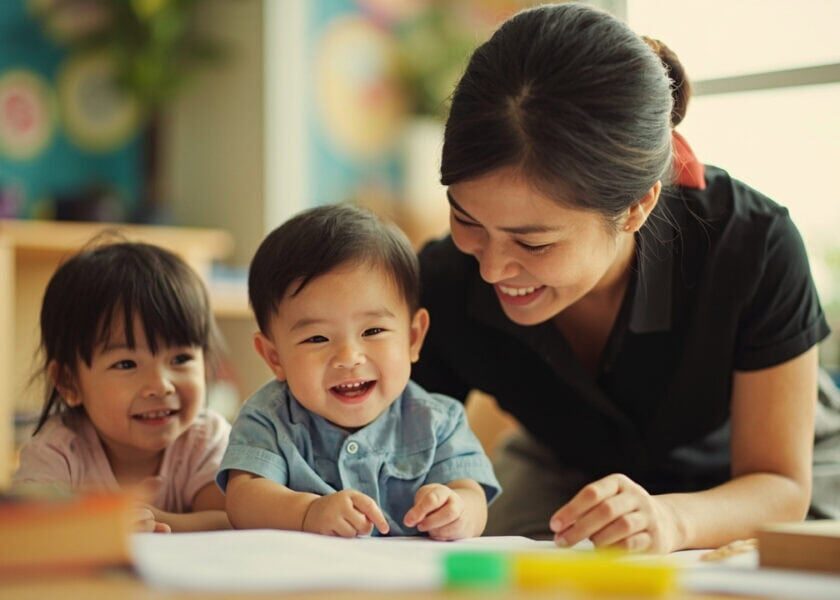
At EduNanny Singapore, the infant room ratios allow for exactly this kind of attunement — up to one caregiver for every three infants. This is not an accident. It is a deliberate architectural choice that allows caregivers to be fully present to one child’s emotional experience rather than managing a group.
When a caregiver can truly see your child — can read their cues, can name their feelings, can sit with their discomfort without trying to fix it too quickly — that child learns something profound:
My feelings are safe here. I don’t have to hide what I feel to be accepted.
Across the Hours of the Care Day
Your child is not in a holding pattern during the day. They are in a developmental environment — one that is warm, responsive, and rich with the kinds of interactions that build neural pathways, language acquisition, motor skills, and emotional regulation.
But more than that, they are building what attachment researchers call internal working models — mental maps of what relationships feel like, what they can expect from others, how to trust.
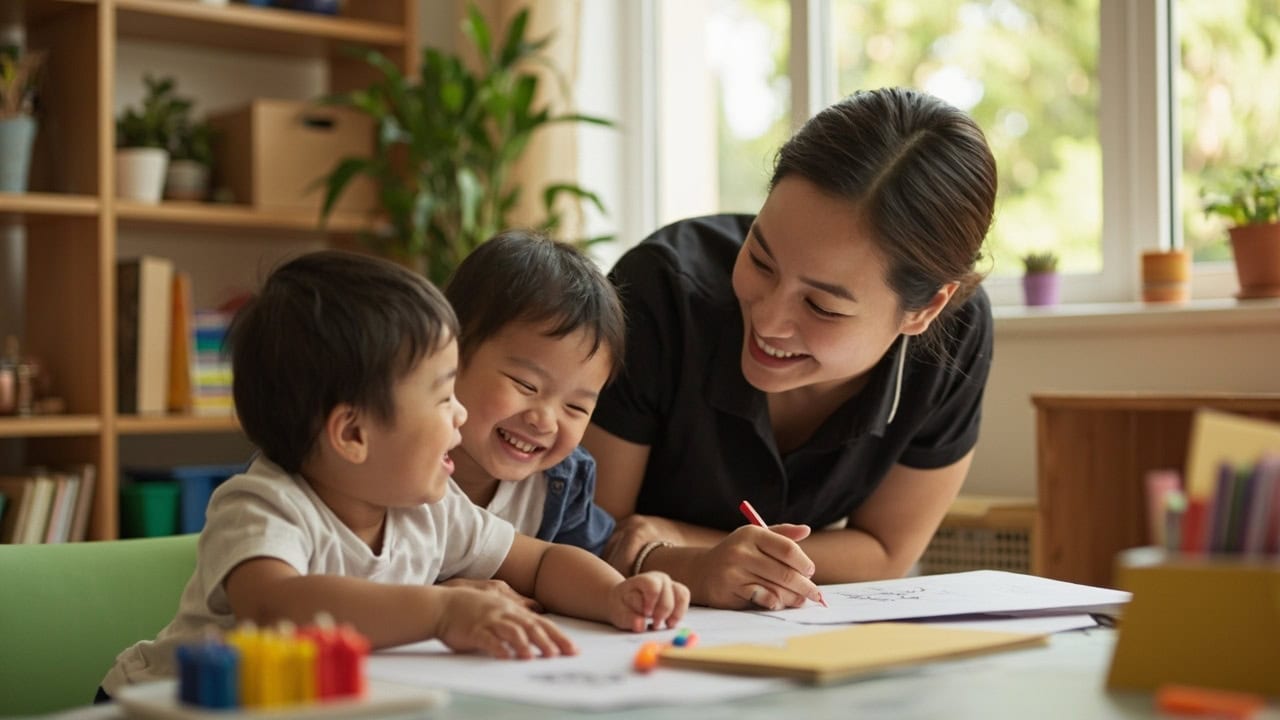
When your child plays on the mat with a caregiver who is narrating their play, responding to their gestures, mirroring their expressions, they are building the same neural architecture that would be built if you were there.
Because what builds attachment is not proximity alone. It is presence. Attentive, attuned, responsive presence.
The Reunion Window: Why Pickup Matters Most
There is a twenty-minute window after you pick up your child that developmental psychologists and early childhood researchers have begun to call the most important part of the childcare day.
And I want to be precise about why, because I think most parents intuitively feel this without having language for it.
What Happens When You Walk Through the Door
When your child sees you at pickup, a cascade of things happens simultaneously. There is relief. There is a resetting of the nervous system. There is the processing of everything that happened during the day — the joys, the frustrations, the small victories, the big feelings they may not have had the words for.
And there is also, often, something else. A shift.
The child who was so brave all day, who explored and played and grew, may suddenly become clingy, or whiny, or impossible. The parent who has been at work for nine hours, drained, cognitively depleted, arrives to collect their child and is immediately confronted with a toddler who won’t walk to the car, who screams when offered a snack, who seems to have forgotten every coping skill they learned all day.
This is not regression. This is not evidence that the day went badly.
This is your child finally feeling safe enough to fall apart.
Why “Falling Apart” Is Actually a Good Sign
When a child is in an environment that is not fully safe — which includes the presence of a parent who is about to leave — they regulate. They hold it together. They use the tools available to them to stay functional.
The caregiver may have watched your child navigate a conflict with another child, manage a disappointment, or tolerate a moment of frustration with remarkable composure.
And then you arrive. And your child knows, with absolute certainty, that they can let down every wall.
You are the person who will catch what falls.
What the Twenty Minutes After Pickup Is For
This is not about efficiency. This is not about getting home, making dinner, starting the bedtime routine. It is about giving your child the space to complete the cycle — to arrive home in your arms and finish the emotional experience they began at 7:45 in the morning.
What does this look like in practice?
- You don’t rush the pickup. You kneel down. You make eye contact. You take a breath before you speak.
- You greet your child with your full attention, even if just for thirty seconds — not with your phone in your hand, not already talking about dinner or bath or the traffic.
- You allow the clinging. You allow the tears if they come. You carry them if they need to be carried — even if you’re exhausted, even if your back hurts, even if you have seventeen things to do.
Because the carrying is not indulgence. It is the reunion ritual. It is the way your child processes the day and integrates it into the relationship with you.
And then, slowly, naturally, the child comes back to themselves. They settle. The exploration of the day becomes a story.
“What did you do today?” “Tell me about your friend.” “What did you have for snack?”
And you listen — not just hearing, but listening — because the story your child tells you about their day is the story of their emotional world, and they need you to know it.
This is how secure attachment is built in a family that uses childcare. Not despite the childcare, but through the entire rhythm — the goodbye, the hours, and the reunion — woven together into a single, coherent experience of love.
Practical Guidance for Drop-Off and Pickup
Understanding all of this — knowing the research, trusting the theory — doesn’t make the morning goodbye feel less heavy. Not at first.
The fear lives in your body. It shaped your nervous system long before you became a parent. And it will be triggered, every morning, for longer than you expect.
But there are things you can do that make a real difference.
At Drop-Off
- Arrive five minutes early. Rushing amplifies stress. Your child reads your hurry like a weather report.
- Kneel to their height. Eye contact grounds the goodbye. It’s not just words — it’s presence.
- Name what you see. “You’re sad that Mummy is leaving. That’s okay. I love you, and I’ll be back after snack time.” Naming the feeling doesn’t make it bigger. It makes it survivable.
- Keep the goodbye brief and warm. Lingering doesn’t help. Confidence does. If you hand them over with genuine warmth — even though your heart is breaking — your child takes that in.
- Don’t sneak away. Leaving without saying goodbye might feel kinder in the moment. But it teaches your child that the person they trust most can disappear without warning. A visible, warm goodbye is always the better choice.
At Pickup
- Give the first five minutes to your child. Phone away. Full attention. This is the reunion ritual.
- Receive whatever they bring you. Whining, clinginess, tears — all of it is communication. All of it is safe.
- Ask open questions. “What was the best part of your day?” “Who did you play with?” Listen like it matters, because it does.
- Allow the cling. If they want to be carried, carry them. If they want to hold your hand for twenty minutes, let them. This is not indulgence. It is completion.
The EduNanny Approach: Built Around the Transition
This is why EduNanny Singapore was built the way it was built.
The ECDA Childminding Pilot, licensed by ECDA, represents Singapore’s recognition that not all families need the same pathway, and that home-based and community-based care — when designed with intention — can offer something that large-centre models sometimes struggle to replicate: continuity, attunement, and the kind of personalised responsiveness that makes the daily transition a developmental milestone rather than a daily wound.
The Design Choices That Matter
EduNanny by BUTLER operates within this framework, offering Monday to Friday care blocks that integrate into the rhythm of working family life.
The infant ratios — up to one to three in infant rooms — are not a regulatory minimum. They are a design philosophy. We believe that the quality of early care is inseparable from the capacity of caregivers to be truly present, and that capacity is only possible when the numbers allow it.
Our caregivers are not just childcare workers. They are co-regulators in your child’s emotional world. They are the people who meet your child when you cannot, who hold the space for the hard feelings, who celebrate the small victories, and who hand your child back to you at the end of the day ready — ready — to complete the reunion and begin the next chapter of the bond you are building together.
Visibility as a Foundation of Trust
We know that trust is not built on philosophy alone. Communication — daily updates, transparent reporting, and where deployed, CCTV access — gives parents visibility into the hours they cannot see.
Not because we have anything to hide. But because we understand that visibility is part of what makes trust possible.
Accessibility for Singapore Families
We know that Singapore families carry real financial pressures alongside their emotional ones. The pilot fee structures, and the usability of CDA and Baby Bonus schemes for eligible families, reflect our commitment to ensuring that this kind of care is accessible — not only to families who can pay a premium, but to families who deserve it.
Walking Alongside You
You are not choosing between your career and your child. You are not abandoning your role in your child’s life.
You are building a rhythm — a daily, weekly, lifelong rhythm — where both thrive.
And the daily transition is where that rhythm lives. It is where your child learns that the world is large and love is constant. It is where you learn that you can be two things at once:
- A parent and a person.
- A provider and a presence.
- A human being with your own ambitions and a mother or father who would move mountains for their child.
There is a voice — sometimes it sounds like guilt, sometimes like doubt, sometimes like a 2 a.m. question that won’t let you sleep — that says: I should be the one doing this. I should be the one raising my child. Something is wrong with the choice I’m making.
Let me speak directly to that voice.
That voice is not a sign that you are failing. It is a sign that you love deeply. It is the sound of a parent who has no ambiguity about what matters.
The research on attachment is clear: children do not resent parents for working. They resent parents who are emotionally unavailable, inconsistent, or unattuned.
The question is never presence or absence. The question is responsiveness. Can your child trust that when you are together, you are truly together? Can they trust that the goodbye is not permanent, that the reunion will be warm, that the hours in between are safe?
When that trust is in place — and it can be in place even in families where both parents work — children don’t just cope with separation. They grow through it.
You are not lesser for working. You are not compromised for needing support.
You are a parent in the 21st century, in one of the most demanding cities in the world, doing something extraordinarily difficult with grace and intention and love.
And the daily transition — the goodbye and the reunion, the hours in between and the twenty minutes that follow — is not evidence of your failure. It is evidence of your ambition.
Here is what we believe at EduNanny Singapore.
We believe that the moment of handover is sacred. It is the moment where a parent entrusts their most precious being to someone else. And we do not take that lightly.
We believe that your presence — when it is structured well, supported well, and surrounded by a care system that understands what it is doing — can be more available, more focused, and more present than it would be without us.
We will never claim to be a substitute for your presence. We will never claim to be that.
But we believe we can be something important: a structure that makes your presence matter more.
EduNanny Singapore is here to walk alongside you in the daily work of raising a child who knows, absolutely and without question, that they are loved — by you, in the morning and the evening and every moment in between.
If you are a parent in Singapore who is carrying this weight — this fear, this guilt, this 2 a.m. question — we see you. We understand. And we are here to help you transform the daily transition from a wound into a workout.
From an interruption into the bond being built.
From a doubt into a foundation.
If this article resonates with you, we invite you to explore how EduNanny Singapore approaches infant care and childminding — and to see how we support the daily transition for families across Singapore.
Your child doesn’t need a perfect parent. They need a parent who shows up — and a care system that supports the showing up.
EduNanny Singapore — where the daily transition becomes a developmental milestone.
Learn more about who we are or get in touch to begin a conversation about your family’s childcare needs.