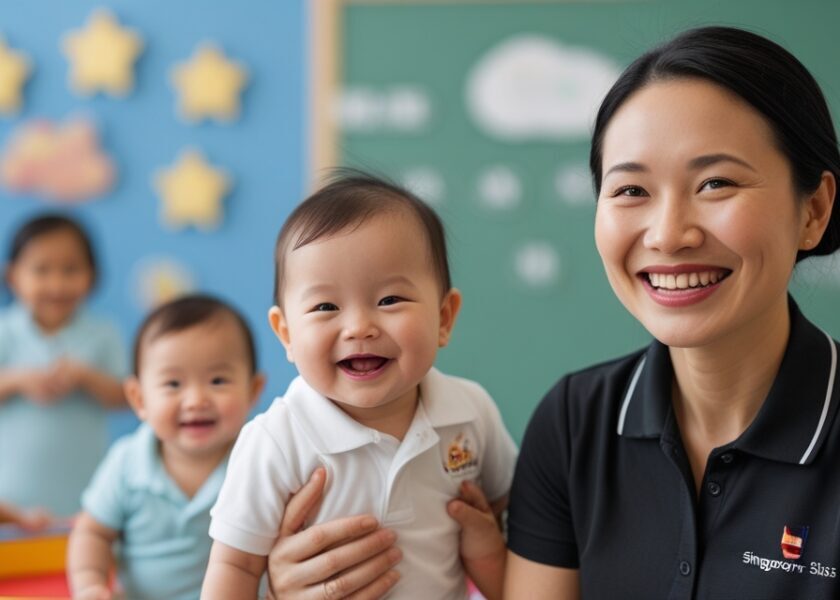
Professional Observation: The Standard Your Child’s Development Deserves
The Problem Is Not Communication—It Is Professional Depth
Most educators are doing exactly what they have always done. They are providing care. They are keeping children safe, fed, and rested. They are following protocols, writing updates as trained, and doing so with genuine care for the children in their charge.
In the overwhelming majority of childcare settings across Singapore, what parents receive is a logbook dressed up as a window into the day.
But here is what EduNanny has always understood: the gap between a parent and their child’s day is not a logistics problem. It is not a communication technology problem. You can add photographs, detailed notes, video clips. These are not the answer.
The gap is a professional problem. It exists because someone who has not been trained to observe development, to interpret behavior, to read the language of a child’s growth across hours and weeks and months, cannot tell you what is actually happening inside those ordinary-seeming moments.
Supervision Versus Observation: Understanding What Matters
Let me offer a different picture of what an afternoon can contain.
An educator notices that a fourteen-month-old, who has been steadily pulling herself up to stand for the past three weeks, has today begun to experiment with releasing her grip. She lets go for half a second. Then one second. She looks around, uncertain, and sits back down. Tomorrow she will try again. Within a week, she will take three steps before her bottom finds the floor. Within two weeks, she will walk clear across the room.
This child is not a project. She is simply a child, being a child. But the educator who has been trained to observe, who knows what the trajectory of physical development looks like, who has seen dozens of children arrive at this same threshold, can read what is happening.
She can tell the parents not just that their daughter had a good day, but that their daughter is at the edge of walking—and here is what you might notice at home, and here is how you might play with her to support this skill. She can point out the way their daughter is already using her eyes to judge distance. That is a cognitive leap happening alongside the physical one.
Supervision asks: Is the child safe? Is the child comfortable? Is the child accounted for? These are not small things. They matter enormously.
Observation asks a different set of questions: What is this child working on? What is the next skill pressing to emerge? Where are the patterns that reveal how this child learns, how this child approaches challenge, how this child connects with others? What does this small moment tell us about the larger story of who this child is becoming?
What Professional Observation Looks Like in Practice
EduNanny educators are trained to ask these questions. Not because it sounds nice on a brochure, but because the quality of the observation shapes the quality of everything that follows.
It shapes how we understand each child’s needs. It shapes how we prepare the environment. It shapes how we communicate with parents. And it shapes, most importantly, how parents come to understand their own child.
Seeing How, Not Just What
When we say that EduNanny educators observe, we mean something specific. We mean that they have been trained in developmental frameworks. We mean that they know what typical development looks like at every stage, and more importantly, they know how to recognize when a child is approaching a developmental shift, when something is about to click or click differently, when a child is moving from one stage to another in their own unique way.
We mean that they notice not just what the child does, but how the child does it. A child who approaches a new toy with hesitation and then gradually warms to it is telling you something different from a child who grabs it immediately. Neither way is wrong. Both are information. The trained educator reads both, holds both, understands that the pace and style of engagement is as important as the engagement itself.
Tracking Patterns Over Time
Developmental observation is not a single snapshot. It is a collection of moments seen in sequence, patterns recognized across weeks, growth understood as a story rather than a checklist.
An educator who has spent four months with a child can tell you things about that child’s developmental journey that no one-day update could ever contain. They have seen the progression. They have noticed which challenges the child has moved through and which ones they are still working on. They know where the child is thriving and where the child needs more support.
Translating Insight Into Parent Partnership
And crucially, they know how to translate this understanding into language that parents can use. This is perhaps the most undervalued skill in early childhood education.
To observe well is difficult. To observe well and then communicate that observation in a way that deepens a parent’s understanding, that gives them something meaningful to do, that helps them feel connected to their child’s growth rather than distant from it—that is a professional art.
A Real Example: When Observation Changes Everything
A father picks up his son at the end of the day. The educator tells him that his son spent a good portion of the afternoon in the block corner, building towers and then deliberately knocking them down. That he was laughing while doing this. That he seemed to be experimenting with height and gravity and the satisfaction of destruction.
The father, who has been puzzling over why his son sometimes seems frustrated during structured play at home, now understands something. His son is working on understanding cause and effect. His son is learning that he has power over his environment. His son needs more opportunities to experiment with this kind of open-ended physics play—and here are three specific ways the father can support this at home this weekend.
That father walks to his car with his son, and the walk feels different. The evening feels different. He is no longer a parent who knows only that his child had a good day. He is a parent who understands his child a little better, who has been given a small piece of the puzzle, who feels that the hours of separation have been bridged by professional insight rather than mere logistics.
This is what EduNanny offers. Not supervision. Not even care, in the basic sense. Partnership. Real, substantive partnership between the educators who spend their days with your children and the parents who spend their days elsewhere but whose hearts are never far from those small faces.
Why EduNanny Does Things Differently
EduNanny was built for this moment. Not the logistics of childcare. Not the infrastructure of care. The actual moment of a parent standing somewhere in Singapore, holding a phone, reading a message that tells them nothing about who their child spent the day becoming.
The EduNanny approach begins with a simple conviction: the educator in the room is not merely a caretaker. The educator in the room is a professional whose trained attention is one of the most valuable resources available to that child’s family.
EduNanny by BUTLER operates as part of the ECDA Childminding Pilot, a government-recognized framework that sets standards for quality childminding in Singapore. This means our approach has been evaluated, our practices have been reviewed, and our commitment to quality care has been formally recognized.
- Small groups with genuine attention. For infants, we maintain ratios that allow for individual attention, because professional observation requires time and focus. An educator who is managing too many children cannot truly see any of them.
- Flexible pathways for real families. We offer both home-based and community or centre-based pathways, because families are not all the same, and the best childcare arrangement is one that fits your actual life. Some families need care in their own home. Others prefer the community environment of a centre setting. Both receive the same quality of observational practice and developmental reporting.
- Transparent communication systems. Updates are designed not just to report activities but to share observations, to highlight developmental moments, to give you something to take home and think about. We want you to feel that you know what happened, but more importantly, that you know what it means.
What This Means for You as a Parent
Singapore parents care deeply about development. Anyone who has walked through the polyclinics and seen the developmental screening charts, who has noticed the serious attention parents pay to language milestones and motor skills and social behaviors, understands this.
Singapore parents want to get it right. They want to give their children every opportunity. They feel, often acutely, the weight of those early years—the understanding that the brain is building itself at extraordinary speed, that the foundations being laid now will matter for decades.
And yet many of these same parents will tell you that they feel, in some essential way, cut off from their child’s daily life. Not because they do not love their children. Not because they are not committed parents. But because they are at work, or at school, or somewhere else entirely, and the hours between morning drop-off and evening pickup are invisible to them, narrated only by thin updates that tell them their child ate and slept and was presumably content.
When your child is with an EduNanny educator, they are being seen. Not supervised. Not merely watched. Seen. Understood, to the extent that months can allow understanding. Observed with professional attention and genuine care.
Not as one child in a large group, processed through a daily log. But as an individual, with their own temperament, their own pace, their own emerging personality, their own developmental story in progress.
And you, as their parent, will be brought into that story. You will receive updates that tell you what is happening and what it means. You will be given language for what you might be noticing at home. You will be treated as a partner, not a customer.
Practical Guidance: What to Look for in Infant Care
The first thousand days of a child’s life carry weight that researchers are still mapping. Neural connections are forming at a pace that will never be replicated. The patterns of attachment, of curiosity, of resilience, of how a child relates to the world and to other people, are being established in ways that will shape decades.
This is why the quality of care in these early years carries such consequence. An educator who observes well, who understands what they are seeing, who can interpret a child’s behavior through the lens of developmental knowledge, who can then share that understanding with parents in a way that empowers rather than overwhelms—that is doing work of real consequence.
If you are currently researching childcare options in Singapore, here are the questions that matter most:
- Does the educator explain the “why” behind activities? Generic updates report what happened. Quality observation explains what it means for your child’s development.
- Do updates give you something to do at home? The best childcare partnerships help you extend your child’s learning beyond the classroom.
- Are educators trained in developmental frameworks? This is different from basic childcare certification. Ask specifically about how educators are taught to observe and interpret behavior.
- What are the group sizes and ratios? Professional observation requires time and attention. If educators are managing too many children, genuine observation becomes impossible.
- Is the communication two-way? You should feel comfortable asking questions and receiving meaningful responses, not just scheduled updates.
Our Commitment to Your Family
We know that there are many childcare options in Singapore. We know that families are making difficult decisions about who will care for their children while they work, while they build careers, while they do the practical business of providing for their families.
We do not take that trust for granted. We know that you are handing someone the most important person in your life, and that this is not a small thing.
There is a version of childcare that operates on the principle that children are being kept. There is a version that operates on the principle that children are being educated. EduNanny operates on a different principle.
We believe that children are being known. That every day in those early years is an opportunity to observe, to understand, to notice what is emerging, and to share that with the people who love these children most.
We believe that the work of observation is meaningful work, because what you see shapes what you do, and what you do shapes the child, and the child shaped in these years will carry that shaping forward into everything they become.
Your child’s developmental story is happening right now, in rooms you cannot see, during hours when you are elsewhere. That story deserves to be witnessed. It deserves to be understood. It deserves to be shared with you in ways that help you be the parent you want to be.
We invite you to experience what it feels like to receive an update that tells you something true about your child. Not just what they ate. Not just when they slept. But who they were being. What they were learning. What they might be ready for next.
If you are looking for childcare that truly sees your child, we invite you to connect with us and learn more about EduNanny by BUTLER’s approach to professional developmental observation.