The Social Curriculum Your Child Is Learning in Quality Singapore Childcare
The Invisible Classroom: What Your Child Is Really Learning in Singapore Childcare
There is a moment that happens in Singapore homes, perhaps most evenings around dinnertime, that most parents recognize but few fully understand. Your child tumbles through the door, still wearing the trace of the day on her face — flushed, bright-eyed, kinetic with something she cannot quite name. She wants to tell you about her day, but the story keeps getting interrupted by the urgency of showing you a block tower, or demonstrating how she shared her snack, or explaining, with the gravity of a Supreme Court judge, why Jia Wei took her crayon and what happened after.
You listen. You marvel at the telling. But you may not realize that you are witnessing something remarkable — that in the hours your child spent in the company of other children and a warm, consistent caregiver, she was not merely passing time. She was doing the most important work of early childhood. She was learning how to be a person among people.
This is the invisible curriculum of quality childcare, and it is the subject we want to explore with you today.
In This Article
- Why social-emotional development is the core work of quality childcare, not a bonus
- How peer interaction builds emotional regulation, empathy, and social confidence
- What separates a supervised group from a curated relational environment
- What to observe at pickup that tells you your child’s growth is supported
- How EduNanny by BUTLER approaches childcare as relational development
Why Social-Emotional Development Cannot Wait
We have become, as a society, remarkably sophisticated about the cognitive dimensions of early childhood. We speak fluently about developmental milestones, about school readiness, about the architecture of the growing brain. Parents in Singapore, in particular, are some of the most informed in the world about what their children need to learn — letters, numbers, motor skills, language acquisition. And all of that matters.
But there is another dimension of early development that has received far less attention, despite being equally foundational and equally worthy of our deliberate investment. This is the social-emotional world of the child — the capacity to feel, to connect, to navigate the complex terrain of human relationships, to understand that other people have thoughts and feelings that are different from and as real as one’s own.
The research on this is both extensive and compelling. Children who have access to consistent, warm peer interaction in their early years demonstrate measurable advantages in:
- Emotional regulation — the capacity to recognize, name, and manage one’s own feelings without becoming overwhelmed
- Early empathy development — the ability to notice when another person is suffering and to feel something in response
- Sophisticated social problem-solving — the ability to think flexibly about how to navigate interpersonal challenges
- Relational self-efficacy — the quiet, bedrock confidence that comes from knowing, in your body, that you are capable of being in relationship with others
These are not soft outcomes. They are the scaffolding upon which later personality is constructed, the foundation upon which future friendships, romantic relationships, professional collaborations, and parenting relationships will all be built.
A child who learns in early childhood that people are navigable, that relationships can be repaired, that sharing and cooperation are possible — that child carries a fundamental orientation toward the social world that will serve them for decades.
What Actually Happens in Quality Childcare
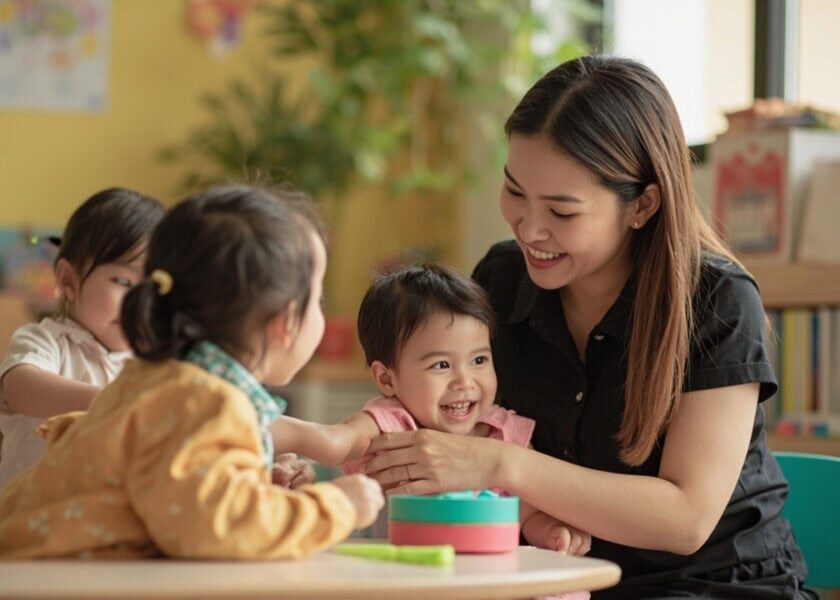
Let us consider what actually happens when a child enters a quality childcare environment. The setup is deceptively simple: a small group of young children, a few consistent caregivers, a space designed for both safety and exploration. But within this seemingly ordinary arrangement, a remarkable process unfolds.
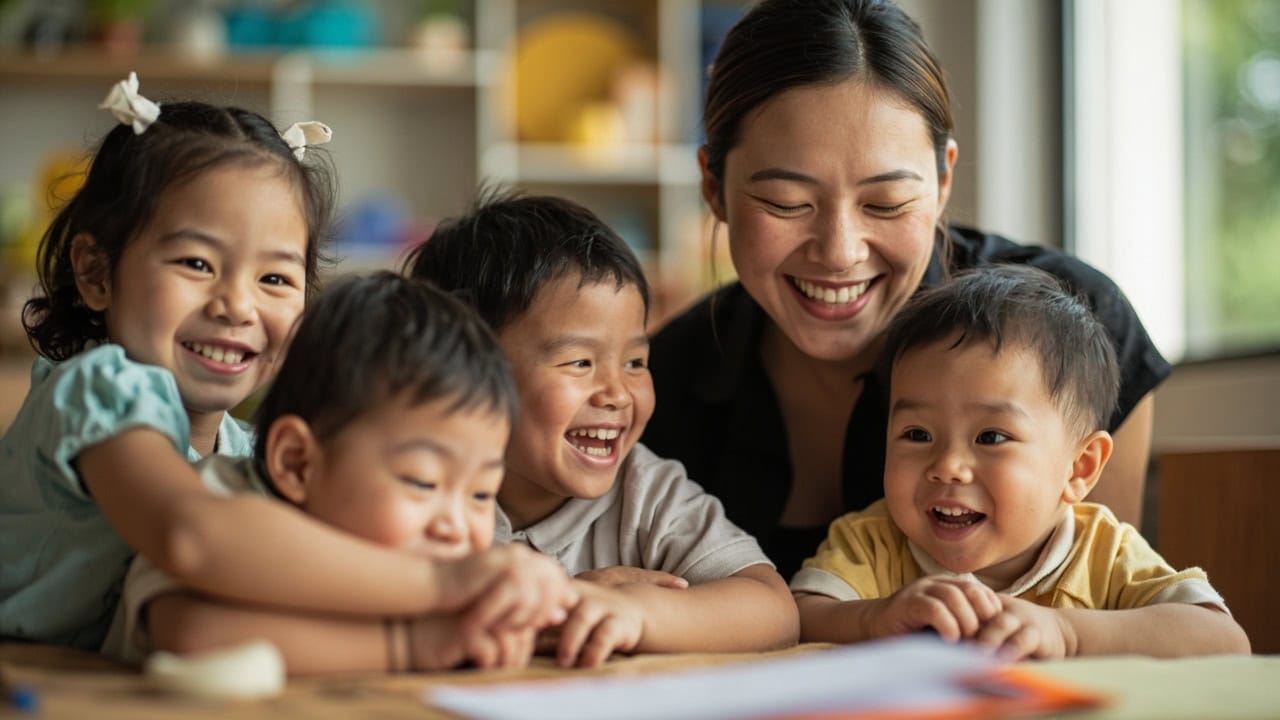
The child encounters peers — other small humans who are also learning how to exist in the world, who want the same toys, who have the same urgent needs, who do not yet have the vocabulary to negotiate these conflicts with words alone.
And in this encounter, slowly and with the patient guidance of trusted caregivers, the child begins to learn that:
- The world contains others with their own wants and feelings
- Relationships require navigation
- Sharing is hard but possible
- Conflict is not the end of connection
- They are capable of influence and also capable of yielding
- Adults can be relied upon to help when feelings become too big to hold alone
This is not play. This is not a bonus. This is the core developmental work of early childhood.
Why It Has to Be Intentional
This development does not happen automatically. It happens in environments that have been thoughtfully designed to support it — environments where the ratio of children to caregivers allows for genuine observation and intervention, where caregivers have the training and emotional bandwidth to serve as co-regulators, where the structure of the day creates space for meaningful peer interaction.
In a curated relational environment, every interaction is an opportunity. Consider how a skilled caregiver might work with moments that arise naturally:
- A dispute over a toy becomes a lesson in emotional vocabulary — “I see that you wanted that truck and now you feel sad because Wei En took it. Can you tell her how you feel?”
- A moment of tears becomes an invitation to connection — “It looks like you missed Mama this morning. I know that feeling. It helps me to give Mama a big hug when she picks me up. Would you like to do that later?”
- A successful moment of sharing becomes celebration — “You and Jia Wei figured out how to take turns with the puzzle! That took such good thinking from both of you.”
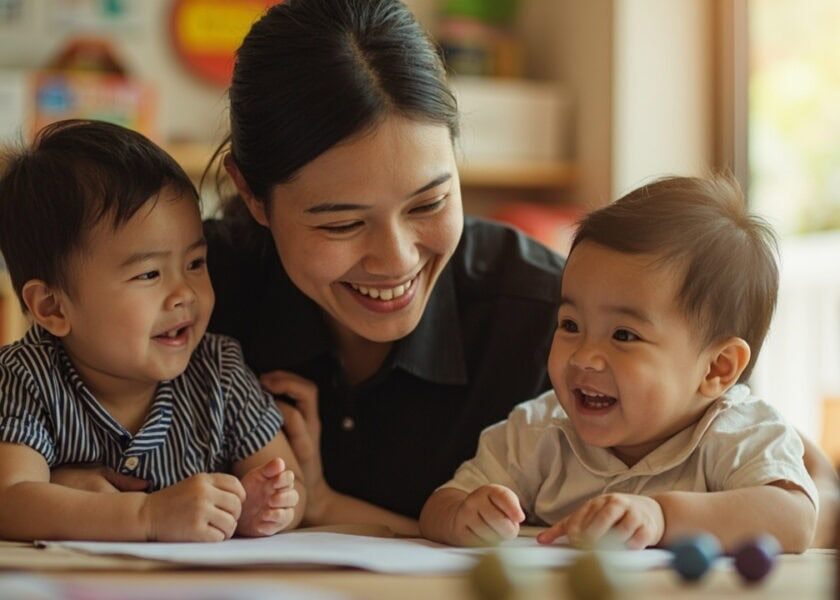
The caregiver who sits with a struggling toddler and helps them find words for the fury they are feeling, who models calm presence when a conflict has escalated, who notices that one child has been hanging back and gently creates an opening for connection — this caregiver is performing a kind of relational pedagogy that is at least as important as any lesson in letters or numbers.
What You Can Observe at Pickup
What can you observe in those daily moments of pickup that tells you whether your child is in an environment supporting their relational growth?
- Warmth toward caregivers — Does your child speak about their caregivers with affection, mentioning them by name, showing genuine comfort in their presence?
- Expanding emotional vocabulary — Does your child bring home new words — not just vocabulary for objects, but words for feelings, emotional language that suggests they have been given a framework for understanding their inner world?
- Social awareness — Does your child mention other children with some emotional texture — enjoyment of a friendship, frustration with a conflict, curiosity about someone new?
- Groundedness at day’s end — Not just tired — young children are always tired. But does your child seem settled, at ease in their own skin? Does there seem to be a quiet confidence in their movements?
Addressing the Concerns Singapore Parents Carry
We understand that Singapore parents carry enormous weight — the demands of careers, the pressures of an expensive city, the high expectations of a society that values both family and achievement. Many parents feel caught between the conviction that their child’s early years matter enormously and the economic and logistical realities that make full-time parental presence impossible.
You may wonder: How can I trust someone else with my child’s emotional development? The answer lies in understanding that quality childcare does not replace parental attachment — it extends and supplements it, in an environment specifically designed to support the particular developmental task of learning to be in relationship with others.
You may wonder: Will my child feel abandoned or anxious? Some separation anxiety is normal and healthy. But in a warm, consistent environment with low child-to-caregiver ratios, children learn that trusted adults can be relied upon — and that parents always return. This is itself a powerful relational lesson.
You may wonder: Is my child getting enough individual attention? This is why ratios matter. In environments with thoughtfully maintained ratios, each child receives the individual observation and responsive caregiving that makes meaningful relational guidance possible.
How EduNanny Approaches Childcare
Quality childcare is relational development, not just supervision. This understanding has guided everything about how EduNanny by BUTLER approaches the work of childcare and childminding.
EduNanny participates in the ECDA Childminding Pilot, reflecting our commitment to regulated, accountable, professionally supported childcare. We offer pathways that include both home-based and community-based models, recognizing that different families have different needs and that the quality of the relational environment is what matters most.
Our infant ratios are maintained at up to one to three, ensuring that each child has the individual attention that makes meaningful relational guidance possible. Our caregivers are trained, observed, and supported — not because the work is simple, but because it is not.
Beyond the philosophy, we offer practical transparency: where deployed, our environments include CCTV measures that provide a window into the day. We maintain open, ongoing communication — not just reports at pickup, but genuine dialogue about how your child is developing socially and emotionally. Our Thomas AI Chatbot makes this communication more accessible and responsive for busy parents.
We also recognize that quality care must be achievable for families beyond the wealthy. Our participation in the ECDA Childminding Pilot includes fee structures designed with accessibility in mind. CDA and Baby Bonus funds are usable where applicable, because every dollar invested in a child’s relational environment is an investment in their future.
Underneath all of this is a fundamental orientation toward the child as a social being from the very beginning of life. When an infant in our care first reaches for another baby, first responds to a caregiver’s smile, first shows the flash of frustration when a toy is taken — these are not incidental moments. These are the first words in a vocabulary that will take a lifetime to master.
Quality Childcare as a Deliberate Investment
There is a way of thinking about childcare that reduces it to a service transaction — parents pay, children are kept safe and occupied, everyone moves on. This way of thinking is understandable. It is efficient. And it misses almost everything that matters.
Because the hours your child spends in quality care are hours in which their capacity for human connection is being shaped, in which their emotional vocabulary is being built, in which their confidence in the social world is taking root. This is not a byproduct of childcare. This is the point.
Thriving is a multidimensional word, and we have sometimes reduced it to a single dimension — academic success, economic achievement, competitive advantage. These things matter. But they rest upon something more fundamental: a human being who knows how to be in relationship, has the emotional resilience to weather disappointment, has the empathy to understand others, and has the confidence to be present in the social world without anxiety or aggression.
These capacities do not appear magically at school entry. They are built, slowly and patiently, in the first years of life, in the company of peers and in the warm, consistent presence of caregivers who understand what they are doing.
Quality childcare is not a convenience. It is a deliberate investment in your child’s relational future. It is a recognition that the social-emotional world your child is building right now, in these earliest years, is the world they will inhabit for the rest of their lives.
And it is an act of love — as deliberate, as intentional, and as consequential as any choice you will make as a parent.
When you choose a childcare environment with intention, when you choose caregivers who understand that their role is relational as much as it is practical, you are making a statement about what you believe matters most — and we believe, as you do, that your child’s capacity to connect, to feel, to navigate the social world with confidence and grace is a gift that will serve them for a lifetime.
If you would like to learn more about how EduNanny by BUTLER supports your child’s relational development, we welcome you to begin a conversation with us.
To learn more about EduNanny’s approach, visit our about us page. You can also explore our homepage for additional resources on quality childcare and childminding in Singapore.