The Secure Base Your Child Builds in Three Years of Quality Childcare
What Singapore Parents Only Understand Three Years After Enrolling in Childcare
There is a moment—most parents experience it sometime in the second or third year—that arrives quietly, without announcement.
You are watching your child play, perhaps in a sandbox at a community park or at a birthday party in one of Singapore’s many indoor play spaces. They stumble. They fall. They look up, not at you, but at whoever has been caring for them through the week, and in that split second of eye contact, something passes between them. Reassurance. Recognition. A quiet return to equilibrium.
And you think: when did that become so natural?
When did my child develop that reflex—not the falling, but the looking? Not the fear, but the recovery?
It is in that moment that you begin to understand what you were actually doing when you enrolled your child in care. Not what you thought you were doing, not what you worried about doing, but what you were building, invisibly, in the daily rhythms of mornings and pickups and ordinary Tuesdays.
You were not buying childcare. You were constructing the internal architecture of a human being. You were giving your child a relationship that would become the template for every relationship that followed.
EduNanny Singapore was built on the understanding that this process takes time to reveal itself. And that is precisely why we want to speak to you now—before enrollment, during enrollment, or perhaps even years after—not to sell you anything, but to offer a frame for something you may already be living through without yet having the language to name it.
The Invisible Architecture of Security
Let us begin at the threshold. The morning you first left your infant in someone else’s arms, you likely did not feel what you were beginning. You felt fear. You felt the weight of a decision that could not be unmade.
You scanned the room for reassurance and found yourself unsure what reassurance even looked like. Was it a clean floor? A bright window? A caregiver who smiled warmly and spoke in gentle tones?
These are reasonable things to notice. But they are surface markers. They tell you about a moment in time, not about the years that will unfold.
Here is what research, the testimony of educators, and the lived experience of thousands of Singapore parents has taught us: the caregiver-child relationship is not a service transaction that you evaluate on the first visit. It is a developmental environment that reveals its significance slowly—sometimes painfully, sometimes with breathtaking beauty—over the course of months and years.
The Psychology of the Bond
Developmental psychologists use a precise term for what your child is building during those months and years of consistent care: an internal working model of relationships. This is the set of unconscious expectations your child develops about how people respond to their needs, how trust operates, how exploration and return work together.
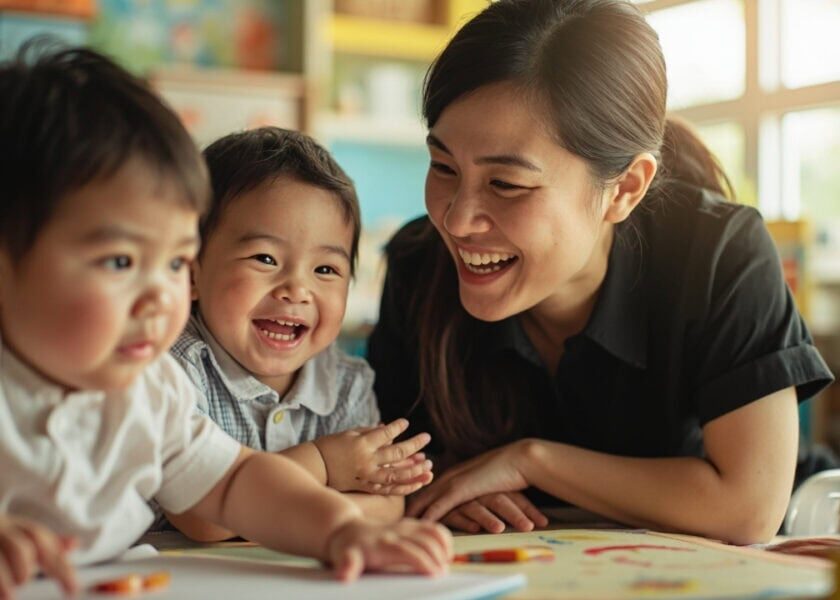
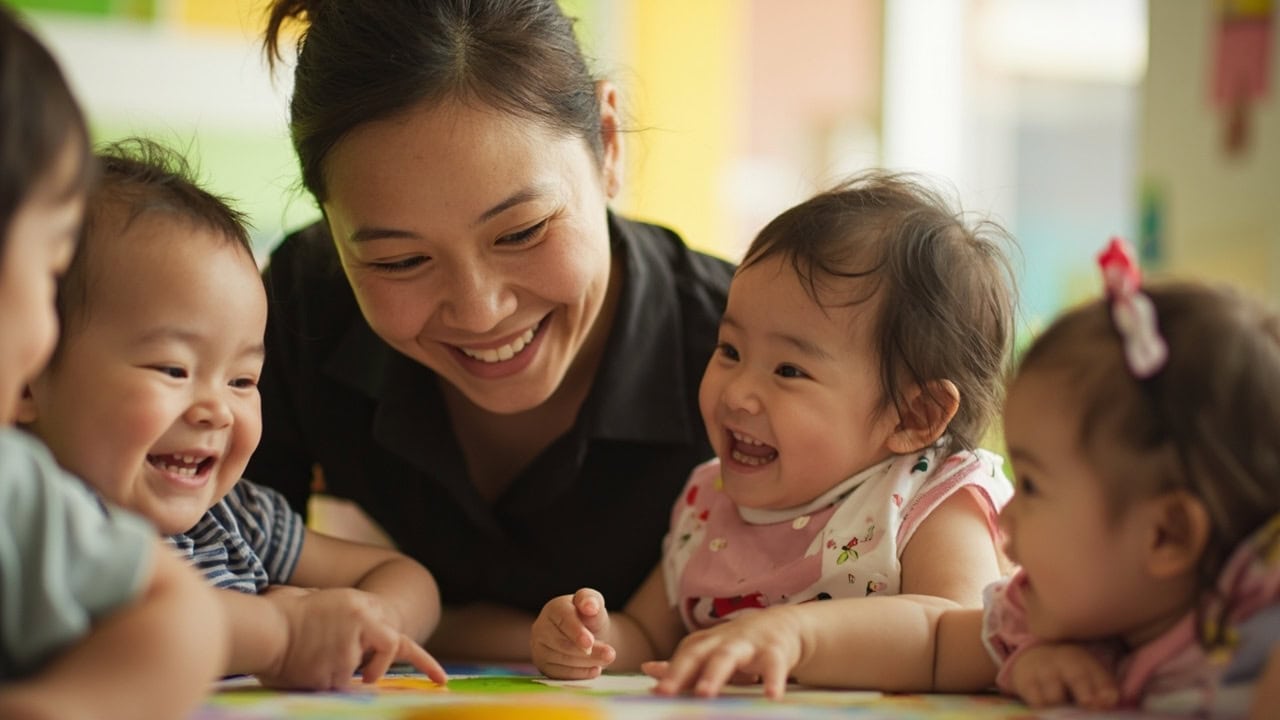
When a caregiver knows your child deeply—when she has been present through the colicky newborn weeks and the mobile mayhem of toddlerhood and every mood in between—she becomes what attachment researchers call a secure base. She becomes the person against whom your child tests independence, safe in the knowledge that she will still be there when they return.
This is not a soft, sentimental idea. It has measurable effects:
- Language acquisition accelerates because children in secure relationships feel safe enough to babble, to attempt, to fail, and to try again without shame.
- Emotional regulation develops through co-regulation—the caregiver’s steady presence teaching the child, wordlessly, how to manage big feelings.
- Independence emerges not from pushy encouragement but from the confidence that comes from knowing someone has your back.
- Attachment security predicts later outcomes in school readiness, social competence, and mental health.
What Quality Childminding Actually Looks Like
In Singapore, parents face a childcare landscape that is, by global standards, remarkably diverse. You can choose between centre-based care and home-based arrangements. You can navigate the ECDA Childminding Pilot and its sister programmes. You can evaluate based on proximity to your home or office, on operating hours, on ratios and qualifications and accreditations.
These are all legitimate considerations. But here is what we have learned from listening to parents across Singapore over many years: the thing that determines whether childcare is truly excellent is not visible on the first tour. It is not captured in a brochure. It is not fully captured even in the first six months of enrollment.
What transforms childcare from adequate to extraordinary is something that develops over time—a relationship between one caregiver and one child that deepens with each passing month, that weathers the child’s developmental shifts, that remains steady when the child’s moods do not.
Patterns Parents Often Recognise in Retrospect
- The greeting: Your child runs toward their caregiver at pickup with the same ease they greet family members. This ease is not trained. It is felt.
- The anticipation: The caregiver begins to know your child’s rhythms so well that she can predict hunger, fatigue, or overwhelm before the child expresses it.
- The vocabulary: Your child begins to use words and phrases that emerged not from home but from the care environment—stories, songs, ways of labelling emotions.
- The resilience: Your child recovers from small falls and disappointments more quickly than you expect. She has learned, through repetition, that setback is not abandonment.
- The exploration: Your child ventures further, experiments more, takes appropriate risks because the secure base remains reliable behind them.
The evidence is consistent across decades of developmental research: children in stable, continuous caregiver relationships demonstrate stronger outcomes across multiple domains. Your child’s brain is building the templates for every future relationship while you are deciding which centre has better parking near your Clementi flat or your Ang Mo Kio HDB. This is not a metaphor. It is neurobiology.
The good news for Singapore parents is that the systems designed to support you—childcare subsidies, the Child Development Account, the Baby Bonus schemes, the ECDA Childminding Pilot fee structures—are built on this understanding. They exist so that economic pressure does not force you to choose between affordability and the kind of quality care that produces these outcomes.
EduNanny’s Approach: Designing for the Relationship
EduNanny Singapore operates as part of the ECDA Childminding Pilot, offering both home-based care and community or centre-based pathways. This structure is not accidental. It reflects our belief that the relationship matters more than the setting—that whether care happens in a carefully prepared home environment or in a centre designed for small-group attention, what the child needs most is one thing above all else: consistency.
Our infant ratios, capped at one to three, mean that your child’s caregiver is not dividing attention across a large group. She is present, attentive, and available in ways that larger settings simply cannot replicate. Over time, this is not a small difference. It is the difference between a child who feels known and a child who feels cared for but anonymous. It is the difference between a relationship and a service.
The Monday-to-Friday care blocks are designed to support this continuity. Five full days a week, your child returns to the same environment, the same rhythms, the same waiting arms. Weekends become a brief pause in a relationship that resumes Monday morning with familiarity and ease. This is not a rigid schedule imposed for administrative convenience. It is an acknowledgment that children thrive on predictability, that trust is built through repetition, and that the caregiver-child bond deepens precisely because it is reliable.
The Parent’s Journey from Skeptic to Partner
In the early months, many parents approach the caregiver as they would any service provider—politely, with appropriate distance, with an eye toward evaluation. They watch carefully during pickups. They scan for signs. They ask questions designed to assess.
But something shifts. Months pass. The child begins to speak the caregiver’s name with the same ease as family. The caregiver begins to anticipate the child’s needs before they are expressed. Small communications pass between them—a gesture, a look, a shared rhythm—that the parent observes but does not fully understand.
And gradually, the parent realises: I am not outsourcing. I am participating. This is not a transaction that I have delegated. It is a relationship that I have joined.
The caregiver becomes a partner in the truest sense—not in the bureaucratic sense of shared paperwork or communication apps, but in the human sense of shared investment in a small person’s flourishing. We have built our communication practices—our transparency measures, our reporting systems, our documentation of milestones and moments—to support this partnership without reducing it to paperwork. The deepest form of connection is not a daily report. It is the knowledge that your child is in hands that know them, that love them, that will catch them when they fall.
What Three Years of Care Actually Builds
If you are a parent whose child is still in care, you may already be living inside this story. You may have noticed your child greeting their caregiver with a particular light in their eyes. You may have heard them use words and phrases that you know did not come from home. You may have watched them navigate a conflict with a peer and recover from disappointment with a resilience that surprises you.
If you are considering enrollment, you may be wondering whether any of this is real, whether it is as significant as we are suggesting, whether it could be achieved through other means.
Here is what we can tell you with confidence, having walked alongside families for years: the developmental outcomes we are describing are not guaranteed. They are not automatic. They do not emerge from any childcare arrangement. They emerge specifically from continuity of care—from the stable, deepening relationship between a caregiver and a child over time.
“My son was three years old and starting preschool. The teacher remarked on how quickly he adapted, how easily he trusted the new adults, how confidently he explored the new environment. I knew why. I had watched it being built for three years.”
— A Singapore father, reflecting on his child’s transition
The Story Behind the Insight
There is a mother in Singapore—we will not use her name—who enrolled her daughter in home-based care when the child was eight months old. She returned to work after maternity leave with a mixture of relief and guilt, anxiety and exhaustion. She visited the caregiver’s home and liked what she saw. She enrolled her daughter and told herself it was a practical decision.
In the early months, she watched anxiously for signs that something was wrong. She scrutinised the daily logs, questioned the caregiver about small incidents, lay awake at night wondering if she had made the right choice.
Then, slowly, the watching became observation, and the observation became appreciation, and the appreciation became something she did not expect: trust.
Her daughter began to flourish. Not in dramatic ways. Not in ways that would appear on any evaluation rubric. But in the small, cumulative ways that matter most—a comfort with other children, a willingness to try new foods, a vocabulary that expanded month by month, a resilience when things went wrong.
The mother did not fully understand what was happening until her daughter was three years old, starting her first week of preschool. She watched from outside the window as her daughter walked confidently into the classroom, turned back briefly to wave—not at her mother, but at the caregiver who had brought her—and then turned to the new teacher with an open, curious smile.
The mother understood, in that moment, what she had built. Not childcare. Not a service. A relationship. And from that relationship, something more: a child who knew how to trust, how to explore, how to attach, how to become.
That is retrospective clarity. It is the understanding that arrives not at enrollment but years later, when you can see the whole shape of what you constructed. You see your child’s ability to attach to new teachers because they learned attachment in the first place. You see your child’s willingness to explore because they always knew someone would catch them. You see your child’s emotional vocabulary because someone spent years naming their feelings with them.
Real Concerns Singapore Parents Bring to Enrollment
“What if the caregiver leaves?”
This is perhaps the most common anxiety Singapore parents voice, and it deserves a direct answer. The risk of caregiver turnover exists in any childcare arrangement. It is one reason why EduNanny structures its training, compensation, and support systems around retention—not because we can guarantee that no one will ever leave, but because we know that the relationship is the product, and the relationship requires stability to develop.
In the home-based and centre-based models within the ECDA Childminding Pilot, we work actively to create conditions where caregivers build careers rather than temporary jobs. The continuity of care is not accidental. It is engineered.
“How do I know my child is really thriving?”
Thriving in the first year of life often looks like ordinary, unsexy things: regular sleep, consistent appetite, gradual acquisition of language, appropriate attachment behaviours. It does not always look like dramatic milestones or visible achievements.
What you will notice, over time, is that your child is becoming someone who can be soothed, who can explore, who can recover from frustration, who greets familiar faces with genuine warmth. These are the markers of a child who feels secure. They are built through thousands of ordinary interactions, not through dramatic interventions.
“Is home-based care as good as centre-based care?”
This is the wrong question. The better question is: which setting allows for the deepest, most consistent relationship between my child and one primary caregiver?
Both home-based and centre-based care can produce excellent outcomes when the relationship with the caregiver is stable and responsive. The ECDA Childminding Pilot explicitly recognises this, offering both pathways with the same standards for caregiver training, ratios, and developmental support. For many Singapore families, the intimate scale of home-based care creates conditions where the caregiver-child bond develops particularly quickly. But the setting matters less than the relationship. Choose the setting that allows your child to have one person who knows them completely, and then protect that relationship.
“Can I afford quality care without compromising on other family needs?”
Singapore has built one of the most comprehensive childcare subsidy systems in the world. The Child Development Account, Baby Bonus schemes, and ECDA Childminding Pilot fee structures are designed to ensure that quality care is not a luxury reserved for high-income families.
We believe you should not have to choose between affordability and excellence. EduNanny is designed to be accessible within the pilot fee structures, not because we have compromised on quality, but because we believe that continuity of care should not be a privilege. The caregiver-child bond does not know the difference between a public subsidy and private payment. It only knows presence, consistency, and love.
Practical Guidance for Choosing Infant Care in Singapore
If you are beginning the search for infant care—whether for the first time or returning to the process after an earlier experience—here is what we recommend prioritising:
Questions to Ask on Your First Tour
- Who will be my child’s primary caregiver, and how long have they been in this role?
- What is the caregiver-to-infant ratio in this environment?
- How does the programme support continuity of care when children transition through developmental stages?
- What training have caregivers received in attachment-informed practices?
- How does the programme communicate with parents about the child’s day-to-day experience?
Red Flags to Watch For
- High caregiver turnover that leadership cannot explain or address
- Ratios that exceed ECDA guidelines for infants and toddlers
- Resistance to transparency or parental visits outside of formal pickup times
- Language that emphasises curriculum and achievement over relationship and security
- Environments that feel institutional rather than warm and responsive
The One Question That Matters Most
When you visit any potential care arrangement, ask yourself: Can I imagine my child having one consistent person here who will know them completely over the course of years?
If the answer is yes—if the environment supports that depth of relationship, if the ratios allow it, if the staff culture values it—then you have found something worth your trust. The rest can be refined over time. But the relationship must be possible from the beginning.
Begin the Conversation
Singapore is a society that invests heavily in its children. You have parenting leave policies, baby bonuses, subsidies for childcare, and a government that actively supports the early childhood sector. These are not small commitments. They reflect a collective understanding that the early years are foundational, that what we build in childhood shapes what becomes possible in adulthood.
But investment is not the same as understanding. And true, deep understanding of how early attachment shapes the capacity for learning, for relationships, for resilience—arrives slowly, often too slowly to guide the decisions that matter most.
Our hope, at EduNanny Singapore, is to offer that understanding before it becomes retrospective. We want parents to know, on the first day, that they are not making a logistical decision. They are not securing a service. They are beginning a relationship that will shape their child’s internal working model of the world.
Every time a caregiver responds to a child’s distress with calm presence, she is teaching that child that distress is survivable. Every time she celebrates a small triumph, she is teaching that child that effort is worthwhile. Every time she remains steady through the child’s difficult moods, she is teaching that love does not depend on performance.
These are the lessons that children carry into school, into friendships, into future partnerships and workplaces and communities. They are the lessons that shape Singapore’s future as surely as its economic policies and infrastructure.
This is what EduNanny Singapore offers. Not promises of miracles or guarantees of outcomes. But something more enduring: the conditions in which your child can build the internal architecture that will serve them for a lifetime.
The caregiver who knows your child completely. The relationship that deepens with each passing month. The stable, consistent presence that becomes, for your child, the safe base from which they will explore the world.
You will not fully understand what you have built for three years. Perhaps longer. Perhaps it will only become clear when your child navigates a difficult friendship, or recovers from a disappointment, or opens themselves to new experience with the confidence that comes from knowing they are loved.
But the architecture is being built now. In every morning drop-off. In every pickup. In every ordinary day that you trusted the process and stayed the course.
We would be honoured to walk that road with you.
EduNanny Singapore is part of the ECDA Childminding Pilot, offering development-focused childcare and childminding built on continuity, trust, and the belief that the most important relationships endure.
Learn more about EduNanny · Get in touch