The Five Capacities Your Child Grows in Quality Childcare Singapore
Who Is My Child Becoming Here?
There is a question that every parent in Singapore eventually asks. Usually late at night. Usually after a long day of wondering.
It is not the question they imagined they would ask when they began searching for childcare. Not about safety credentials, or whether the centre has a modern kitchen, or if the teacher has proper certifications. The question comes from somewhere deeper—from that quiet, persistent place where hope lives alongside doubt.
And the question is this: who is my child becoming here?
You have placed something irreplaceable in someone else’s hands. You have handed over mornings and afternoons, the hours when your child is most awake, most curious, most open to the world. You have made this choice, and you have made it well. But part of you still wonders: is this actually doing something? Is my child growing in the ways I want? Am I making the right choice—not just for this month, but for who my child is becoming?
What Quality Childcare Grows
Before we go deeper, here is what developmental science and experienced caregivers have learned, again and again, across decades of watching children grow: quality care does something specific and profound in a child. It is not merely supervision. It is not merely safety. It is a cultivation—day by day, interaction by interaction—of the whole human being your child is becoming.
When the environment is warm, consistent, and professionally supported, quality childcare cultivates:
- Confidence — the quiet belief that the world is navigable, that your child can handle what comes
- Curiosity — the genuine desire to explore, question, and understand
- Emotional resilience — the capacity to experience difficult feelings and return to calm
- Social intelligence — the instincts that allow navigation of cooperation, sharing, and empathy
- Cognitive foundations — language, thinking, and problem-solving capabilities that prepare your child for life
These are not optional extras. They are, in the most fundamental sense, what makes everything else possible—including later academic success.
The Five Capacities: What Quality Care Actually Grows
Confidence — The Belief That the World Is Navigable
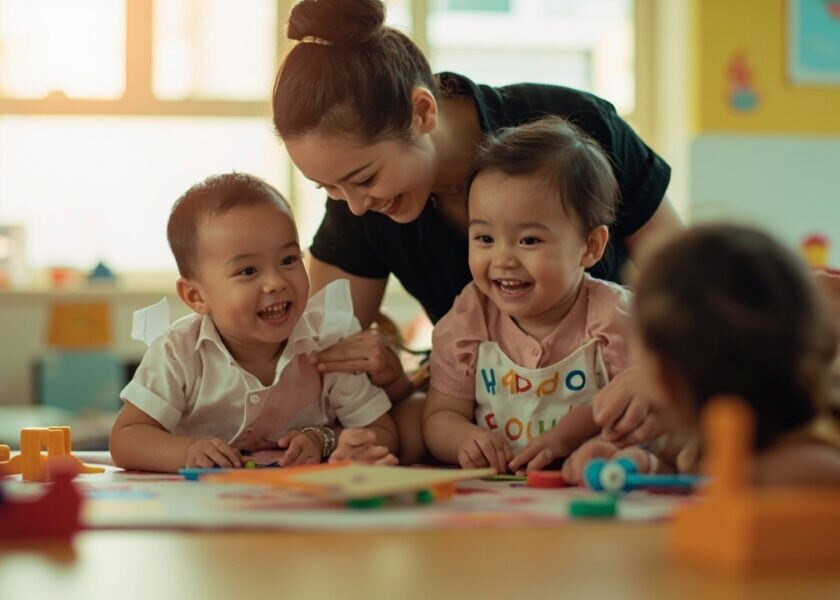
A toddler who once hesitated at the edge of new situations begins to step forward with something that looks, unmistakably, like confidence. Not bravado. Not performance. Real confidence: the quiet belief that they can handle what comes, that their presence matters.
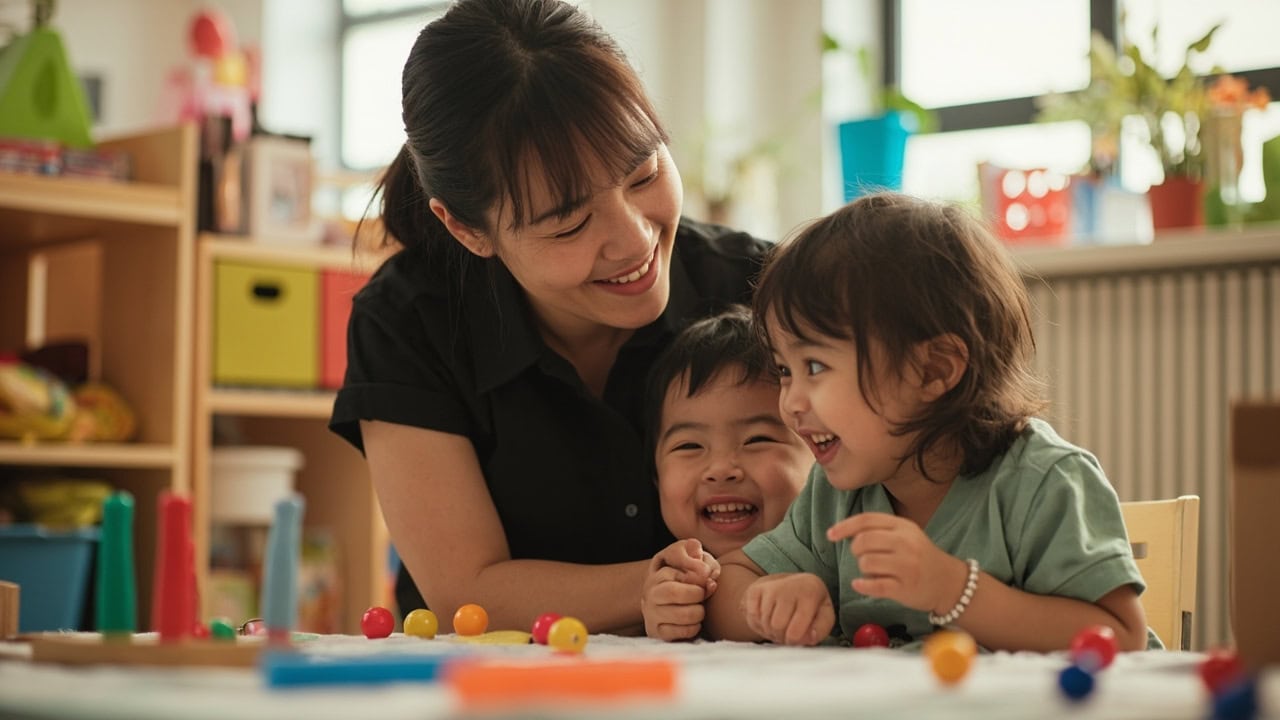
Where does this come from? It comes from a caregiver who celebrates small attempts—who says, with genuine warmth, “you did it.” Who creates an environment where trying is always more valued than succeeding. Who shows up, day after day, so consistently that the child begins to trust that the world will catch them if they stumble.
This is not something a child learns from a lesson. It is something a child absorbs from an experience.
Curiosity — The Desire to Know
You will recognize it as the questions start to multiply. Why this? Why not that? What happens if I do this?
A child in quality care is surrounded by a caregiver who is genuinely engaged—who responds to questions with more questions, who introduces novelty with delight, who treats the child’s interests as worthy of serious attention.
Curiosity is not born from having access to the most expensive toys. It is born from the experience of having your questions matter.
Emotional Resilience — The Capacity to Return to Calm
Quality care also builds something far more important, and far less discussed: emotional resilience. The ability to experience a difficult feeling and come through it. The capacity to be upset and return to calm. The trust that big emotions are survivable, and that someone nearby is equipped to help.
You see this in the way a child responds to small frustrations—the first stumble, the toy that will not work the way they want it to. In quality care, they begin to discover that emotions are manageable, that upset does not last forever, that someone nearby can help them find their way back to calm.
What does it look like when it is growing? You might notice:
- Your child recovering from disappointment more quickly
- Your child returning to play sooner after an upsetting moment
- Your child beginning to use words like “frustrated” or “angry” to describe what they feel—not because they have been taught to, but because someone nearby has consistently helped them name what they are feeling and shown them that the feeling will pass
Social Intelligence — Understanding Others
A toddler in a warm, consistent care environment begins to notice other children. Slowly, they learn that other children have needs. They learn that sharing is possible, even when it is hard. They learn that some conflicts can be solved with words, and that other people are worth caring about.
These social instincts do not arrive fully formed. They emerge gradually, through hundreds of small experiences of being in relationship with others.
You will see the trajectory over time: a child who increasingly demonstrates care for others, who can negotiate, who can wait their turn and feel the satisfactions of sharing. This is not something that can be taught in a single lesson. It is cultivated through consistent, real experience—and it is one of the most valuable outcomes quality care can provide.
Cognitive Foundations — Language, Thinking, and Problem-Solving
Quality care does not produce cognitive development through flashcards or academic drilling. It produces it through something far more powerful: interaction.
The thousands of small moments in a day when a caregiver speaks to a child, responds to their sounds, introduces new vocabulary during play, asks a question and waits for an answer, follows the child’s lead and extends their thinking—these moments, repeated daily, build the neural architecture that underlies language and thought.
A child in quality care often begins to demonstrate this growth in ways that are both obvious and subtle. They ask more questions. They experiment more freely. They begin to show the kind of thinking that is the true precursor to academic ability: the ability to wonder, to hypothesize, to test.
Why Developmental Readiness Matters More Than Academic Readiness
There is a confusion that trips up many parents in Singapore. There is a tendency to conflate academic readiness with developmental readiness. These are not the same thing.
Academic readiness—knowing letters, being able to count, reciting facts—can be taught, and it can be measured, and it can be demonstrated in a tour or a brochure. It is visible and quantifiable, which makes it appealing.
But it is not the same as the deeper developmental capacities we have been describing. A child who can count to twenty at age three but who has not developed the emotional resilience to handle frustration, the social skills to collaborate with peers, and the curiosity to wonder about the world, will be less well-prepared for the challenges ahead than a child who arrives at school with these deeper capacities intact.
This is not an argument against academic learning. It is simply a reminder that what is most measurable is not always most important.
The answer lies not in any single program or philosophy, but in the accumulated weight of daily interactions. The relationship between caregiver and child is the engine of development. Everything else—the materials, the activities, the environment—serves this relationship or it does not.
When a caregiver responds to a child’s distress with patience and comfort, the child is building emotional regulation. When a caregiver waits for a child to attempt something before helping, the child is building confidence. When a caregiver turns a routine moment into a rich conversation, the child is building language and thinking.
These are not separate events. They are the texture of daily life in quality care. And what matters most is their quality and their consistency.
- Not the size of the playground, but the quality of the attention
- Not the flashiness of the curriculum, but the depth of the relationship
This is why developmental depth is a better indicator of quality than any list of features or facilities. You cannot see emotional resilience on a facility tour. You cannot measure social intelligence by looking at the toys.
What you can see is how the caregivers interact with the children. Are they genuinely engaged? Do they respond to the children with warmth and thoughtfulness? Do they seem to know the children as individuals?
Recognizing Growth in Your Own Child
One of the most powerful things you can do as a parent is to learn to recognize the subtle signs of growth in your child—not just the obvious milestones like first steps or first words, but the quieter developments.
Watch for these marks of developmental capacity:
- The way your child’s play is becoming more complex and imaginative
- The way they are beginning to show empathy for others—offering comfort, noticing when someone is upset
- The way they are increasingly able to express what they feel and need in words
- The way they approach new situations with curiosity instead of fear
- The way they recover from disappointment and return to play
When you begin to see these, something changes: you realize that the choices you are making for your child are actually working. You see your child becoming someone. Not just being cared for, but growing.
You are not simply leaving your child with your caregiver. You are partnering with them in the work of raising your child. The most effective childcare arrangements recognize this—they keep you informed, involved, and attuned to what is actually happening in your child’s development.
What Quality Childminding Looks Like in Practice
For infants and young children, intimate, home-like settings often support development most effectively. In these environments, the caregiver can truly attune to each child, and the ratio of adults to children allows for genuine responsiveness.
Quality indicators worth noting:
- Consistent, warm relationships — Caregivers who know each child as an individual, who remember preferences, fears, and interests
- Responsive interaction — Conversations that go both ways, questions that invite thinking, comfort offered when needed
- Safe emotional environment — Where trying is valued over succeeding, where mistakes are learning opportunities
- Age-appropriate structure — Routines that provide security without rigidity
- Transparent communication — Regular updates that help you understand what is happening in your child’s day
These are the features that produce developmental outcomes—not the size of the playroom or the color of the walls.
The EduNanny Approach: Built for the Whole Child
EduNanny Singapore is built on the understanding that quality care is not about supervision. It is about cultivation.
As part of the ECDA Childminding Pilot, EduNanny’s approach reflects a broader recognition that quality childcare for Singapore’s youngest children requires thoughtful, intentional approaches that put developmental outcomes at the centre.
The home-based care pathway reflects the understanding that infants and young children often thrive in intimate settings where caregivers can truly attune to each child. With infant ratios of up to one to three, caregivers have the space to do what quality care requires: to notice, to respond, to nurture.
Fee structures are designed to be accessible, and families can utilize CDA and Baby Bonus funds. Transparent communication and, where deployed, CCTV measures reflect the belief that trust between parents and caregivers must be grounded in openness.
But the features, while real and important, are not what ultimately defines the approach. What defines it is the understanding that your child is not a project to be managed. Your child is a whole person, developing in real time, and what they need is not just supervision but cultivation.
What they need is a place where they can grow into confidence, curiosity, emotional resilience, social intelligence, and the foundational capabilities that will serve them for a lifetime.
Questions Worth Asking When Choosing Childcare
If you are researching infant care or childminding options, here are questions worth asking—not just about facilities, but about what your child will actually experience:
- How do caregivers respond to children’s emotional moments? Look for patience, consistency, and warmth in how distress is handled.
- What does a typical day actually look like? Are there rich conversations, or mostly scheduled activities? Is there space for child-led exploration?
- How does the caregiver communicate with parents? Are you kept informed about your child’s day—not just logistics, but development?
- What is the caregiver-to-child ratio? Can each child actually receive individual attention?
- How does the environment support trying over succeeding? Is effort celebrated? Are mistakes treated as learning?
The answers to these questions will tell you more about what is actually being cultivated than any brochure or facility tour.
The Work That Matters Most
Choosing childcare is not just a logistical decision. It is a statement about what you believe your child deserves. It is an act of hope—hope that the world will be good to your child, hope that you are making the right choices, hope that your child is becoming someone you will be proud of.
We take this responsibility seriously, because we know you do.
When you bring your child to quality care, you are entrusting something irreplaceable. And what you should expect in return is not just supervision, but cultivation—not just childcare, but the nurturing of everything your child is and everything your child can become.
You will see it. You will see it in the way your child approaches new situations with curiosity instead of fear. You will see it in the way your child recovers from disappointment and returns to play. You will see it in the way your child begins to show care for others, to use words to express feelings, to think and wonder and experiment.
You will see it in the whole person your child is becoming.
And when you see it, you will know that the question you asked at the beginning—the question every parent asks—has been answered. Not with a brochure or a tour or a promise. But with your child, standing in front of you, showing you exactly who they are becoming.
This is what quality care does. This is what EduNanny Singapore exists to provide. And this is the work that matters most: not the watching over of children, but the growing of them. Not the filling of time, but the shaping of futures.
Every child deserves to be seen, nurtured, and given the space to become who they are meant to be. That is the work. That is our purpose. And that is what we are honored to do, together with you, every single day.
If this article has resonated with you, we would be glad to continue the conversation. Reach out to learn more about how EduNanny Singapore supports families who are looking for something more—quality care that sees your child as a whole person and is committed to cultivating everything they can become.
You can also learn more about who we are and what we offer.