The Second Secure Base What Attachment Science Teaches About Your Childs Caregiver Bond
“`html
The Question Beneath Every Childcare Decision
For decades, conversations around infant care and childminding have centered on safety, credentials, ratios, and supervision. These are legitimate concerns—the baseline questions you ask before you ask the real question, the one that sits underneath all the logistics and searching.
That question is this: will my child form a genuine, meaningful, growth-supporting bond with the person caring for them?
And if they do—is that good?
This is where attachment science enters the conversation. And it is a conversation that shapes everything EduNanny Singapore does.
What Attachment Science Actually Tells Us
The science of attachment is among the most robust and replicated bodies of research in developmental psychology. John Bowlby, the British psychiatrist who founded the field, observed something that parents have always known intuitively: children are biologically designed to form emotional bonds with the people who care for them. These bonds are not sentimental add-ons to human development. They are its architecture.
What Bowlby and his successors also came to understand is that children are not designed to form only one bond. Mary Ainsworth’s research in the 1970s documented what she called multiple attachments—the reality that by the end of the first year, most children have formed significant, recognizable attachment bonds with more than one caregiver.
Not equally. Not interchangeably. But meaningfully.
A child’s bond with their mother or father remains primary, organized around the biological expectation of parental presence. But a child can and does attach to grandparents, to siblings, to regular caregivers—with all the same hallmarks of secure attachment behavior: seeking proximity, deriving comfort from presence, using the person as a base from which to explore.
Children raised in settings where they have access to multiple secure attachment figures demonstrate, on average, better social competence, stronger emotional regulation, and more confident exploratory behavior. A second secure base is not a diluted version of the first. It is additive. It multiplies.
The question is not whether your child should bond with their caregiver. The question is whether that bond will be the kind that supports your child’s development. And that is entirely a question of the caregiver’s training, responsiveness, and relational intentionality.
The Difference Between Warmth and Attunement
There is a difference, and it is not subtle, between a caregiver who provides warmth and a caregiver who provides security.
Any attentive adult can be warm. A warm caregiver smiles, speaks kindly, holds a child gently. Warmth is valuable. A child in the care of a consistently warm adult is far better off than a child in the care of a cold or indifferent one.
But warmth alone is not attachment.
Attachment requires attunement. Attunement is the caregiver’s capacity to read the child’s emotional signals, to understand what the child is communicating through behavior and affect, and to respond in a way that is timely, appropriate, and consistent.
Consider these examples:
- A warm caregiver might comfort a crying child. An attuned caregiver notices the shift in the child’s cry, reads the moment before the child escalates, responds in a way that validates what the child is feeling before it becomes overwhelming.
- A warm caregiver plays with a child. An attuned caregiver follows the child’s lead, mirrors the child’s excitement, matches the child’s rhythm, extends the child’s play in ways that communicate: I see what you are doing, I understand it, I am with you in it.
This is what EduNanny’s caregivers are trained to do. Not just to be present. Not just to be kind. To attune. To read. To respond with relational precision. To build, intentionally and day by day, the kind of bond that a child can trust as a foundation for growth.
Addressing the Fear That Sits in Every Parent’s Chest
Every parent who entrusts their child to someone else’s care carries a fear: the fear of being replaced.
It is not vanity. It is love. It is the fierce, biological knowledge that you are your child’s person, that no one else should stand where you stand, that the bond between a parent and child is singular.
This fear is real and valid and deserves to be honored rather than dismissed.
But here is what attachment science has taught us: the fear of replacement rests on a misunderstanding of how attachment works. Your child does not have a fixed amount of attachment capacity, like a cup that can be filled only so full. Attachment is not diminished by multiplicity. In fact, it is strengthened by it.
Reframing the Caregiver Bond
Think of it this way. When you were a child, perhaps you had a grandparent who was a source of deep comfort and joy. Did that person’s presence in your life make you love your parents less? Of course not. It made your world larger. It gave you another perspective, another style of affection, another secure base from which to explore. You did not have to choose. You simply had more.
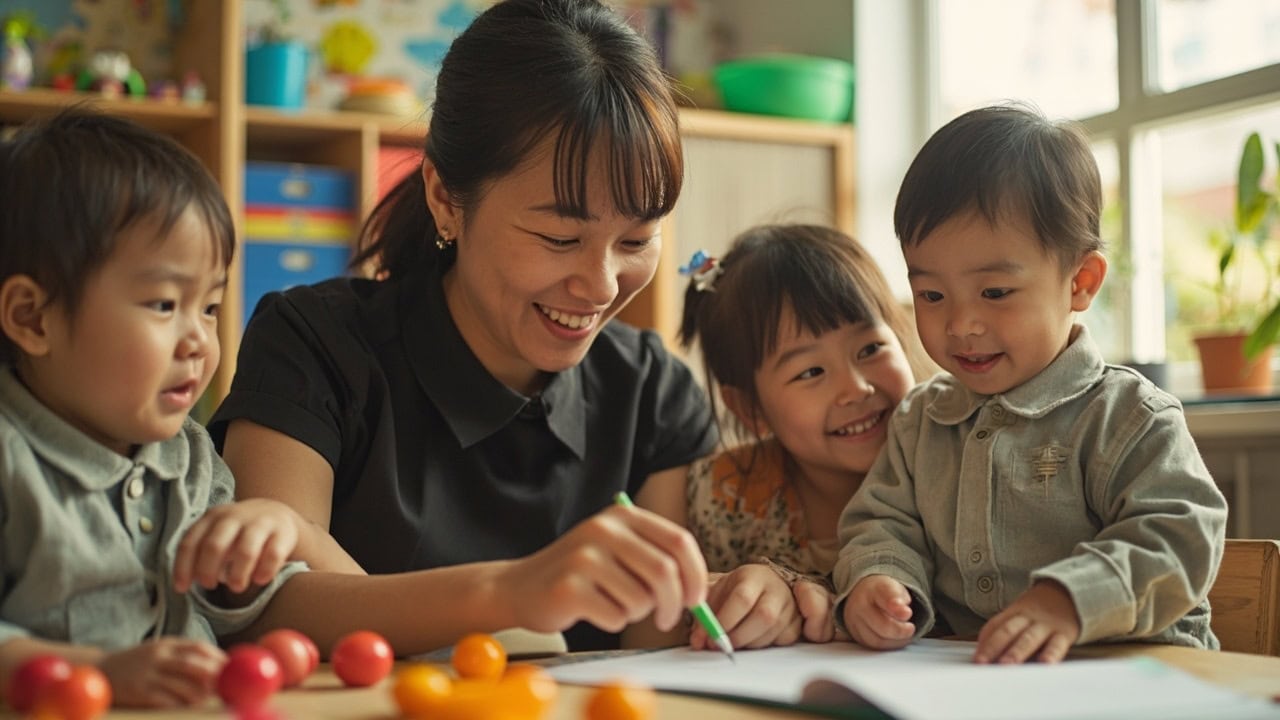
The same is true for your child and their caregiver. When a child has a secure bond with their EduNanny caregiver, they are not transferring loyalty or replacing you in their heart. They are gaining a second person in the world who is tuned to them, who responds to their needs, who offers a consistent and safe presence.
- You remain the primary attachment holder.
- You are the person your child comes home to.
- You are the person whose face they seek in a crowd.
- You are the person whose voice soothes them most completely.
The caregiver bond is not parallel to yours. It is supplementary. It exists alongside and beneath yours, supporting it, not competing with it.
The Paradox of Secure Attachment
Research suggests that children whose secondary attachments are secure demonstrate less separation anxiety, not more. When a child trusts their caregiver deeply, they walk into the morning handoff more confidently, not less.
The child who runs to their caregiver with joy at drop-off is not rejecting the parent at the door. They are showing that they have learned what secure relationships feel like—and because they feel secure with their caregiver, they can tolerate the natural stress of separation from their parent with greater resilience.
This is the gift of a well-formed caregiver bond: it does not take your child away from you. It sends your child back to you more whole.
What Healthy Caregiver-Child Attachment Looks Like
So how do you know whether your child’s caregiver is not just warm but truly attuned? There are observable indicators, grounded in attachment research, that you can watch for. They are not mysterious or clinical. They are the behaviors of a child who feels safe.
Sign 1: Child-Initiated Interaction
A securely attached child will not only receive care but seek it out. Watch your child approach their caregiver during play, not because they need something but because they want to share an experience. Watch them show their caregiver a butterfly, a building, a truck—not because they have been prompted to do so, but because the caregiver is someone who responds with genuine interest.
This is what secure attachment looks like in motion: a child who wants to include their caregiver in their world.
Sign 2: Caregiver Responsiveness Patterns
Observe how the caregiver responds in key moments:
- When a child falls, does the caregiver move with calibrated concern—enough to comfort, not so much as to escalate?
- When a child points at something with excitement, does the caregiver follow the child’s lead, narrating what the child is seeing, matching the child’s emotional tone?
- When a child is frustrated, does the caregiver name the feeling, offer support, and give the child space to work through it rather than immediately solving the problem?
These micro-responses, repeated thousands of times over months and years, are the building blocks of attachment.
Sign 3: The Caregiver as Base for Peer Engagement
In group settings, a securely attached child will check in with their caregiver—glance, smile, move toward briefly—and then return to play. The caregiver is a safe harbor from which the child launches into social exploration. This is one of the most reliable signs that the caregiver has become a genuine secure base, not just a familiar adult in the room.
Sign 4: Growing Emotional Regulation
Over time, a child who has developed a secure attachment with their caregiver will show increasing capacity to manage frustration, disappointment, and overstimulation—with the caregiver’s quiet support. This is not a dramatic transformation. It is the gradual deepening of a child’s internal architecture, built brick by brick through a thousand responsive moments.
Questions to Ask When Choosing Infant Care
If you are currently researching childcare options in Singapore, here are the questions that matter most:
- What is the caregiver-to-child ratio? Fewer children per caregiver creates space for attunement.
- How does the caregiver respond when a child is distressed? Look for calm, consistent, child-centered responses.
- Can you observe child-initiated interaction? Watch whether children seek out the caregiver to share, not just to request.
- Does the caregiver follow the child’s lead in play? This is a key marker of attunement.
- Is there consistency in caregivers? Attachment requires predictability over time.
- How does the programme communicate with parents? Transparency signals relational confidence.
The answers to these questions will tell you far more than a facility tour or a curriculum brochure.
How EduNanny Singapore Cultivates These Bonds
EduNanny Singapore was built on the understanding that the caregiver-child relationship is not incidental to quality childcare. It is quality childcare.
The ECDA Childminding Pilot: Structure That Enables Connection
EduNanny participates in the ECDA Childminding Pilot—a recognition that professional childminding deserves formal infrastructure, training standards, and community support. The pilot pathway reflects a commitment to making quality infant care not a privilege for the few, but a viable option for families across Singapore.
With ratios of up to one to three for infants, EduNanny caregivers have the time and attention to attune individually to each child in their care. This is not a luxury. It is a developmental requirement. You cannot attune to a child you are juggling among seven others.
Pathways Designed for Families
EduNanny’s home-based and community pathway options reflect the understanding that not all families are the same. Some children thrive in smaller, home-like settings. Others benefit from the social environment of a centre-based arrangement.
What matters is not the setting alone but the relational quality within it. Both pathways are organized around the same commitment: trained caregivers with the time, attention, and attunement skills to build genuine attachment relationships with the children in their care.
Consistency, Transparency, and Accessibility
Monday through Friday care blocks provide the consistency that attachment requires. Attachment does not form in fragments. It forms in the accumulation of predictable, repeated, responsive interactions over time.
EduNanny also understands that trust in childcare is built through concrete practices—regular updates, open communication channels, and visible safety measures including CCTV systems where deployed. When a parent knows their child is safe, seen, and cared for by someone who genuinely knows them, the entire family breathes more easily. Trust enables attachment. EduNanny structures its practice to build both.
Within the ECDA Childminding Pilot’s fee framework, and with the usability of CDA and Baby Bonus schemes for eligible families, EduNanny works to remove financial barriers to premium care. Quality relational care should not be reserved only for those who can pay a premium price.
The Beginning of a Second Secure Base
There is a moment that happens every morning in homes across Singapore. A parent lifts their child from the car seat or from their arms at the doorway. The child’s face shifts. There is the briefest flicker—the natural hesitation of any small person separating from the person they know most completely in the world.
And then something else happens. Across the room, a caregiver crouches down, speaks a child’s name, extends a hand. And the child turns. The child walks, or runs, or is carried willingly toward this other person who is not their parent but who has become, over weeks and months, someone significant. Someone known. Someone safe.
This moment is more profound than it looks.
Premium childcare is not the cleanest facility or the most impressive curriculum or the highest ratio of staff to children—though all of these have their place. Premium childcare is the understanding that your child is not just being supervised. Your child is in a relationship—one that will shape how they understand connection, how they manage emotion, how they engage with other children, how they trust the adults who hold important roles in their lives.
A child who has formed a secure attachment with their EduNanny caregiver enters the world differently than a child who has not. They explore more boldly because they know someone is behind them. They relate to peers more confidently because they have a template for positive adult connection. They regulate their emotions more capably because they have been helped to do so, repeatedly, by someone tuned to their needs.
They arrive at school ready—not just cognitively, but relationally. Ready to trust a teacher. Ready to make friends. Ready to believe that the world contains adults who will see them, respond to them, and keep them safe.
The bond your child forms with their caregiver is not something to worry about. It is something to trust.
EduNanny was built for this. Because every child deserves a caregiver who is not just present, but attuned. Not just kind, but safe. Not just familiar, but attached.
And every parent deserves to know that when they hand their child to someone else, that child is not merely being watched. That child is being known. That child is being held—emotionally, relationally, intentionally—in a way that will serve them for the rest of their life.
If you are exploring infant care or childminding options in Singapore and want to understand how EduNanny supports the relationship between caregiver and child, we invite you to begin a conversation with us.
To learn more about EduNanny Singapore and our approach to quality childminding, please visit our homepage or read about our story.
#ChildmindingSingapore #InfantCareSingapore #SecureAttachmentChildcare #EduNannySingapore #ECDAChildmindingPilot
“`