The Quiet Moments That Reveal Whether Your Childcare Is Truly Excellent
You Are Not Looking for Safety. You Are Looking for Something More.
You are not looking for safety. Safety is a floor, not a ceiling. You are not even looking for supervision. Supervision is the minimum.
What you are looking for, perhaps without yet having the exact words for it, is something much more precise: you want to know that during those hours your child is not simply being kept, but being seen. Being responded to. Being noticed in their small moments of curiosity, their quiet expressions of need, their everyday discoveries of the world.
Here is the truth we want to share with you: quality childcare is not mysterious. It is not unknowable. It is, in fact, deeply observable—for those who know what to look for.
The Architecture of Intentional Care
Quality childcare leaves visible traces. Not just in the certificates on the wall or the gleaming toys in the play area, but in the thousand small interactions that happen throughout each day.
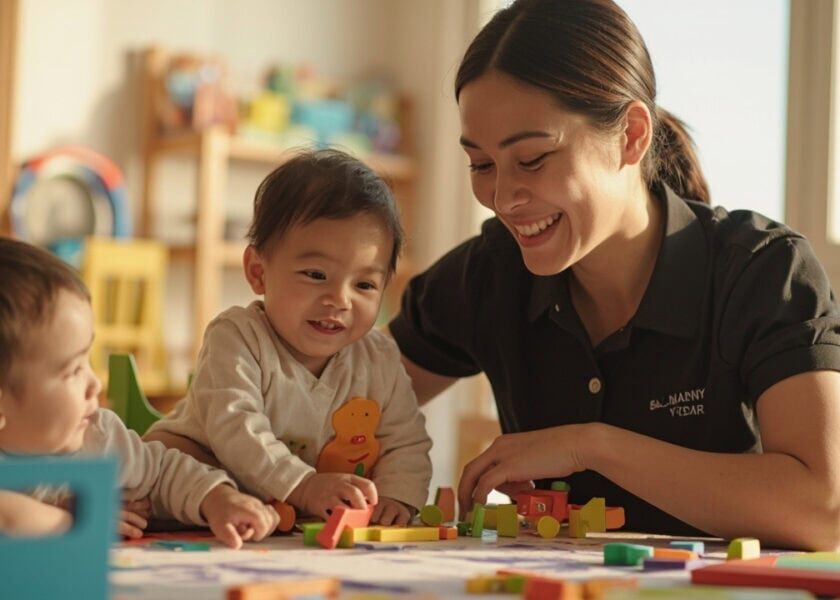
In the way a caregiver kneels to a child’s level when speaking. In the pause before responding to a child’s babble, as if the sound genuinely mattered. In the arrangement of the room itself—who chose those materials, and why, and what is a child meant to discover there?
These are not accidents. They are not the byproduct of good intentions alone. They are the evidence of a practiced, intentional approach to care—the kind of care that shapes a child’s early sense of the world, their understanding of whether they are worthy of attention, whether their needs will be met, whether the people around them are trustworthy.
In Singapore, we are fortunate to be living through a remarkable period in childcare development. The ECDA Childminding Pilot has opened new pathways for families, recognizing that not all children thrive in the same settings, and that the early years carry weight that echoes across decades. Home-based care, community pathways, centre-based environments—each offers something different, and each can be excellent when the principles guiding it are sound.
But the architecture of the building, the color of the walls, the reputation in parent forums—these are not what makes the difference. The difference lives in the hands, the eyes, the voice of the person caring for your child.
What Responsive Care Looks Like in Everyday Moments
The Morning Greeting
In a setting driven by genuine attunement, your child is not processed through a door but welcomed into a relationship. The caregiver knows their name—not just as a label, but as something spoken with recognition.
The caregiver may kneel, or sit, or lean down to a level where eye contact is natural. There is a pause. A moment of genuine meeting. This is not performative. It is the first communication of the day: you are here, I see you, you belong in this space. That moment sets the tone for everything that follows.
When a Child Becomes Upset
In a setting focused only on logistics, the response might be efficient and impersonal—distraction, redirection, perhaps a gentle voice that nonetheless communicates urgency: stop crying, move on.
But in an intentionally responsive setting, the caregiver’s first move is different. They do not silence the emotion. They acknowledge it. They name it. They lean in, not to fix the problem immediately, but to communicate: I understand that you are upset, and that makes sense, and I am here with you while you feel this.
This distinction matters enormously. A child who is consistently met with attunement learns that their emotions are valid, that they do not need to hide what they feel, that adults can be trusted to stay with them in difficulty. This is the foundation of emotional regulation. This is what we are building when we respond to a toddler’s tantrum with presence rather than dismissal.
Transitions Between Activities
Those often-overlooked intervals between activities are where chaos can easily erupt—and where the quality of care becomes most visible.
When a caregiver moves a group of children from playtime to circle time, notice the approach. An intentional caregiver does not simply call out instructions from across the room. They gather the children, move with them, use their voice and their physical presence to lead the transition with calm and clarity.
You will see children who are engaged, following, participating—not because they have been forced, but because the rhythm has been set by someone who understands that transitions are learning moments, not just logistical necessities.
The Physical Environment
Walk into a well-designed childcare space and notice what you see. The toys are not all piled together in a bin. They are arranged intentionally—some on open shelves at a child’s eye level, some in clearly defined areas. There is a logic to the space. There is room to move, but also a sense of structure and calm.
This is not decoration. This is the caregiver’s language expressed through the environment, communicating to the child: this is a space where you can explore safely, where there are interesting things to discover, where your independence is honored.
What Children Reveal About the Care They Receive
A child who feels secure in this environment will show it. You can see it in their body language, in the way they move through the space with confidence, in the way they engage with other children—not perfectly, never perfectly, but with a baseline of trust that they are in a good place.
When you pick up your child at the end of the day, notice how they greet you. A child who has been in a responsive, attuned environment often has a quality of openness—happy to see you, but not desperate to flee. They can bear the transition because they trust that the previous setting was good, and they trust that the next one will be too.
This is what security looks like in a young child. It is not the absence of tears. It is the presence of a quiet confidence that the world is generally responsive, that adults generally notice and care, that they can explore and then return.
A Practical Framework for Evaluating Quality
Most of this is learnable. You do not need a degree in child development to recognize quality when you see it. You need a framework. You need to know what questions to ask, what moments to observe, what language to use when you are evaluating a childcare arrangement for your child.
When You Visit: What to Look For
- Look at the caregiver first. Not at you, not at your child—at the children who are already there. Notice how the caregiver speaks to them. Is it with patience and presence? Does the caregiver kneel down, or sit, or otherwise make themselves physically accessible to the children’s level? When a child approaches the caregiver with a need or a question, how does the caregiver respond? Do they give their full attention, or does their gaze drift elsewhere?
- Notice the room. Is it organized with intention, or is it simply full? Are there distinct areas for different types of activity—quiet play, active movement, creative exploration? Is there evidence that the space was set up by someone who thinks carefully about what children need?
- Notice the rhythm. Young children thrive on predictable routines—not rigid, but reliable. Does the day seem to have a flow that children can anticipate and trust? When one activity transitions to another, is there a sense of calm guidance, or chaos?
- Notice the children themselves. Are they engaged, or merely occupied? There is a difference. A child who is merely occupied is passing time. A child who is engaged is learning, discovering, growing.
Observable Markers of Intentional Care
| What to Observe | Signs of Attunement | Signs of Concern |
|---|---|---|
| Morning greeting | Warm welcome at eye level; caregiver uses child’s name with recognition | Procedural handoff; child processed through door without personal connection |
| Response to upset | Emotion acknowledged and named; caregiver stays present without rushing to fix | Quick distraction or dismissal; focus on stopping tears rather than understanding them |
| Transitions | Calm guidance; children follow because rhythm is set, not forced | Calling across room; chaos between activities; children seem unsettled |
| Environment | Intentional organization; materials at child height; distinct activity zones | Clutter; toys piled together randomly; no clear logic to space |
| Child behavior | Engaged and exploring; body language shows confidence and trust | Only occupying time; no spark of curiosity; signs of distress or withdrawal |
These are the observable markers of intentional care. They are not secrets. They are not mysteries accessible only to specialists. They are visible, everyday practices that any attentive parent can learn to recognize—and they are the difference between a childcare arrangement that merely keeps your child safe and one that actively supports their development.
How EduNanny Makes Quality Visible, Tangible, and Trustworthy
This is where EduNanny enters the picture. We did not set out to build just another childcare option. We set out to answer a specific question: what would childcare look like if everything we did was designed to make quality visible, tangible, and trustworthy for parents?
EduNanny by BUTLER operates within the ECDA Childminding Pilot, which means we are part of Singapore’s serious, thoughtful effort to expand quality options for families. We offer both home-based and community-based pathways, recognizing that every family has different needs, different rhythms, different circumstances. Some children flourish in intimate home settings. Others thrive in the dynamic environment of a well-run centre. Our role is not to prescribe one model, but to ensure that whichever pathway a family chooses, the quality of care is consistent, intentional, and observable.
Structural Commitments That Enable Quality
Our caregiver-to-child ratios are structured with care—not just meeting minimum standards, but designed to allow for genuine responsiveness. In infant care especially, we maintain ratios that allow a caregiver to truly know each child, to notice each small moment, to respond with the attention that early development requires.
We know that trust is built through transparency. Where deployed, we have implemented communication measures that allow parents insight into their child’s day—not through intrusive surveillance, but through thoughtful updates that give you windows into what is actually happening. You should not have to guess. You should not have to wonder. You should be able to know, in real and meaningful ways, how your child is being cared for.
The Heart of Observation-Informed Care
The heart of what we do is something more fundamental, and it is something that cannot be captured in a brochure or a website. Our caregivers are trained not just in the mechanics of childcare, but in the discipline of noticing.
To watch a child not just for safety, but for understanding. To notice what holds their attention, what makes them laugh, what makes them pull away. To notice patterns over days and weeks—the child who always gravitates to the blocks, the child who needs extra time to warm up in the morning, the child whose fussiness at noon might be hunger rather than tiredness.
This is the invisible work of great childcare: the patient, attentive, ongoing project of truly knowing the child in your care.
Support Beyond Care Hours
We understand that parenting means navigating a volume of information, questions, and decisions that previous generations could never have imagined. The questions do not stop when you leave the childcare setting. They follow you home. They surface at midnight. They are real and they deserve real answers.
That is why we have developed the Thomas AI Chatbot—a thoughtful, reliable resource designed to support you as a parent, answering your questions about infant development, childcare, and the everyday puzzles of raising a young child. Thomas does not replace human judgment. He supports it. He gives you a place to start, a framework to think with, a sense that you are not navigating this alone.
This is part of what it means to be a true childcare partner. It is not just what happens during care hours. It is the entire ecosystem of support that surrounds a family in these precious, demanding years.
Practical Accessibility for Singapore Families
- Monday through Friday care blocks designed around working families
- Structures that allow for CDA and Baby Bonus utilization
- Affordable fee structures within the pilot framework
Excellent childcare should not be a privilege available only to those with significant means. It is our conviction that thoughtful, development-oriented care deserves to be within reach for every family who values it.
The Early Years Matter More Than We Often Realize
The years from birth to three are not just a phase to be gotten through. They are not simply the period before “real” learning begins. They are the period when the foundations of learning, trust, and emotional regulation are being laid at a speed that will never be equaled again.
They are the period when a child is forming their core understanding of whether the world is safe, whether they are worthy of love, whether they can trust the people around them. These are not abstract ideas. These are the questions that are being answered, every single day, in the small moments of care that your child receives.
You are not powerless in this. You do not have to simply hope that quality is happening and trust that it will be enough. Quality is observable. Quality has markers. Quality leaves evidence—in the way a caregiver kneels, in the way a room is arranged, in the way a child moves through their day with quiet confidence or quiet distress.
And quality, when it is genuine, when it is consistent, when it is practiced by people who genuinely love this work, is transformative. It shapes children who are secure, curious, and ready to learn. It shapes families who can face the challenges of working parenthood with less anxiety and more trust. It shapes a community that is investing in its youngest members with seriousness and care.
Come See Quality for Yourself
This is why EduNanny exists. Not to offer you a product, but to offer you a partner. Not to promise that you will never worry—you will still have those moments in the morning silence—but to promise that when you feel that worry, you will have good reasons to set it aside. You will have evidence. You will have transparency. You will have caregivers who are doing the work that matters, in the hours that matter most.
We would be honored to walk this path with you. To show you what we do, to let you see it for yourself, to answer your questions with honesty and care.
Because you deserve a childcare partner who understands that your child is not just a small person in your charge, but a world in the making—and that the work of caring for them well is one of the most important things we can do together.
If you are exploring infant care or childminding options in Singapore, we invite you to learn more about EduNanny by BUTLER and our approach to observation-informed, intentionally responsive childcare within the ECDA Childminding Pilot.
We also welcome you to reach out to us directly with any questions, or to learn more about our team and our story.