The Science Behind Your Child’s Executive Function
The Silence After You Leave: Understanding What Your Child Is Building While You’re Apart
There is a particular silence that exists in the moment after you hand your child to someone else and walk away.
It is not the silence of doubt, exactly. It is more specific than that. It is the silence of a question you cannot quite finish asking: Is this the right choice? Is my child okay? What is happening in these hours that I will not see?
If you have ever stood in that silence, I want you to know that you are not alone in it. And more importantly, I want you to know that the question itself—your willingness to ask it, to care so deeply about what happens in your absence—is the very quality that makes you an extraordinary parent.
The anxiety you feel is not a sign that something is wrong. It is a sign that you understand, at a level that developmental science is only beginning to fully articulate, just how consequential the early years truly are.
That understanding is what this article is about. Not to dismiss your concerns, but to sit with them honestly—and to offer something the research consistently confirms: when you understand what is actually happening in quality care during those hours, that silence can begin to transform into something else. It can become confidence. Not the confidence that comes from pretending the choice is easy, but the confidence that comes from knowing you have made an informed, intentional investment in your child’s development.
What the Research Tells Us
Decades of research on early childhood development converge on several key findings that can reshape how we think about the hours children spend in quality care:
- The hours your child spends in quality care are added to their development, not subtracted from it.
- Executive function—the foundation of self-control, focus, and emotional regulation—is built most rapidly in the first five years, precisely through the kinds of moments that happen in quality care settings.
- Social competence, intrinsic motivation, and cognitive resilience are developed through guided peer interaction and purposeful play, not in isolation.
- The ratio of caregivers to children, the training of those caregivers, and the intentional design of the environment are not administrative details—they are developmental variables that directly affect your child’s growth.
- Children who experience both secure attachment at home and rich, supportive experiences in quality care are advantaged by that combination, not disadvantaged by it.
The Story We’ve Been Told vs. What Science Reveals
For a long time, the conversation around childcare has been framed as a choice between two competing truths: the professional and personal demands that require your physical presence elsewhere, and the fear that your child’s hours without you are somehow hours lost.
This framing has kept parents in a defensive crouch, justifying their decision rather than understanding it. It has positioned childcare as a necessary compromise when, in fact, the most current research in developmental psychology and cognitive science suggests something altogether more hopeful.
The hours your child spends in quality care are not subtracted from their development. They are added to it.
Before going further, I want to acknowledge something important: you are not choosing between theoretical options in a vacuum. You are choosing between options that all have constraints, and you are doing so while exhausted, while navigating the extraordinary cost of raising a child in one of the world’s most expensive cities.
You have a commute. Meetings that run over. A household that does not manage itself. The reality of modern parenting in Singapore means time is not a luxury you have in abundance.
I see you. And I am not here to minimize that reality. What I am here to offer is this: when you understand what is actually happening in quality care, the calculus changes. It is not simply a matter of finding someone to watch your child while you work. It is a matter of choosing an environment that is actively contributing to your child’s development in measurable, specific ways—and understanding that this contribution has a value that extends far beyond the hours of care itself.
The Skill That Predicts Everything: Understanding Executive Function
When developmental scientists study what predicts school readiness, academic achievement, and even long-term health outcomes, there is one cluster of skills that consistently emerges as more predictive than vocabulary size, than early reading ability, than almost any other metric researchers have tried to measure.
This cluster of skills has a name: executive function.
What Executive Function Actually Is
Executive function is the set of mental capacities that allows us to manage our thoughts, regulate our emotions, hold information in mind while we work on something else, resist impulses that do not serve us, and shift flexibly between different tasks or demands.
It is the foundation of what we commonly call self-control, but it goes far beyond that. Executive function is what allows a five-year-old to remember the steps of a puzzle while she works on it, even when her friend calls her name. It is what allows a three-year-old to recognize that he is feeling frustrated and to choose to take a breath instead of throwing a block. It is what allows a toddler to hold a goal in mind—finishing his art project—even when the more immediately rewarding impulse is to abandon it and do something else.
And here is what is remarkable, and quietly urgent: executive function is not fixed at birth. It is built. And it is built most rapidly during the first five years of life—not in spite of the chaos and energy of early childhood, but through it.
Every Small Moment Counts
Every time a child is asked to wait, to share, to try again, to navigate a small disappointment or a moment of not-knowing, she is exercising and strengthening the neural pathways that will later become the architecture of her executive function.
This is not metaphor. Brain imaging studies have shown that the prefrontal cortex—the region most associated with executive function—develops more rapidly during these years than at any other point after infancy, and it develops in direct response to the demands placed upon it.
What this means is that the everyday moments of early childhood are not filler. They are foundational. And environments that are designed to support children through these moments—rather than simply to supervise them—are environments that are actively building the cognitive and emotional architecture that will serve your child for the rest of their life.
What Quality Care Actually Looks Like
The research is clear that not all childcare is equal in its developmental impact. But when we look at high-quality environments—ones with trained and responsive caregivers, appropriate ratios, and intentionally structured experiences—the evidence shows that children are not merely being kept safe. They are being challenged in specific, developmentally calibrated ways that actively build executive function.
A Real Moment in Quality Care
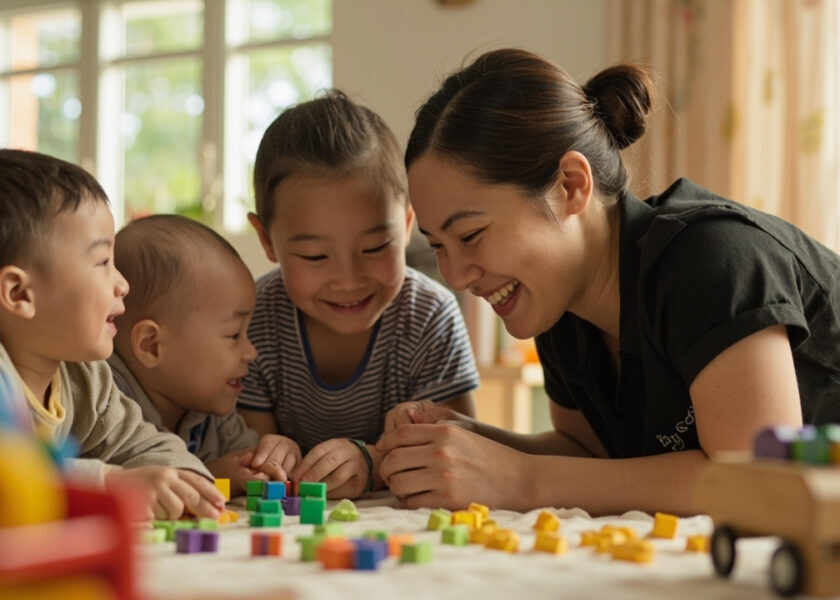
Consider the simplest scenario. A group of toddlers is playing with a set of wooden toys. One child reaches for the toy another child is holding. In a high-quality care setting, the caregiver does not immediately intervene with a solution. She watches. She might offer a word: “Kai wants a turn too. What can we do?”
This is not passive supervision. This is scaffolded social problem-solving—precisely the kind of moment that builds cognitive flexibility and impulse control.
The child who must wait, who must consider another person’s perspective, who must navigate the small frustration of not-getting-what-he-wants-right-now, is doing cognitive work. Difficult, essential cognitive work.
Supervision says: your child is safe.
Purposeful engagement says: your child is safe, and here is someone who understands what your child needs in order to grow.
Why the Ratio Matters
Cognitive load theory, extensively studied in educational psychology, explains why the caregiver-to-child ratio matters so profoundly. When children are in environments that are chaotic, under-stimulating, or emotionally unsafe, their cognitive resources are consumed by the effort of managing those conditions. There is little left over for learning.
When children are in environments that are warm, predictable, appropriately challenging, and rich with responsive interaction, their cognitive resources are freed for the work that actually builds their brains.
In settings where caregivers can truly attune to the children in their care—where there is time to notice when a child is becoming frustrated and to offer a quiet word of support before that frustration escalates—the environment functions very differently than in settings where children must compete for attention.
When ratios are appropriately low, children learn something profound: I am seen. My needs matter. The world is responsive to me.
What Children Learn From Being With Peers
Quality group care provides something genuinely difficult to replicate in a one-on-one parent-child relationship, however warm and loving: the experience of navigating social complexity with peers.
Social competence is one of the most significant gifts that early group experiences can give a child. This includes:
- The ability to navigate being part of a group
- Understanding that other people have needs and perspectives different from your own
- Learning to negotiate, cooperate, and manage the inevitable small conflicts that arise when multiple young children are together
- Knowing how to invite another child to play
- Learning to express a preference without demanding
- Understanding, in small but significant ways, how to be part of something larger than yourself
These capacities do not develop spontaneously. They develop when there are consistent, trained adults who model them and who create the conditions in which children can practice them.
What This Looks Like Long-Term
When children enter Primary One, their teachers often notice differences within the first weeks of school. This is not opinion; it is documented in educational research and confirmed by practitioners.
Teachers can identify which children have spent their early years in environments that challenged them to regulate, to persist, to navigate social complexity, to manage uncertainty. These children do not necessarily know more facts. But they arrive with a different quality of attention, a different capacity to engage with challenge, a different baseline of social competence.
They have, without knowing it, been training for the work of school.
Intrinsic Motivation: Nurturing the Drive to Learn
One of the most robust findings in developmental psychology is that children who grow up in environments where learning is treated as a process of curiosity and discovery—rather than as a performance to be evaluated—develop stronger intrinsic motivation.
They are more likely to take intellectual risks, to persist through difficulty, to approach the world with openness rather than anxiety.
In quality care settings, this is cultivated through the structure of daily experiences. Play is not filler. Play is not a break from learning. In the early years, play is the work of childhood, and in high-quality care, it is designed with intention.
The materials available, the way spaces are arranged, the balance between guided activities and free exploration, the caregiver’s language and responsiveness—all of these variables shape whether children experience learning as something that is joyful and worth pursuing, or as something that is obligatory and externally imposed.
When your child encounters a carefully designed learning experience that stirs his curiosity and invites his engagement, he is building more than knowledge. He is building a relationship with learning itself—a relationship that will shape how he approaches challenge, curiosity, and discovery for the rest of his life.
The Role and Dignity of the Childminder
I want to take a moment to speak to something that is rarely addressed directly: the role and dignity of the childminder herself.
In Singapore, as in many places, the term “childminder” can sometimes carry a diminutive connotation, as though the work of caring for young children is somehow less skilled than other forms of work. I want to name what this actually involves.
A skilled childminder is not simply someone who keeps children safe. She is a developmental specialist in her own right. She reads cues that most adults would miss. She knows when to step in and when to let a child struggle productively. She manages her own emotional regulation in the presence of crying, tantrum, and need—and models that regulation in real time.
She is, in the most literal sense, scaffolding the development of the children in her care, and she is doing it with a knowledge base that comes from training, from experience, and from a kind of professional wisdom that is genuinely difficult to acquire.
When you choose a care arrangement, you are not just choosing a place. You are choosing a set of human beings who will spend more waking hours with your child than almost anyone else. The quality of those human beings—their training, their attunement, their consistency—matters enormously.
This is why at EduNanny, we build our approach on the recognition that the people who do this work must be supported, trained, and treated as the professionals they are.
EduNanny: A Partner in Singapore’s Early Childhood Ecosystem
EduNanny operates within the ECDA Childminding Pilot, and it is worth explaining what this means in practical terms, because it matters for your peace of mind.
The Childminding Pilot is Singapore’s recognition that home-based and community-based care pathways are not an afterthought or a compromise—they are a legitimate, supported, and increasingly formalized part of the early childhood ecosystem.
When you engage with EduNanny, you are engaging with a structure that is aligned with national standards, actively working within a framework designed to elevate the quality and accessibility of childminding across Singapore.
What This Means for Your Family
For parents, this has concrete implications:
- Fee structures within the pilot are designed to make quality care more affordable
- Your Child Development Account and Baby Bonus can be used, meaning the subsidies and incentives that the government has put in place to support early childhood are available to you
- Singapore has made significant investments in early childhood support, and understanding how to access those investments is part of making informed choices
EduNanny offers both home-based and centre-based pathways, which means you can choose the arrangement that best fits your family’s needs. Whether your child thrives in a home environment with a smaller group of children, or whether a community setting is what you are looking for, there is a structure designed to support that choice.
The infant-to-caregiver ratio is maintained at up to one to three, which is—as noted earlier—a developmental variable, not an administrative detail. This is the kind of ratio that allows for the attunement and responsiveness that actually builds executive function and emotional regulation.
Transparency as Partnership
Because transparency matters enormously to parents—because trust in this space is not given but earned—EduNanny incorporates communication and transparency measures, including CCTV where deployed.
This is not about surveillance. It is about partnership. It is about the recognition that when parents feel confident in what is happening in their child’s day, they are better able to transition into their own work and life.
Parent peace of mind, as counterintuitive as it might sound, is itself a developmental variable. When parents are less anxious, their own presence with their children in the hours they are together is more attuned, more responsive, more beneficial. The care arrangement does not exist in isolation from the family. It exists within it.
The Hours You Are Away Matter: Addressing Guilt and Moving Toward Confidence
Let me speak directly to something that may feel like the heart of the matter. I have watched many parents in Singapore carry enormous guilt about placing their child in care. I have seen mothers and fathers who are brilliant, devoted, deeply loving parents, and who nonetheless carry a persistent undercurrent of worry that they are somehow failing their children by not being present every hour of every day.
If you are one of those parents, I want to say something to you directly.
The love you feel for your child is not diminished by the hours you are apart. The care you take in choosing a quality environment is not a sign of inadequacy—it is a sign of investment.
The developmental science supports what I suspect you already know in your bones: children who are securely attached to their parents, who experience warmth and attunement in the hours they share, and who also have rich, supportive, intentionally designed experiences in quality care settings, are not disadvantaged by that combination. They are, in many measurable ways, advantaged by it.
What Quality Care Is Not
This is not about pressure. I want to be clear about that. This is not about accelerating academic learning or pushing children into competencies they are not ready for.
The research on early childhood development is unanimous on this point: the best learning in the first five years happens through play, through exploration, through the slow and sometimes frustrating business of being a small person in a world of big people.
What quality care provides is not a curriculum in the traditional sense. It is a carefully designed environment in which the natural work of childhood—play, exploration, social negotiation, emotional learning—can unfold in ways that are maximally supportive of development.
The Decision Is Not a Surrender
The decision to place your child in quality care is not a surrender. It is not an admission that you cannot handle it alone, or that you are prioritizing your career over your child, or that you are somehow less committed to parenting than someone who has made a different choice.
It is a recognition that human development has always been a collective endeavor, and that your child has things to learn and gains to make from experiences that you, alone, cannot provide.
Every time your child learns to manage a small frustration in a setting where a trained adult supports that process, she is building something. Every time your child navigates a social challenge with peers, supported by a caregiver who does not rush to solve it for him, he is building something. Every time your child encounters a carefully designed learning experience that stirs his curiosity and invites his engagement, he is building something.
And when you come back at the end of the day, and your child runs to you, and you sit together, and you are fully present because you know your child has been well-cared-for—that quality of presence, that ability to be truly together in the hours you have, is also a gift. It is a gift to your relationship. And it matters.
Practical Guidance: Choosing Infant Care in Singapore
If you are researching infant care and childminding options in Singapore, here are the questions that matter most:
Questions to Ask Any Provider
- What is the caregiver-to-child ratio? Lower ratios mean more attunement, more responsiveness, more developmental support.
- What training do caregivers have? Look for providers who invest in ongoing professional development for their staff.
- How is the environment designed? Quality care is intentional. The space, the materials, the daily structure—all of these should reflect an understanding of child development.
- What does a typical day look like? There should be a balance of guided activities and free play, structured learning experiences and open exploration.
- How do you communicate with parents? Transparency matters. You should feel informed, not anxious.
- What subsidies and payment options are available? Understand what government support you can access, including your Child Development Account and Baby Bonus.
Signs of Quality
- Caregivers who observe more than they intervene
- Children who are engaged, not just occupied
- A daily rhythm that feels calm and predictable
- Caregivers who can describe what each child is working on developmentally
- Transparent communication about your child’s day
- An environment that feels warm, not institutional
Ready to Begin the Conversation?
Let me return to that silence I described at the beginning. The silence in the moment after you hand your child to someone else and walk away.
I want to suggest that when you understand what is actually happening in those hours, that silence can become something different.
It can become the quiet confidence of knowing that your child is in a place that is designed for her growth. It can become the peace of knowing that she is building skills that will serve her for the rest of her life. It can become the recognition that you are not compromising on her development—you are investing in it, actively and intentionally.
EduNanny was built on this belief. It was built on the conviction that childminding in Singapore should not be a lesser option, but a respected and excellent one. That the people who do this work deserve support and training and recognition. That parents deserve transparency, reliability, and the confidence that comes from knowing their child is in hands that understand what children need. That the early years are not a period to be endured but a window to be maximized.
If you are making this choice—and I know it is not a simple one—I want you to know that it is worthy of respect.
You are not simply outsourcing care. You are choosing a developmental partner. And in doing so, you are giving your child something that is genuinely precious: the experience of growing in an environment that sees her, challenges her, and supports her in exactly the ways that the science of early childhood tells us she needs.
The hours you are away matter. Not because they subtract from your relationship with your child, but because they add to it. They add to her. And when you come back together at the end of the day, you are both better for it—more present, more connected, more ready to be exactly who you are to each other.
That is what quality care makes possible.
If you would like to explore how EduNanny can support your family—through home-based or centre-based pathways within the ECDA Childminding Pilot—we invite you to reach out and begin a conversation. No pressure, no obligation. Just an honest discussion about what your family needs and whether we are the right partner for that journey.
You can also visit our website or learn more about our approach to understand the specific options available to you, including how to access government subsidies through your Child Development Account.
Because you deserve to walk away from that handover moment with confidence. And your child deserves an environment that is actively building everything she is capable of becoming.
Let’s start the conversation.