Beyond ABCs and Numbers: What Your Child Needs for Primary 1
What School Readiness Actually Means
Watch a classroom of new Primary 1 students on their first week. You will see everything you need to understand about school readiness.
Some children sit attentively, looking around with curiosity rather than fear. They can sit still when the teacher asks them to. They can wait their turn. They can say, in words, that they are feeling nervous and ask for help.
These children are ready — not because they arrived knowing how to read or do basic arithmetic, but because they have learned something far harder and far more important: how to be human in a room full of other humans.
The children who flourish in Primary 1 are not the ones who started academic preparation earliest. They are the ones who arrived with emotional resilience, social confidence, independence, and a genuine sense that learning is something worth doing.
These are the foundations of school readiness. Unlike alphabets and numbers, they cannot be rushed or flashcarded into existence. They are built, slowly and quietly, in the years before formal schooling — in the quality of care, the consistency of relationships, and the everyday rhythms of early childhood.
The Four Foundations Worth Knowing
- Emotional regulation is the first academic skill — it determines whether a child can persist, focus, and recover from setbacks
- Social confidence comes from daily peer interaction guided by warm, consistent caregivers
- Independence is built through real daily responsibility, not through protection from struggle
- A love of learning is preserved when children are given time, space, and freedom to explore
The Invisible Foundations: What Schools Actually Look For
Emotional Regulation
A child who cannot manage frustration will not persist through a difficult problem. A child who cannot name their anxiety will express it through disruption or withdrawal. A child who has never been in a room where they had to share a teacher’s attention with ten other children will struggle with the most basic demand of formal schooling: that you are one of many, and the world does not always revolve around you, and that is okay.
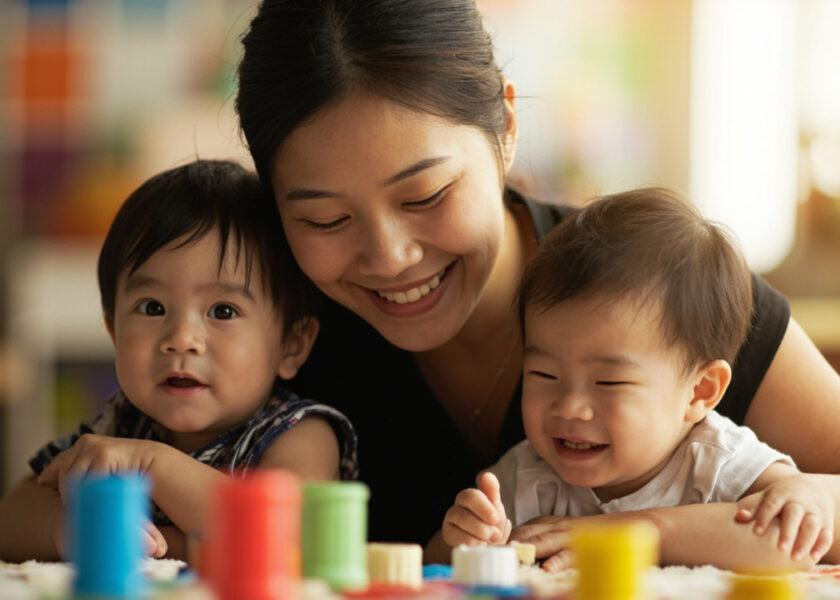
Quality childcare builds this foundation through the natural architecture of daily life. When a child spends their days in an environment where they are seen, where their big feelings are named and respected, where they learn through gentle repetition that routines are predictable and adults keep their promises — that child is building the emotional architecture that allows them to walk into a classroom and belong there.
Social Confidence
Emotional regulation and social confidence are deeply connected. When a child has learned to manage their own emotions, they become capable of noticing other people. They can read a peer’s facial expression. They can wait for a turn in a game without melting down. They can apologise when they have done something wrong. They can include someone who has been left out.
In quality childcare settings, children encounter peers in structured and unstructured ways every single day. They learn the hard lessons of sharing and cooperation that no amount of adult facilitation can fully replicate. They experience the full range of early friendship — the joy of a new playmate and the pain of a rejected invitation — with caregivers nearby who help them make sense of it. This is where social resilience is built.
Independence
The children who walk into Primary 1 ready to thrive are the children who have already been given real responsibility in their early years. They can manage their own belongings. They can go to the toilet without assistance. They can open their own food containers. They can ask for what they need. They can entertain themselves for stretches of time without needing an adult to direct their every moment.
These seem like small things. They are not. They are the difference between a child who feels competent and a child who feels helpless in an unfamiliar environment. And they are built through exactly the kind of daily independence-giving that quality childcare provides — where children are trusted to try things for themselves, where adults step back at the right moments, where failure is treated as information rather than catastrophe.
A Love of Learning
Children are born curious. Anyone who has spent time with a toddler knows that they are natural scientists, constantly hypothesizing, testing, and revising their understanding of the world. The question is whether the environments we place them in preserve that curiosity or gradually extinguish it.
Rushed academic preparation — the kind that fills a preschooler’s years with rote learning and structured drills — often achieves the opposite of what it intends. It teaches children that learning is something that happens at a desk, that has right and wrong answers, that requires compliance rather than exploration.
Quality childcare takes a different approach. When an environment is rich with materials that invite investigation, when caregivers ask open-ended questions and genuinely wait for answers, when children are given time and space to persist through difficulty without being rescued or redirected — that is where a lifelong love of learning takes root.
What Quality Childminding Actually Looks Like
For parents navigating the transition from infant care to more structured early childhood environments, the question becomes: what does quality actually look like on a daily basis? How do you know when the environment is doing the foundational work that school readiness requires?
It looks like small things that are not small at all. It looks like a caregiver who kneels down to a child’s eye level when they are distressed, who names the feeling out loud — “I can see you’re really frustrated” — and waits. It looks like a room where the same sequence of events happens every day, so that children can internalize the rhythm and feel secure within it. It looks like children being given real choices — which activity to begin with, whether to play inside or out, how to solve a dispute with their words.
Quality childminding means caregivers who understand child development, not just safety protocols. It means ratios small enough for genuine individual attention. It means communication systems that keep you informed about what your child is experiencing, not just what they ate for snack. It means consistency — the same familiar faces day after day, so that your child builds the attachment security that becomes the launching pad for every other kind of exploration and learning.
These are not luxuries. They are the conditions under which emotional regulation, social confidence, independence, and curiosity are built.
The Questions Worth Asking
If you are researching infant care or childminding for a child approaching Primary 1 age, here are the questions that matter most:
- How does the environment handle big emotions? Is distress met with patience and naming, or with redirection and suppression?
- What does a typical day look like? Is there rhythm and predictability, or is the schedule frantic and over-scheduled?
- What is the caregiver-to-child ratio? Can each child receive genuine individual attention?
- Are the caregivers trained in child development, not just safety and curriculum delivery?
- How does the environment support independence? Are children given real responsibility for their own belongings, meals, and choices?
- How are peer conflicts handled? Is there adult guidance that helps children develop social problem-solving skills?
- What does communication with parents look like? Are you kept informed about your child’s experience, not just their activities?
- How does the centre or caregiver support a love of learning? Is exploration encouraged? Are open-ended questions asked? Is there time for child-directed play?
These questions will not be answered by a centre’s marketing materials or curriculum brochure. They are answered by observation, by conversation, by the feeling you have when you walk into a space and watch how the children and caregivers move together. Trust that feeling. It is an important data point.
Common Concerns Worth Addressing
“Will my child be behind if we don’t do academic prep?”
Schools are prepared to teach your child to read and count. What they cannot teach — what must be built in the years before your child ever enters a classroom — is the ability to manage frustration, cooperate with peers, function independently, and engage with learning as something worth doing. These foundations are what make academic learning possible.
“Is home-based childminding as good as a centre?”
Quality matters more than setting. What matters is the consistency of the caregiver, the warmth in the environment, the ratio of adults to children, and the developmental intentionality behind daily routines.
“How do I know if my child is on track?”
Developmental milestones that predict school adjustment are less about what a child knows and more about how they navigate their world. Can they recover from disappointment? Can they initiate play with peers? Can they focus on a task for a reasonable stretch of time? Can they express their needs in words? These are the indicators that matter, and they are best understood through conversation with caregivers who observe your child daily.
“Is this going to be worth the cost?”
The investment you make in quality childcare is an investment in the foundations that everything else — formal schooling, relationships, resilience, curiosity — will be built on. Support structures like the Child Development Account and Baby Bonus schemes make quality care more accessible than many parents realise.
EduNanny and the ECDA Childminding Pilot
For many Singapore families, home-based and community-based childminding pathways are emerging as an answer to the question of quality early care. These models bring developmental care into environments where children are most comfortable. Small ratios allow caregivers to know each child deeply. Predictable daily rhythms build security. Peer interaction, while smaller in scale, is often richer and more supervised than larger centre settings allow.
EduNanny Singapore has been part of the ECDA Childminding Pilot — an initiative to develop care pathways that prioritise exactly the foundations described above. Small ratios allow for genuine individual attention. Caregivers are trained not just in safety protocols but in child development — they understand why a child is having a meltdown, not just how to manage it. Communication systems keep parents informed and involved in their child’s daily experience.
EduNanny’s approach is designed to cultivate disposition rather than deliver content. It is not about acceleration. It is about depth — giving children the time, space, and support they need to build the foundations that make everything else possible.
For parents navigating questions that arise outside of office hours — because parenting does not pause between nine and five — EduNanny’s Thomas AI Chatbot offers a resource that is available when you need thoughtful guidance.
The Foundation You Are Building
In a few years, your child will walk through the gates of a Primary school. They will be small, and slightly overwhelmed, and wearing a uniform that feels unfamiliar. They will look back at you once, maybe twice, before the door closes.
And then they will turn around and walk into a world that will ask everything of them.
It will ask them to sit still when their body wants to move. It will ask them to share attention with thirty other children who also need the teacher to look at them. It will ask them to try something difficult and fail and try again. It will ask them to make friends with children who are different from them, to manage disappointment, to speak up for what they need, to care about something beyond themselves.
Your job — the job you are doing right now, by caring enough to think carefully about this — is not to give them a head start in reading or mathematics, as important as those things will be. Your job is to give them the foundations that make everything else possible.
Emotional regulation. Social confidence. Independence. A love of learning. A deep, bone-level sense that they are capable and worthy and that the world is a place where they can belong.
These foundations are not built in a single programme or a single year. They are built in a thousand small moments across the years before Primary 1. In how often someone really listens to them. In how much freedom they are given to try and fail. In how consistently the adults around them respond with warmth and patience and trust.
You are building that foundation. And finding the right support for that journey — a partner who understands what school readiness actually means, who prioritises developmental depth over impressive curricula, who sees your child as a whole person in the process of becoming — is not a luxury. It is one of the most practical steps you can take.
Choosing childcare is one of the most consequential decisions you will make as a parent. It is also, we would argue, one of the most hopeful. Because it means you believe that the environment matters. That who cares for your child shapes who your child becomes. That early years are not just a phase to survive but a foundation to build.
EduNanny is here to build it with you.
Ready to explore what school-ready childcare looks like for your family? Connect with EduNanny Singapore to learn more about their childminding approach, available care arrangements, and how they support families through the ECDA Childminding Pilot.