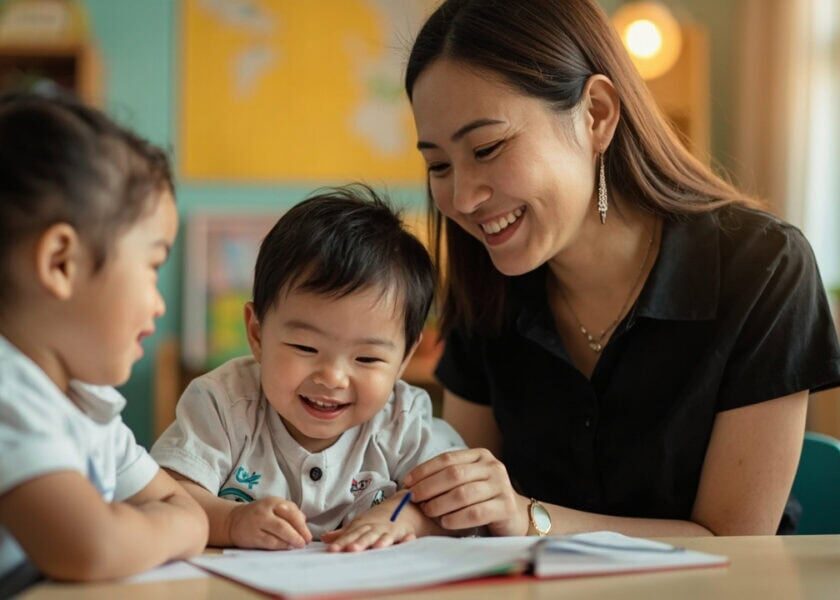
The Real Work of Childcare Begins After You Sign the Enrollment Form
The Moment Every Singapore Parent Knows
There is a moment familiar to every parent who has stood at a childcare doorway. You catch yourself paused mid-step, watching your child settle into a room you have only just begun to trust. It is a moment filled with something more complex than simple doubt. You care so much. You have thought so carefully about this choice. And yet, even after the decision is made, even after the deposit is paid and the orientation is complete, there lingers a quiet question that most parenting conversations do not address:
What exactly is my role now?
This is the question that separates good childcare from great childcare. It is the question that Singapore’s most meaningful childcare relationships are quietly built upon. And it is the question this article is here to explore with you.
The Disconnection Singapore Parents Rarely Talk About
Singapore parents care enormously about their children’s development. You research carefully, compare centres, ask friends, read reviews, visit campuses, and weigh philosophies. You do the work. And in most cases, you choose beautifully.
But here is what the dominant narrative around childcare quietly assumes: that parenting and childcare exist in separate orbits. You make the decisions. You carry the emotional weight. The childcare provider receives your child, cares for them according to standards you have evaluated, and returns them each day. The quality of your choice determines the quality of the outcome.
This framing feels natural. But it contains a quiet error. It positions you as a consumer of a service rather than a participant in a relationship. It implies that once you have selected well, the rest is someone else’s responsibility.
And this error is why so many parents feel a persistent sense of disconnection from their child’s early education — even when they have chosen beautifully. They have done everything right, by the old definition, and still feel uncertain. Still wonder if they should be doing more. Still sense that something is missing from the equation.
What is missing is not effort. What is missing is the recognition that your role in your child’s childcare relationship does not end when you sign the enrollment form.
Quality Childcare Is a Partnership, Not a Handoff
The most fulfilled, most confident parents are not the ones who found the perfect childcare provider and then stepped back. They are the ones who understood, early on, that quality childcare is not a handoff. It is an ongoing collaboration — and it is one of the most important professional relationships you may ever build on behalf of your child.
The most powerful thing you bring to your child’s development is not the childcare provider you chose. It is who you are as a parent, and the way you choose to engage with the people who share in your child’s early days.
Your child’s educators have training, systems, and years of experience. But you have something no curriculum can replicate: the intimate, irreplaceable knowledge of your own child — their rhythms, their fears, the specific quality of their curiosity, the things that make them laugh and the things that make them pause. You know them in ways that no observation chart can capture.
When you bring that knowledge into genuine partnership with your child’s caregivers, something powerful happens. Development stops being a service delivered to your child and becomes a shared language — spoken fluently in both environments.
Partnership does not mean micromanagement. It does not mean hovering, second-guessing, or undermining the professional judgment of your child’s caregiver. It does not mean sending daily instructions or expecting your preferences to be treated as curriculum.
Partnership means something more mature than that:
- Trusting your caregiver’s expertise while also honouring your own
- Asking questions instead of giving orders
- Receiving feedback without defensiveness
- Offering feedback without presumption
- Showing up consistently, over time, with the same attentiveness you bring to any relationship that matters to you
Trust in this relationship flows in both directions. A caregiver who trusts a parent will share more, observe more carefully, reach out more often, and invest more deeply. And a parent who is trusted by their child’s caregiver feels seen, respected, and invited into the process rather than kept at arm’s length. Each honest exchange builds the capacity for the next.
What Genuine Partnership Looks Like in Practice
Sharing What You Observe at Home
Partnership begins when a parent notices something at home and brings it to a caregiver’s attention — not in a formal report, but in an honest conversation at drop-off or over a message.
When a father realises his daughter is going through a phase of intense interest in how things open and close, and mentions it casually — that caregiver may then begin to notice the same curiosity surfacing in the playground, finding small ways to extend it through play.
Or when a mother notices her son struggling with transitions between activities, and shares this with the educator — and together they develop a gentle, consistent approach that works at home and at childcare in the same language.
These are not grand gestures. They are small, daily acts of shared attention. And over time, they create a developmental continuity that is extraordinarily difficult to achieve in any other way.
Asking Different Questions
The question of communication is where most partnerships falter — not because parents do not care, but because they have never been shown what good communication with a caregiver actually looks like.
Structured communication matters. The daily updates, the incident reports, the formal channels all have their place. But genuine dialogue happens when you begin to ask different questions. Not just “Did she eat well and sleep well?” — though of course those things matter. But:
- What was she interested in today?
- What made her laugh?
- What seemed to challenge her?
- What did she notice that was new?
These questions invite educators to share what they actually observed. Over time, they build a shared narrative of your child’s development that neither home nor childcare could create alone. They also signal something important to your caregiver: that you are paying attention, that you value their professional perspective, and that you see them as a partner rather than a service provider fulfilling a contract.
Aligning Goals Across Both Environments
Most parents think about alignment in terms of values — they want a provider whose philosophy resonates with their own. This matters. But alignment in a true partnership goes deeper than shared philosophy. It extends to the specific goals you hold for your child, and whether those goals are understood and reinforced in both environments.
Consider the child who is learning to manage frustration. The caregiver has been patient, has offered language for big feelings, has created safe boundaries. But if the child returns home each evening to an environment where patience is not modelled, where frustration is met with impatience or dismissed, the lesson fragments. The child receives contradictory signals from two worlds that should be speaking to each other.
Now consider the parent who has talked with the caregiver about what they are working on together. Who has asked: “How can I reinforce at home what you are doing during the day?” Who has shared their own challenges and asked for suggestions. That parent creates something entirely different — continuity. The child experiences the same language, the same expectations, the same patient guidance in both places. And in that continuity, learning deepens. Skills take root. Development accelerates.
What This Means for Your Child
Children are exquisitely attuned to the relational world around them, far more than we often give them credit for. They sense when the adults in their life are connected, communicating, and aligned. They feel it in their bodies.
That felt sense of coherence becomes the foundation upon which they build their own capacity for relationship, for trust, and for collaboration in the world beyond their early caregivers.
A child who experiences their parents and caregivers as a unified, respectful, communicative team receives something that no single set of interventions could provide. They receive the message — spoken through behaviour rather than words — that adults can work together, that they are worth investing in, and that the world around them is safe enough and connected enough to be trusted.
This is not a soft outcome. It is a foundational achievement, built through partnership.
Your child’s development is not a product. It cannot be purchased, optimised, or outsourced. It is a process, and you are part of it whether you choose to engage actively or not. Every day that your child spends in quality childcare, they are absorbing not just activities and routines but relational patterns, communicative styles, and expectations about how adults respond to them.
As a parent, you are either consciously contributing to that shaping, or allowing it to happen without your input.
The EduNanny Approach to Partnership
At EduNanny Singapore, partnership is something we have built our model around. We know that parents in Singapore carry enormous weight. We know that many of you are navigating demanding careers, complex family dynamics, and the particular pressures of raising children in one of the world’s most competitive environments. We also know that behind every enrollment decision is a parent who wants to do right by their child, who cares enormously, and who deserves to be met with professionalism and warmth rather than bureaucratic distance.
When you enroll your child with EduNanny, you are not simply accessing a service. You are entering into a relationship designed to grow with you.
- Our caregivers communicate not just updates but insights — sharing what they actually observe, not just what happened on the surface
- Our feedback mechanisms are structured to invite dialogue rather than just report events
- Our care pathways, including our participation in the ECDA Childminding Pilot, are designed with the recognition that every family has different needs and different rhythms
- We provide direct communication channels and transparency measures including CCTV where deployed, because we believe parents deserve to know what is happening in their child’s day
Within the ECDA Childminding Pilot, small ratios of up to one to three infants mean your child receives the attentive, responsive care that the earliest months and years demand. Our Monday to Friday care blocks are structured around real family life. And we have worked to ensure that our fees remain accessible within the pilot framework, with support for CDA and Baby Bonus usability — because quality partnership-based childcare should not be available only to those with unlimited resources.
These are not peripheral details. They are expressions of our belief that partnership must be accessible in order to be meaningful.
Your Role Is Just Beginning
Let us return to that moment at the childcare doorway. The one where you pause, watch your child settle, and feel the quiet question rise: what exactly is my role now?
Here is the answer. Your role is not finished. It is not even close to finished. It is, in fact, just beginning to unfold in its most meaningful form.
You have found a childcare provider. That was the first step. The second — and the one that most parents never fully take — is to step into genuine partnership with the people who share your child’s days.
To ask better questions. To share what you observe. To reinforce what happens at childcare at home. To communicate not just concerns but curiosities. To trust your caregiver enough to receive their observations with openness, and to earn their trust in return by showing up consistently, as someone who cares deeply and is willing to collaborate.
This is not a perfect relationship. No relationship is. There will be miscommunications, differences of perspective, moments when the rhythm feels off. But a partnership that is real is more resilient than one that is polite and surface-level. And over time, the real relationship is the one that serves your child best.
If you are currently comparing infant care and childminding options in Singapore, here are a few things worth considering beyond the checklist of ratios, curricula, and facilities:
- How does this provider communicate with parents? Is it structured, or does it invite genuine dialogue?
- Do the caregivers share observations about what your child is curious about, not just what they ate and how they slept?
- Is there a clear way for you to share what you notice at home and have it inform the care your child receives?
- Do you feel welcomed as a participant, or managed as a client?
- Does the provider earn your trust through transparency, and do they extend trust to you in return?
The answers to these questions will tell you far more about the quality of a childcare relationship than any tour or brochure ever could.
We built EduNanny not just to provide excellent infant care — though we care deeply about excellence. We built it to offer something that Singapore families deserve and rarely find: a childcare relationship that grows with you, that invites your participation, and that treats your role as a parent as not just valued, but essential.
We are not here to replace you. We are here to walk alongside you, and to help you understand that the most powerful developmental force in your child’s life is not a curriculum or a centre or a caregiver, however excellent. It is the sustained, intentional, respectful collaboration between the people who love them most and the people trained to help them grow.
You are not just a parent. You are a partner. And that partnership, cultivated with care and patience and honesty over the years of your child’s early development, will become one of the greatest gifts you ever give them.
It begins today. It begins with the next question you ask at drop-off. And it continues, one conversation at a time, for as long as you choose to show up.
Ready to explore what genuine partnership looks like in practice? Speak with our team about our infant care and childminding options, including our participation in the ECDA Childminding Pilot, and discover how we walk alongside Singapore families from the very first conversation.
At EduNanny Singapore, we believe the best childcare relationships are built on trust, communication, and shared purpose. Learn more about our approach or get in touch to begin the conversation.