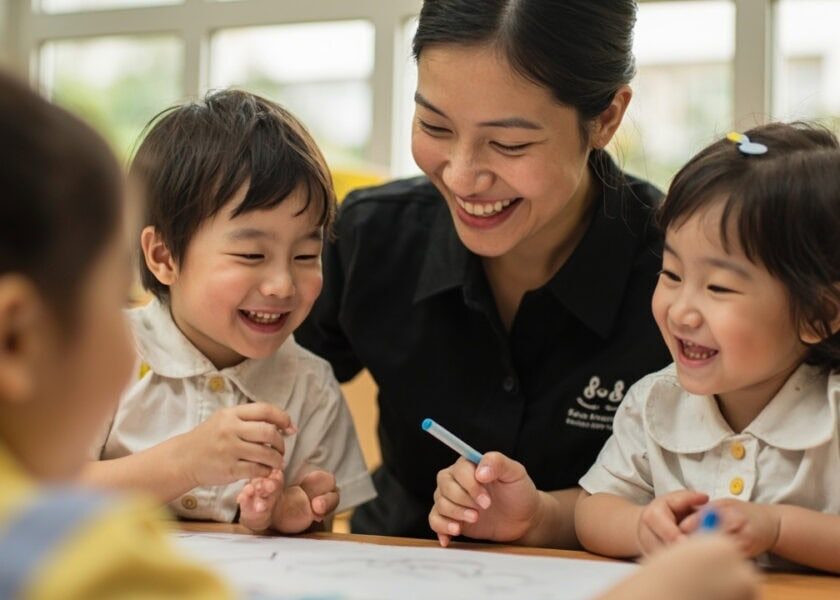
Singapore Parents, Your Exhaustion Is Not Failure
The Hidden Grief of Modern Singapore Parenting
You chose to return to work, or perhaps you never had a choice. The mortgage does not pause. The career does not wait. The reality of dual-income households in Singapore means that both parents are often working not from ambition alone but from necessity.
And somewhere between the MRT commute and the 6 p.m. handover, you carry a quiet terror: that your child is forming their deepest bonds with someone else. That the caregiver knows their rhythms better than you do. That when they cry, they reach for someone else. That you have somehow become optional in the very relationship that defines you.
This fear is so common that it has become almost invisible. Parents speak about it in whispers, in parenting groups, in the 11 p.m. messages to a partner who is equally depleted. It is the shame that sits beneath the exhaustion—the belief that wanting time away from parenting makes you selfish, that needing a break means you are failing.
But here is what most childcare conversations miss: that version of you—the one running on empty, who has nothing left to give after the workday, who shows up physically but is mentally elsewhere—does not serve your child well.
That parent is not a bad parent. That parent is an exhausted one. And there is a difference that matters enormously.
Presence Over Proximity
Here is the paradox at the heart of modern parenting: children do not need more time from us. They need us to be present.
You have felt it. An hour of genuine play, where you are fully there—laughing at what they laugh at, following their lead, your attention resting entirely on this small person who is watching you learn the world through their eyes. Now contrast that with an afternoon where you are physically present but mentally negotiating a work deadline, rehearsing an uncomfortable conversation, or simply surviving until bedtime.
Those afternoons feel longer. They are longer. But they give your child less.
Developmental researchers call this the difference between presence and proximity. Proximity is the physical fact of being near your child. Presence is the quality of attention you bring to that proximity. A parent who is present for four focused hours gives a child something that a parent who is physically there for twelve distracted hours cannot.
And here is the part that Singapore parents need to hear: you cannot manufacture presence from exhaustion.
What Parental Burnout Actually Costs
There is a concept in psychology called parental burnout. It is not clinical exhaustion or ordinary tiredness. It is a state of chronic stress where the demands of parenting begin to exceed your capacity to meet them.
Research from Belgian psychologist Isabelle Roskam and her colleagues describes a syndrome that includes emotional exhaustion, a sense of having lost your personal identity, and a troubling emotional distance from your children. Parents in this state describe feeling like they are performing parenthood rather than living it. They are there, but they are not there.
Here is what should stop you in your tracks: parental burnout does not just affect parents. It affects children. When parents are burned out, children exhibit higher rates of behavioral problems, emotional dysregulation, and anxiety. The very thing parents are working so hard to provide—a stable, present, loving environment—is undermined by the conditions that working parents find themselves in.
You are not imagining this. The tension you feel is not weakness. It is a biological signal that you are giving more than you have to give.
Singapore parents, particularly mothers in dual-income households, are some of the most dedicated parents they know. They carry the weight of breadwinning and caregiving simultaneously, with little of the village that previous generations relied on. Grandparents may live across the causeway or across the island. Community connections that once made raising children a shared endeavor have thinned in the pace of urban life.
They are not the problem. The system that leaves them without restoration is the problem. And within that reality, there is something you can do. And it is not what you think.
Quality Childcare Restores You to Yourself
When childcare works—when it is thoughtful, when it is safe, when it is designed around both child development and family flourishing—it does something extraordinary. It gives you back to yourself.
Think about what becomes possible when you are not running on empty. The patience to sit through the third story before bed without checking the time. The attention to notice when your child seems off, when something is bothering them, when they need you in a way they cannot yet articulate. The emotional availability to receive their big feelings without your own overwhelm drowning them out. The energy to play, really play, with the kind of presence that makes a child feel seen.
This is what children need from us. Not more hours. More of who we are when we are whole.
What Quality Childminding Looks Like
Not all childcare is created equal. And this matters, because the kind of restoration we are talking about only happens when childcare is genuinely good—not just adequate supervision, but care that holds your child the way you would.
- Infant-to-caregiver ratios that allow for genuine responsiveness. When one caregiver is responsible for three infants rather than six or ten, your child is not one of many competing for attention. They are known, held, responded to.
- Consistency and continuity. Children thrive when they can form secure attachments. A rotating cast of caregivers undermines the very bond you are trying to protect.
- Communication that keeps you connected. When you can check in throughout the day—when you receive genuine updates rather than generic reassurances—you can actually rest while you are away.
- Flexibility that serves real families. Care blocks that acknowledge the rhythm of working life, with arrangements that adapt when circumstances change.
- Transparency you can trust. Not because you are suspicious, but because trust is built through openness.
EduNanny: Built for This Reality
This is why EduNanny operates the way it does.
The ECDA Childminding Pilot programme creates pathways that are flexible enough to serve real families—home-based arrangements for those who prefer intimacy and continuity, centre-based options for those who value community and structured learning environments.
The infant-to-caregiver ratios, capped at one to three in the infant rooms, are not bureaucratic requirements. They are intentional design choices. They mean your child is not one of ten competing for attention. They are one of three.
The Monday to Friday care blocks acknowledge the rhythm of working life. The fee structures within the pilot are designed to be accessible, not to treat childcare as a luxury—because EduNanny understands that this is not about privilege. It is about infrastructure.
The ability to use CDA funds and Baby Bonus schemes means that the financial architecture of Singapore parenting is actually leveraged to support what matters.
But all of this—the ratios, the training, the pathways—would be meaningless without something else. Without the kind of trust that lets you leave your child and actually rest.
EduNanny’s approach to trust is not sentimental. It is operational. Communication systems that keep you informed. Transparency measures where deployed. The understanding that when you hand over your child, you are not handing over your role. You are temporarily sharing a watch so that you can return refreshed.
Answers to the Questions You Have Not Said Out Loud
Before you choose childcare, you deserve honest answers to the questions that keep you up at night.
Will my child form a stronger bond with the caregiver than with me?
Research on attachment consistently shows that children can form multiple healthy attachments. What matters is the quality of each relationship. A child who is securely attached to a caregiver is not thereby less attached to you. What undermines parental attachment is not the presence of other caring adults—it is the depletion that prevents you from being emotionally available. Quality childcare addresses the condition that threatens your bond; it does not replace the bond itself.
Does needing childcare mean I am failing as a parent?
No. Singapore parents are doing what humans have always done—relying on community to help raise children. The nuclear family as the sole unit of childcare is historically anomalous. The village is not gone; it is being rebuilt with intention, rigor, and the kind of care that actually works. Needing support is not a concession. It is a recognition of reality.
What if I cannot afford quality care?
EduNanny’s fee structures within the pilot are designed to be accessible. The use of CDA funds and Baby Bonus schemes is not incidental—it reflects an understanding that childcare is infrastructure, not luxury. If you are exploring options, ask about financial support. The question is not whether you can afford to invest in quality care; it is whether you can afford not to.
How do I know I can trust a caregiver with my child?
Trust is built through systems, not sentiments. Look for transparent communication practices. Ask how you can check in during the day. Observe whether the caregiver wants you to see what they do, not just hear about it. Trustworthy care invites scrutiny, not because it is perfect, but because it is honest.
Choosing Infant Care in Singapore: What to Look For
If you are beginning to research your options, here is what I want you to hold onto:
- Your gut matters. When you visit a centre or meet a childminder, notice how you feel. Not just whether the checklist is met, but whether you can imagine trusting this person with your child. Your instincts are worth listening to.
- Ask about ratios. In infant rooms, lower is better. One to three is a standard of quality that allows for genuine responsiveness.
- Ask how they communicate. What does a typical update look like? How can you reach your child’s caregiver during the day? Communication is not a bonus; it is the foundation of trust.
- Notice whether they want you to ask questions. Quality care is transparent. If a provider seems evasive or dismissive of your concerns, that is information.
- Remember what you are ultimately looking for. Not just supervision. Not just safety. You are looking for a partner in your child’s care—someone who holds your child with the same seriousness and tenderness that you do, and who gives you back to your child transformed.
When You Find Care You Can Trust, You Come Back to Yourself
The guilt that used to sit beneath every handover—the 7 a.m. drop-off, the distracted evening, the weekend when you were too tired to engage fully—begins to dissolve. Not because the circumstances have changed. Because you have.
You are no longer the parent who is there but absent. You are the parent who walks through the door and your child runs to you, and you are actually able to be present for that moment.
You are no longer the parent who snaps and regrets it. You are the parent who has the reserves to stay regulated.
You are no longer the parent who wonders if you are enough. You know—and you can feel—that you are showing up in a way that matters.
And your child feels it too. Children are exquisitely attuned to the quality of our presence. They do not remember the hours we spent in the same room. They remember how we made them feel. Whether we were really there. Whether we saw them.
Begin Here
EduNanny is built on the belief that childcare is not a concession to working parents. It is not a compromise. It is a gift you give yourself so that you can give your child the best of who you are.
When we think about childminding in Singapore, we are really thinking about a question that has echoed through every generation: how do we raise children well when the village is gone?
The answer is not to pretend that the village can be recreated exactly as it was. The answer is to build something new—something that honors what parents actually need: reliable care they can trust, communication that keeps them connected, flexibility that serves real life, and the quiet, profound gift of being able to return to their child as a restored version of themselves.
EduNanny is not replacing parents. It is empowering them. It is saying: you are not less important because you work. You are not less bonded because you need support. You are not failing because you cannot do this alone.
You are doing what humans have always done—relying on community to raise the child. You are just doing it with intention, with rigor, with the kind of care that actually works.
The first thousand days of your child’s life are precious. But so are the next three thousand. So are all the days that follow, through every transition, every challenge, every beautiful ordinary moment that makes up a childhood.
EduNanny is here for all of it—for the infant who needs gentle hands and consistent rhythms, for the toddler discovering the world with boundless energy, for the parent who needs to know their child is safe, is loved, is becoming who they are meant to be.
And for you. Because you matter in this equation. Your wellbeing is not a luxury or an afterthought. It is the condition that makes everything else possible.
So if you have been carrying the weight alone, wondering if you are enough, if you should be doing more, if the guilt you feel means something about who you are as a parent—I want you to hear this clearly:
You are enough. And you deserve to feel it.
Quality childcare does not diminish your role. It restores you to it. EduNanny is not taking your place in your child’s heart. It is giving you back to your child as the parent your child needs you to be.
There is care that restores. There is support that empowers. There is a community that sees you, that holds your family with the same seriousness and tenderness that you do.
You are raising the next generation of Singapore. You are doing it in a world that asks more of you than any generation before.
You do not have to do it depleted. You do not have to do it alone.
Your child is waiting for the version of you that is ready to arrive. Take the step. You have earned it.
If you are ready to explore what thoughtful, development-oriented childminding looks like for your family, begin a conversation with EduNanny today. Or learn more about how EduNanny is built to support working parents across Singapore.