The Real Signs of Quality Childcare Every Singapore Parent Should Notice
Why Choosing Childcare Feels So Hard
Before we go further, it is worth acknowledging why this decision carries so much weight — and why the stakes are higher than most parenting choices you will make.
The early years of a child’s life are not a waiting room before real learning begins. The first thousand days, from gestation through roughly age three, represent a period of extraordinary brain development. Neural connections form at a speed that will never be matched again.
Language acquisition, emotional regulation, social trust, motor coordination — these are not skills that will be taught later. They are being built right now, in every interaction, in every response, in the way an adult catches a toddler’s eye during a moment of frustration and helps them find words for what they feel.
What this means, practically, is that the quality of care in these early years is not a logistical arrangement. It is a developmental one. The childcare decision is not simply about who watches your child while you work. It is about who helps shape the architecture of your child’s mind during its most receptive season.
Singapore parents understand this instinctively. They care deeply. They worry. And they deserve better than a decision-making process that relies on surface impressions and trust in marketing.
The challenge is that parents are busy. They are navigating work, pregnancy recovery, extended family expectations, the cost of living, and the sheer physical weight of raising a small child. They do not have months to research developmental psychology or visit twelve childcare centres. They need to walk into a tour, look around, and leave with something useful.
But the truth is that the most important things about a childcare environment are often the least visible during a scheduled visit. That is exactly why a different approach to evaluation can change everything.
What to Look For: Evaluating Beyond the Surface
Watch the caregiver, not just the room
When you walk into a childcare space, who do you watch?
Most parents look at the toys, the layout, the cleanliness, the wall displays. These are not useless signals, but they are surface signals. The more revealing question is: what do you not see on a tour that matters most?
The answer, almost always, is interaction.
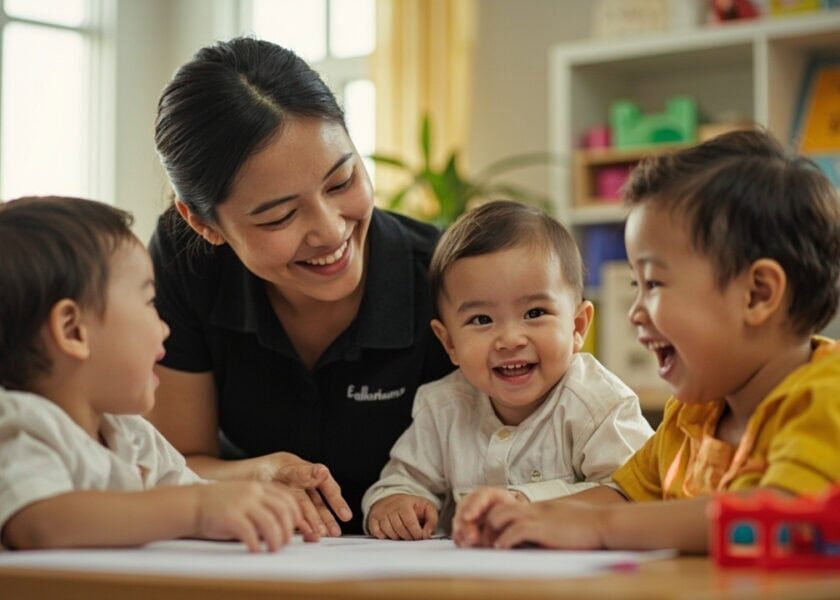
Walk into a room and look past the furniture. Watch the caregiver and the child who is not your child. Not for five seconds, but for a minute or two. Watch how the adult speaks to the infant. Consider these specific patterns:
- Physical positioning. Is the adult at the child’s eye level — literally, physically down at their level — or does she speak down to them from above?
- Tone and pace. Is the tone of voice matched to the child’s pace, or is it hurried, generic, performative?
- Attention. When a child drops a toy and looks up, does the adult notice? When a toddler is exploring something quietly, does the caregiver let that exploration continue?
- Responsiveness to emotion. Does the caregiver recognize the slight frustration building in a nine-month-old who cannot quite stack the blocks? Does she respond with patience rather than correction?
These moments seem small. They are not. They are the texture of every single day of your child’s life.
What children reveal about the environment
Consider another dimension that is even easier to overlook: how the children themselves behave within the environment.
Children are extraordinarily honest creatures. They do not perform for visitors the way adults do.
A child who feels safe will move through a room with easy curiosity. She will not be clinging to a caregiver’s leg in distress, but she also will not be wandering aimlessly, disconnected from everything. She will be engaged — exploring, testing, returning to familiar people and objects with a sense of security.
A child who is merely supervised will look different. There is a particular flatness to children who are in environments where they are kept occupied but not connected. They may appear quiet, even compliant, but the quietness is not the quietness of security. It is the quietness of disengagement.
In a high-quality infant care environment, you will hear a kind of conversational back-and-forth, even between an adult and a twelve-month-old who has only a handful of words. The caregiver narrates, names, responds. She does not just manage behaviour. She talks with the children, as if they are already full participants in a community.
Caregiver stability matters
There is a question that centres rarely volunteer an answer to: how long have the caregivers been here?
Staff stability is one of the most underappreciated factors in infant care quality. Young children form deep attachments. They need consistency not as a luxury but as a psychological necessity.
A secure attachment to a consistent caregiver in the first years of life is one of the strongest predictors of emotional resilience later on. When a child is passed between a rotating cast of unfamiliar faces, the developmental cost is real, even if it is not immediately visible.
Ask about caregiver tenure. Not just the centre director’s tenure — ask about the infant room caregivers specifically. How long have they been working with this age group? What is the turnover rate?
And notice something else while you are in the room. Watch the caregiver’s face when a child approaches her. Does she know that child’s name immediately? Does she respond with the small, automatic warmth of familiarity?
That moment of recognition is a window into the depth of relationship in that room. It cannot be faked on a tour, but it also cannot be hidden for long.
Asking the Questions That Matter
A centre that looks beautiful during a tour is not difficult to arrange. The real indicators of quality reveal themselves differently — in how a centre handles difficulty, and in the kind of communication it maintains with families.
How centres handle difficulty
Every childcare environment has difficult moments. A child refuses to eat. Two toddlers fight over a toy. A baby is inconsolable after a parent leaves. A group transition becomes chaotic.
These are not failures. They are the real curriculum of childcare, and the way a centre manages them reveals everything about its actual philosophy.
During a tour, you will almost never see difficulty. Centres are careful about this. But you can ask:
- What does a typical morning look like when a child is having a hard time separating from a parent?
- How do you handle it when two children conflict over a toy?
- What is your approach to managing the transition to nap time?
Listen carefully to the answers. You are not looking for a perfect script. You are looking for a coherent, considered approach — one that reflects genuine understanding of child development rather than a one-size-fits-all compliance mindset.
A centre that says, “We comfort the child and give them time to adjust,” is doing something different from a centre that says, “We have a policy that children must settle within ten minutes.” One approach respects the child’s emotional reality. The other manages the centre’s schedule. The difference matters enormously.
Communication as partnership
One dimension that most directly affects you as a parent is communication — and it is often evaluated least effectively.
Ask yourself how the centre communicates with families. Not whether they send photographs — most do — but what kind of information flows between the centre and your home. Consider what daily updates actually include:
- Feeding patterns and responses
- Sleep quality and duration
- Mood and engagement levels
- Activities and notable moments
More importantly, is the communication reciprocal? Can you share information about your child’s night, a new word they said at home, a developmental milestone they reached — and does that information actually influence what happens at the centre?
The feedback loop between parent and caregiver is one of the clearest signs of a centre that practices what it preaches. In truly excellent infant care, the parent is not a customer dropping off a child and collecting a report card. The parent is a partner.
EduNanny: A Thoughtful Approach to Infant Care
All of this raises a practical question. Even with a better evaluation framework, Singapore parents still face real constraints. Affordability. Location. Availability of infant care places, which remain genuinely scarce in parts of the island. The centre that scores perfectly on every dimension may simply not have a space for your child next year.
The ideal and the available are not always the same, and parents should not feel that they have failed if they cannot access the very best option. What every parent can do is become a more informed chooser within the options that are actually available to them.
You do not need perfection. You need clarity. You need to know what questions to ask, what patterns to watch for, what signals actually indicate quality versus what simply looks impressive on a tour.
That is why we built EduNanny the way we did.
EduNanny by BUTLER is part of something that began as a pilot programme — the ECDA Childminding Pilot — representing a genuine effort to expand what childcare can look like in Singapore. We have been part of that conversation from the beginning, and we share that as a point of pride.
EduNanny offers a pathway that sits alongside the traditional centre-based model. We provide home-based childminding, and we also offer community and centre-based options depending on what works best for your family. This flexibility is not incidental. For infants especially, the home-based environment can offer something that a larger centre sometimes cannot: a smaller, more intimate setting where the ratio of caregiver to child allows for genuinely individualized attention.
In our infant care programme, we maintain a ratio of up to one to three — one caregiver for up to three infants. That number is not arbitrary. It is the number that makes real interaction possible. It is the number that allows a caregiver to know your child’s rhythms, your child’s preferences, your child’s small joys and bigger frustrations, because she has the space to notice.
In a room with fifteen infants and three caregivers, noticing is heroic. In a room with three infants and one attentive adult, noticing is the baseline.
We offer Monday to Friday care blocks, and we have designed our fee structures to be accessible within the pilot framework. For families, this means that CDA and Baby Bonus funds can be utilized, which eases the financial planning that every Singapore parent must navigate. We want the practical dimension of childcare — the cost, the logistics, the funding options — to be clear and manageable, not a source of additional stress.
And we believe in transparency as a core operating principle. Where we have deployed communication measures including CCTV, we do so not as a surveillance mechanism but as a trust mechanism — because we know that parents need more than assurances. They need windows. They need to know that the care they have chosen is the care their child is receiving.
Your Child Deserves to Be Seen
Here is what we have learned, from working within this model, about what parents in Singapore actually need from the childcare decision.
They need a framework, not just a feeling. They need to walk into a tour and know what to look for. They need to leave with something concrete — a question they asked that revealed something important, a pattern they noticed that told them something true.
They need to know that the choice they make matters — not in a way that induces guilt, but in a way that affirms the seriousness of what they are doing. Raising a child is not a logistical exercise. It is a developmental act of profound importance, and the people and environments you choose to support you in that act carry real weight.
Some practical considerations for your search:
- Start with observation, not documentation. The most revealing visit may be one where you sit quietly in a room and watch for ten minutes before asking any questions.
- Ask the uncomfortable questions. Caregiver turnover, daily structure, how they handle tears and transitions — these questions separate centres that think carefully from those that manage impressions.
- Trust your instincts. If something feels off, it probably is. If something feels warm and genuine, investigate further.
- Remember that good enough is okay. You do not need to find the perfect centre. You need to find a good fit within your real constraints.
The best centre you can find is not the one with the most impressive facilities or the most polished portfolio. It is the one where, when you watch the caregiver with the children, you see something that cannot be designed or manufactured: genuine care, held in place by structure, supported by training, and expressed in thousands of small moments that add up to a child’s sense of the world as a safe and interesting place.
That is what you are really choosing. Not a service. A relationship for your child.
And you are capable of evaluating it, if you know what to look for.
We trust you to look. And we are here if you need a hand.
If you are ready to explore what a smaller, more intentional approach to infant care looks like in Singapore, we welcome the conversation. Whether you are months away from your return to work or facing a more immediate need, we are happy to talk through your situation without any obligation.
EduNanny by BUTLER — part of the ECDA Childminding Pilot. Home-based, community-based, and centre-based options for infants and young children across Singapore. Learn more about our approach.