Reading the Signs of Quality Childcare in Singapore
The Weight of This Question in Singapore
In Singapore, this question carries particular weight. We live in a city where childcare is not a lifestyle preference but often an economic and professional necessity. We carry the weight of that necessity differently than parents in other contexts, and we are right to take it seriously.
But the quality of early childcare is not primarily a question about parents. It is a question about the child — and specifically, about the daily world that the child inhabits when we are not watching.
The beautiful thing is this: once we begin to look through that lens, once we allow ourselves to become students of our child’s experience rather than evaluators of a service, we find that the answer is not hidden. It is visible. It lives in the child’s body, in the child’s language, in the small observable moments that accumulate into a life.
The Threshold Moment: When Safety Becomes Neurological
There is a threshold moment in quality childcare that most parents do not consciously register but that a child registers entirely. It is the transition from the parent’s hand to the caregiver’s presence — the few minutes between arrival and settling. In that window, a great deal is communicated. The child’s body language, the caregiver’s posture, the quality of the handoff: these are the opening sentences of the day’s story.
Watch, if you have ever had the chance to observe from a distance, what happens when a child who has been in the right place encounters the right caregiver in the morning. There is a loosening. A release of the grip on the parent’s leg. Perhaps not immediately — sometimes the child needs a moment to feel that it is all right to let go — but eventually, there is a shift. The child looks toward the caregiver. There is recognition. And then, remarkably, there is curiosity. The child turns toward the room, toward the toys, toward the other children.
Something has been communicated, wordlessly, between the caregiver and this small person: you are safe here. This is a good place. You can go.
That moment of safety is not sentimental. It is neurological. A young child’s developing brain cannot engage with the world of exploration and growth when it is operating in a state of alert. The stress hormones that flood the system in unfamiliar or anxious situations close down the very circuits needed for curiosity, learning, and social connection. What we call feeling safe is, for a young child, literally a physiological state of openness to the world.
In the best childcare environments, this safety is communicated in a thousand small ways: the caregiver who kneels to the child’s level before speaking, the voice that is warm without being performative, the space that feels scaled to the child rather than borrowed from the adult world. When you see a child settle within minutes of arrival — not because they have been bribed or distracted but because they have genuinely encountered safety — you are watching the foundation of everything else being laid.
The Environment as Teacher
Now, observe what happens next. The child moves into the room. And this is where the second discovery awaits.
The environment of quality childcare is not merely a backdrop. For a young child, the environment is a collaborator in development. A child does not simply exist in a room; the room exists in the child. The colors, the textures, the arrangement of materials, the quality of light — these are not neutral. They enter the child’s sensory world and shape how the child understands their place in it.
Consider what it means to a child to spend their days in a space that has been thoughtfully prepared for them. The shelves at their eye level. The materials within their reach. The quiet corners for solitude and the open spaces for movement. The natural light. The presence of the outdoors, where it is available.
When a child grows up in a childcare environment that has been designed with this kind of attention, the space becomes, in a very real sense, a teacher. It says, through its arrangement: you belong here. This world was made, in part, for you.
Over time, you can see this in the child’s relationship to space. A child who is thriving in their childcare environment will often display a particular kind of confidence in navigating it. They know where things are. They move toward what interests them. They do not need to be directed every moment because the environment itself has become familiar, readable, safe.
The Architecture of Rhythm
Alongside the physical environment, there is the rhythm.
Young children are creatures of pattern. Their developing minds are still learning to predict what comes next, and when the world follows a reliable sequence — morning circle, snack, play, meal, rest, play again — something profound happens within them. The anxiety of the unknown diminishes. The capacity for genuine engagement expands.
They do not feel constrained by rhythm; they feel liberated by it. Rhythm is the architecture of trust for a young child. It is the gift of consistency that makes the space feel like home.
The Relationship: Knowing and Being Known
By the third hour of the morning, something else begins to emerge. The child is settled. The environment has welcomed them. The rhythm has begun. Now, what becomes visible is the relationship.
This is perhaps the most important element of quality childcare, and the most difficult to articulate. It is not about qualifications on paper or ratios on a chart. Those things matter, but they are proxies for something more essential: the question of whether this particular caregiver genuinely knows this particular child.
Every child has a temperament. Every child enters the world with a particular style of relating, a particular sensitivity to stimulation, a particular pace at which they warm to new experiences. A caregiver who is attuned to the child will adjust. The child who is quiet and watchful will not be pushed into boisterous sociability before they are ready. The child who is gregarious and needs less personal space will not be restrained. The child who is highly sensitive to transitions will receive extra support at moments of change.
None of this is written in a manual. It is read, moment by moment, from the child themselves.
And the child knows. The child is reading the caregiver too.
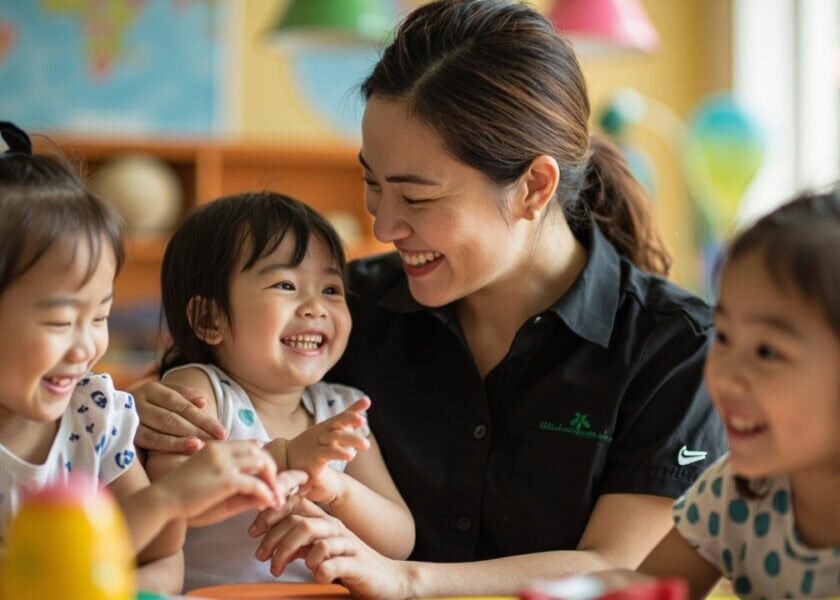
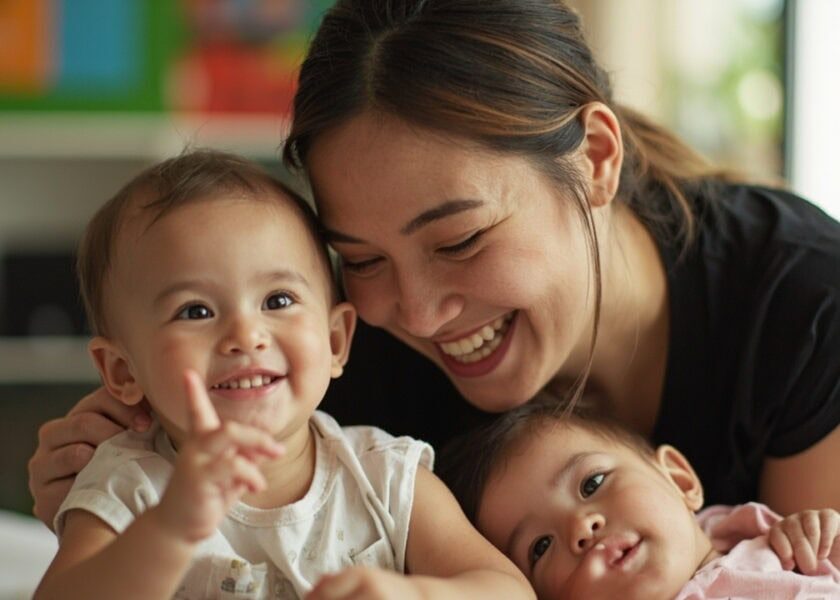
Watch a child in the presence of a caregiver who truly knows them, and you will see something unmistakable. There is a responsiveness that goes beyond compliance. The child looks at the caregiver not with mere attention but with something more like recognition. They seek out the caregiver not only for comfort but for shared attention — look at this, come see what I found.
And the caregiver responds in kind: not with performed warmth but with genuine interest, the interest of someone who has taken the time to understand this particular small person and who finds them genuinely fascinating.
This is what the child carries home at the end of the day. Not a new skill, necessarily, though skills may come. What the child carries is a feeling: I am known. My presence matters to this person. I am not just one of many. I am seen.
When a child experiences this kind of individual recognition in their earliest years, they are building something that will stay with them for life: a sense of their own worth, an internal sense of being significant to others, the beginning of a healthy relationship with their own place in the social world.
The Peer World and Engagement: Learning and Flow
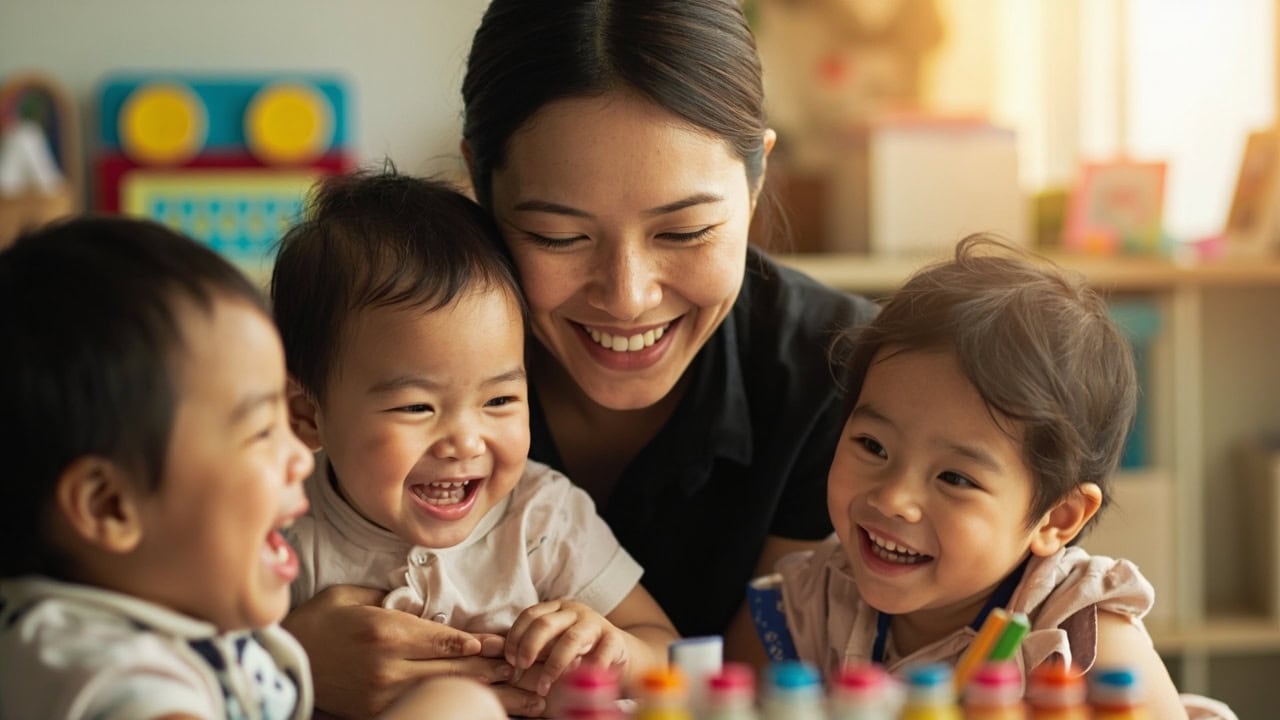
For children in group care, there is an experience that is simply unavailable in the family setting: the experience of other children. Brothers and sisters are not peers in quite the same way. Other children — small people who are also learning how to navigate the social world — offer something distinct. They offer mirrors, antagonists, collaborators, and teachers. They offer the raw material of social development.
In quality childcare, the peer environment is not left to chance. Caregivers create the conditions for positive social interaction, model conflict resolution, and guide children toward the skills they need to navigate group life. But the real learning happens in the messy, irreducible reality of children being together:
- A toddler learning to share a toy
- A two-year-old discovering that other children have feelings too
- A three-year-old navigating the complex politics of friendship
These are not lessons that can be taught directly. They must be lived.
Over months and years, you can watch genuine social competence develop. Children who have learned, through lived experience, how to assert themselves and also how to yield. How to read social cues. How to negotiate. How to recover from disappointment and re-enter a group. How to express care for another child.
And there is something particular about the child who has experienced belonging in a peer group. They carry a quality of social confidence that is observable. They are not afraid of other children. They can approach a group, join a game, find a friend. This is not extroversion — it is the result of having had successful social experiences in the formative years, of having learned, in a safe environment, that the social world is navigable.
Engagement and the State of Flow
As the morning unfolds, there are moments of guided activity, moments of free play, moments of discovery. What matters here is the quality of engagement that is possible when a child is in an environment genuinely attuned to their developmental needs.
Engagement looks like absorption. A child who is genuinely engaged with an activity is not performing learning. They are lost in it. They have found something that captures their interest, and they are exploring it with the full intensity of their developing mind.
This state of flow — the experience of discovering that learning is not work but pleasure — is one of the most important experiences a child can have. It is the experience of discovering that the world contains wonders worth pursuing. That they themselves are capable of sustained attention and genuine curiosity.
In quality childcare, the environment is designed to support this kind of engagement. Not through pressure, not through forced instruction, but through the provision of materials and time and space that allow genuine interest to emerge.
A child who has spent years in an environment like this has built something invisible but profound: a relationship with curiosity itself. They have learned that there are things worth investigating, that difficulty is not a reason to quit, that help is available when needed, and that the world is full of things to discover.
These are the internal resources that a child carries forward. Not the specific activity they did, but the disposition toward learning that they developed through that activity. This is what quality childcare really builds: not just the child’s day, but the child’s capacity for a lifetime of engagement with the world.
Reading the Signs: A Guide for Your Search
Quality is not something you can fully evaluate from the outside. It is something you read in the child themselves.
The child’s face, after a day in quality care, carries information. There is a quality of ease, a brightness, a presence. When you see it, you know. And when you do not see it — when there is something flat or anxious or shut down in the child’s expression — that, too, is information.
This is not mystical. It is observational. Children are not yet skilled at hiding what they feel. Their inner lives are written on their faces, in their bodies, in their play. And a parent who is paying attention can read that text.
They can ask the child about their day and hear, in the child’s language, what that day contained. They can notice whether the caregiver’s name comes up with warmth, whether the child speaks of activities with energy, whether the child asks to go back.
When a child asks to go back — not because they have been told to say so, but because they genuinely want to return — that is perhaps the most honest indicator of all. That is the child’s own vote of confidence in the world you have chosen for them.
What to Look For
When you visit a potential childcare setting, notice:
- How the caregiver approaches the children who are present — with attention, warmth, genuine interest
- Whether the space feels scaled to children — shelves at their level, materials in reach, natural light
- Whether there is a visible rhythm — predictable sequences that give children something to rely on
- How the children move through the space — with confidence, with ease, with curiosity
These observations cannot replace thorough research into credentials and ratios. But they add something that credentials alone cannot provide: a glimpse into whether this place might be one where your child is genuinely encountered, not merely adequately supervised.
Addressing Common Concerns
“Will my child feel anxious?”
Some anxiety at transitions is normal and healthy — it reflects a healthy attachment. What matters is whether the anxiety eases. A child in quality care will often show signs of settling within days or weeks, not months. If the anxiety persists without easing, that is information worth attending to.
“How will I know what happens during the day?”
The best indicator is not the frequency of updates — it is the quality of what you observe in your child. Does your child speak of the caregiver with warmth? Does your child mention activities with energy? Does your child want to go back?
“Is full-day care too much for a young child?”
This depends entirely on the quality of the care, not the hours themselves. A child in high-quality full-day care can thrive. A child in low-quality half-day care can struggle. The question is not how many hours, but what fills those hours.
“How do I know if the caregiver really knows my child?”
Ask to see how the caregiver responds to different temperaments. Watch whether the caregiver adjusts their approach for the child who is shy versus the child who is bold. Notice whether your child’s name is used naturally, whether the caregiver seems to anticipate your child’s needs, whether there is a sense of familiarity between them.
EduNanny: Quality Care Within Reach
EduNanny, operating under the ECDA Childminding Pilot, has been built with an understanding of what children need at its center. Not as an abstraction, but as a daily practice.
The pilot offers pathways in both home-based and community or centre-based settings, each with ratios designed to allow for genuine attention — ratios that make it possible for caregivers to know the children in their care as individuals, not just as names on a register.
There is a structure here that has been thoughtfully designed: Monday to Friday care blocks, pilot fee structures that keep quality care within reach for families across Singapore, and the ability to use CDA and Baby Bonus funds. Quality should not be the privilege of the few. It should be available to every child who needs it.
In the spirit of genuine transparency and partnership with parents, the program incorporates communication measures, including CCTV where deployed, so that parents can feel connected to their child’s day. Not because surveillance is the answer to parental anxiety — it is not — but because some parents find that a window into the observable moments of the day helps them to settle into trust. And trust, once it can settle, frees the parent to step back from anxiety and step inside the child’s experience.
Choosing Quality: The Invitation
Imagine a child, years from now, moving through the world with a quality of confidence and curiosity that seems to belong to them naturally. Perhaps they approach a new situation with openness rather than fear. Perhaps they navigate social settings with an ease that others notice and admire. Perhaps they possess a resilience that allows them to stay with difficulty without collapsing. Perhaps they are, simply, at home in their own skin.
Now imagine that you could trace that quality backward. Not to a single lesson or a single experience, but to the accumulated weight of a thousand mornings. A thousand small safe arrivals. A thousand caregivers who knelt to their level. A thousand environments that said, through their warmth and their order, you belong here. A thousand peer relationships that taught the intricacies of human connection. A thousand moments of genuine engagement that built, quietly, a relationship with curiosity itself.
This is what quality childcare builds. It builds from the inside out. It does not produce outcomes that can be measured on a test or reported on a scorecard. It produces something more fundamental: a child who has been well, who has been known, who has been safe, and who therefore has the inner resources to flourish.
The search for childcare is not simply a logistical task. It is a profound act of care — an attempt to find, for your child, a daily world worthy of them. And when you find it, you will know. Not because the brochures told you so, but because your child told you so, in a thousand small ways, every single day.
If you are ready to explore what quality care looks like for your child — a place where your child will be known, encountered, and supported — EduNanny welcomes the conversation. We are here to answer your questions, walk you through your options, and help you discover whether we might be the right fit for your family.
Begin your journey with EduNanny today.