The Real Secret to School Readiness Singapore Parents Are Missing
The Pressure Is Real—But Is It Pointing You in the Right Direction?
Singapore parents navigate one of the world’s most competitive educational landscapes while balancing demanding careers, extended family expectations, and the constant pressure amplified by social media. The market for early academic acceleration is enormous. It speaks to a real fear. And it would be unfair to expect parents to resist that fear on their own.
But here is the uncomfortable truth most enrichment marketing does not want you to hear: the race to academic acceleration is often winning the wrong race.
The question most parents ask is: How do I prepare my child for Primary One?
But this is not the right question.
The right question is: What does my child actually need to thrive—not just in Primary One, but in every year that follows?
What Genuine School Readiness Actually Looks Like
The children who arrive at Primary One truly ready are not the ones who learned to read at three or memorized their multiplication tables at four. They are the children who can pay attention when the lesson is hard. They are the children who can wait their turn without falling apart. They are the children who can ask for help when they do not understand, who can try again after failing, who can sit with discomfort long enough to learn something new.
These are not soft skills. These are not luxuries. These are the actual architecture of academic success.
The Science Behind What Actually Matters
Developmental scientists call it executive function—the brain’s capacity to manage attention, regulate emotion, resist impulse, hold information in mind, and shift flexibly between tasks.
Research consistently shows that executive function in early childhood predicts academic performance, social competence, and even health outcomes in adulthood more reliably than early academic knowledge.
- A child who can self-regulate will outlast a child who knows more but falls apart under pressure.
- A child who is intrinsically curious will outlearn a child who has been drilled to perform.
- A child who trusts adults and feels safe will take the intellectual risks that real learning requires.
Why Enrichment Classes Often Miss the Point
Enrichment classes are not inherently harmful. Many are well-designed and taught by passionate educators. But what research and Primary One teachers consistently observe is this: enrichment classes often address the symptoms of unpreparedness rather than building the foundations that prevent it.
- If a child lacks attention span → send her to a focus training class
- If she lacks social skills → send her to a social skills class
- If she lacks intrinsic motivation → offer rewards for compliance
We are treating the leaves while the root remains unaddressed.
Children who arrive at Primary One with strong executive function and emotional regulation perform better academically not just in Primary One, but throughout their schooling. Children who arrive with early academic knowledge but weak foundational capacities often lose their early advantage by Primary Three or Four, when academic demands increase and the importance of self-regulation becomes more pronounced.
Why Quality Childcare Builds What Enrichment Classes Cannot
Executive function, emotional regulation, intrinsic motivation, social confidence, cognitive flexibility—these capacities are not taught. They are built.
They are built in environments where children are allowed to play without predetermined outcomes, to solve problems they encounter naturally, to experience appropriate frustration and learn that it is survivable, to form secure attachments with caregivers who are consistently warm, responsive, and attuned.
The Learning Hidden in Play
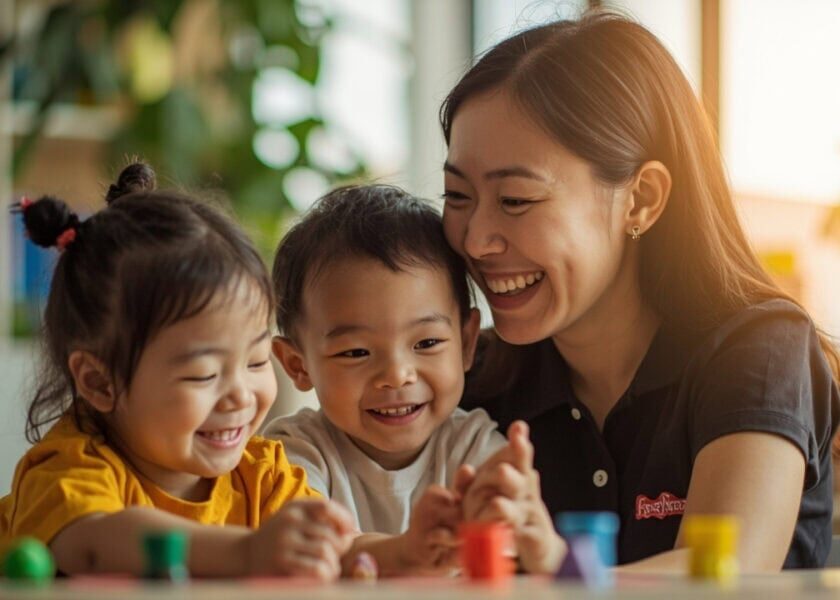
When your child plays make-believe with other children, she is building the capacity to see things from another perspective, to negotiate, to manage conflict, to sustain focus on a shared goal.
When your child builds a tower and it falls and she builds it again, she is building persistence, problem-solving, and the understanding that effort leads to result.
When your child navigates a disagreement with a peer and a caregiver helps her name her feelings and find words for what she needs, she is building the emotional vocabulary and regulation skills that will allow her to sit in a classroom and manage the inevitable frustrations of learning.
None of this looks like homework. All of it is the real work.
Why Small Ratios Matter More Than You Think
Quality childcare environments do not just happen. They require:
- Trained caregivers who understand child development, not just crowd control
- Ratios that allow genuine attention—one caregiver who can truly observe, respond, and support three infants is fundamentally different from one caregiver managing twelve
- Curriculum that emerges from children’s interests and developmental needs rather than scripted predetermined outcomes
- Physical environments that are safe enough to allow exploration and challenging enough to stretch growing minds
- Consistency that lets a child know, every single day, that the world is predictable and the adults around her are reliable
A child who has spent her early years in a developmentally rich environment with attentive caregivers and peer interaction does not need a social skills class—because she has been practicing social skills every day, in real contexts, with real stakes and real relationships.
What to Look For: Finding Quality Childcare in Singapore
For Singapore families, not all childcare options offer the same developmental environment. Understanding what to look for can make the difference between supervision and genuine preparation.
| What to Observe | What It Indicates |
|---|---|
| Caregiver responds to distress within minutes | Secure attachment formation |
| Children are engaged in self-directed play | Intrinsic motivation being supported |
| Small group ratios (maximum three infants per caregiver) | Individualized attention and attunement |
| Caregiver names emotions and guides resolution | Emotional regulation development |
| Children have time for unstructured play | Problem-solving and cognitive flexibility |
| Consistent caregiver over time | Relational security and trust |
Questions to Ask When Visiting a Childcare Setting
- What is the caregiver-to-child ratio?
- How does the daily schedule balance structured activities with free play?
- How do caregivers respond when a child becomes frustrated or upset?
- What training do caregivers have in child development?
- How does the environment support different stages of development simultaneously?
- What communication can parents expect about their child’s day?
EduNanny Singapore: Built on Developmental Science
EduNanny was built on a simple but profound recognition: the first years of a child’s life are not a waiting period before real learning begins. They are the period in which the capacity for all future learning is constructed.
A child who is cared for by someone who understands brain development, who knows how to support emotional regulation through attunement rather than control, who can create a learning environment that feels like discovery rather than instruction—that child is being prepared for Primary One in the most meaningful sense of the word.
The ECDA Childminder Pilot: What It Means for Families
EduNanny operates within the ECDA Childminder Pilot, which reflects a growing understanding in Singapore that childcare solutions must be as diverse as Singapore’s families. Home-based care, delivered by trained, supported, and professionally recognized caregivers, offers something that centre-based care alone cannot:
- Continuity of care in a familiar environment
- Small ratios—a maximum of three infants per caregiver—that make genuine attunement possible
- Flexibility within a structured framework that prioritizes the child’s developmental needs
Care blocks are designed for working families—Monday through Friday, with options that align with Singapore’s professional schedules. Families can utilize the Child Development Account and Baby Bonus schemes, because quality care should not be a privilege available only to those with significant financial resources.
For parents who prefer centre-based settings, EduNanny also offers community and centre-based pathways, recognizing that one size does not fit all.
Trust Requires Transparency
For parents, trust is not abstract. Trust is practical.
When you leave your child in someone else’s care, you need to know what is happening. EduNanny implements communication and transparency measures, including CCTV where deployed, because parents need more than promises. You need visibility. You need to know that your child’s day includes not just supervision but genuine engagement, not just safety but stimulation, not just care but care informed by developmental understanding.
Common Questions Answered
What if my child needs extra support? Quality childcare is not a replacement for specialized support when needed. Rather, it creates the strong developmental foundation that makes any additional interventions more effective. A child with secure attachments and strong self-regulation is better positioned to benefit from targeted support if required.
How do I know if it’s working? You will see it in how your child handles frustration, in their willingness to try new things, in their growing ability to express themselves and navigate relationships with peers. These are the visible signs of the invisible foundations being built.
The Invitation
Your child does not need to be the most academically prepared child in her Primary One class. She needs to be the child who wants to learn, who knows how to try, who can manage herself when learning is hard, who trusts that adults in her life are on her side, who has the social confidence to ask questions and make friends and navigate the complex world of school with resilience and joy.
That child is not purchased. That child is built.
And you are already building her.
- Every time you respond to her cry, you are building her capacity to trust.
- Every time you let her struggle and then succeed, you are building her persistence.
- Every time you name her emotions instead of dismissing them, you are building her emotional intelligence.
You are doing this work. You have been doing this work all along.
Quality childcare extends and complements what you are already building at home. It offers environments that amplify the developmental work you are doing, not replace it. It offers caregivers who understand child development and can support the foundations you are establishing.
Parenting in Singapore is exhausting in ways that are not always visible. You are making decisions with incomplete information, under time pressure, with resources that feel inadequate, while surrounded by people who seem to be doing it better.
The anxiety you feel is not a sign that you are failing. It is a sign that you are paying attention.
The question is what you do with that attention.
You do not have to do it alone, and you do not have to buy every enrichment class on the market to give your child what she needs. The foundation is simpler and more profound than the market wants you to believe. It is built through relationship, through responsive care, through play, through the slow and patient work of helping a human being become ready to learn.
Let us build this together. Not for Primary One. For everything that comes after. For the person your child will become. For the learner she will grow into. For the life she will live with curiosity, with resilience, with the kind of quiet confidence that no enrichment class can teach but that quality care, quality relationships, and quality environments can grow.
That is what EduNanny Singapore believes in. And that is what your child deserves.
If you are ready to explore what thoughtful, development-oriented childcare looks like for your family, we would love to hear from you.