Beyond the Checklist: Building Genuine Childcare Partnership in Singapore
The Question Singapore Parents Carry Quietly
There is a question that many Singapore parents arrive at months after settling their child into care. It does not come up in the pamphlets or orientation visits. It is not the question they asked when comparing centres or interviewing nannies. It sounds something like this:
How do I know this relationship is actually working?
Not whether the centre has good ratings. Not whether the caregiver has the right certifications. Those questions have answers. Parents can find those answers.
But this other question—whether the partnership itself is deepening in the right way, whether the relationship between you and the person caring for your child is genuinely growing—does not have a checklist.
So many parents carry it in silence. Wondering if they are paying attention enough, or perhaps too much. Wondering whether the caregiver truly sees their child. Wondering whether they themselves are showing up as the kind of partner this relationship needs.
If you have found yourself in that quiet uncertainty, know that you are not alone. And that this question itself is a sign of something important: you care about the relationship, not just the logistics. And that is exactly where the best care begins.
What Partnership Actually Means in Childcare
The partnership that forms between a parent and their childcare provider is one of the most consequential and least discussed relationships in a family’s life. In Singapore, where so many families rely on some form of childcare—whether through a childminder in the home, a community-based arrangement, or a centre-based programme—the quality of that relational bond matters enormously.
Not just for the child’s immediate wellbeing, but for everything that unfolds from there. Research tells us about attachment. Parenting guides tell us about developmental milestones. What they rarely tell us is how to be a good partner to the person who shares in raising our children.
Beyond the Transaction
A partnership is not a business arrangement, though it involves practical terms and mutual commitments. It is not a supervisory relationship, though there is a natural flow of information and accountability. A partnership is something more fluid and more demanding.
It is a relationship in which two parties—the parent and the caregiver—share a common purpose: the flourishing of the child. And in which both parties grow in their understanding of that child over time.
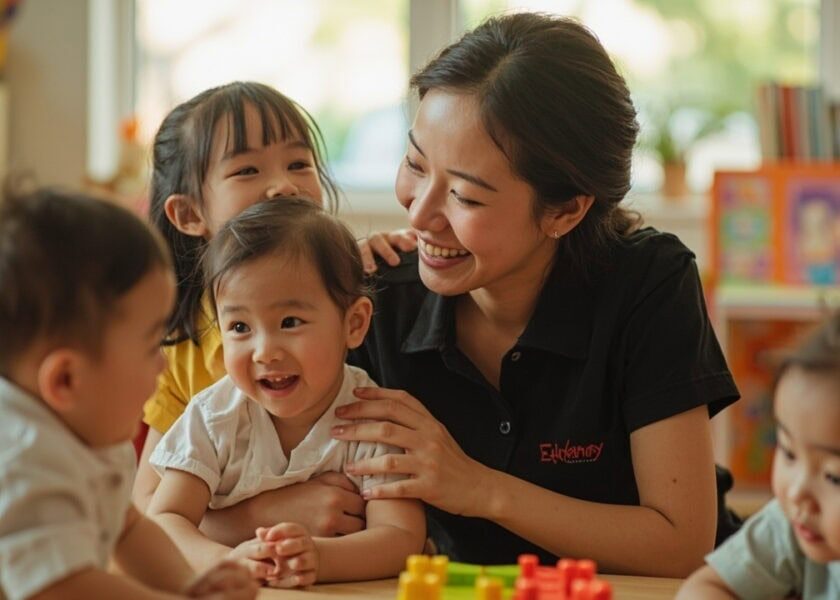
What makes this relationship a partnership, rather than a service transaction, is the quality of attention that flows between both sides. In a true partnership, the caregiver does not simply follow instructions. She learns the child. She notices patterns, preferences, the subtle shifts in mood that precede a meltdown or a breakthrough.
And the parent, in turn, does not simply hand over their child and hope for the best. They stay engaged. They share what they observe at home. They listen to what the caregiver notices. They treat the caregiver’s insights as genuinely valuable, because over time, they become genuinely valuable.
The relationship deepens because both parties are paying close attention to the same small person, and that shared attention creates a kind of knowledge that belongs to neither party alone. It belongs to the partnership itself.
Signs Your Partnership Is Growing
So what does this look like in practice? How do you know when your relationship with your childcare provider is becoming a genuine partnership rather than a routine exchange?
There are signals worth noticing—not hard rules, but signs of deepening connection.
Consistent Attunement
One of the most telling signs is consistent attunement. When a caregiver is truly partnered with a family, she begins to anticipate the child’s needs in ways that feel almost intuitive.
She knows that this child needs a few minutes of quiet transition after nap time before they are ready to engage. She notices when a usually social child is pulling back and adjusts the morning’s activities accordingly. She reads the child’s cues—the way a toddler communicates through gesture and expression long before words arrive—and responds with accuracy.
This is not a skill that appears overnight. It is built through daily presence, through thousands of small interactions, through a caregiver who has made it her work to understand this particular child.
As a parent, you will begin to notice this too. You will see it in the way your child responds when the caregiver arrives. Not with anxiety or reluctance, but with a kind of recognition. Your child knows this person. Your child trusts this person.
Shared Understanding of Development
Another sign of a deepening partnership is shared understanding of the child’s development. In a true partnership, both parent and caregiver are on the same page—not because they have identical philosophies, but because they are in ongoing conversation about what the child is learning and experiencing.
The caregiver notices that your two-year-old has started using more complex sentences and tells you about it with genuine delight. She observes that your infant is becoming more mobile and proactively talks to you about how they are creating safe spaces for exploration.
She shares observations not as reports, but as contributions to a shared understanding. And you, as the parent, receive those observations not as updates, but as insights that deepen your own knowledge of your child.
This is what partnership sounds like in daily life: not a handover checklist read aloud, but a conversation between two people who care deeply about the same small human.
Your Role in the Partnership
Many parents quietly wrestle with the question of their own role. When you have placed your child in someone else’s care—even for part of the day, even with the most wonderful caregiver—there can be a strange uncertainty about where you fit.
Are you still the parent? Of course you are. But what does that mean when someone else is also holding your child, nourishing them, playing with them, soothing them?
Your role is not diminished by the presence of a trusted caregiver. It is, in fact, made more possible by it. When you have a genuine childcare partnership, you gain another set of eyes on your child. Another heart that is paying attention. Another person who can tell you what they see.
Staying Present Does Not Mean Micromanaging
Staying present means intentional communication. It means asking good questions and listening deeply to the answers.
It means sharing what you notice at home—the new word your child said this morning, the way they have been asking about the neighbour’s cat, the book they keep wanting to read again and again. These are not trivial details. They are the currency of partnership.
Staying present also means honoring the caregiver’s expertise. A good childcare partner is not someone who needs to be managed or monitored in every moment. She is someone whose judgment you trust because you have seen it proven over time.
When you have questions or concerns, bring them as a partner raising a concern with a partner, not as a client filing a complaint with a service provider. The way you approach these conversations matters. It shapes the culture of the relationship.
You Are Allowed to Love the Person Caring for Your Child
Something many parents do not give themselves permission to feel: you are allowed to love the person caring for your child. Not in the same way you love your own family, but in a real and meaningful way.
You are allowed to feel gratitude that such a person exists in your child’s life. You are allowed to want her wellbeing, to remember her birthday, to think of her as part of your village.
A partnership thrives when both parties allow it to be more than professional. When it becomes human.
When Difficulties Arise and Partnerships Must Recalibrate
Every childcare relationship encounters friction eventually. A missed communication. A difference of approach. A time when the caregiver and the parent see the same situation quite differently.
In a transactional relationship, these moments become points of conflict, negotiation, or disengagement. In a partnership, they become moments of growth.
The caregiver who trusts you will raise a concern openly rather than letting it fester. And you, as a parent who trusts her, will be able to hear that concern without defensiveness.
You will be able to say: Tell me more. Help me understand what you are seeing.
And you will listen not just to the words, but to the care behind them.
This is the texture of a relationship that is working. It is not the absence of disagreement. It is the presence of enough trust that disagreement becomes dialogue.
Partnerships are not static. As your child grows, as their needs evolve, as your family’s circumstances change, the shape of the partnership will shift.
What worked when your infant needed almost constant physical comfort will not be what works when your toddler is asserting their independence with full force. What worked when you were on maternity leave will not be what works when you have returned to work full time.
The partnership must grow, or it will strain. This is not a sign that something is wrong. It is a sign that things are moving.
And that is not a failure. It is the nature of any living relationship.
Signs the Partnership Is Serving Your Child’s Development
How do you know when the partnership is serving your child’s development? There are signs here too, and they are worth knowing.
- Your child is meeting developmental milestones in the ways that feel right for your family—not according to external pressure, but in a rhythm that feels healthy and natural.
- Your child speaks about the caregiver with warmth and familiarity, not with anxiety or avoidance.
- Your child is beginning to show the kind of secure exploration that comes from knowing they are held—a curiosity that extends outward because the foundations at home and in care are steady.
- The caregiver speaks about your child with specificity and affection. Not generic praise, but genuine knowledge. She knows your child’s favourite song. She knows the way your child reacts to being frustrated. She knows what makes your child laugh. This specificity is a window into the quality of the relationship.
- You, yourself, feel different. Not perfect—there is no perfect—but clearer. More confident in your role as a parent, not less. A good childcare partnership does not replace your parenting. It supplements it, challenges it, enriches it.
You should feel, over time, that you are learning from this relationship. That the caregiver’s observations are teaching you things about your child that you could not have seen alone.
This is what partnership does at its best. It does not divide your attention. It multiplies it.
How EduNanny Singapore Supports Lasting Partnership
EduNanny operates within the ECDA Childminding Pilot, and this is not incidental. It is a deliberate structure designed to support exactly the kind of relationship described here.
The Philosophy Made Concrete
The pilot maintains low ratios—up to one to three in infant care—which means that caregivers can truly know the children in their charge. They are not spread across seven or eight infants. They are present, attentive, and able to build the kind of attunement that partnership requires.
This is not a bureaucratic detail. It is a philosophy made concrete.
Pathways That Meet Families Where They Are
EduNanny offers pathways that include home-based care, community-based care, and centre-based options where applicable. For families in Singapore, this means that whether you need a caregiver who comes to your home, a small group setting in your neighbourhood, or a centre-based programme, there is a structure that can meet you where you are.
Accessible Without Compromising Quality
The pilot fee structures are designed with accessibility in mind, while still maintaining the quality of care that partnership demands. For families using CDA or Baby Bonus funds, these payment options are available, because EduNanny believes that thoughtful, development-oriented care should not be reserved only for those who can pay premium rates.
Communication Structures That Build Trust
The communication structures in place—transparency measures, regular updates, and in some settings, CCTV—are not there because the organisation does not trust its caregivers. They are there because trust is built on transparency, and because parents deserve to feel that they can see what is happening in their child’s day.
A partnership is strongest when both parties feel secure in what they are building together.
A Framework for Growing Relationships
EduNanny offers something worth naming: a framework for thinking about the relationship as it grows. Many parents enter childcare without any language for what they are experiencing. They know something feels right or something feels off, but they do not have a way to name it or talk about it.
EduNanny is building a culture in which partnership is not just a pleasant idea but a practiced orientation. From the first conversation to the ongoing relationship, there is an expectation that this is a collaboration, and that both parties are expected to bring their best to it.
When parents and caregivers are operating within a structure that values partnership, they behave differently toward each other. The caregiver feels respected and included. The parent feels welcomed and heard.
And the child, who is watching all of this with eyes that miss nothing, receives the message that this is a safe world—populated by adults who work together on their behalf.
The Invitation to Begin the Conversation
In all of this discussion about partnership and communication and recalibration, we must not lose sight of the child. All of this—the trust, the conversation, the growing relationship—exists in service of one purpose: that a small person is being raised well.
That they are known, loved, challenged, and held.
The partnership between parent and caregiver is a means to that end. It is not an end in itself.
When you choose childcare, you are not choosing a vendor. You are choosing a collaborator. You are choosing someone who will walk alongside you in the daily, sometimes mundane, sometimes extraordinary work of raising a child.
You are choosing to build a relationship that will deepen over time, that will have its seasons of ease and its seasons of challenge, and that will, if tended well, become one of the most meaningful relationships in your family’s life.
This is the invitation that EduNanny extends to every family it serves. Not a transaction. Not a service level agreement.
An invitation into a partnership that grows with your child, that evolves as your family evolves, and that holds at its centre the simple, profound truth that children thrive when the adults who love them choose to work together.
If you are a parent reading this, and you find yourself wondering whether your childcare relationship is deepening in the right way, I want to leave you with this:
The fact that you are asking that question means you are already paying attention. You are already doing the work.
Partnership is not about getting it perfect. It is about staying present, staying curious, and choosing, again and again, to show up for the relationship that serves your child.
That choice—to partner rather than merely to purchase, to grow rather than to settle, to build something that lasts—is the choice that shapes not just your child’s early years, but the village that will surround them for years to come.
The work of raising children has never been meant to be done alone. It is meant to be shared. And when it is shared well—with intention, with care, with trust—the children are not the only ones who grow.
So does everyone around them.
That is the partnership worth building. That is the partnership EduNanny is here for.
To learn more about what a genuine childcare partnership looks like for families in Singapore, explore EduNanny’s approach or begin a conversation today.