The Quiet Years Before Your Child Speaks: Why Language Development Starts So Early
Before They Say Their First Sentence, They Have Already Been Listening for Two Years
Before your child speaks their first real sentence, they have already been listening for two years.
This is the quiet truth that rarely gets spoken aloud in the rush of parenting conversations, in the checklists of school readiness, in the anxious midnight searches for the right childcare. We talk so much about what comes after—the tests, the vocabulary checks, the reading levels, the transition to Primary One. But the story that matters most begins in the months before any of that: in the way a caregiver responds when a nine-month-old babbles, in the kind of sentences a child hears repeated during feeding and play and the gentle transitions of a morning routine.
Language is not something that arrives at school. It is built, word by word, conversation by conversation, in the first years of life. And the people who build it most consistently, most responsively, most intentionally—are the ones who care for your child when you are not in the room.
This article gives you the framework to understand what quality language development actually looks like—and what to look for when you are trusting someone else with these most formative years.
Why the First Years Build the Architecture of Language
There is a reason neuroscientists call the early childhood period a window of extraordinary opportunity. The architecture of the brain during these years is unlike anything that comes after. Neural connections form at a speed that will never be matched again, and language is one of the primary building blocks of that architecture.
By the time a child turns two, they have already absorbed the fundamental sounds, rhythms, and patterns of their home language—or languages. They have mapped the grammar in their heads before they can write a single letter. They have heard thousands of conversations and begun to understand not just words, but the way meaning works, the way questions invite answers, the way stories have beginnings, middles, and endings.
This is not metaphor. It is biology. The environment in which a young child spends their waking hours is not simply a place of supervision. It is a place where the most important cognitive construction of their lives is actively underway.
The Oral-to-Literacy Foundation
In those first years, oral language development is the foundation for everything that comes after. Reading and writing will come in school, and they require their own specific skills. But they rest on a base of oral language that must be built first.
A child who enters Primary One with strong listening comprehension, a rich vocabulary, and the ability to follow multi-step instructions and understand complex sentences—that child has a foundation. They can learn to read because they already know what language sounds like, what words mean, how sentences work.
A child who enters without this foundation faces a different challenge. They must not only learn to decode symbols on a page but also construct the meaning those symbols represent, simultaneously. This is exponentially harder—and why the pressure to focus on early literacy drills can sometimes be misplaced.
The Bilingual Dimension in Singapore
In Singapore’s bilingual context, this matters even more. Many parents worry about English literacy, about Mandarin exposure, about maintaining home languages while preparing for a school system that operates primarily in English.
These are real concerns. But the foundation for bilingual development is the same as the foundation for any strong language development: oral fluency, listening comprehension, and the ability to understand and use language in context. A child who has had rich exposure to language—who has been spoken to extensively in all the languages of their home—enters the bilingual classroom with something invaluable. They understand that language is a tool for meaning. They have already learned how to listen, how to infer, how to use context clues.
What Quality Language Building Actually Looks Like
Here is where the difference between childcare and supervision becomes visible—and this is what every parent deserves to understand.
Responsive Narrating
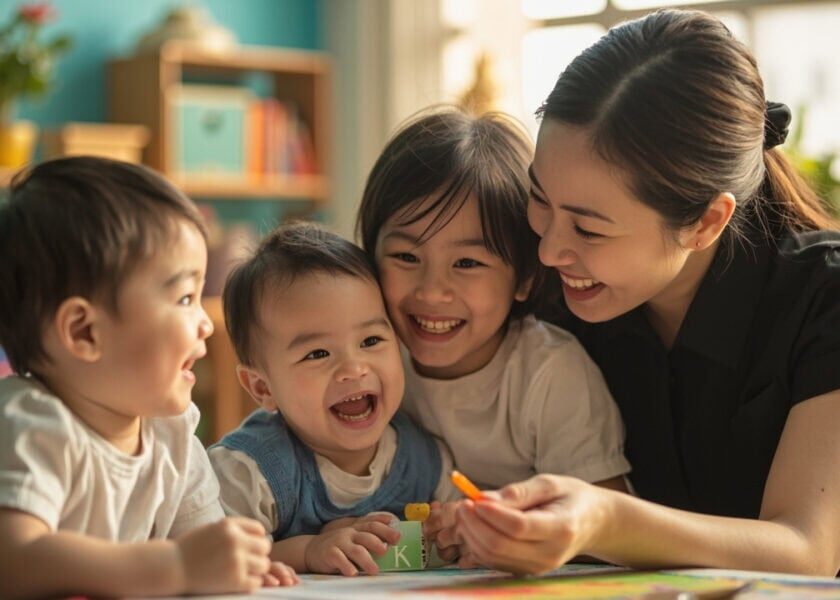
When a caregiver sits with an infant and narrates what is happening—“Now we are washing your hands, the water is warm, can you feel the bubbles?”—that caregiver is not simply filling time. They are giving the child a running translation of experience in words, expanding each moment into language, building the connections between what is seen and felt and what is heard and understood.
When a toddler drops a block and the caregiver responds not just with “no, don’t do that” but with “I see you dropped the block, it fell down, do you want to pick it up again?”—that caregiver is modeling complete sentences, teaching cause and effect through language, showing the child that words are responses, that communication is reciprocal, that every action can be translated into meaning.
The Engine of Language Development
This back-and-forth is what psychologists call contingent responding—the caregiver’s ability to listen, notice, and respond to a child’s communication attempts in a way that matches and extends what the child is doing or saying.
It is not about talking at a child. It is about talking with them, at their level, in a rhythm that teaches them the music of language before they ever need to read a single word.
Why Training Changes Outcomes
A caregiver who understands language development knows to kneel at eye level when speaking to a child. They know to wait after asking a question—not two seconds, but five or six, giving the child time to process and respond. They know that a child’s attempt to communicate, even when it is just a gesture or a sound, deserves a real response.
These are not instinctive behaviors. They are learned skills, and they make a measurable difference in the language outcomes of the children in their care.
What to Look For and Ask About
Knowing that language matters is different from knowing what to look for, what to ask about, what to observe. Here is what quality language scaffolding looks like when you pick up your child at the end of the day.
Four Things to Notice at Pickup
- Notice how your child responds to language. Does your toddler understand not just simple commands, but more complex requests? Can they follow a story when you read it, anticipating what comes next? Can they answer questions about what happened earlier in the day?
- Observe how your child communicates with their caregiver. Is there a comfort there, a back-and-forth that looks like real conversation—even if your child’s part in it is still developing? Do caregivers kneel down and speak at your child’s level, or do they speak down to them from above?
- Ask specific questions. Not just “What did you do today?” but: “What story did the teacher read? What was your favorite part? Who did you play with at the playground?” If your caregiver can answer these in rich, specific detail, it tells you something important—your child’s experiences are being narrated and processed, and the caregiver is noticing and reflecting your child’s day back to them in words.
- Notice what is not happening. Is your child coming home exhausted from overstimulation or screen time? Is their language use repetitive, limited, or oddly scripted? These can be signs of an environment where language is consumed rather than constructed—where children watch more than they are spoken to.
What Distinguishes Quality Childminding
Beyond these observations, there are structural factors that shape whether quality language development can happen consistently:
- Individual attention and responsive ratios. Quality language development requires caregivers who can listen, observe, and respond to individual children. Small ratios matter. Where ratios are too high for individual attention, even well-intentioned caregivers cannot provide the consistent responsive interaction that builds language.
- Caregiver training in development. The skills that build language—kneeling at eye level, waiting after questions, responding to attempts at communication—are learned, not instinctive. Training that covers language development milestones and responsive interaction techniques directly affects the quality of the language environment a child experiences.
- Transparent communication. Parents should know what is happening in their child’s day—not in the vague sense of “they had fun,” but in the specific sense of what they said, what they noticed, what surprised them. When a caregiver can narrate your child’s day in specific, rich detail, it tells you that language is genuinely happening in that environment.
- Consistency and continuity. Language development thrives in stable environments. A child who experiences consistent caregivers and predictable routines has more opportunity for the deep, responsive interaction that builds language than a child in a fragmented arrangement with frequent transitions.
Simple Ways to Reinforce Language Development at Home
If you are wondering what you can do at home to reinforce what quality childcare is building, the answer is both simpler and more profound than you might expect.
Talk With Your Child
Narrate your day. Describe what you are doing and why. When your child points at something, name it, and then expand: “Yes, that’s a bus. It’s a double-decker bus, do you see? It’s going to the city. Where do you think it’s going?”
This expansive, responsive talking is the single most powerful thing you can do for your child’s language development, and it costs nothing.
Listen and Wait
When your child speaks, wait. Give them time to find their words. Resist the urge to finish their sentences or correct their grammar in the moment. Communication first, accuracy later. A child who is encouraged to speak will speak more, and speaking more is how language grows.
Read Interactively
Do not just read words—pause, ask questions, let your child turn pages and tell you what they see. “What do you think happens next? Why do you think the bear looks worried?”
This transforms reading from a passive activity into a language-rich dialogue. It teaches your child that texts are meaning to be questioned and explored, not just decoded.
Be Kind to Yourself
You do not need to turn every moment into a language lesson. The goal is not perfection. It is presence—consistent, warm engagement with your child, trust in the process. The children who develop language most strongly are not the ones whose parents never missed an opportunity for vocabulary building. They are the ones whose parents talked with them, listened to them, and responded to them, day after day, in the ordinary rhythms of home life.
The EduNanny Approach: Built Around Language Development
EduNanny by BUTLER was built to support quality language development as a core part of its approach—not as an add-on, but as a fundamental understanding that shapes how care is delivered.
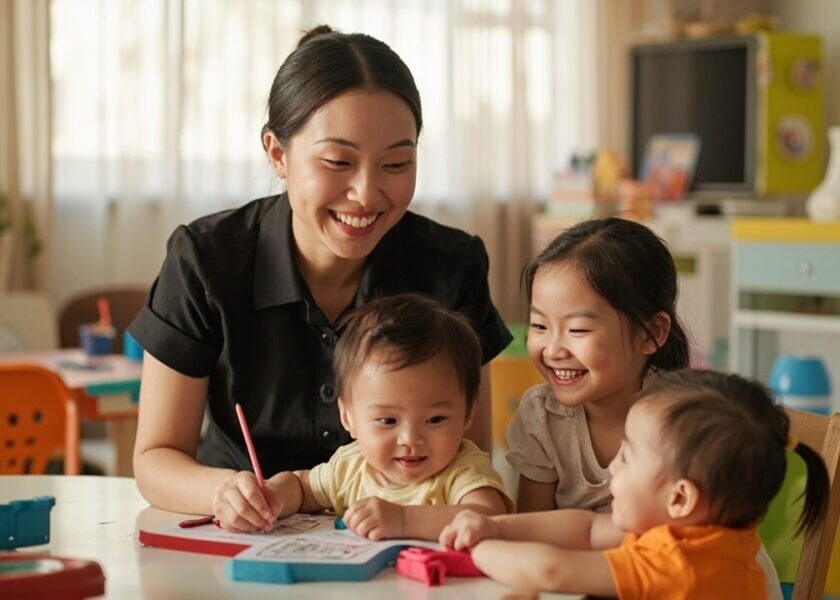
EduNanny operates under the ECDA Childminding Pilot, which means our caregivers are trained and supported within a framework that takes early development seriously. We offer home-based and community pathways, with infant ratios that allow for the kind of individual attention responsive interaction requires—up to three infants in some arrangements, ensuring that each child is seen and spoken to, not simply watched and managed.
Where applicable, CDA and Baby Bonus funding can be used, and Monday to Friday care blocks give parents the consistency they need while ensuring that the language environment your child experiences is stable and continuous.
Communication is fundamental to what we do. We believe you should know what is happening in your child’s day—not in the vague sense of “they had fun,” but in the specific sense of what they said, what they noticed, what surprised them. Where our services include transparency measures such as CCTV access, we offer them not because we have anything to hide, but because we believe trust is built through openness.
We have also developed resources to support parents beyond childcare hours. Our Thomas AI Chatbot is available to help with questions about development, about what to expect at different stages, about how to support language growth at home. It is not a replacement for human guidance, but it is a resource—intelligent, accessible, always available when you have a question at 9pm or 6am and you want to know if what you are seeing is normal.
The Weight and Privilege of These Early Years
In the end, this is not about any one childcare arrangement. It is about your child, and the words they are choosing right now, in this very moment, before you can hear them clearly.
Every ba and da, every pointed finger and meaningful look, every attempt to tell you something—these are the early drafts of the sentences your child will use for the rest of their life.
The people who care for your child during these years are not just caregivers. They are language builders. They are the architects of the foundation on which everything else will rest—reading, writing, thinking, communicating, connecting.
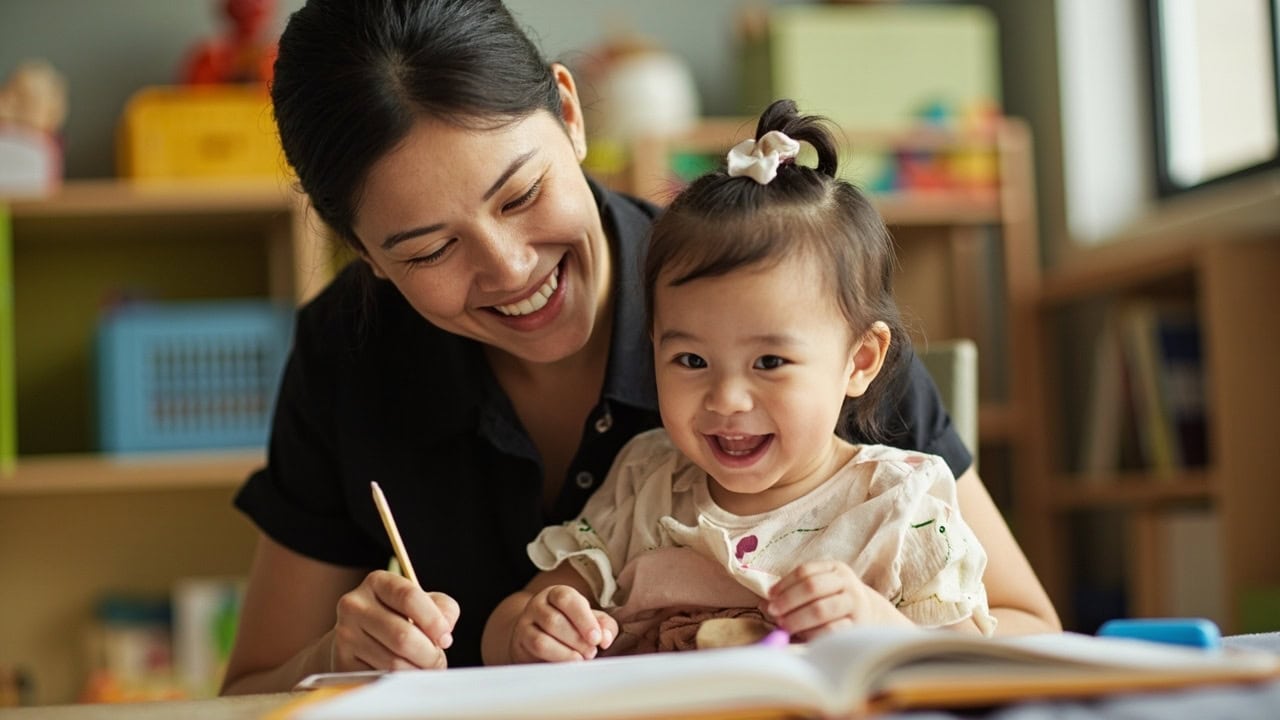
The best language scaffolding often looks like nothing at all. It looks like a conversation at eye level. It looks like a pause before a response. It looks like a caregiver kneeling down to meet a child where they are, and speaking to them as if what they have to say matters.
Because it does. It always has. And it always will.
Every child deserves this quality of attention, this intentionality in care, this understanding that the early years are not just a time to be gotten through but a time to be built upon.
If you are looking for childminding that takes language development seriously—that speaks to your child the way your child deserves to be spoken to—we would welcome the conversation.
Ready to explore what quality, language-focused childminding looks like? Speak with our team to learn how EduNanny can support your child’s early language development, or use our Thomas AI Chatbot for answers to your questions about early childhood development.
To learn more about EduNanny and our approach to thoughtful, development-oriented childminding, visit our homepage or read about how we are supported by the ECDA Childminding Pilot. You can also read about our team and get in touch at any time.