The Quiet Work That Shapes Your Child’s First Thousand Days
That Quiet Voice in the Car: What Quality Childcare Really Looks Like
It’s eight in the morning. You’ve just dropped your child at childcare. You kiss their forehead. They cling for one more second. A caregiver warmly takes their hand and leads them away. You force a smile. You tell yourself it’s fine.
But in the quiet of the car ride to work—or on the MRT, or in those first moments at your desk before the day begins—there is a small voice that asks: What did I just leave behind?
Not literally. Your child is safe, you know that. But something more specific: What did they discover? What did they struggle with? What did they say that was new, or do that surprised them?
You will get a photo later. A happy photo. You’ll look at it and feel relief—and that relief is real and valid. But beneath it, there is often something else. A wondering. Is this all there is? Is my child simply being kept busy until I come back? Or is something more happening—something that shapes them?
This article is about answering that question with clarity, not reassurance. Because that question is not a failure of trust. It is the most reasonable question a parent can ask. In Singapore, where childcare costs are significant and the pressure on working parents is real, you deserve more than a happy photo. You deserve to know.
What Quality Developmental Observation Looks Like
- Trained caregivers notice the invisible: Language bursts, motor progressions, and social-emotional leaps that parents miss because they are too close
- Development happens in observable increments: Those “overnight” milestones unfold over days and weeks—if someone is watching
- Quality childcare is a partnership: Observation without communication is incomplete; parents need regular, meaningful updates
- Continuity matters: When the same caregiver tracks your child over time, they build a narrative—not just a record
- You are not overthinking: Wanting to know how your child is developing is not distrust. It is love.
Why Those First Years Shape Everything
Here is what developmental science tells us: the first thousand days are the most neurologically active period of human development. Every day, new connections form. Every interaction, every discovery, every moment of frustration followed by a small triumph is wiring something permanent into your child’s brain.
This changes what we should expect from childcare. If the early years are simply a waiting room, then any competent supervision is sufficient. But if the early years are the foundation—then the quality of care your child receives during those hours apart from you is not a logistical convenience. It is an educational and emotional investment.
What Trained Caregivers Actually Notice
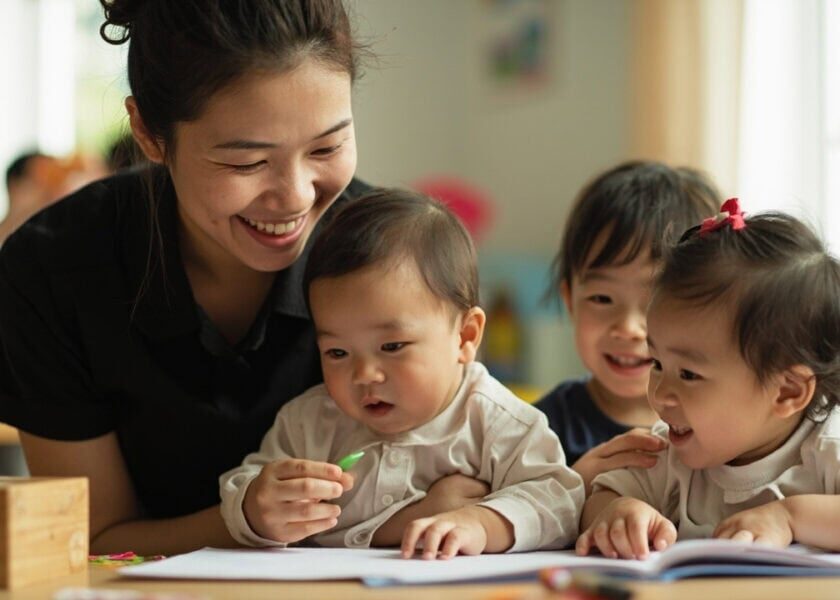
A trained caregiver in a quality infant care environment notices things that might seem small but are quietly monumental.
She notices that yesterday, Maya used the word “want” for the first time—pointing at a book, vocalizing, looking to an adult for confirmation. She logs it not as a checkbox, but as a moment of significance. Because three weeks ago, Maya was in single words. Now she is combining them. The language burst that parenting books describe—her caregiver is watching it happen in real time, in increments invisible without intentional observation.
Or consider Ethan, who is not quite walking yet, but today his caregiver watched him take four deliberate steps between two pieces of furniture. She knows he has been working on this for two weeks, that there is now visible intention in his movement where before there was only curiosity. When Ethan does take those first independent steps, it will not be a surprise—it will be a celebration of a journey she has been honored to witness.
Then there is Priya, three years old and learning to navigate sharing. Yesterday, she cried when another child took the red truck. Today, she took a breath and said, “My turn next?” It was a social-emotional leap—no checklist would have captured it, but her caregiver recognized it immediately because she has been watching Priya’s frustration tolerance grow. This is development too. The development that shapes every relationship your child will ever have.
Why You Cannot Always See It Yourself
You might wonder: why cannot I see this myself? Why do I need someone else to tell me what my child is learning?
Here is the truth: parents are too close. You have been with your child since the beginning. Because you are with them every day, the changes are harder to see. The small, steady progress becomes invisible precisely because you are living it.
A trained caregiver brings perspective. She has seen dozens of children at similar stages. She knows that language comes in bursts, that motor milestones follow predictable progressions, that social-emotional development moves in spirals. She knows what to look for—and what to notice when something is not developing as expected.
This is not about diagnosing. It is about observing, recording, and partnering with parents so that concerns can be addressed early, when intervention is most effective.
What EduNanny Singapore Does Differently
Philosophy without practice is just intention. Here is what this looks like in practice.
ECDA Childminding Pilot Standards
EduNanny operates under the ECDA Childminding Pilot, which means our childminders are not just caregivers—they are trained, supported, and held to standards that reflect the seriousness of the work they do. This regulatory framework requires specific training, ongoing professional development, and documented observation practices.
Ratios That Allow for Real Observation
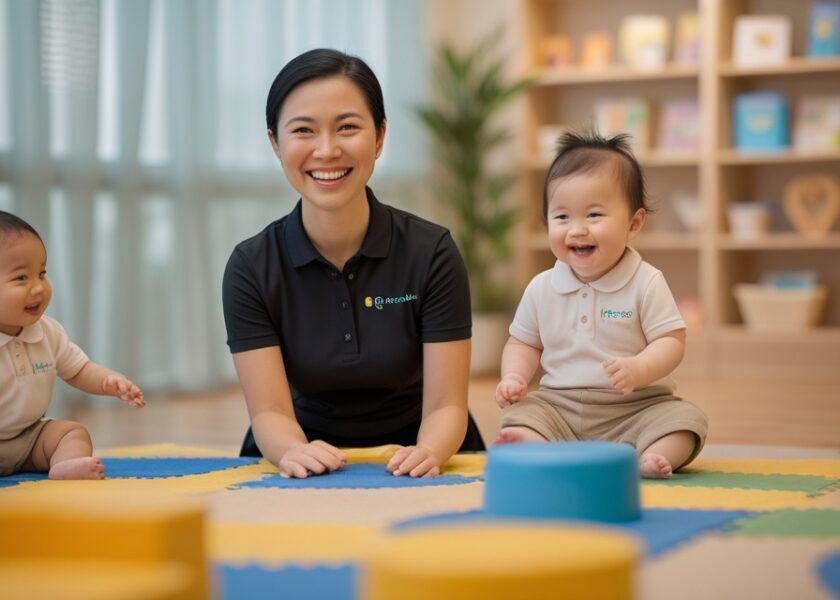
In our infant care settings, we maintain ratios of up to one to three. Developmental observation requires time and space. It requires a caregiver who is not managing chaos, who can slow down and watch, listen, and notice.
Pathways That Fit Singapore Families
- Home-based care: The childminder becomes a trusted visitor in your own home, a familiar face where your child feels safest. Ideal for infants who thrive with consistency.
- Community-based care: Children benefit from peer interaction in an intentionally designed space. Ideal for families seeking social development alongside individual attention.
Neither is inherently superior. Quality care should be flexible enough to meet different needs.
Communication: The Bridge Between Observation and Partnership
We have built systems that keep you informed—not with daily reports that read like spreadsheets, but with meaningful updates that help you understand what your child is experiencing and how you can reinforce that learning at home.
In appropriate settings, transparency measures including CCTV deployment ensure that trust is not assumed but can be verified. You are not expected to simply believe that good things are happening. You can see them, ask about them, and engage with them.
Our Thomas AI Chatbot is available to answer questions and provide guidance. It is not a replacement for human connection—it cannot replicate the warmth of your child’s caregiver. But it is a tool, a resource, a way of extending support when and where you need it.
Making Quality Care Accessible
We believe that developmental partnership should not be a privilege available only to families with significant resources. The pilot fee structures have been designed to make quality infant care accessible, and many families find that their child’s CDA or Baby Bonus funds can be applied directly.
The Overlooked Dimension: Continuity and Being Known
There is another dimension worth considering: continuity.
In those first years, your child is learning to be a person in the world. They are learning that relationships are safe, that routines are predictable, that adults around them can be trusted. When your child experiences consistent, quality care—when the same caregiver observes them over time, tracks their development, communicates with you honestly—they are receiving something profound.
They are receiving a narrative. Not the fragmented story of a centre with high turnover, where your child is one of dozens and their history is unknown, but a continuous story of who they are, what they have learned, and who they are becoming.
A child who is observed, who is noticed, who is tracked in their development, feels something different than a child who is simply supervised. They feel valued. They feel that their small achievements matter. They feel that they are not just being managed, but being championed.
This is the gift quality infant care offers—not just to parents, who gain peace of mind, but to children, who gain the experience of being seen.
Choosing Infant Care in Singapore: What to Ask
If you are currently researching childcare options, these questions will help you understand what you are actually signing up for:
- How are developmental milestones tracked? Ask how observations are recorded and shared. Generic answers like “we follow MOE guidelines” deserve follow-up.
- What is the caregiver-to-child ratio? For infants, lower ratios allow for genuine observation. One to two or one to three makes individual tracking possible.
- How is communication handled? Understand the expected frequency and format of updates. What will you actually learn about your child’s day?
- What training do caregivers have? Look beyond certificates. Ask what ongoing professional development looks like.
- What does a typical day look like? Quality environments can articulate how activities support different developmental domains.
- What happens if there are concerns? How are developmental concerns communicated, and what pathways exist for addressing them?
Red Flags Worth Noting
- Routines that prioritize adult convenience over child engagement
- Vague answers about developmental observation practices
- Defensive reactions to questions about communication or ratios
- High turnover rates—ask caregivers how long they have been there
What You Left Behind This Morning
Let me return to the question I posed at the beginning. What did you leave behind when you dropped your child at childcare this morning?
If the answer is uncertainty, I understand. That is the default state for most parents in most childcare situations. You hope for the best. You trust, as much as you can, that good things are happening.
But there is another answer available. You left behind a child who is being watched with intention. Who is being observed by trained eyes that know what to look for and care enough to look. Who is being tracked in their language, their motor skills, their curiosity, their social-emotional development. Who is not just supervised, but supported. Who is not just kept safe, but known.
And you left behind a partnership waiting to be formed. A communication channel. A bridge between home and childcare built on mutual respect, professional care, and shared investment in your child’s future.
EduNanny Singapore exists because we believe this kind of care should not be rare. It should be available to every parent in Singapore who drops their child at childcare and wonders, with perfect reasonableness, what their child is becoming while they are apart.
Your child’s story is being written every day. Let us make sure someone is paying attention to every word.
Ready to explore what developmental partnership looks like for your family? Connect with EduNanny Singapore to learn about our infant care and childminding pathways, understand our approach to developmental observation, and find the right fit for your child’s first thousand days.
To learn more about EduNanny’s approach to quality childminding, read our story or get in touch with our team.